
Evolution Review
Presentation
•
Science
•
9th - 12th Grade
•
Medium
+11
Standards-aligned

Kaitlyn Cochran
Used 1+ times
FREE Resource
31 Slides • 28 Questions
1
2
3
Multiple Choice
Which statement below would be something Lamarck would say?
Birds grew out their beaks and passed on the newly grown beak to offspring
There is variation of beaks in the population
Some beaks are advantageous and some are disadvantageous
Offspring resemble parents
4
5
Drag and Drop
6
7
Multiple Choice
Who was Charles Darwin and what did he do?
He was a naturalist who figured out how living things evolve
He was a doctor who cured polio
He was a monk who figured out how living things pass their traits to the next generation
He was scientist who developed the technique used for genetic engineering
8
Multiple Choice
What did Charles Darwin contribute to the field of biology?
Theory of Lamarckian inheritance
Theory of evolution through natural selection
Theory of spontaneous generation
Theory of intelligent design
9
10
11
Multiple Choice
What are adaptations in the context of evolution?
Characteristics that enhance survival
Characteristics that hinder survival
Characteristics that are irrelevant
Characteristics that are only physical
12
Multiple Choice
This makes an organism more suited to its environment
species
lifespan
adaptation
mutation
13
Hotspot
Which moth is better adapted to an environment with light trees?
14
15
16
Multiple Select
What are the two methods mentioned for determining the age of a fossil?
Relative dating
Absolute dating
Carbon dating
Fossil dating
17
18
Multiple Choice
Based on the fossil layers shown in the image, which of the following statements is true?
Species in the upper layers are older than those in the lower layers.
Species in the lower layers are believed to have lived prior to those in the upper layers.
All species lived at the same time.
Fossils in the middle layers are the most recent.
19
20
21
Multiple Choice
The diagram represents a theory about cells. Which theory is represented in this diagram?
A. The theory that all living organisms are made of cells
B. The theory that all living organisms share the same basic genetic components
C. The theory that organisms function best when their internal conditions are maintained within narrow limits
DThe theory that complex cells evolved after primitive cells engulfed bacterial cells that continued functioning
22
23
Multiple Choice
What does the tree of life represent in the context of evolution?
The relationship between different species
The age of the Earth
The process of natural selection
The extinction of species
24
25
Match
Analogous Structure
Homologous Structure
Comparative Embryology
Biochemical Evidence
Vestigial Structures
Same function different structure
Same structure different function
Comparing embryological development of different species
Comparing DNA and amino acid sequences of different species
Structures in the body of an organism that no longer work.
Same function different structure
Same structure different function
Comparing embryological development of different species
Comparing DNA and amino acid sequences of different species
Structures in the body of an organism that no longer work.
26
Multiple Choice
The limbs of several organisms are shown in the illustrations below. Scientists sometimes compare the limbs of these organisms to look for evidence of common ancestry. These limbs provide evidence of common ancestry because they -
have the same basic structure
perform the same function
are the same size
are parts of mammals
27
28
Multiple Choice
29
30
31
Categorize
Characteristics inherited from a common ancestor.
Characteristics evolved independently and not from a common ancestor.
Divergent evolution
Convergent evolution
An example would be the shape of the for limb of a human and a cat.
An example would be the wings of a butterfly and the wings of a bat
Characteristics have different functions due to living in different environments.
Structures have similar functions because they live in similar environments.
Categorize the following:
32
33
Multiple Choice
Penguin flipper and fish fin
Homologous
Vestigial
Analogous
None of the above
34
35
Multiple Choice
Whales have pelvic bones. What type of structure does this best represent?
Homologous structure
Analogous structure
Vestigial structure
None of the above
36
37
Multiple Choice
Cytochrome C is protein commonly studied to determine evolutionary relationships by comparing the amino acid sequences of cytochrome c from different organisms. According to the table, which of the following organisms are the least related to humans?
Chimpanzees
Rabbits
Pigeons
Fruit flies
38
39
Multiple Choice
According to the information presented, which two species are the most closely related based on comparisons of amino acid sequences for the protein hemoglobin?
horse and zebra
human and chimpanzee
horse and gorilla
human and gorilla
40
41
Multiple Choice
Which of these animals is MOST closely related to the human?
Kangaroo
Gorilla
Chimp
Monkey
42
43
Dropdown
44
45
Multiple Choice
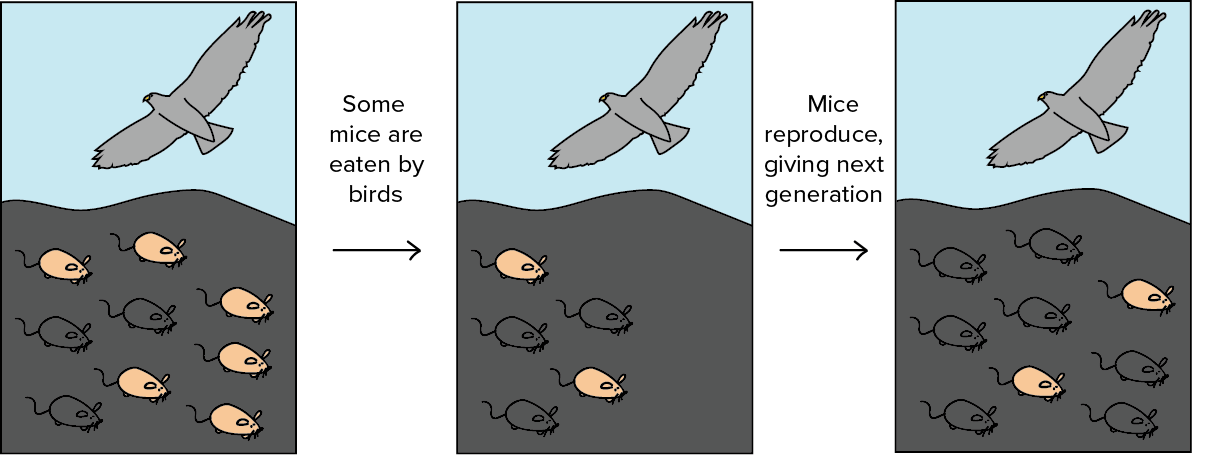
46
47
Fill in the Blank
Type answer...
48
49
Multiple Choice
What happens to the sensitive strain of bacteria when antibiotics are added?
They are killed
They multiply
They become antibiotic resistant
They transfer drug-resistance
50
51
52
53
54
55
56
Multiple Choice
A forest fire ignites in the Sam Houston State Forest and kills many members of a population of pigmy rattlesnakes.
Gene Flow
Genetic Drift
57
Multiple Choice
Pollen from a population of flowers on one side of a river travels by wind to a population of flowers on the other side of the river. This is an example of:
Gene flow
Bottleneck effect
Founder effect
Inbreeding
58
Multiple Choice
Maria Concepcion Soto settled in the northern area of Venezuela. She suffered from a rare genetic disorder called Huntington’s Disease. As a result, the now 20,000 individuals who live there also have a high risk of Huntington’s Disease. This is an example of:
Gene flow
Bottleneck effect
Founder effect
Inbreeding
59
Drag and Drop
Show answer
Auto Play
Slide 1 / 59
SLIDE

Similar Resources on Wayground
51 questions
SC9 DNA,Chromosomes
Presentation
•
9th - 12th Grade
54 questions
PS.Chem 2.1 Coloring the PT's Groups
Presentation
•
9th - 12th Grade
53 questions
Unit 9: Surface Processes Review
Presentation
•
9th - 12th Grade
57 questions
Genes and Punnett squares
Presentation
•
9th - 12th Grade
52 questions
Biodiversity Basics
Presentation
•
9th - 12th Grade
59 questions
NAMING BINARY IONIC COMPOUNDS
Presentation
•
10th - 12th Grade
Popular Resources on Wayground
10 questions
5.P.1.3 Distance/Time Graphs
Quiz
•
5th Grade
10 questions
Fire Drill
Quiz
•
2nd - 5th Grade
20 questions
Equivalent Fractions
Quiz
•
3rd Grade
22 questions
School Wide Vocab Group 1 Master
Quiz
•
6th - 8th Grade
20 questions
Main Idea and Details
Quiz
•
5th Grade
20 questions
Context Clues
Quiz
•
6th Grade
20 questions
Inferences
Quiz
•
4th Grade
12 questions
What makes Nebraska's government unique?
Quiz
•
4th - 5th Grade
Discover more resources for Science
10 questions
Exploring the Layers of the Earth
Interactive video
•
6th - 10th Grade
25 questions
Naming Ionic and Covalent Compounds
Quiz
•
9th Grade
20 questions
Balancing Chemical Equations
Quiz
•
9th Grade
15 questions
Protein synthesis
Quiz
•
9th Grade
20 questions
Human Impact on the Environment Review #2
Quiz
•
9th Grade
20 questions
Newton's Laws of Motion
Quiz
•
9th Grade
20 questions
Mendelian Genetics Review
Quiz
•
9th Grade
16 questions
Balancing Chemical Equations and Types of Reactions
Quiz
•
9th - 10th Grade