Search Header Logo
  1. Resource Library
  2. Science
  3. Biology
  4. ...
  5. Evolutionary Relationships
Evolutionary Relationships

Evolutionary Relationships

Assessment

Presentation

Science

9th - 12th Grade

Medium

NGSS
MS-LS4-2, MS-LS4-4, HS-LS4-1

+7

Standards-aligned

Created by

Alexandra Osler

Used 11+ times

FREE Resource

6 Slides • 31 Questions

1

media

2

media

3

media

4

media

5

media

6

media

7

Multiple Choice

What type of structure shows evolution when a cat's leg, a human arm, a bat's wing, and whale's flipper have different functions even though they all are related species?

1

Analogous structures

2

Homologous structures

3

Identical structures

4

Vestigial structures

8

Multiple Choice

Question image

What pattern of evolution occurs when related species form, originating from a common ancestor?

1

divergent evolution

2

convergent evolution

3

co-evolution

4

endosymbiosis

9

Multiple Choice

Question image

Which organism does NOT have a placenta?

1

Lion

2

House cat

3

Brown bear

4

Platypus

10

Multiple Choice

What type of structure shows evolution when birds, bats, and insects have wings even though they don't share a common ancestor?

1

Analogous structures

2

Homologous structures

3

Identical structures

4

Vestigial structures

11

Multiple Choice

Question image
The picture shows the members of the Camelidae family. The physical features and the geographical origin of these animals provide evidence that - 
1
they live in the same type of environment.
2
have slowly evolved to become herbivores.
3
have a common ancestor.
4
exchanged DNA in the past.

12

Multiple Choice

What type of structure shows evolution when arctic animals have white fur, short ears and limbs, and extra fat even though they don't share a common ancestor?

1

Analogous structures

2

Homologous structures

3

Identical structures

4

Vestigial structures

13

Multiple Select

Which of the following are characteristics of homologous structures? Select all that apply.

1

Same bone structure, different function

2

Shared by species with a common ancestor

3

Show divergent evolution

4

Same function, different structure

14

Multiple Choice

Question image

What pattern of evolution occurs when analogous structures developed in unrelated species?

1

divergent evolution

2

convergent evolution

3

co-evolution

4

endosymbiosis

15

Multiple Choice

Question image

What pattern of evolution occurs when 2 different species evolve together b/c they rely on each other?

1

divergent evolution

2

convergent evolution

3

co-evolution

4

endosymbiosis

16

Match

Match the following groups to the picture that describes they type of evidence that leads to common ancestry.

A trace of an ancient organism that has been preserved in rock.

Structures in different species that have the same bone structure / different function.

A structure that is present that no longer serves its original purpose.

Study of the early development of organisms

Structures that have similar functions but different structures

Fossil

Homologous Structures

Vestigial Structures

Embryology

Analogous structures

17

Multiple Choice

Question image
The Table below shows the # of differences in amino acids in a protein called “Cytochrome C” when comparing humans to other organisms. 
List the 4 closest human relatives based on this biochemical comparison.
1
chimpanzee, horse, rattlesnake, snapping turtle
2
chimpanzee, gorilla, rhesus monkey, horse
3
fruit fly, bread mold, tuna fish, snapping turtle
4
gorilla, rhesus monkey, rattlesnake, gorilla

18

Multiple Choice

Question image

Species 2 is a common ancestor of which species?

1

Species B only

2

Species B and C

3

Species B, C, and D

4

Species A, B, C, and D

19

Multiple Choice

Question image

Which species belong in the clade for fur and mammary glands?

1

Gorilla only

2

Rat and gorilla

3

Lizard, alligator, robin, rat, and gorilla

4

Hagfish, salmon, and frog

20

Multiple Choice

Which of the following best describes adaptive radiation?

1

When unrelated species develop similar traits due to similar environments

2

When one species evolves into many different forms to adapt to different environments

3

When two or more species influence each other's evolution over time

4

When all species are related through a common ancestor

21

Multiple Choice

Which of the following is an example of convergent evolution?

1

Darwin's finches developing different beak shapes

2

Clownfish and anemone benefiting each other

3

Shark and killer whale both having streamlined bodies and fins

4

Red panda and meerkat sharing a common ancestor

22

Multiple Choice

Divergent evolution produces:

1

Unrelated species with similar traits

2

Many species from a common ancestor

3

Species without variation

4

Only one new species

23

Multiple Choice

What is convergent evolution?

1

evolution toward similar traits in unrelated species

2

evolution toward different traits in closely related species

3

elimination of a species from Earth

4

the rise of two or more species from one existing species

24

Multiple Choice

Which of the following statements best explains the significance of evidence in understanding evolutionary relationships among species?

1

Evidence shows that all species are related and descended from a common ancestor.

2

Evidence proves that all species evolved independently without any common ancestor.

3

Evidence shows that only mammals share a common ancestor.

4

Evidence suggests that evolutionary relationships are not determined by ancestry.

25

Dropdown

Question image
These limbs provide evidence of common ancestry because they -

26

Multiple Choice

Question image

What do these structures suggest about the evolution of organisms?

1

A common ancestor

2

Similar purpose

3

One evolved into another

27

Multiple Choice

Question image

What

type

of structure?

1

Homologous

2

Analogous

3

Embryological

4

Vestigial

28

Multiple Choice

Question image

This table shows the number of differences in amino acids of a protein when compared to humans. Which species is LEAST closely related to humans?

1

Chimpanzee

2

Fruit fly

3

Horse

4

Pigeon

5

Rattlesnake

29

Multiple Choice

The amino acid sequence for a protein was compared between three species. Species A and B had 2 differences, Species A and C had 6 difference, & Species B and C had 4 differences. Which species are most closely related?

1

A and B

2

A and C

3

B and C

4

All species are equally related

30

Multiple Select

Which of the following statements about fossil records is/are correct?

1

Older fossils are found in deeper layers.

2

Younger fossils look less like modern species.

3

Fossils provide a record of species that lived long ago.

4

Scientists compare fossils to modern species to study evolution.

31

Fill in the Blank

32

Multiple Choice

Question image

The diagram below represents stages in embryonic development of eight organisms. The similarities in embryonic development shown in the diagrams suggests that these organisms-

1

All undergo external development

2

May have evolved from a common ancestor

3

Are all members of the same species

4

Have adaptation for the same environment as adults

33

Hotspot

Click on the organism that is most closely related to Haplonycteris fischeri

34

Multiple Choice

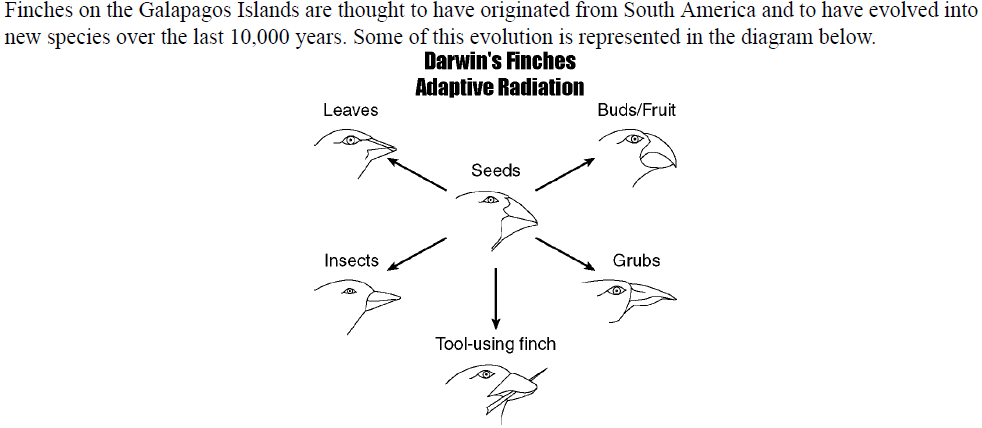
Question image

The seed-eating finch in the given diagram was most likely the

1

common ancestor

2

most successful

3

largest finch

4

parent of the other finches

35

Multiple Choice

Why can similarities in amino acid sequences be used to determine species relatedness?

1

You are born with all of you amino acids

2

amino acids control which DNA is used to build you

3

DNA codes for amino acid sequences, so similar amino acid sequences indicate similar DNA

4

amino acids cannot provide valid data on species relatedness

36

Multiple Choice

Which pair shows analogous structures?

1

Human arm & whale flipper

2

Dog leg & cat leg

3
Shells of turtles and snails
4
Wings of bats and birds

37

Multiple Choice

DNA provides evidence of evolution because all organisms share

1

Different nitrogen bases

2
a distinct cellular membrane
3

The same four nucleotides

4

The same chromosome number

media

Show answer

Auto Play

Slide 1 / 37

SLIDE