

Search Header Logo
ABM - Week 3

ABM - Week 3

Assessment

Presentation

•

Science

•

12th Grade

•

Practice Problem

•

Medium

Created by

Lalaine Guillermo

Used 1+ times

FREE Resource

1 Slide • 9 Questions

1
media

2

Multiple Choice

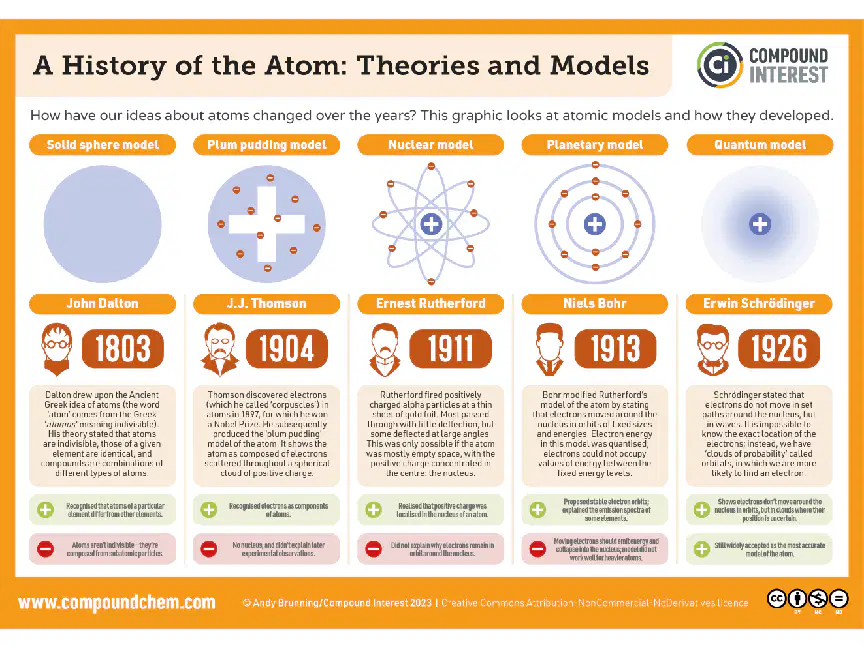
What are the key differences between the Plum Pudding model and the Nuclear model of the atom?

1

The Plum Pudding model suggests that electrons are embedded in a positively charged 'soup', while the Nuclear model has a dense nucleus with electrons orbiting around it.

2

The Plum Pudding model was proposed by Rutherford, while the Nuclear model was proposed by Thomson.

3

The Nuclear model does not include electrons, while the Plum Pudding model does.

4

The Plum Pudding model was developed in 1911, while the Nuclear model was developed in 1904.

3

Fill in the Blanks

Electrons stay confined in space 

surrounding the nucleus because of its attraction to the positively charged

.

4

Fill in the Blanks

media image

Use the word bank in the picture to answer the questions that follow:

Fill-in the Blank:

One way the modern atomic model differs from Thomson’s atomic model is that electrons are no longer scattered throughout an atom’s positive matter like chocolate chips in cookie dough. Instead, each electron is outside of the nucleus occupying a specific

.

5

Fill in the Blanks

media image

The description of the structure of the atom is called the

.

6

Fill in the Blanks

media image

Use the word bank in the picture to answer the questions that follow:

Fill-in the Blank:

The description of the structure of the atom is called the

.

7

Multiple Choice

Dalton developed the first scientifically tested atomic theory.

1

True

2

False

8

Multiple Choice

Which scientist is responsible for first stating that all the atoms of a particular element are identical but are different from the atoms of all other elements (Atomic Theory)?

1

Dalton

2

Thomson

3

Aristotle

4

Democritus

5

Proust

9

Multiple Choice

Question image

1.5 Dalton's billard ball model of the atom proposed that

1

The atom has electrons that are small massless negative charges in a "plum pudding" goop of positivity, because the electricity beam was repelled by a magnet in the cathode ray experiment.

2

Atoms exist and we know this experimentally. Atoms have their own element identity and are rearranged, not changed, in chemical reactions.

3

The atom has electrons in energy levels. When you put energy into those electrons, they go into a higher excited state. They emit light on their way back to their ground state.

4

The atom has a small dense nucleus, because the alpha particles ricocheted off in the gold foil experiment.

10

Multiple Choice

Question image
Dalton concluded that the various compounds were combinations of atoms of different _____
1
facets
2
materials
3
elements
4
ingredients
pattern-tertiary
media

Show answer

Auto Play

Slide 1 / 10

SLIDE
