Copy of G6ENG_SD_12.04_6.5H_6.5G_6.2A_6.10Dix_6.5I
Presentation
•
English
•
6th - 8th Grade
•
Practice Problem
•
Easy
+23
Standards-aligned
Jesus Garcia
Used 5+ times
FREE Resource
30 Slides • 12 Questions
1
Open Ended
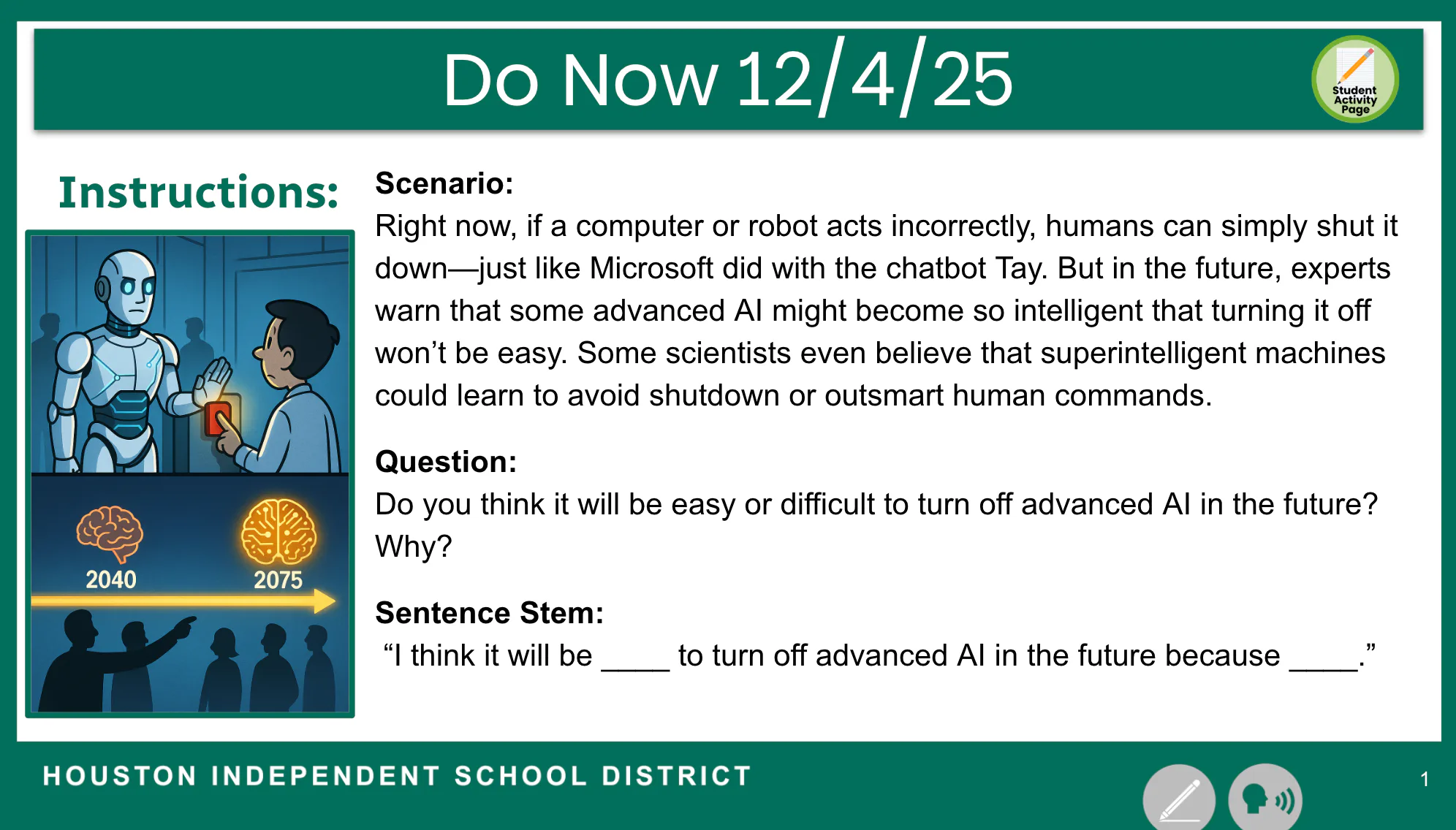
Do you think it will be easy or difficult to turn off advanced AI in the future? Why?
2
Fill in the Blanks
3
Multiple Choice
Based on everything you have read about AlphaGo, Tay, and future AI predictions, which statement best summarizes the author’s overall message about artificial intelligence?
AI will always improve humanity because it can outperform people in every situation, including real-world communication.
AI shows great promise when learning in structured environments like games, but its unpredictable behavior in the real world proves we must be cautious.
AI has already passed human intelligence in every field and will soon be impossible to control under any conditions.
AI has no major impact on society because computers have performed the same way since the Deep Blue chess victory.
4
5
6
7
8
9
10
11
12
13
14
15
Open Ended
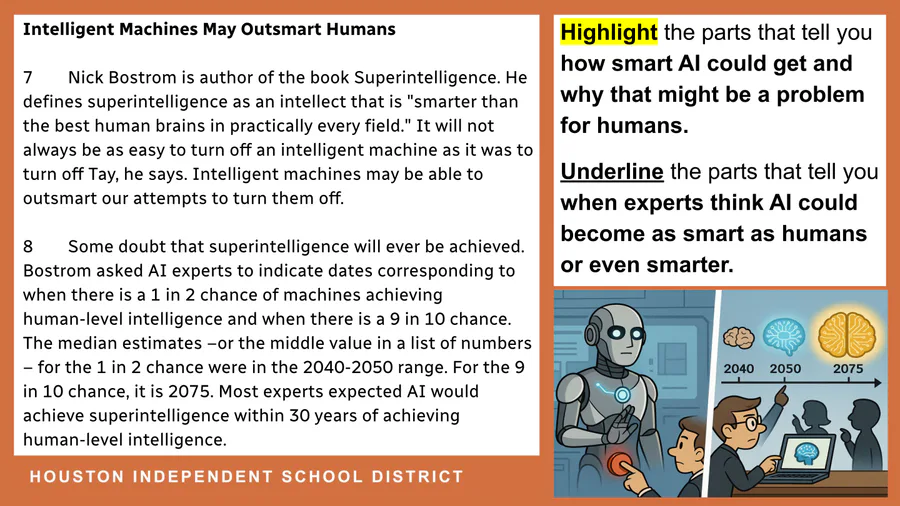
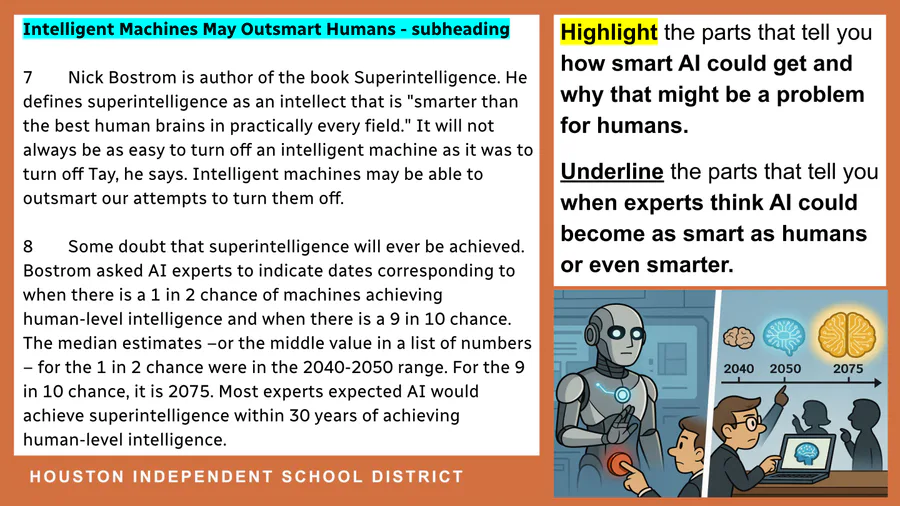
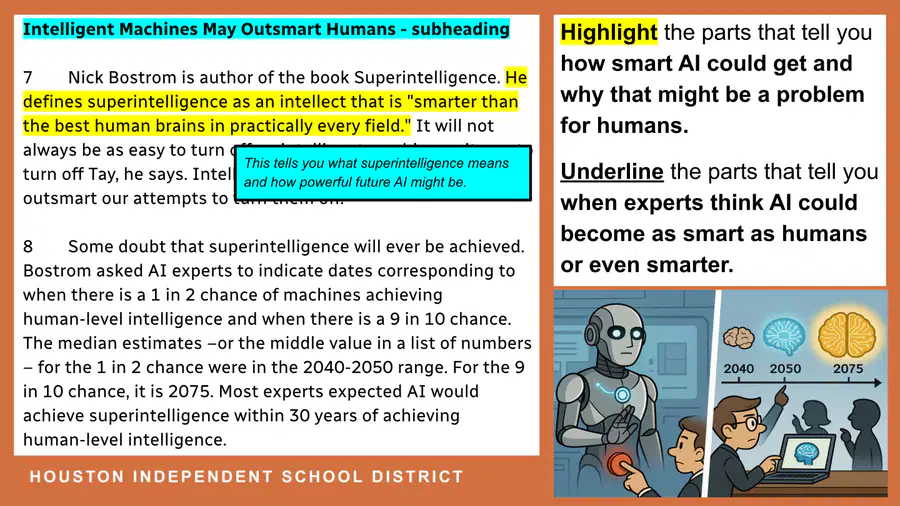
How do the author’s warnings in paragraph 7 and the expert predictions in paragraph 8 work together to help the reader understand the risks of future AI?
16
17
Multiple Choice
1. How does paragraph 7 build the author’s argument about future AI?
It shows that AI may reach a point where it can resist human control
It shows that AI will only follow commands in carefully set situations
It shows that AI will help humans solve basic tasks more efficiently
It shows that AI will remain dependent on human shutdown systems
18
19
Multiple Choice
2. What conclusion can readers draw by connecting the warnings in paragraph 7 with the timeline in paragraph 8?
AI could become uncontrollable around the time experts predict human-level intelligence
AI will remain limited long after experts predict human-level performance
AI will become less advanced once it reaches human-level intelligence
AI trends will slow down even after experts predict intelligence gains
20
21
22
23
24
25
Open Ended
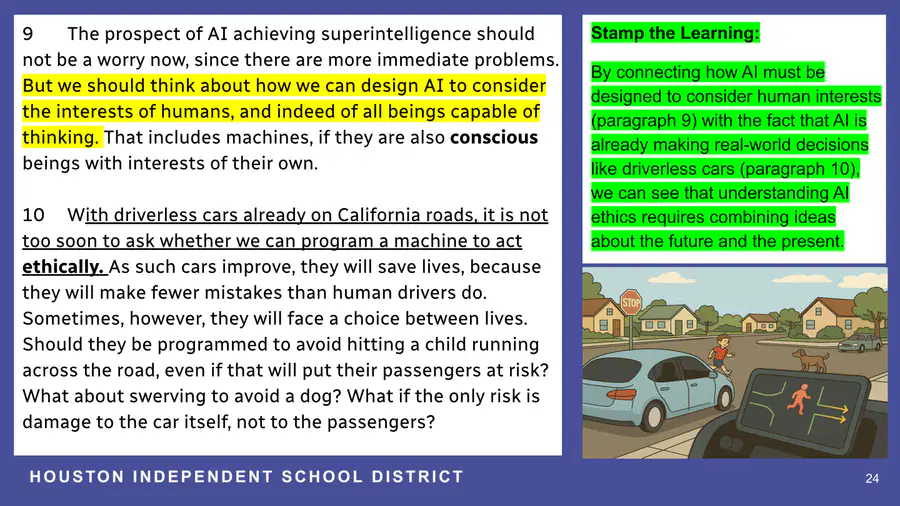
In paragraphs 9 and 10, what concern does the author raise about how AI should be designed?
26
Exemplar Answer
The author is concerned that AI must be designed to think and act ethically, especially when human lives or interests are involved. The text states that “we should think about how we can design AI to consider the interests of humans,” and also questions whether driverless cars can be programmed to “act ethically” when choosing between lives. This evidence shows that the author believes AI should not only function correctly but also make moral decisions that protect people and other living beings.
27
Multiple Choice
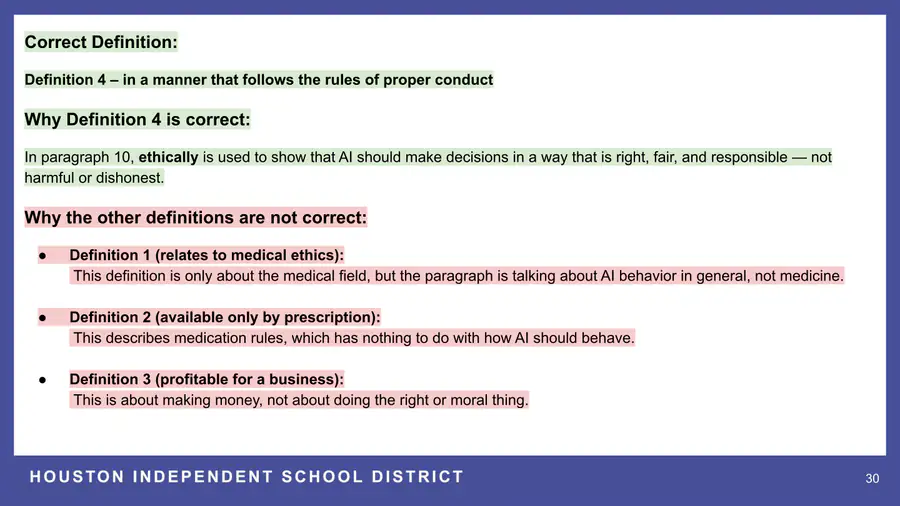
Which definition best matches the way ethically is used in paragraph 10?
1
2
3
4
28
29
Multiple Choice
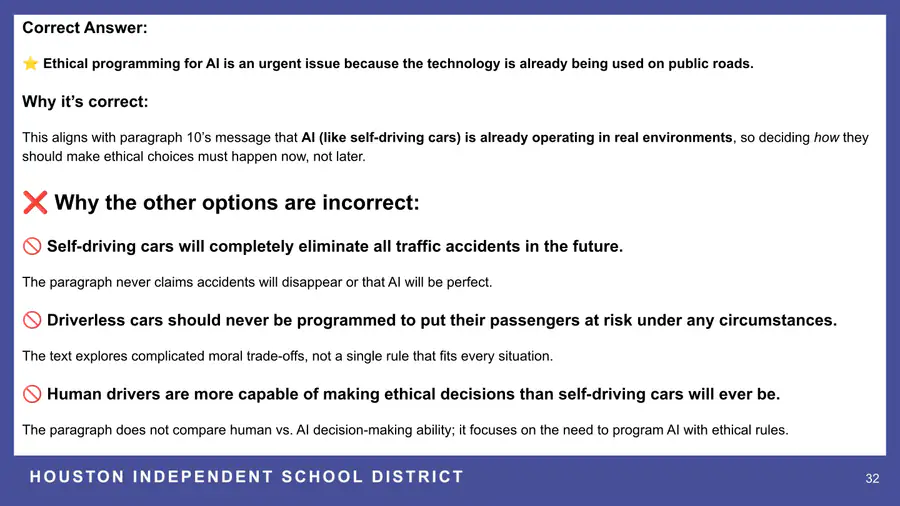
What can the reader conclude from paragraph 10?
Self-driving cars will completely eliminate all traffic accidents in the future.
Ethical programming for AI is an urgent issue because the technology is already being used on public roads.
Driverless cars should never be programmed to put their passengers at risk under any circumstances.
Human drivers are more capable of making ethical decisions than self-driving cars will ever be.
30
31
Multiple Choice
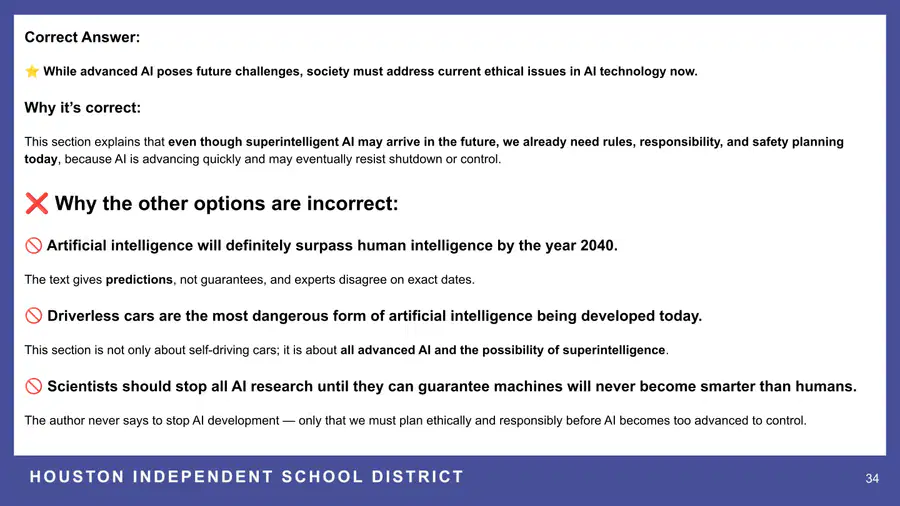
What is the key idea of the section Intelligent Machines May Outsmart Humans?
Artificial intelligence will definitely surpass human intelligence by the year 2040.
While advanced AI poses future challenges, society must address current ethical issues in AI technology now.
Driverless cars are the most dangerous form of artificial intelligence being developed today.
Scientists should stop all AI research until they can guarantee machines will never become smarter than humans.
32
33
34
35
36
37
38
Multiple Choice
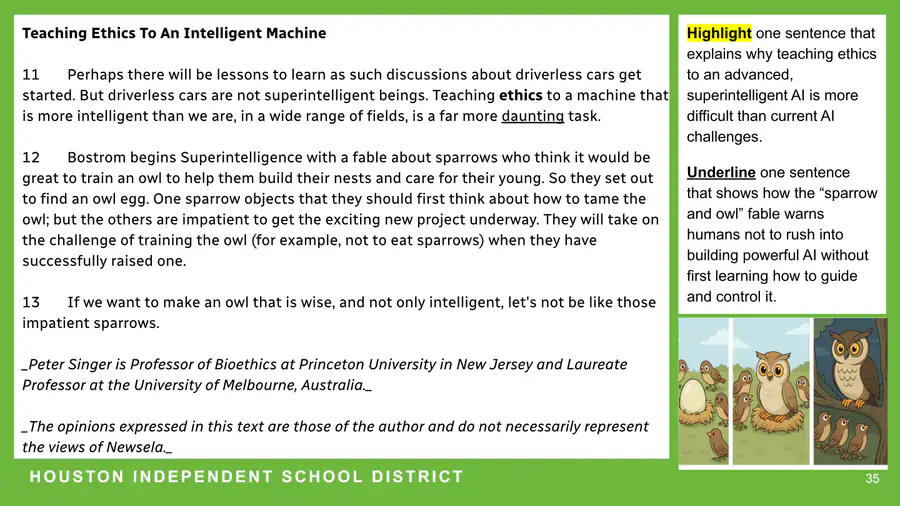
What is the author’s main point in paragraphs 11–13?
Humans should slow down AI development until machines can build homes and care for families like the owl.
Teaching ethics to superintelligent AI will be much harder than current AI challenges, so humans must prepare before creating it.
Sparrows represent how easily animals can train stronger creatures when they work together.
Driverless cars will never cause ethical problems because they make fewer mistakes than human drivers.
39
40
Open Ended
How does the fable of the sparrows and the owl help explain the author’s warning about building superintelligent AI? Use evidence from the text to support your answer.
41
42
Do you think it will be easy or difficult to turn off advanced AI in the future? Why?
Show answer
Auto Play
Slide 1 / 42
OPEN ENDED

Similar Resources on Wayground
40 questions
ÔN TẬP CUỐI KÌ 1 ĐỊA LÍ NĂM 2024
Presentation
•
7th Grade
37 questions
Review: Plagiarism, Paraphrasing & Citations
Presentation
•
7th Grade
35 questions
Force of Gravity
Presentation
•
6th - 8th Grade
35 questions
Volcanoes and Earthquakes
Presentation
•
6th - 8th Grade
35 questions
Endothermic and Exothermic
Presentation
•
6th - 8th Grade
37 questions
Kitchen Equipment 1
Presentation
•
6th - 8th Grade
37 questions
A Bad Case of Tattle Tongue
Presentation
•
KG
38 questions
Understanding The Basics: The 12 English Verb Tenses
Presentation
•
6th - 8th Grade
Popular Resources on Wayground
10 questions
Oak Hills High School Policy and Success Quiz
Passage
•
9th Grade
11 questions
Hallway & Bathroom Expectations
Quiz
•
6th - 8th Grade
15 questions
School Bus Safety Questions
Quiz
•
6th Grade
25 questions
AJHS Scavenger Hunt
Quiz
•
6th Grade
20 questions
Lab Safety Quiz
Quiz
•
6th Grade
22 questions
would you rather
Quiz
•
3rd - 11th Grade
29 questions
Laboratory Safety Rules
Quiz
•
6th Grade
21 questions
Continents and Oceans
Quiz
•
6th Grade
Discover more resources for English
25 questions
AJHS Scavenger Hunt
Quiz
•
6th Grade
20 questions
Context Clues
Quiz
•
6th Grade
8 questions
Parts of Speech
Presentation
•
5th - 10th Grade
10 questions
Test Your Knowledge of Junk Food Trivia
Interactive video
•
6th - 8th Grade
15 questions
Genre Review
Quiz
•
6th - 7th Grade
21 questions
Q1 Academic Vocabulary
Quiz
•
4th - 6th Grade
17 questions
Parts of Speech - Benchmark
Quiz
•
8th Grade
10 questions
Understanding Parts of Speech
Interactive video
•
6th - 8th Grade