Non-Contact Forces Review
Presentation
•
Science
•
8th Grade
•
Medium
+6
Standards-aligned
Sarah Wohletz
Used 5+ times
FREE Resource
10 Slides • 23 Questions
1
MS-PS2-3
Electric and Magnetic Forces
Middle School
2
Understanding Magnetic Fields and Forces
A magnetic field is an invisible area that creates a magnetic force.
This force is strongest at the magnet’s north and south poles.
Force strength depends on the magnet’s strength and the distance between them.
Like poles repel each other, while opposite poles attract each other.
3
Multiple Choice
What is a magnetic field?
An invisible area that creates a magnetic force.
A force that is only visible between two magnets.
The force that pulls all objects towards the Earth.
An area that is only found in the center of a magnet.
4
Multiple Choice
What factor determines whether the force between two magnets is attractive or repulsive?
The distance between them.
The strength of the magnets.
The alignment of their poles.
The temperature of the magnets.
5
Multiple Choice
To create the strongest possible repulsive force between two magnets, how should they be positioned?
Place their north poles very close to each other.
Place a north pole very close to a south pole.
Place their north poles far apart from each other.
Place the center of one magnet against the pole of the other.
6
What Are Electric Forces and Charges?
Electric forces act on objects with an electric charge, either positive (+) or negative (-).
Like the rules of magnetism, opposite charges will attract each other.
In the same way, charges that are the same will repel each other.
Force strength depends on the amount of charge and the distance between objects.
7
Multiple Choice
An electric force will act on an object if it has what property?
An electric charge
A magnetic field
A specific mass
A high temperature
8
Multiple Choice
Which statement correctly describes how electric charges interact with each other?
Like charges repel, while opposite charges attract.
Like charges attract, while opposite charges repel.
All charged objects attract each other.
All charged objects repel each other.
9
Multiple Choice
If two objects with positive charges are moved closer to each other, what will happen to the electric force between them?
The repulsive force between them will become stronger.
The repulsive force between them will become weaker.
The force will change from repulsive to attractive.
The force will not change in strength.
10
How Electromagnets Work
An electromagnet works on the principle that an electric current generates a magnetic field.
More turns of wire around the core increase the magnet's strength.
A stronger electric current results in a stronger magnetic field.
Adding an iron core inside the coil makes the electromagnet much stronger.
11
Multiple Choice
What is the fundamental principle that allows an electromagnet to work?
An electric current is used to generate a magnetic field.
A magnetic field is used to generate an electric current.
An iron core by itself can create a strong magnetic field.
The number of wire turns determines the electric charge.
12
Multiple Choice
How can the strength of an electromagnet be increased?
By increasing the current and adding more turns of wire.
By decreasing the current and using fewer turns of wire.
By replacing the iron core with a plastic one.
By using a weaker current with more turns of wire.
13
Multiple Choice
An engineer is designing an electromagnet to lift heavy scrap metal. Which combination of features would create the most powerful magnet?
A coil with few wire turns, a weak current, and an iron core.
A coil with many wire turns, a strong current, and an air core.
A coil with many wire turns, a weak current, and an iron core.
A coil with many wire turns, a strong current, and an iron core.
14
Poll
On a scale of 1-4, how confident are you about the factors that affect electric and magnetic forces?
1
2
3
4
15
MS-PS2-4
Gravitational
Interactions
Middle School
16
Understanding Gravity: Aristotle vs. Galileo
Aristotle's View
For nearly 2,000 years, it was believed that heavier objects fall faster than lighter ones.
This view was based on logical arguments rather than direct, precise experimental evidence.
His ideas were widely accepted and went unchallenged for a very long period of time.
Galileo's Discovery
Galileo used experiments to test the long-held beliefs about gravity and falling objects.
He demonstrated that objects of different masses fall at the same rate, ignoring air resistance.
His work marked a major shift towards modern scientific methods based on experimentation.
17
Multiple Choice
If a heavy cannonball and a much lighter baseball were dropped from a high tower at the exact same moment, what would Galileo predict would happen, ignoring air resistance?
The cannonball would hit the ground first because it is heavier.
The baseball would hit the ground first because it is lighter.
They would both hit the ground at the same time.
The cannonball would fall for a longer period of time.
18
The Scale of Gravity
A gravitational force exists between any two masses.
This force is only significant for very large masses.
Earth's large mass creates a strong gravitational pull.
19
Multiple Choice
According to the principles of gravity, between which of the following does a gravitational force exist?
Only between planets and stars
Only between objects on Earth
Between any two objects with mass
Only between objects that are moving
20
Multiple Choice
What is the primary reason you don't feel a gravitational pull between yourself and a pencil?
The force is only significant when at least one of the objects has a very large mass.
Gravitational force does not exist for small objects.
The force depends on the material the objects are made of.
Gravitational force only pulls objects downward.
21
Multiple Choice
Imagine two planets are discovered. Planet A has a mass much larger than Earth's, and Planet B has a mass similar to Earth's moon. Which planet would have a stronger gravitational pull and why?
Planet A, because its larger mass creates a stronger gravitational pull.
Planet B, because smaller planets have a more concentrated pull.
Their gravitational pulls would be identical.
It's impossible to tell without knowing their distance from the sun.
22
Gravity, Mass, and Interaction
Objects with mass attract each other through an invisible force called gravity.
The more mass an object has, the stronger its gravitational pull is.
The Earth's larger mass is what keeps the smaller Moon orbiting it.
The Sun's immense mass keeps all the planets of our solar system in orbit.
23
Multiple Choice
Which statement best explains why the planets in our solar system orbit the Sun?
The Sun is the hottest object, and its heat keeps the planets in their paths.
The planets are all moving too fast to escape the Sun's pull.
The Sun has an immense mass, creating a strong gravitational pull that keeps the planets in orbit.
The planets push on each other, which keeps them all in a stable formation around the Sun.
24
Gravity and Orbits in Space
Gravity isn't absent in space; it keeps the Moon in orbit around Earth.
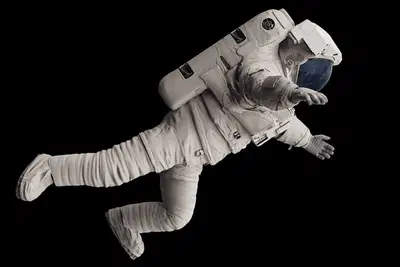
On the ISS, astronauts feel weightless because they are in constant free fall.
An orbit is the curved path an object follows around a larger object.
Newton's cannon shows how an object can orbit by falling around Earth.
25
Multiple Choice
What is an orbit?
The curved path an object follows around a larger object
A state of complete weightlessness in space
The force that pulls all objects toward each other
A straight line an object travels through the cosmos
26
Multiple Choice
What is the relationship between gravity and the Moon's orbit around Earth?
Gravity provides the force that keeps the Moon moving along its curved path.
The Moon's orbit is a path where Earth's gravity is completely absent.
The Moon's orbit creates the force of gravity between the two objects.
Gravity only affects objects on Earth, not objects in space like the Moon.
27
Multiple Choice
Which statement best explains why astronauts on the ISS feel weightless while in orbit?
They are in a state of constant free fall around Earth, along with their spacecraft.
There is no gravity from Earth affecting them at that distance.
The ISS has its own artificial gravity that cancels out Earth's pull.
They have traveled beyond Earth's gravitational pull and are now floating freely.
28
Poll
On a scale of 1-4, how confident are you about explaining the concept of gravity and orbits?
1
2
3
4
29
Mastery Check
The next four questions are taken directly from the state practice test.
See how well you can do on these Level 2 and Level 3 questions!
30
Dropdown
Based on the data, select from the menus to correctly complete the statement about the gravitational force on an object.
When the mass of the planet increases by a factor of 2, the force of gravity on an object at the planet’s surface
31
Multiple Choice
A student must create an electromagnet that can pick up the most metal paper clips. The student is given three batteries, a length of wire, an iron nail, and many paper clips. The student wraps the wire around the nail and connects the wire to the battery terminals, as shown in the picture.
The student will conduct an experiment in which only one variable is changed. Investigating which question most likely would help the student create an electromagnet that will pick up the most metal paper clips?
How do the number of turns in wire affect electromagnet?
Does turning the nail around before connecting the wires to the battery affect the electromagnet?
Does turning the battery around before connecting the wires affect the electromagnet?
How is the electromagnet affected if the wire is connected to the battery for 10 second, 20 seconds and 30 seconds?
32
Drag and Drop
Will the electromagnet pick up more paper clips if I
33
Multiple Choice
Two students are trying to map the electric field of a positively charged metal rod. They place the metal rod on a big piece of white paper that is on a level table. The students also have a small positively charged steel ball.
The students place the ball at different locations around the rod. To determine the electric field lines, at each location they
Record the speed of the ball just after it starts moving
Release the ball and draw an arrow in the direction it moves
Roll the ball toward the metal rod and record the time it takes to reach the rod
Use a compass and record the direction north from where it was released.
MS-PS2-3
Electric and Magnetic Forces
Middle School
Show answer
Auto Play
Slide 1 / 33
SLIDE

Similar Resources on Wayground
26 questions
Geologic Time Scale
Presentation
•
8th Grade
27 questions
8.8A Components of the Universe
Presentation
•
8th Grade
28 questions
PMA Physical Science Review
Presentation
•
8th Grade
28 questions
8.E.2.1 Review
Presentation
•
8th Grade
24 questions
Water Unit Lesson
Presentation
•
8th Grade
23 questions
Light as a Wave
Presentation
•
8th Grade
28 questions
Igneous Rocks Virtual Lab
Presentation
•
8th - 9th Grade
26 questions
Speed
Presentation
•
8th Grade
Popular Resources on Wayground
16 questions
Grade 3 Simulation Assessment 2
Quiz
•
3rd Grade
19 questions
HCS Grade 5 Simulation Assessment_1 2526sy
Quiz
•
5th Grade
10 questions
Cinco de Mayo Trivia Questions
Interactive video
•
3rd - 5th Grade
17 questions
HCS Grade 4 Simulation Assessment_2 2526sy
Quiz
•
4th Grade
24 questions
HCS Grade 5 Simulation Assessment_2 2526sy
Quiz
•
5th Grade
13 questions
Cinco de mayo
Interactive video
•
6th - 8th Grade
20 questions
Math Review
Quiz
•
3rd Grade
30 questions
GVMS House Trivia 2026
Quiz
•
6th - 8th Grade
Discover more resources for Science
16 questions
Interactions within Ecosystems
Presentation
•
6th - 8th Grade
30 questions
GMAS Physical Science Review
Quiz
•
8th Grade
10 questions
Exploring the Rock Cycle
Interactive video
•
6th - 8th Grade
18 questions
Carbon Cycle
Quiz
•
8th Grade
10 questions
Exploring Earth's Seasons and Their Causes
Interactive video
•
6th - 8th Grade
26 questions
Amplify Chemical Reactions
Quiz
•
6th - 8th Grade
10 questions
Evidence of Evolution
Presentation
•
6th - 8th Grade
20 questions
8th Grade Science NC EOG Review
Quiz
•
8th Grade