

Unit 3 Review

Presentation
•
Science
•
6th - 8th Grade
•
Easy
+18
Standards-aligned

Shay Paddie
Used 2+ times
FREE Resource
31 Slides • 32 Questions
1
By Shay Paddie
2

Middle School

3
Key Vocabulary

DNA
A molecule carrying the genetic instructions for the growth, development, and reproduction of all living organisms.

Nucleotide
The basic building block of DNA, made of a sugar, a phosphate group, and a nitrogenous base.

Double Helix
The shape of a DNA molecule, which looks like a twisted ladder with two intertwined strands.

Base Pairing Rule
The principle that adenine (A) pairs with thymine (T), and guanine (G) pairs with cytosine (C).

Antiparallel Strands
A key feature of DNA where the two strands of the double helix run in opposite directions.
4
DNA in Eukaryotic Cells
DNA holds genetic instructions for complex organisms like plants and animals.
It is safely stored within a membrane-bound structure called the nucleus.
This organized storage helps manage the complex functions of eukaryotic organisms.

DNA in Prokaryotic Cells

DNA carries the essential genetic code for simpler organisms like bacteria.
It is located in the cytoplasm in a region known as the nucleoid.
This simpler arrangement allows for rapid growth and reproduction in prokaryotic cells.


5
Multiple Choice
What is the primary role of DNA and where is it located within a eukaryotic cell?
To create energy; found in the mitochondria
To store genetic information; found in the nucleus
To transport materials; found in the cytoplasm
To build proteins; found in the ribosomes
6
The Structure of DNA
DNA is shaped like a twisted ladder, a structure called a double helix.
The building blocks that make up the DNA chain are called nucleotides.
A nucleotide contains a sugar (deoxyribose), a phosphate group, and a nitrogenous base.


7
Multiple Choice
What are the three components that make up a single nucleotide?
Deoxyribose sugar, phosphate group, and nitrogenous base
Ribose sugar, amino acid, and phosphate group
Deoxyribose sugar, lipid, and nitrogenous base
Phosphate group, fatty acid, and amino acid
8
The Backbone
The sides of the ladder are made of a sugar-phosphate backbone.
The sugar and phosphate groups are held together by strong covalent bonds.
These strong bonds make the DNA molecule stable and durable.

The Rungs

The rungs of the ladder are made of pairs of nitrogenous bases.
These base pairs are connected to each other by weak hydrogen bonds.
The weak bonds allow the DNA strands to separate for important processes.
9
Multiple Choice
What forms the 'backbone' of the DNA ladder, and what type of bond holds it together?
Nitrogenous bases, held by hydrogen bonds
Sugar and phosphate groups, held by covalent bonds
Deoxyribose sugars only, held by ionic bonds
Phosphate groups only, held by hydrogen bonds
10
Adenine & Thymine
In DNA, the base Adenine (A) consistently pairs up with the base Thymine (T).
This base pair is held together by two chemical connections called hydrogen bonds.
This complementary relationship is a fundamental component of Chargaff's rules of base pairing.

Guanine & Cytosine

The base Guanine (G) consistently connects with the base Cytosine (C) within the DNA molecule.
Three hydrogen bonds are formed between Guanine and Cytosine, holding them securely together.
The presence of three bonds makes this pair slightly stronger than the Adenine-Thymine pair.
11
Multiple Choice
According to the rules of base pairing, which base pairs with Guanine (G) and how many hydrogen bonds are formed between them?
It pairs with Thymine (T) via 2 hydrogen bonds.
It pairs with Adenine (A) via 3 hydrogen bonds.
It pairs with Cytosine (C) via 3 hydrogen bonds.
It pairs with Guanine (G) via 2 hydrogen bonds.
12
Antiparallel Strands
The two strands of a DNA double helix are antiparallel.
This means the two DNA strands run in opposite directions.
This structure lets the nitrogenous bases meet in the center.
It allows complementary bases (A-T and G-C) to pair correctly.


13
Multiple Choice
What is the significance of the DNA strands being 'antiparallel'?
It prevents the DNA from replicating.
It allows the base pairs to properly connect in the center of the molecule.
It makes the sugar-phosphate backbone stronger.
It ensures that both strands have the exact same sequence.
14
Misconception | Correction |
|---|---|
The two strands of DNA are identical. | The strands are complementary, not identical. |
All bonds in DNA are equally strong. | Covalent bonds are strong, while hydrogen bonds are weak. |
The order of bases does not matter. | The sequence of bases contains genetic instructions. |
15
Multiple Choice
Why is it structurally important for the hydrogen bonds between bases to be weak while the covalent bonds of the backbone are strong?
The weak backbone and strong base connections allow the DNA to be flexible.
The strong backbone provides stability, while the weak bonds between bases allow the strands to separate for replication.
Both types of bonds are actually equal in strength.
The weak covalent bonds allow the DNA to be easily broken down for energy.
16
Multiple Choice
If a scientist determines that a DNA sample contains 30% Adenine, what percentage of the sample should be Thyamine?
30%
60%
40%
20%
17
Poll
On a scale of 1-4, how confident are you about the structure of DNA after this review?
1
2
3
4
18
19
heterozygous - different alleles
homozygous - same alleles

20
Multiple Choice
Heterozygous or homozygous?
BB
heterozygous
homozygous
21
Multiple Choice
Heterozygous or homozygous?
Bb
heterozygous
homozygous
22
Think "ph" in phenotype and "ph" in physical

23
Multiple Choice

Genotype or phenotype?
genotype
phenotype
24
Multiple Choice
Genotype or phenotype?
Bb
genotype
phenotype
25
Find the genotype for each parent.
Draw a 2 x 2 square
The male parent goes at the top.
The female parent goes along the left side.
Bring the male letters down.
Bring the female letters across.

26
All recessive traits would come from homozygous alleles.

27
You only need one dominant allele for a dominant trait to show up.

28
Multiple Choice
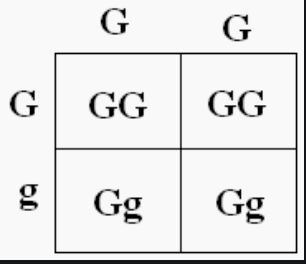
How chance the offspring born from this cross will have a homozygous dominant genotype?
25%
50%
75%
100%
29
Multiple Choice
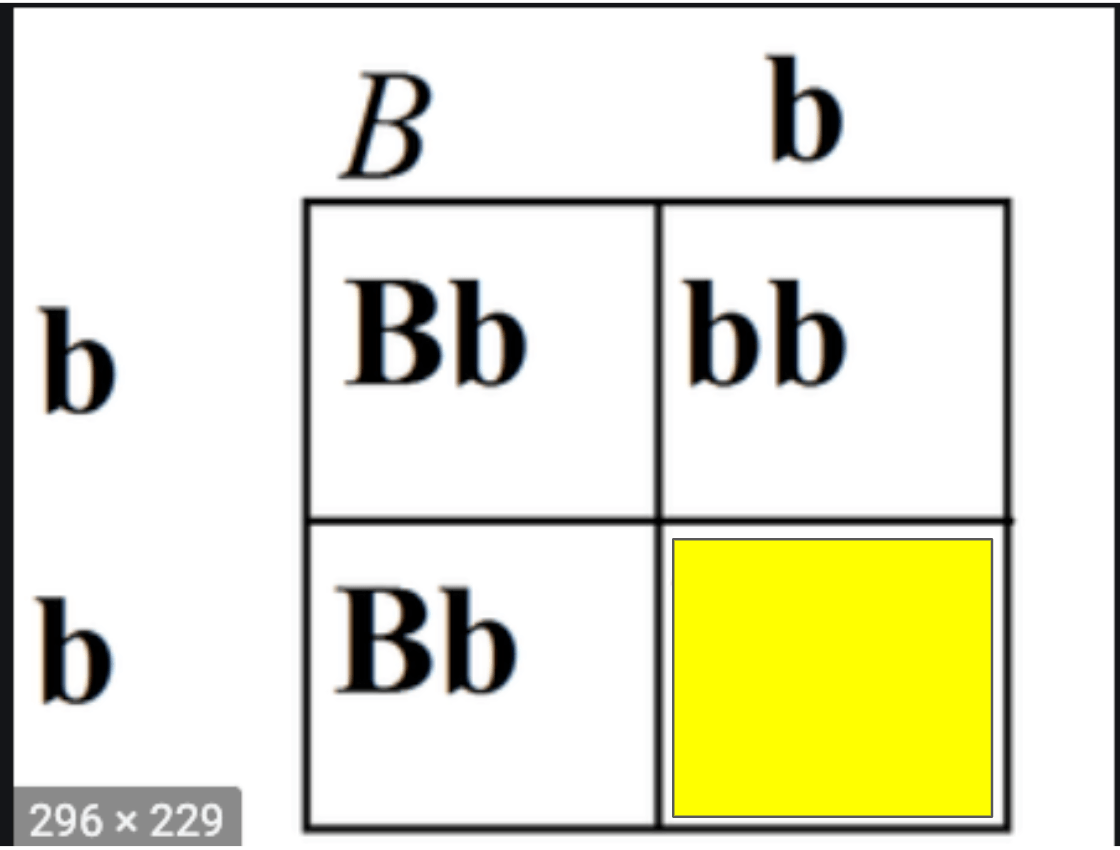
Fill in the Yellow Box
Bb
BB
bb
30

31
Open Ended
What is Meiosis? (Use complete sentences)
32

33

34
Open Ended
Why is Meiosis Important? (Use complete sentences)
35

36

37

38
Multiple Choice
Which of the following events occur during prophase 1 of meiosis 1?
a) Chromosomes align at the equator of the cell
b) Homologous chromosomes exchange genetic material
c) Sister chromatids separate and move to opposite poles
d) The nuclear envelope forms back
39

40
Multiple Choice
Homologous pairs line up in the middle of the cell in what phase of Meiosis?
Metaphase I
Metaphase II
Mitosis
Prophase II
41
Multiple Choice
What part of the cell disappears during Prophase and reappears in Telophase?
nuclear membrane
cell membrane
chromosomes
42

43
Multiple Select
What happens in Anaphase 1?
Chromosomes are lined up in the middle of the cell
Two new cells are formed
Chromosome pairs separate
This phase ensures that each cell has HALf the number of chromosomes
44

45
Multiple Select
What happens during Telophase 1?
The cytoplasm splits and two haploid daughter cells are formed
Two new nuclear membranes are formed
The cytoplasm splits and four haploid daughter cells are formed
Chromosome pairs separate
46

47
Multiple Choice
What happens in Prophase 2
The two haploid cells separate to make 4 new cells
The chromosomes condense and nuclear membrane disappears
The chromosomes line up in the middle of the cell
The nuclear membrane reappears and diploid cells are formed
48

49
Open Ended
What happens in Metaphase 2? (Use complete Sentences)
50

51
Multiple Choice
What happens in Anaphase 2?
The sister chromatids separate and move to opposite ends of the cell
The sister chromatids separate and move to the same side of the cell
The sister chromatids line up in the center of the cell
The nuclear membrane reappears and four new cells are formed.
52

53
Multiple Select
What happens during Telophase 2?
Four new nuclear membranes form around the chromosomes.
The cytoplasm splits and four new haploid cells are formed
The cytoplasm splits and two new haploid cells are formed
The cytoplasm splits and four new diploid cells are formed
54

55

56
Open Ended
What are some advantages for meiosis? What are some examples of this advantage that you can see in real life? (Use complete sentences)
57

58
Multiple Choice

What phase of Meiosis is this?
Telophase I
Anaphase I
Anaphase II
Telophase II
59
Multiple Choice

What phase is the picture showing?
Metaphase I
Metaphase II
Prophase II
Anaphase I
60
Multiple Choice
How many chromosomes are in an egg or sperm cell at the end of Meiosis?
23
46
64
32
61
Multiple Choice
In what phase is the DNA of the cell replicated or copied?
Interphase
Prophase I
Telophase I
Metaphase I
62
Multiple Choice
What part of the cell disappears during Prophase and reappears in Telophase?
nuclear membrane
cell membrane
chromosomes
63
Multiple Choice
Homologous pairs line up in the middle of the cell in what phase of Meiosis?
Metaphase I
Metaphase II
Mitosis
Prophase II
By Shay Paddie
Show answer
Auto Play
Slide 1 / 63
SLIDE
Similar Resources on Wayground

60 questions
Metabolism: Chapter 2,2.1&2.2
Presentation
•
6th - 8th Grade
59 questions
ELPAC: Speaking
Presentation
•
6th - 8th Grade
58 questions
Geologic Time review
Presentation
•
6th - 8th Grade
61 questions
Modal Auxiliary Verbs Master Review
Presentation
•
6th - 8th Grade
59 questions
Physical Science Review
Presentation
•
6th - 8th Grade
56 questions
La célula y su estructura
Presentation
•
6th - 8th Grade
56 questions
Super Quiz Test #3
Presentation
•
6th - 8th Grade
55 questions
Research Design
Presentation
•
6th - 8th Grade
Popular Resources on Wayground
10 questions
How much do you know about our Portrait of an Eagle?

Quiz
•
10th Grade
10 questions
Fast Food Slogans
Quiz
•
6th - 8th Grade
21 questions
Continents and Oceans
Quiz
•
6th Grade
20 questions
Parts of Speech
Quiz
•
5th Grade
16 questions
Subject & Predicate
Quiz
•
5th Grade
25 questions
Multiplication Facts
Quiz
•
5th Grade
12 questions
Map Skills
Quiz
•
3rd Grade
22 questions
Continents and Oceans
Quiz
•
5th Grade
Discover more resources for Science
17 questions
7.6D Aqueous Solutions
Quiz
•
7th Grade
20 questions
Scientific Method and Variables
Quiz
•
8th Grade
20 questions
Scientific method and variables
Quiz
•
8th Grade
27 questions
Counting Atoms - Subscripts
Quiz
•
8th Grade
10 questions
6.6D - Relative Density Review
Quiz
•
6th Grade
20 questions
Claim, Evidence and Reasoning (CER)
Quiz
•
6th - 8th Grade
18 questions
Counting Atoms
Quiz
•
7th - 8th Grade
20 questions
Density
Quiz
•
6th Grade