

Microbe mystery pt 1

Presentation
•
Biology
•
Professional Development
•
Practice Problem
•
Medium

Eric Perry
Used 4+ times
FREE Resource
3 Slides • 3 Questions
1
By Eric Perry and Ericka Hayes
2
Multiple Choice
A one month old infant who was prematurely born on November 1st at 30 weeks gestation, develops a fever of 104, rhinitis and a cough.
The infant goes on to develop acute respiratory distress requiring ventilator support.
A nasal pharyngeal swab is collected and tested for respiratory viral pathogens.
The test is positive for a virus who’s infection might have been prevented by the prophylactic administration of Beyfortus (nirsevimab). What is this virus?
Influenza A
Influenza B
RSV
Adenovirus
Parainfluenza or Human metapneumovirus
3
July 17, 2023
Therapeutic indication
Beyfortus is indicated for the prevention of RSV lower respiratory tract disease in:
Neonates and infants during their first RSV season
Children up to 24 months of age who remain vulnerable to severe RSV disease through their second RSV season

4
Multiple Choice
A patient presents to his primary care physician after returning from a two week ecotourism trip in the Amazon. The patient reports staying in thatched roof homes and inconsistently using insecticide treated bed nets during his travels, but was careful to take his malaria prophylaxis as directed.
Upon presentation, the patient has a swollen eyelid and reports experiencing body aches, headache and diarrhea.
Given this patient's history and presentation, what laboratory diagnostic test would you suggest?
Stool ova and parasite examination with iodine wet mount and trichrome stain
Stool culture
Blood culture
Thick and thin blood smears with Giemsa stain
Plasmodium immunoassay
5
Multiple Choice
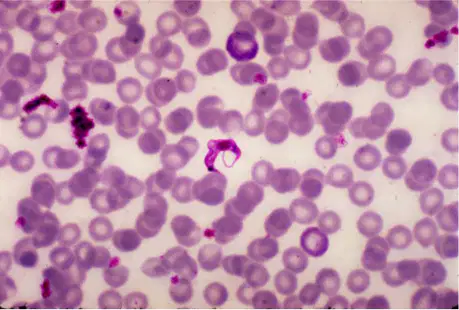
This image of thin blood smear with Giemsa stain shows what organism.
Plasmodium vivax
Leishmania donovani
Trypanosoma cruzi
Plasmodium falciparum
Trypanosoma brucei
6

This patient was infected with Trypanosoma cruzi while on his trip to the Amazon. Trypanosoma cruzi, the causative agent of Chagas disease, is transmitted by the feces of an infected triatomine bug ("kissing bug").
Generally, transmission occurs after a triatomine bug bite is scratched, and the bite is infected with the bug's feces.
An indication that a person may be acutely ill withTrypanosoma cruzi is known as Romaña's sign - swelling of the eyelid caused by introduction of triatomine bug feces into the eye.
It is likely that this patient was exposed to triatomine bugs due to his accommodations while traveling (thatched roof homes) and his inconsistent bed net usage.
If untreated, acute Chagas disease can progress into a "chronic indeterminate" form marked by the absence of blood parasitemia. Individuals progressing to this chronic stage can remain asymptomatic for decades. However, 20-30% of asymptomatic individuals will experience a reactivation of disease and may develop life threatening medical issues, including heart rhythm abnormalities, a dilated heart, a dilated esophagus or a dilated colon. Additionally, immunosuppression can result in a reactivation of disease and parasitemia.
Infection with T. cruzi is diagnosed through preparation of thin and thick blood smears stained with Giemsa stain. Trypomastigotes can be seen on both smear types. On thin smears, the trypomastigotes are "C" shaped with a central nucleus and prominent, subterminal kinetoplast, as in the image above.
Treatment of T. cruzi infection is recommended for all infected individuals. Treatment options include Benznidazole or Nifurtimox.
By Eric Perry and Ericka Hayes
Show answer
Auto Play
Slide 1 / 6
SLIDE
Similar Resources on Wayground

6 questions
SOCRATES
Presentation
•
Professional Development
6 questions
Information System
Presentation
•
Professional Development
4 questions
man quiz (only for mans or boys)
Presentation
•
Professional Development
7 questions
Personality Adjectives and Idioms
Presentation
•
Professional Development
5 questions
CRM Script Information Updates Review
Presentation
•
Professional Development
10 questions
Personality, Past, and Present
Presentation
•
Professional Development
10 questions
Know your Zoll Cardiac Arrest
Presentation
•
Professional Development
Popular Resources on Wayground
10 questions
Safety Day 2026 – Student Review

Quiz
•
9th Grade
21 questions
Continents and Oceans
Quiz
•
6th Grade
20 questions
Parts of Speech
Quiz
•
5th Grade
16 questions
Subject & Predicate
Quiz
•
5th Grade
25 questions
Multiplication Facts
Quiz
•
5th Grade
12 questions
Map Skills
Quiz
•
3rd Grade
22 questions
Continents and Oceans
Quiz
•
5th Grade
15 questions
Rounding Decimals
Quiz
•
5th Grade