

Freedom of Speech & Press

Presentation
•
Social Studies
•
9th - 12th Grade
•
Practice Problem
•
Medium

Patrick Newell
Used 1+ times
FREE Resource
32 Slides • 21 Questions
1

2

3

4
5
Multiple Choice
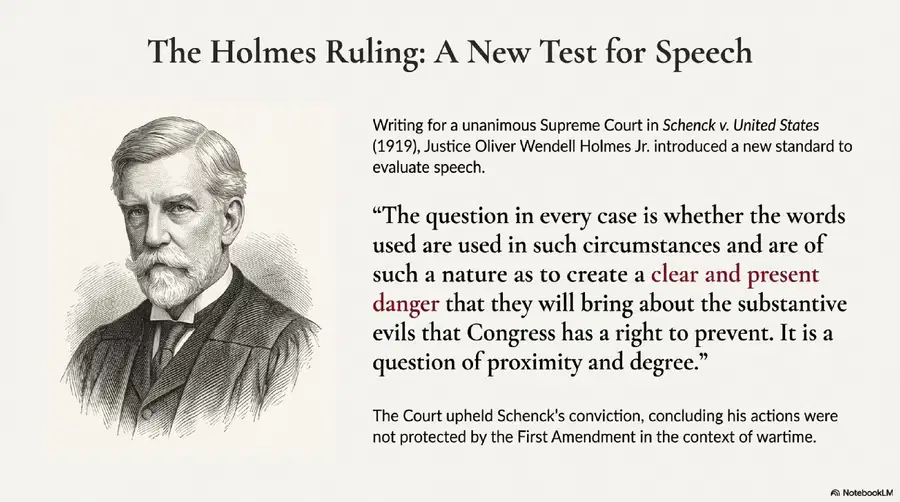
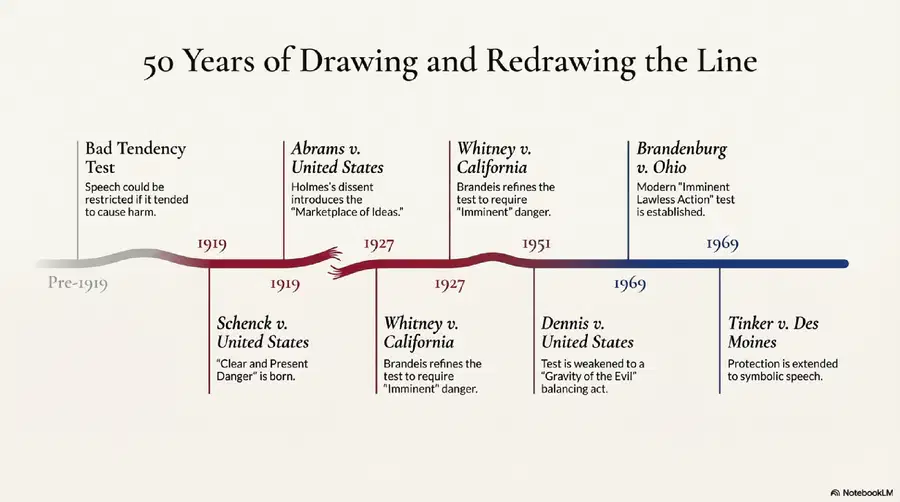
A group unhappy with local law enforcement distributes a memo to members encouraging physical confrontations with police officers. The leaders of the group are promptly arrested.
Which of the following Supreme Court cases best justifies the actions taken by law enforcement in this scenario?
Tinker v. Des Moines Independent Community School District (1969)
Engel v. Vitale (1962)
New York Times v. United States (1971)
Schenck v. United States (1919)
6
7
Multiple Choice
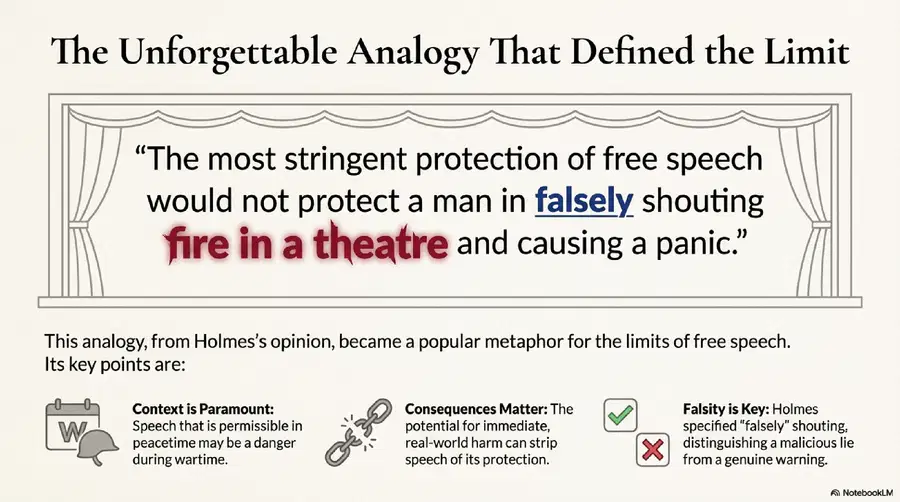
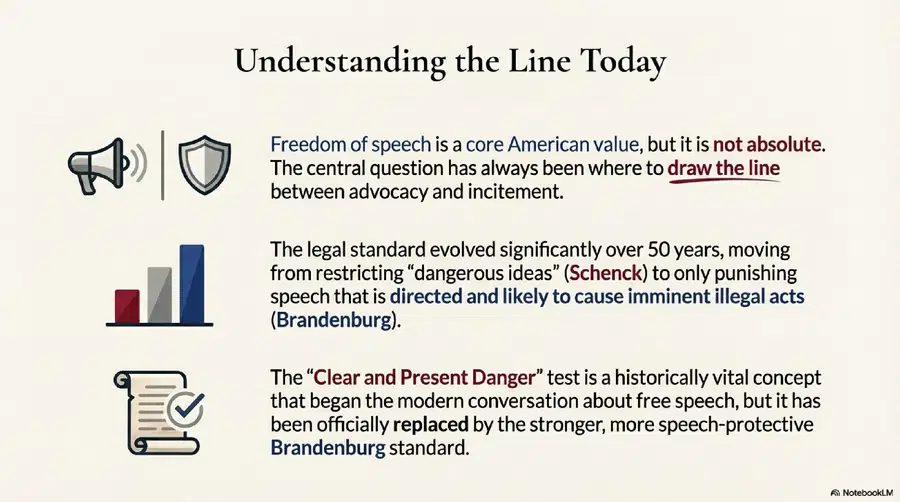
The clear-and-present danger test devised by the Supreme Court was designed to define the conditions under which public authorities could
ban obscene materials
suspend habeas corpus protections
limit free speech
commit troops to situations of potential foreign combat
8
Multiple Choice
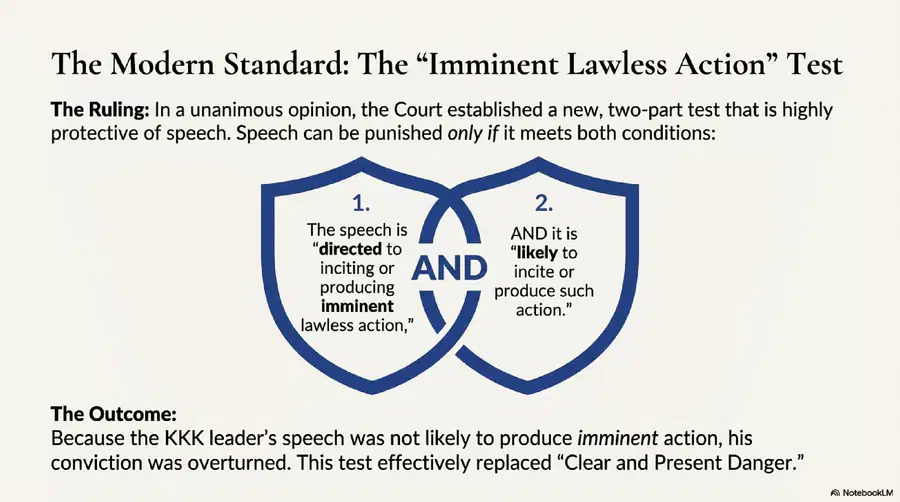
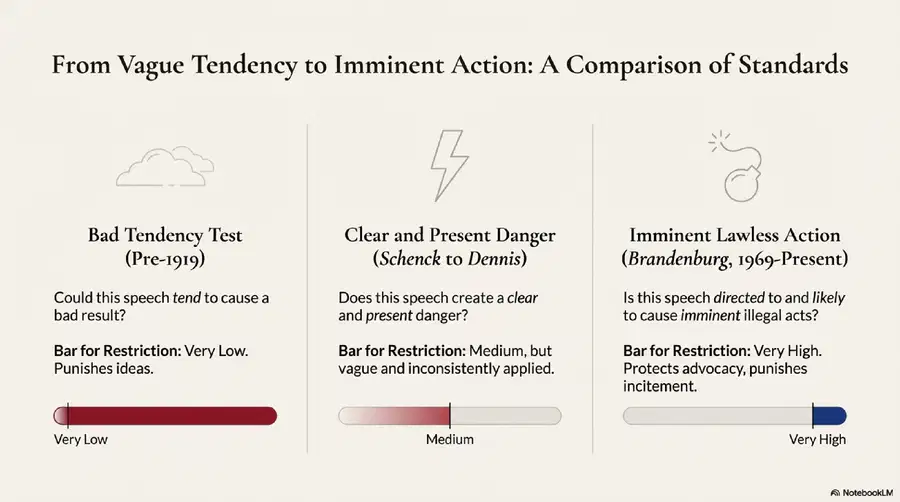
According to the clear and present danger test, speech may be restricted
when it incites violent action
when it lacks a political purpose
if it is deemed offensive to religious organizations
whenever the United States is at war
9

10
11
12

13
14
Multiple Choice
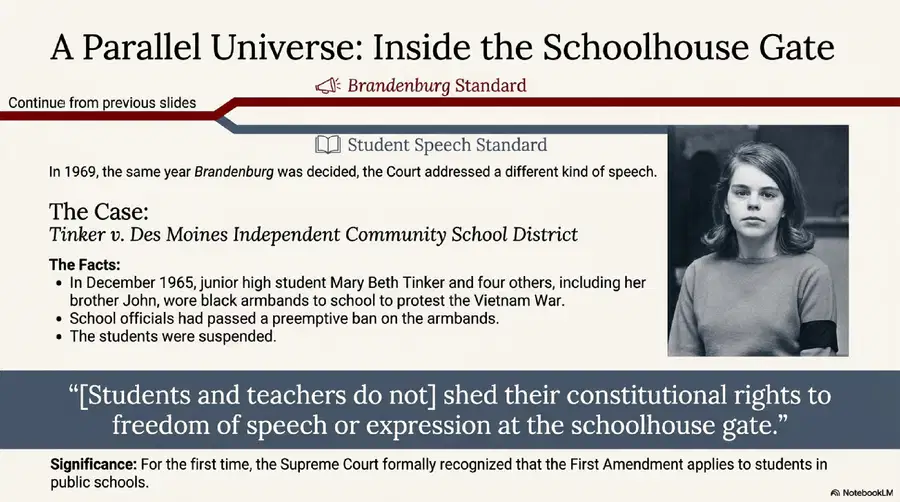
Which of the following decisions is most likely to cite the Supreme Court’s decision in Tinker v. Des Moines Independent Community School District (1969) as a legal precedent in support of the decision?
A decision in favor of students holding signs that protest a new policy
A decision against a public school’s practice of having prayer at school assemblies
A decision supporting the creation of gun-free zones in public schools
A decision enforcing mandatory vaccinations for all children before attending school
15
Multiple Choice
Which of the following Supreme Court decisions allows public school students to wear T-shirts protesting a school board decision that eliminates funding for high school arts programs?
Engel v. Vitale (1962)
Wisconsin v. Yoder (1972)
Tinker v. Des Moines Independent Community School District (1969)
New York Times Co. v. United States (1971)
16
Multiple Choice
At a public high school, several students raised a banner and wore clothing in support of a candidate running in the upcoming presidential election during lunch period. The principal asked the students to put away the banner, citing safety concerns.
Which of the following Supreme Court cases is most relevant to this scenario?
Wisconsin v. Yoder (1972)
Brown v. Board of Education of Topeka (1954)
Tinker v. Des Moines Independent Community School District (1969)
Citizens United v. Federal Election Commission (2010)
17
18
19

20
21
Multiple Choice
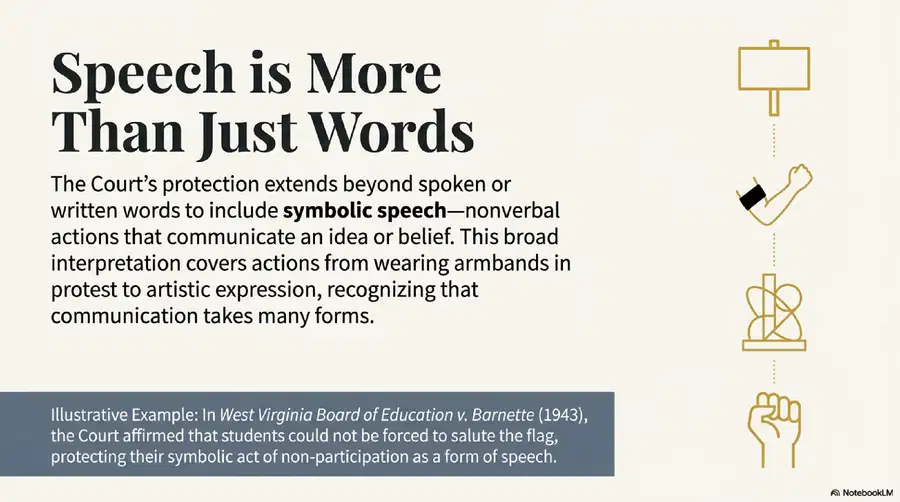
Which of the following is true about the right of free speech, as currently interpreted by the Supreme Court?
It protects the right to express opinions even without the actual use of words.
It protects the use of language deemed obscene by the courts.
It allows citizens to disobey laws that they believe to be unjust.
It is protected from infringement by the federal government but not from infringement by state governments.
22

23
24

25
26
Multiple Choice
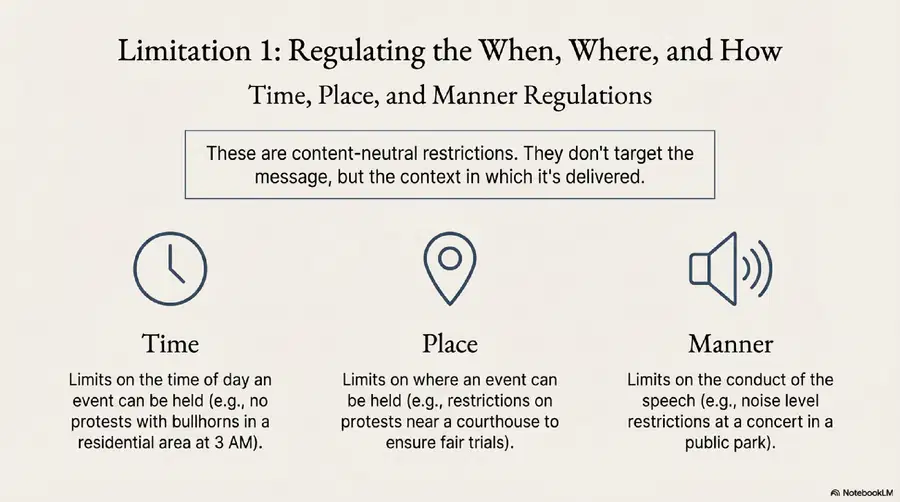
Which of the following illustrates a situation that would not be protected by the First Amendment due to time, place, and manner restrictions?
A student is expelled from school for wearing a black T-shirt expressing opposition to a law recently passed by the state legislature.
An organization regarded as a hate group is not able to obtain a permit to march through a major city because of its message.
Antibusiness protestors are arrested and prosecuted for shutting down major intersections in New York City’s Times Square during rush hour.
An independent political advocacy organization is prevented by the Federal Communications Commission (FCC) from running political advertisements on television.
27
Multiple Choice
Which of the following statements best describes how United States citizens regard the rights of free speech and assembly?
A majority agrees in principle with these rights, but in practice many people are often intolerant of views they do not support.
A majority actively supports these rights without any reservations.
Conservatives have traditionally been more supportive of these rights than have liberals.
A majority opposes these rights in principle.
28
Multiple Choice
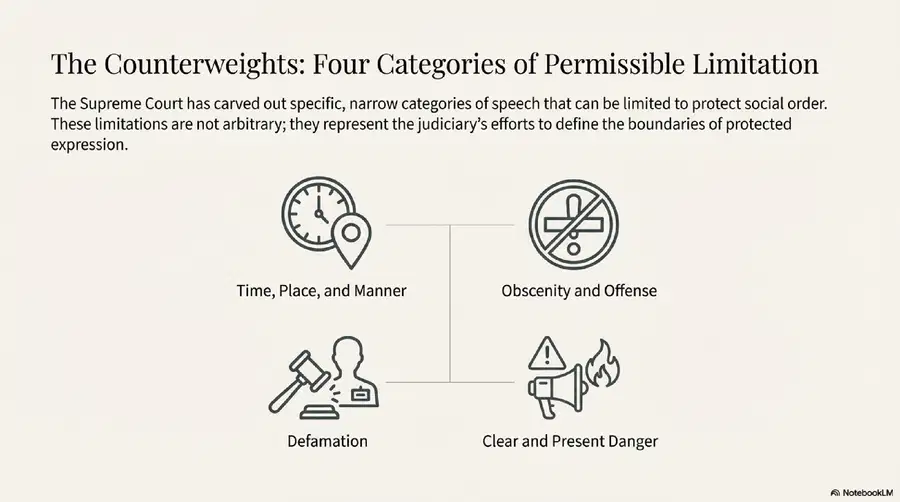
Which of the following would be considered an instance in which time, place, and manner restrictions would be applied to the First Amendment?
A city enforces its laws restricting noise to limit the scale of an outdoor concert event intended to raise public awareness of climate change.
A group with offensive signs is denied a permit to march through the streets because local residents and businesses oppose the group’s message.
A person is arrested after making a threat to police officers who are investigating a crime scene.
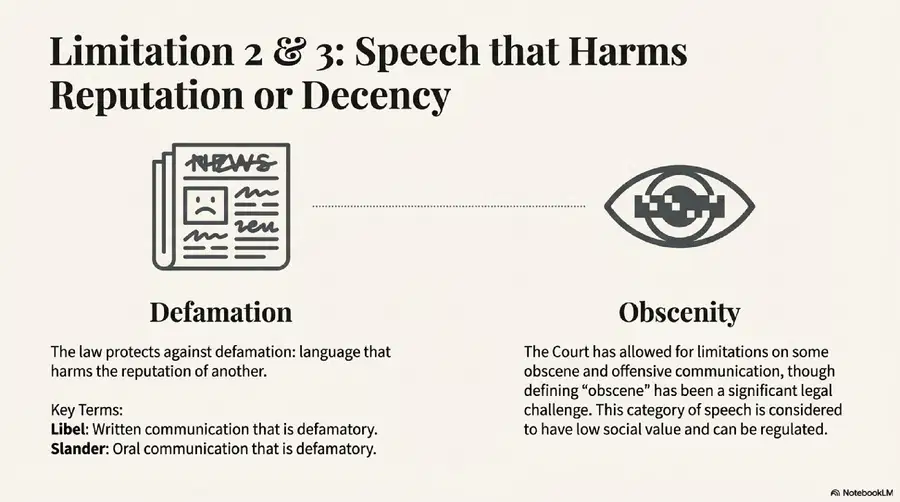
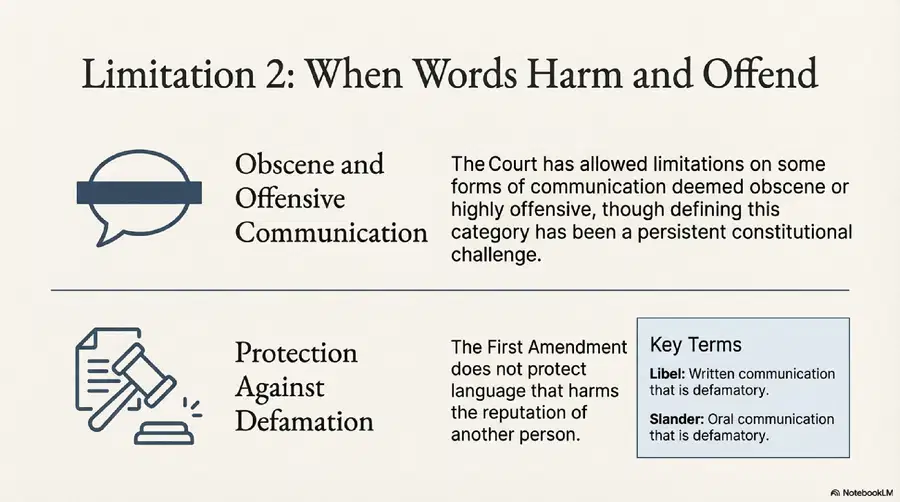
A newspaper publishes an article that publicly defames the reputation of a private individual.
29
30
31

32
33
Multiple Choice
Which of the following is most likely to be considered speech that is protected by the First Amendment?
A newspaper publishes a factually untrue article that defames the reputation of a public individual.
A group of people who are upset with a judge’s decision stage a protest on the judge’s private property.
An individual posts something on social media that is highly critical of the president.
A person threatens to commit an act of violence in an online video.
34

35

36

37

38
Multiple Choice
A classified Department of Defense study on the effectiveness of the United States involvement in the Afghanistan War is obtained by a newspaper. The president seeks to block the publication of the document. The court rules in favor of the newspaper, citing as precedent the Supreme Court’s decision in New York Times Co. v. United States (1971). Based on the ruling in the Supreme Court’s decision, which of the following lines of reasoning does the court most likely use?
Freedom of the press cannot be abridged except for restrictions on time, place, and manner of the communication.
Freedom of the press requires that the government show a significant danger to national security in order to stop publication.
Freedom of the press permits the press to print any story, but if the story embarrasses public officials, they can sue under defamation laws.
Freedom of the press cannot be abridged by the actions of the president without a law passed by Congress.
39
Multiple Choice
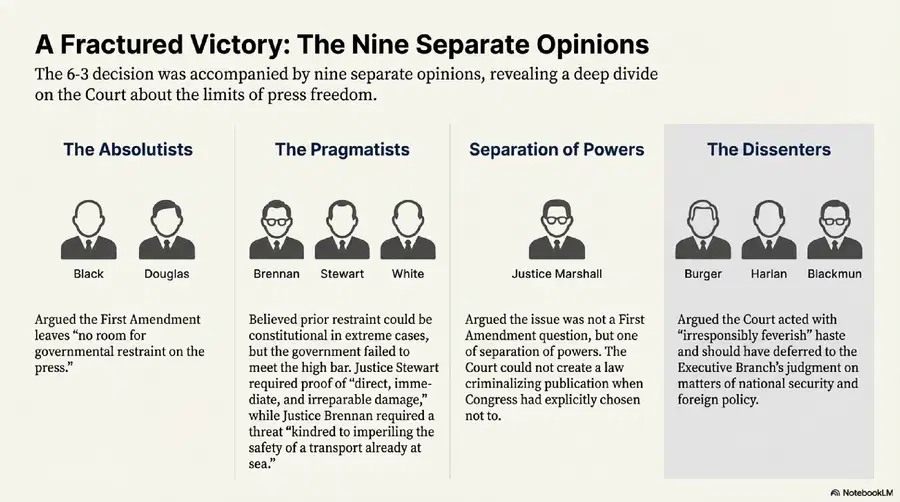
The Washington Post receives a top secret report that details how the executive branch mishandled a deal made with a foreign nation regarding nuclear weapons. The executive branch attempts to stop the publishing of the report, but the publishers cite the precedent in New York Times Company v. United States (1971) establishing which of the following legal rules?
The application of strict scrutiny
The exclusionary rule for evidence
The heavy presumption against prior restraint
Time, place, and manner restrictions
40
41
42
Multiple Choice
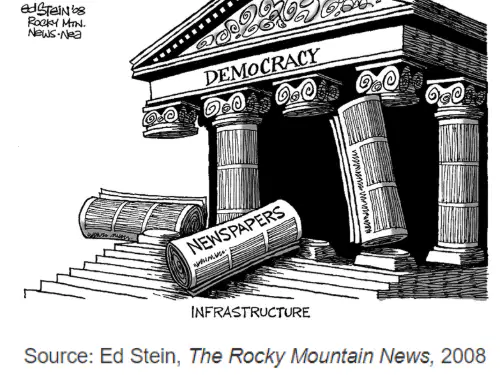
Which of the following headlines is most relevant to the political cartoon?
Supreme Court Refuses to Stop the Presses for National Security
Supreme Court Rules High School Students May Silently Protest Vietnam War
Supreme Court Hears Flag Burning Case
War Protestor Presented “Clear and Present Danger” Says Court
43
Multiple Choice

The facts of which of the following cases are most related to the political cartoon?
New York Times Co. v. United States (1971)
Gideon v. Wainwright (1963)
Schenck v. United States (1919)
Wisconsin v. Yoder (1972)
44
Multiple Choice
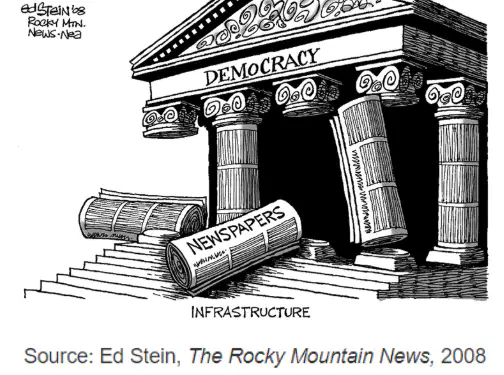
Which of the following attributes of the political cartoon would best represent the government’s use of prior restraint?
The steps of the building
The fallen pillars
The word “democracy” written on the building
The standing pillars
45
46

47
48
Multiple Choice
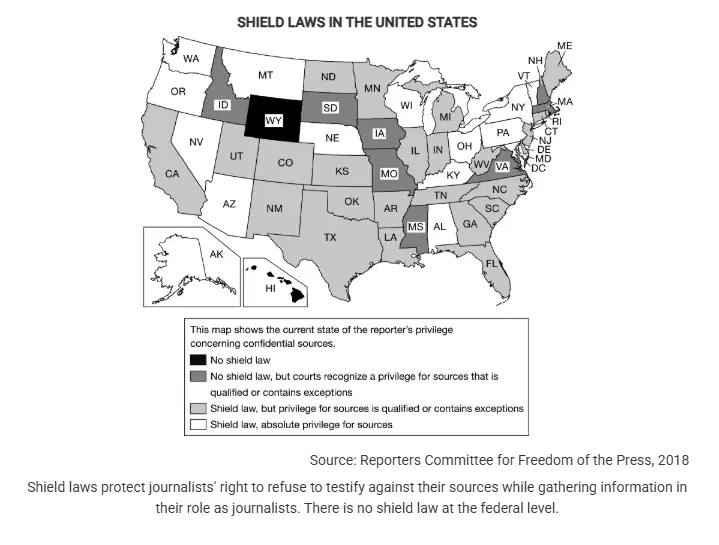
Which of the following statements is best supported by the information on the map?
Some states are more interested in cooperating with the federal government than others are.
Some states prioritize freedom of the press over criminal prosecutions.
Some states receive more federal funding for shield law programs than other states do.
Some states adhere to the exclusionary rule of the First Amendment more than other states do.
49
Multiple Choice
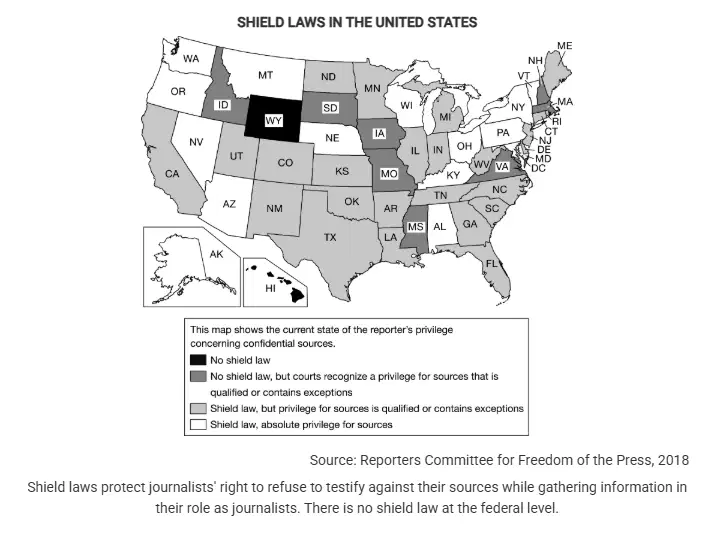
Based on the map and your knowledge, which of the following is a major difference between the issue of shield laws and the issue of prior restraint?
The Supreme Court has ruled that shield laws are incorporated to the states to decide on their own, while the issue of prior restraint applies only to the federal government.
The issue of shield laws does not apply to the federal government because criminal prosecutions occur only at the state level. On the other hand, the issue of prior restraint arises only in situations in which the president is invoking executive privilege to prevent information from being reviewed.
The Supreme Court has ruled that the First Amendment protects against prior restraint by the government. However, protections for journalists and their sources are not as strong, as evidenced by the many states with weak or no shield laws.
The First Amendment supports freedom of the press, which requires that each state develop guidelines for shield laws. However, the issue of prior restraint is not incorporated to the states because it is not related to freedom of the press.
50
Multiple Choice
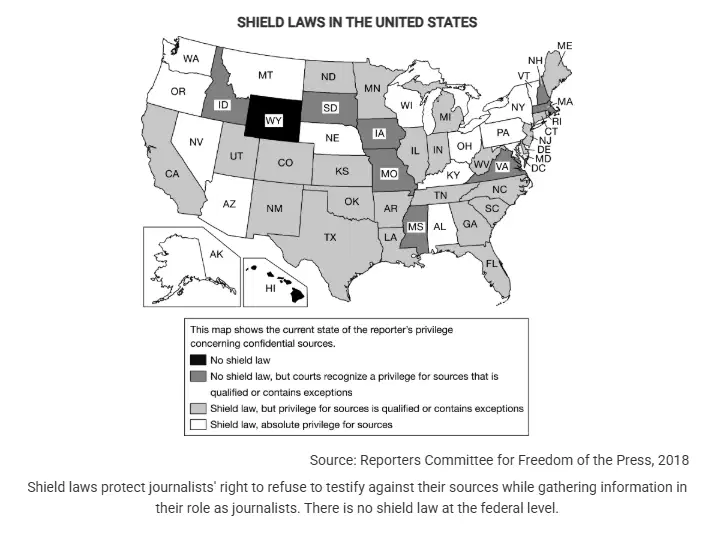
Which of the following states has the greatest protection for freedom of the press based on the information on the map?
New York (NY)
Missouri (MO)
Wyoming (WY)
Georgia (GA)
51

52
Multiple Choice
An investigative reporter uncovers illegal and unethical behavior on the part of a state government official. When the local newspaper announces that it will publish the story, the state government issues an injunction to stop the story from being released before being reviewed by government lawyers.
Which of the following best represents how the court will most likely respond to the case?
The newspaper will be required to delay publication until after the lawyers review the materials.
The newspaper will publish the story but face a libel lawsuit if the information contained is embarrassing to the government.
The newspapers will be permitted to publish the story without a review by the government’s lawyers.
The newspapers will not be permitted to publish the story if the government objects.
53
Multiple Choice
The president privately discusses with his staff a decision to increase economic sanctions on Iran. Before a final decision is made, a draft of the proposal is leaked to a reporter. The president orders the reporter and her newspaper to suspend publication of the plan, citing issues of national and economic security.
Which of the following best indicates how a court would rule in this case if the Supreme Court’s ruling in New York Times Co. v. United States (1971) was used as a precedent?
The president has the authority to stop the publication of the story because the administration has asserted that the information in the story threatens national security.
Although the documents have already been obtained by the press, a court must review the documents prior to publication to ensure that no information that threatens national security is made public.
Freedom of the press includes a heavy presumption against government censorship, and the documents can be published by the press.
Because the president’s staff leaked the documents and the newspaper obtained them in an illegal manner, a court can stop publication until law enforcement investigates.
Show answer
Auto Play
Slide 1 / 53
SLIDE
Similar Resources on Wayground

50 questions
Family Members
Presentation
•
9th - 12th Grade
52 questions
Spanish Flu
Presentation
•
9th - 12th Grade
50 questions
1.1 Introduction to Economics: Scarcity and Choice
Presentation
•
9th - 12th Grade
47 questions
Electricity & Magnetism Review
Presentation
•
10th - 12th Grade
47 questions
Systems of Linear Equations: Solve by Graph and Substitution
Presentation
•
9th - 11th Grade
47 questions
Polynomials-Characteristics and Operations
Presentation
•
9th - 11th Grade
46 questions
US Imperialism Hawaii
Presentation
•
9th - 12th Grade
Popular Resources on Wayground
10 questions
HCS SCI 03 Summer School Assessment 1

Quiz
•
3rd Grade
15 questions
HCS SCI 05 Summer School Assessment 1 Review
Quiz
•
5th Grade
22 questions
Day 9 Equations and Inequalities Review
Quiz
•
9th Grade
10 questions
Writing and Identifying Ratios Practice
Quiz
•
5th - 6th Grade
7 questions
PYRAMID PERSPECTIVES part 1
Presentation
•
9th - 12th Grade
12 questions
Understanding the Fourth of July
Quiz
•
9th Grade
15 questions
Soccer World Cup Quiz Questions
Quiz
•
7th Grade