

Macromolecules Practice

Presentation
•
Science
•
9th - 12th Grade
•
Medium
Standards-aligned

Barbara White
Used 1+ times
FREE Resource
14 Slides • 11 Questions
1

Macromolecules Practice
High School
2
Learning Objectives
Define macromolecules, monomers, and polymers, and how they are formed and broken down.
Identify the four major classes of biological macromolecules.
Describe the structure, monomers, and functions for each macromolecule class.
Provide examples and common food sources for each macromolecule type.


3
Key Vocabulary

Macromolecule
A large molecule, often a polymer, made of repeating monomer subunits essential for life's processes.
Monomer
The single basic building block unit that joins with others to form a larger polymer molecule.
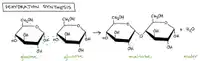
Dehydration Synthesis
A chemical reaction where monomers are joined by removing a water molecule to form a polymer.

Hydrolysis
The chemical breakdown of a compound by reacting with water, splitting a polymer into monomer subunits.
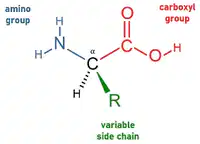
Amino Acid
The monomer building block of proteins, containing an amino group, a carboxyl group, and a unique R group.
4
Building Blocks of Life
Dehydration Synthesis
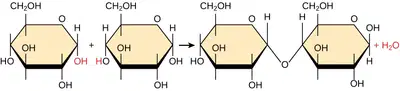
This process joins monomers together to build larger molecules called polymers.
It is an anabolic, or building, reaction that forms a chemical bond.
During this process, a water molecule is released as a product.
Hydrolysis
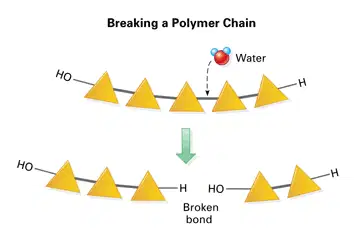
This process breaks down large polymers into their individual monomer units.
It is a catabolic, or breakdown, reaction that breaks a chemical bond.
To break the bond, a water molecule is added or consumed.
5
Multiple Choice
Which process is responsible for breaking down a large polymer into its smaller monomer subunits by adding water?
Hydrolysis
Polymerization
Dehydration Synthesis
Anabolism
6
Carbohydrates: Quick Energy

Monosaccharides
Monosaccharides are the basic building blocks of all carbohydrates.
They are simple sugars, consisting of just one sugar molecule.
Glucose is a common and very important monosaccharide for energy.
Disaccharides
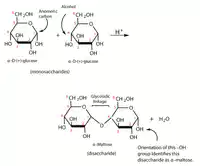
Disaccharides are formed when two simple sugars are joined together.
This joining is a chemical reaction linking two monosaccharide molecules.
Table sugar, also known as sucrose, is a common disaccharide.
Polysaccharides
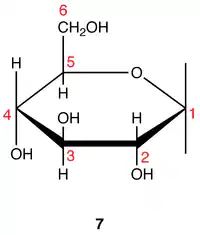
Polysaccharides are large molecules made of many linked monosaccharides.
Plants store their energy as a polysaccharide known as starch.
Cellulose is a polysaccharide that provides structure to plant cells.
7
Solved Example 1
A carbohydrate molecule has 6 carbon atoms. Based on the typical 1:2:1 ratio of elements in carbohydrates, how many hydrogen and oxygen atoms does this molecule contain?
Step 1: Analyze and Sketch the Problem
Goal: Determine the number of hydrogen and oxygen atoms in a carbohydrate with 6 carbon atoms.
Knowns: Number of Carbon (C) atoms = 6. The ratio of Carbon:Hydrogen:Oxygen is 1:2:1.
Unknown: Number of Hydrogen (H) atoms = ?; Number of Oxygen (O) atoms = ?
Formula: Use the ratio C:H:O = 1:2:1.
8
Solved Example 1
A carbohydrate molecule has 6 carbon atoms. Based on the typical 1:2:1 ratio of elements in carbohydrates, how many hydrogen and oxygen atoms does this molecule contain?
Step 2: Solve for the Unknown
9
Solved Example 1
A carbohydrate molecule has 6 carbon atoms. Based on the typical 1:2:1 ratio of elements in carbohydrates, how many hydrogen and oxygen atoms does this molecule contain?
Step 3: Evaluate the Answer
Check the ratios: C:H is 6:12, which simplifies to 1:2. C:O is 6:6, which simplifies to 1:1.
The calculated number of atoms (12 for H, 6 for O) correctly fits the 1:2:1 ratio for a carbohydrate with 6 carbon atoms.
10
Multiple Choice
A carbohydrate is made of multiple monosaccharide units. What is its primary function in living organisms?
Providing long-term energy storage
Serving as a source of quick energy
Storing genetic information
Acting as a structural component of cell membranes
11
What are Lipids?
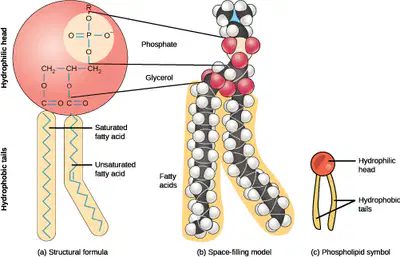
Lipids are made of C, H, and O and do not mix with water.
They provide long-term energy storage, insulation, and form some hormones.
Lipids are a major structural component of all cell membranes.
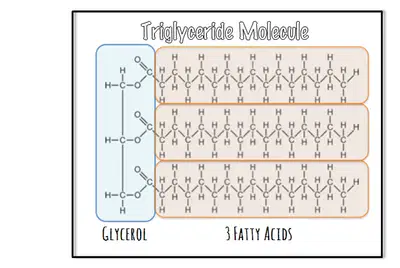
Their building blocks are molecules called glycerol and fatty acids.
12
Multiple Choice
Based on the information provided, what is a primary role of lipids in the body?
Catalyzing chemical reactions as enzymes.
Long-term energy storage and forming cell membranes.
Providing a source of quick energy.
Storing and transmitting genetic information.
13
Saturated vs. Unsaturated Fats
Saturated Fats
Contain only single bonds between their carbon atoms in the fatty acid chain.
Each carbon atom is fully 'saturated' with as many hydrogen atoms as possible.
These fats, like butter, are typically solid at room temperature.

Unsaturated Fats

Feature at least one double bond between carbon atoms in the fatty acid chain.
The double bond creates a kink or bend in the molecule's overall structure.
These fats, such as olive oil, are typically liquid at room temperature.
14
Multiple Choice
What key structural difference causes unsaturated fats like oils to be liquid at room temperature, while saturated fats like butter are solid?
Having a higher number of oxygen atoms.
The presence of at least one double bond in their fatty acid chains.
Being 'saturated' with more hydrogen atoms.
The absence of glycerol in their structure.
15
Proteins: The Workhorses
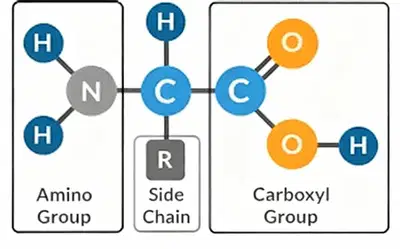
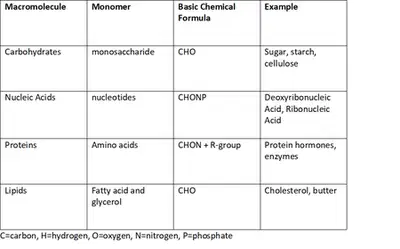
Proteins are molecules of C, H, O, and N, built from amino acids.
Of 20 types, 8 essential amino acids must come from your diet.
Each amino acid has a unique side chain called an 'R' group.
They function as enzymes, provide structure, aid movement, and form antibodies.
16
Multiple Choice
What are the fundamental building blocks of proteins, and what element is found in proteins but not typically in carbohydrates or lipids?
Monosaccharides; Nitrogen
Nucleotides; Phosphorus
Fatty acids; Phosphorus
Amino acids; Nitrogen
17
What Are Nucleic Acids?
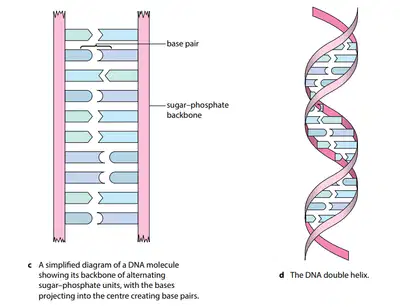
Nucleic acids are macromolecules that store and transmit genetic information.
They are composed of Carbon, Hydrogen, Oxygen, Nitrogen, and Phosphorus.
Their monomer is a nucleotide with a sugar, phosphate, and base.
DNA, a major type, forms a double helix with this structure.

18
Multiple Choice
Which of the following correctly lists the three components of a nucleotide, the monomer of nucleic acids?
Amino acid, R group, and carboxyl group
Simple sugar, carbon ring, and oxygen atom
Sugar, phosphate group, and nitrogenous base
Glycerol, fatty acid, and phosphate group
19
Common Misconceptions about Macromolecules
Misconception | Correction |
|---|---|
All fats are unhealthy. | Unsaturated fats are healthy; lipids are vital for long-term energy and insulation. |
Carbohydrates are the only source of energy. | Carbohydrates provide quick energy, while lipids offer long-term energy storage. |
The body can make all necessary amino acids. | There are 8 essential amino acids that must be obtained from food. |
20
Multiple Choice
A newly discovered molecule is found to be a major component of a cell's membrane, is insoluble in water, and provides long-term energy. How would this molecule be classified, and why?
As a nucleic acid, because all cell components are made of them.
As a protein, because it is part of a cell's structure.
As a lipid, because it is insoluble in water and stores energy long-term.
As a carbohydrate, because it provides energy.
21
Multiple Choice
Explain the structural difference between starch (a polysaccharide) and a protein, referencing their respective monomers.
Starch is a chain of amino acids, while a protein is a chain of monosaccharides.
Starch is made of glycerol and fatty acids, while proteins are made of nucleotides.
Both are chains of nucleotides, but they are folded in different ways.
Starch is a chain of monosaccharides, while a protein is a chain of amino acids with complex folding.
22
Multiple Choice
A genetic mutation occurs in an organism that alters the sequence of nucleotides in a DNA molecule. Predict the most likely downstream effect of this change.
The process of hydrolysis would be permanently halted throughout the organism.
The structure and function of a corresponding protein could be altered, as protein sequence is determined by DNA.
The cell membrane would lose its insolubility, affecting its function as a barrier.
The body's ability to store quick energy as a carbohydrate would be compromised.
23
Multiple Choice
How do dehydration synthesis and hydrolysis work together to manage the body's macromolecules?
Both processes build larger molecules, one using water and one releasing it.
Dehydration synthesis breaks down molecules for energy, and hydrolysis builds them for storage.
Dehydration synthesis builds polymers for storage or function, and hydrolysis breaks them down to release monomers for use elsewhere.
Both processes break down large molecules to release energy and water.
24
Summary
The four main types of macromolecules are carbohydrates, lipids, proteins, and nucleic acids.
Monomers form polymers through dehydration synthesis, and hydrolysis breaks them apart.
Carbohydrates provide quick energy, and lipids provide long-term energy storage.
Proteins have diverse roles, while nucleic acids store and transmit genetic information.
25
Poll
On a scale of 1-4, how confident are you about the concepts covered in today's review?
1
2
3
4
Macromolecules Practice
High School
Show answer
Auto Play
Slide 1 / 25
SLIDE
Similar Resources on Wayground

20 questions
Properties of Water
Presentation
•
9th - 12th Grade
18 questions
Weather and Climate
Presentation
•
9th - 12th Grade
19 questions
What is photosynthesis?
Presentation
•
10th - 12th Grade
18 questions
Flow of Energy in an Ecosystem
Presentation
•
10th - 12th Grade
16 questions
Counterfeit Money
Presentation
•
9th - 12th Grade
17 questions
Seasons
Presentation
•
8th - 12th Grade
16 questions
3.6 Climate Change
Presentation
•
9th - 12th Grade
19 questions
Dead Zone in the Gulf of Mexico
Presentation
•
9th - 12th Grade
Popular Resources on Wayground
20 questions
Math Review

Quiz
•
3rd Grade
15 questions
Fast food
Quiz
•
7th Grade
20 questions
Context Clues
Quiz
•
6th Grade
20 questions
Inferences
Quiz
•
4th Grade
19 questions
Classifying Quadrilaterals
Quiz
•
3rd Grade
20 questions
Figurative Language Review
Quiz
•
6th Grade
20 questions
Equivalent Fractions
Quiz
•
3rd Grade
10 questions
Identify Fractions, Mixed Numbers & Improper Fractions
Quiz
•
3rd - 4th Grade
Discover more resources for Science
25 questions
Naming Ionic and Covalent Compounds
Quiz
•
9th Grade
40 questions
NCFE Earth and Environmental Science Released Test
Quiz
•
9th - 12th Grade
10 questions
Exploring Weather Influences and Map Reading

Interactive video
•
6th - 10th Grade
20 questions
Human Impact on the Environment Review #2
Quiz
•
9th Grade
20 questions
Balancing Chemical Equations
Quiz
•
9th Grade
61 questions
End of the Year Trivia Fun
Quiz
•
9th Grade
15 questions
Protein synthesis
Quiz
•
9th Grade
30 questions
Environmental Science Final Exam REVIEW
Quiz
•
9th - 12th Grade