

The Integumentary System

Presentation
•
Science
•
9th - 12th Grade
•
Easy
Standards-aligned

Barbara White
Used 8+ times
FREE Resource
14 Slides • 11 Questions
1

High School
2
Describe the main functions of the integumentary system.
Identify the three main layers of the skin and their primary components.
Explain the process of keratinization and how melanin determines skin color.
Compare the structures and functions of hair, nails, and skin glands.


3
Key Vocabulary

Epidermis
The epidermis is the outermost layer of skin, providing a protective barrier for the body.

Dermis
The dermis is the inner layer of skin that contains blood vessels, nerves, and glands.

Keratinization
Keratinization is the process where cells harden and die as they migrate to the skin's surface.
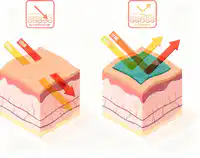
Melanin
Melanin is the pigment that absorbs UV radiation and gives color to our skin and hair.

Sebaceous Gland
This gland secretes an oily substance called sebum into hair follicles, preventing skin from drying out.
4
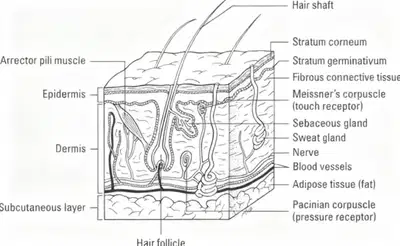
The Integumentary System: An Overview
The Integumentary System is the body's largest organ, including skin, hair, and nails.
It regulates body temperature, eliminates waste, and protects the body from damage.
This system gathers sensory information and produces vitamin D with sun exposure.
The skin has two main layers, the Epidermis and Dermis, over a Subcutaneous layer.
5
Multiple Choice
According to the overview, which of the following is NOT listed as a primary function of the integumentary system?
Production of vitamin D
Digestion of nutrients
Protection of the body
Regulation of body temperature
6
The Epidermis: Our Outer Shield
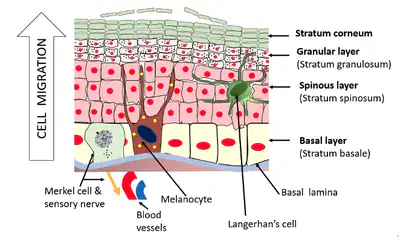
The epidermis is the skin's thin, avascular, and outermost protective layer.
It is made of stratified squamous epithelium, a special type of tissue.
New cells, keratinocytes, are made in the deepest layer, the stratum basale.
These cells harden and die, forming a tough, water-resistant outer wall.

7
Solved Example 1
The stratum corneum is 30 cell layers thick, and the total epidermis is 40 cell layers thick. What percentage of the epidermis is the stratum corneum?
Step 1: Analyze and Sketch the Problem
Goal: Find the percentage of the epidermis that is the stratum corneum.
Knowns: Stratum corneum thickness = 30 layers; Total epidermis thickness = 40 layers.
Unknown: Percentage of epidermis that is stratum corneum.
Formula: Percentage = (Part / Whole) * 100%
8
Solved Example 1
The stratum corneum is 30 cell layers thick, and the total epidermis is 40 cell layers thick. What percentage of the epidermis is the stratum corneum?
Step 2: Solve for the Unknown
9
Solved Example 1
The stratum corneum is 30 cell layers thick, and the total epidermis is 40 cell layers thick. What percentage of the epidermis is the stratum corneum?
Step 3: Evaluate the Answer
The stratum corneum makes up a significant portion of the epidermis, so 75% is a reasonable answer.
To check the calculation, convert the percentage back to a decimal (75% = 0.75) and multiply by the total layers (0.75 × 40 = 30). This matches the given thickness, confirming the answer is correct.
10
Multiple Choice
What is the key process that makes the outermost layer of the epidermis a tough, protective barrier?
Melanin production
Vasodilation
Keratinization
Sebum secretion
11
The Dermis and Subcutaneous Layer
The dermis is the thick inner skin layer below the epidermis.
It contains blood vessels, nerves, hair follicles, and sweat glands.
Dermal papillae are projections that help form your unique fingerprints.
The subcutaneous layer lies below the dermis, anchoring the skin.
It consists of areolar and adipose tissues, which is fat.
This layer's main roles are to insulate and absorb shock.

12
Multiple Choice
Which layer of the skin is rich with blood vessels and contains structures like hair follicles and sweat glands?
Subcutaneous layer
Dermis
Stratum corneum
Epidermis
13
What Determines Skin Color?
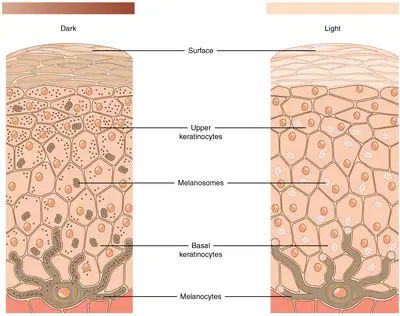
Skin color is determined by a pigment called melanin, produced by melanocytes.
Melanin protects the cell's nucleus from damaging U.V. radiation from the sun.
Eumelanin creates a brown-black pigment, while pheomelanin makes a reddish one.
Unusual skin colors like cyanosis (blue) or jaundice (yellow) can signal health problems.

14
Multiple Choice
What is the main protective function of melanin within the epidermis?
To insulate the body from cold
To make the skin waterproof
To produce vitamin D
To absorb U.V. radiation
15
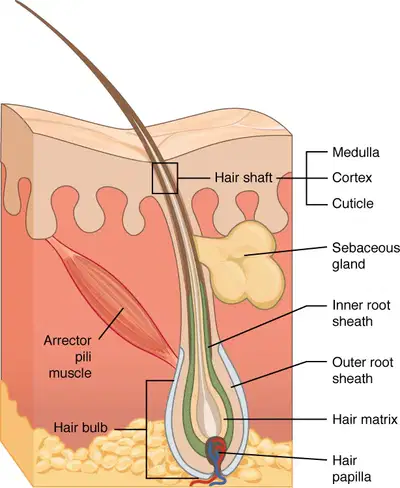
Hair
Hair is primarily made of protein, fat, and water.
It grows from a structure called a hair follicle.
The arrector pili muscle makes hair stand on end.
Nails
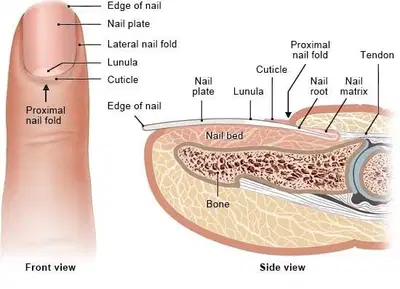
Nails are made of densely packed, keratinized epithelial cells.
Their main purpose is to protect the tips of fingers and toes.
A nail consists of the nail plate, cuticle, and nail bed.
16
Multiple Choice
What is the name of the tiny muscle that attaches to a hair follicle and causes 'goosebumps'?
Follicle Constrictor
Keratinocyte Muscle
Arrector pili muscle
Dermal Papilla
17
Sweat Glands
Eccrine glands are widespread and produce sweat to cool the body and remove wastes.
Apocrine glands are scent glands found in the armpit and groin regions.
These glands activate at puberty and respond to emotional stress.

Oil Glands

Sebaceous glands open into hair follicles and secrete an oily substance called sebum.
Sebum keeps the skin and hair from drying out and offers mild antibacterial protection.
When ducts are blocked by too much sebum, it can result in pimples.
18
Multiple Choice
Which type of gland secretes sebum, an oily substance that keeps skin and hair from becoming brittle?
Sudoriferous glands
Sebaceous glands
Eccrine glands
Apocrine glands
19
Misconception | Correction |
|---|---|
The epidermis has its own blood supply. | The epidermis is avascular, getting nutrients from the dermis below. |
A suntan is a sign of healthy skin. | A tan is the skin's response to damage from UV radiation. |
Sweat is naturally smelly. | Sweat is odorless until broken down by bacteria on the skin. |
The hypodermis is the third layer of skin. | The hypodermis is located beneath the skin but is not a skin layer. |
20
Multiple Choice
Based on the structure of the skin's layers, why does a shallow paper cut that only penetrates the epidermis often not bleed?
The cut is too shallow to reach nerve endings.
The epidermis is avascular, meaning it lacks blood vessels.
Keratin in the cells immediately clots any potential bleeding.
Sebum from nearby glands quickly seals the wound.
21
Multiple Choice
How do the primary functions of eccrine glands and sebaceous glands work together to maintain the skin's health?
Eccrine glands absorb shock; sebaceous glands eliminate waste products.
Eccrine glands regulate body temperature; sebaceous glands prevent the skin from drying out.
Eccrine glands produce melanin; sebaceous glands grow hair.
Eccrine glands provide scent; sebaceous glands provide insulation.
22
Multiple Choice
A person quickly moves from a very cold room into a hot, humid environment. Analyze the most likely initial responses of their arrector pili muscles and eccrine sweat glands.
The arrector pili muscles will contract, and the eccrine glands will become inactive.
Both the arrector pili muscles and eccrine glands will be completely inactive.
The arrector pili muscles will relax, and the eccrine glands will activate to produce sweat.
Both the arrector pili muscles and eccrine glands will contract to conserve body heat.
23
Multiple Choice
If the stratum basale layer of the epidermis completely lost its ability to undergo mitosis, what would be the long-term consequence for the skin's integrity?
The dermis would lose its blood supply and vital nutrients.
The skin would be unable to repair itself, leading to thinning and a loss of its protective barrier.
The skin would become much darker as melanocytes overproduce melanin.
The body would overheat because sweat glands would cease to function.
24
The integumentary system provides protection, thermoregulation, and sensory perception.
Skin has three layers: the epidermis, dermis, and subcutaneous layer.
Keratinization forms a tough barrier, and melanin protects from UV damage.
Hair, nails, and glands have specialized protective and regulatory functions.
25
Poll
On a scale of 1-4, how confident are you about the structure and functions of the integumentary system?
1
2
3
4
High School
Show answer
Auto Play
Slide 1 / 25
SLIDE
Similar Resources on Wayground

21 questions
Unit 7: Energy Transformations
Presentation
•
9th - 12th Grade
20 questions
Evolution of Plant Transport System
Presentation
•
9th - 12th Grade
17 questions
Genetics Review Part 2 (Practice)
Presentation
•
6th - 9th Grade
20 questions
ions
Presentation
•
10th - 12th Grade
22 questions
Ecological Succession EOC Review
Presentation
•
9th - 12th Grade
18 questions
Passive and Active transport
Presentation
•
9th - 11th Grade
20 questions
Cell Differentiation and Specialized Cells
Presentation
•
9th - 12th Grade
19 questions
Marine and brackish biomes
Presentation
•
9th - 12th Grade
Popular Resources on Wayground
10 questions
How much do you know about our Portrait of an Eagle?

Quiz
•
10th Grade
10 questions
Fast Food Slogans
Quiz
•
6th - 8th Grade
21 questions
Continents and Oceans
Quiz
•
6th Grade
20 questions
Parts of Speech
Quiz
•
5th Grade
16 questions
Subject & Predicate
Quiz
•
5th Grade
25 questions
Multiplication Facts
Quiz
•
5th Grade
12 questions
Map Skills
Quiz
•
3rd Grade
22 questions
Continents and Oceans
Quiz
•
5th Grade
Discover more resources for Science
10 questions
Exploring Chemical and Physical Changes

Interactive video
•
6th - 10th Grade
20 questions
Atomic Structure
Quiz
•
9th Grade
10 questions
Decoding the Periodic Table of Elements
Interactive video
•
6th - 10th Grade
10 questions
Exploring the Periodic Table
Interactive video
•
6th - 10th Grade
14 questions
Physical and Chemical Changes
Quiz
•
10th Grade
22 questions
Periodic Table Review
Quiz
•
9th - 12th Grade
20 questions
Observation vs. Inference
Quiz
•
7th - 9th Grade
14 questions
Periodic Trends
Interactive video
•
11th Grade