

6.12 - Civil Law

Presentation
•
Social Studies
•
11th Grade
•
Practice Problem
•
Easy

John Christiansen
Used 1+ times
FREE Resource
17 Slides • 6 Questions
1
6.12
By John Christiansen

2

Apple CEO Steve Jobs unveils the first iPhone
2007
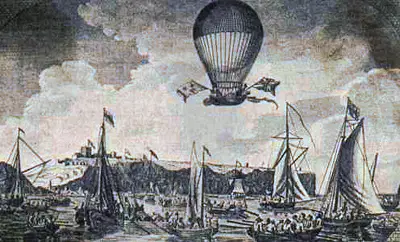
Jean-Pierre Blanchard becomes the first person in the United States to fly a balloon
1793
3
Learners can:
identify types of civil law
evaluate whether the plaintiff in a civil case meets the burden of proof
create a fictional civil case
Vocabulary: class-action lawsuit, intellectual property, lawsuit, out-of-court settlement, tort
Overview
4

Not all court cases involve people on trial for allegedly committing a crime.
And not all court cases result in monumental decisions that affect people throughout the country
Imagine someone hitting a baseball through your window.
Essential Question:
What kinds of cases occur in civil law, and how are the cases settled?
Engage
5
Poll
If the situations below happened to you, how likely would you be to pursue legal action?
A shelf in a store falls on you and injures you.
You discover someone used your music or art in an online video without your permission.
Someone hits a baseball through your home's window.
An appliance manufacturer refuses to repair a faulty refrigerator.
6

Civil cases do not involve the government as a party to the case; the only role that government plays is as the finder-of-fact in the form of the judge who will hear the arguments of both sides and reach a decision according to the law.
A lawsuit is a legal claim that a party brings to court to solve a legal dispute. Examples:
- contracts
- property laws
- family law
- tort
Types of Civil Law
7

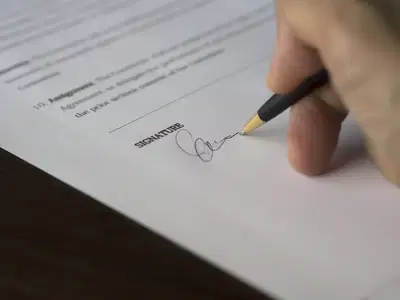
A contract is a legally binding agreement.
Contracts can be verbal or written.
For example, in job contracts, an employee agrees to do certain types of work and the employer agrees to provide certain payments and possibly other benefits like insurance.
If either party believes the contract has been violated, the party may file a lawsuit.
Contracts
8

Property law involves disputes over who owns something.
This could be physical property, such as land. Or, intellectual property, or ownership of an idea or creative work that an individual holds a patent or copyright for.
For example, if one music artist believes another artist copied part of a song, they could sue for copyright infringement
- Happy Birthday Song
- Ice Ice Baby and Under Pressure
Property Law
9

Legal disputes within a family are another type of civil law. Cases may relate to the end of a marriage, arrangements for how unmarried parents share custody of a child, or which family member owns certain property.
Family Law
10

Tort is a non-criminal behavior that causes harm to another person and may result in a civil law case.
It may be intentional or be result of negligence or recklessness
For example, a tort case could involve suing:
- a reckless driver for causing an accident.
- a dog owner for their dog biting someone
- an employer for unsafe working conditions
A tort can also be in addition to a criminal case
- a driver could be charger criminally for reckless driving and sued civilly for property damage
Tort
11
Match
Match the example to the type of civil law.
An employee sues their employer for not accurately counting the employee's work hours and underpaying the employee.
A comedian sues another comedian for copying their jokes.
Two adult siblings disagree about who gets ownership of their deceased parent's house.
A shelf in a store falls on a child and causes a concussion. The child's parents sue the store.
contract
property law
family law
tort
contract
property law
family law
tort
12

In a civil case, the plaintiff is the party accusing another party of causing harm or injustice. They hope that the court will force compensation from the defendant.
Most lawsuits involve one plaintiff filing a lawsuit due to individual harm against the plaintiff. However, some lawsuits may be class-action lawsuits, where one plaintiff or a group of plaintiffs file a lawsuit due to harm against a larger group, or class.
An example of a class-action lawsuit is Brown v. Board of Education, in which Oliver Brown was the plaintiff in a case involving multiple children who were denied access to Whites-only schools.
Plaintiff, Defendant, and Attorneys
13
Like in criminal cases, the defendant in a civil case is the accused party. They hope to convince the court of no wrong doing or to minimize compensation
Both sides in civil cases often have attorneys. Remember that an attorney is a legal expert who argues on behalf of a client and speaks for the client in court. Laws can be complex and confusing, and attorneys use their expertise to help their clients make a strong case.
Plaintiff, Defendant, and Attorneys
14
Multiple Choice
Which role is part of a criminal court case, but not part of a civil court case?
attorney
defendant
prosecutor
plaintiff
15
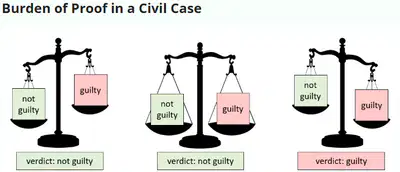
In criminal cases, the prosecutor's burden is to prove the defendant is “guilty beyond a reasonable doubt.”
In civil cases, the burden of proof is “a preponderance of evidence.” This means that something is more likely than unlikely.
Burden of Proof in Civil Cases
If it seems unlikely that the defendant is guilty, the burden of proof has not been met.
If it seems equally likely that the defendant is guilty or not guilty, the burden of proof has not been met.
If the court is more than 50 percent certain that the defendant is guilty, the burden of proof has been met. The defendant does not need to be proven "guilty beyond a reasonable doubt." As long as the defendant appears more likely guilty than not guilty, the defendant is found guilty.
16
Scenario A
Toppley and his children are shopping at the superstore Major Value. A store shelf falls on one of the children and causes a concussion. Toppley sues Major Value, seeking monetary compensation. Toppley is the plaintiff, and Major Value is the defendant.
In court, Major Value presents video surveillance footage of Toppley's child climbing on the shelf, causing it to fall. Toppley claims the shelf was not secure, and Major Value is at fault. The jury decides that Toppley's child is just as responsible for the incident as Major Value is. The burden of proof has not been met, and Major Value does not need to compensate Toppley.
17
Scenario B
Major Value presents the surveillance footage of Toppley's child climbing the shelf. Toppley claims the shelf was not secure. Toppley also identifies the model of the shelf and presents the user manual, which has a warning that the shelf should be attached to a wall or floor to prevent it from falling. Major Value claims the shelf was bolted to the floor. Toppley points out that in the surveillance footage, the shelf appears to have tipped easily, and no holes from bolts are visible in the floor after the shelf tips.
The jury decides that Major Value is more likely at fault than Toppley's child is. The burden of proof has been met, and Major Value must pay compensation to Toppley.
18
Multiple Select
In which cases would the court hold the defendant responsible for alleged damage?
The jury is certain that the plaintiff's claims are false or unreasonable, and the defendant did not cause damage.
The jury thinks it is equally likely that the defendant is responsible or not responsible for the damage.
The jury thinks it seems likely, though not certain, that the defendant is responsible for the damage.
The jury is certain that the defendant caused the damage.
19
20
Multiple Select
Do you think XYZ Appliances is at fault?
YES SIR
NO SHOT
21

When someone files a civil legal action, it does not immediately go to court. Over 90 percent of civil cases end with an out-of-court settlement, an arrangement the two parties agree to outside of court. Under Pressure and Ice Ice Baby
Out-of-court settlements are usually a more attractive option than filing a lawsuit and going to court.
Settling out of court saves both parties a lot of time and money
Out-of-Court Settlement
22
Multiple Select
Why do many people prefer to settle out of court rather than file a lawsuit and bring a dispute to court?
to minimize how much the dispute interrupts their lives
to reduce the legal fees they need to pay
to reach a final resolution faster
to avoid the risk of a verdict they do not want
23
In this lesson, you answered the Essential Question:
What kinds of cases occur in civil law, and how are the cases settled?
You learned:
Civil law may involve contracts, property, family, or tort.
Plaintiffs, defendants, and attorneys act in civil cases.
The burden of proof in a civil case is “a preponderance of evidence.”
Most cases are settled out of court.
In an upcoming lesson, you will learn about the process of law in criminal and civil cases.
Summary
6.12
By John Christiansen
Show answer
Auto Play
Slide 1 / 23
SLIDE
Similar Resources on Wayground

19 questions
World War II - Day 1 - The Rise of Hitler
Presentation
•
11th Grade
17 questions
Chapter 14: Money, Banking, and The Fed
Presentation
•
12th Grade
17 questions
U.S Enters WWII
Presentation
•
11th Grade
20 questions
Gulf war
Presentation
•
11th Grade
18 questions
Gilded Age: Capital and Labor
Presentation
•
11th Grade
16 questions
RECONSTRUCTION LESSON
Presentation
•
11th Grade
18 questions
War in Vietnam - Overview
Presentation
•
11th Grade
16 questions
Mengenal Konstitusi dan UUD NRI 1945
Presentation
•
10th Grade
Popular Resources on Wayground
10 questions
Safety Day 2026 – Student Review

Quiz
•
9th Grade
21 questions
Continents and Oceans
Quiz
•
6th Grade
20 questions
Parts of Speech
Quiz
•
5th Grade
16 questions
Subject & Predicate
Quiz
•
5th Grade
25 questions
Multiplication Facts
Quiz
•
5th Grade
12 questions
Map Skills
Quiz
•
3rd Grade
22 questions
Continents and Oceans
Quiz
•
5th Grade
15 questions
Rounding Decimals
Quiz
•
5th Grade
Discover more resources for Social Studies
39 questions
Unit 7 Key Terms
Quiz
•
11th Grade - University
38 questions
Unit 6 Key Terms
Quiz
•
11th Grade - University
38 questions
The Progressive Era
Quiz
•
11th Grade
25 questions
Progressive Era
Quiz
•
11th Grade
25 questions
Gilded Age Gallery Walk
Presentation
•
9th - 12th Grade
20 questions
How The Constitution Has Changed
Quiz
•
11th Grade
25 questions
Mastery Quiz SSUSH 11-14
Quiz
•
11th Grade
30 questions
Q1 US History Check
Quiz
•
11th Grade