

Untitled Presentation

Presentation
•
Chemistry
•
11th Grade
•
Hard

Marta Carvalho
FREE Resource
10 Slides • 12 Questions
1

2
Multiple Choice
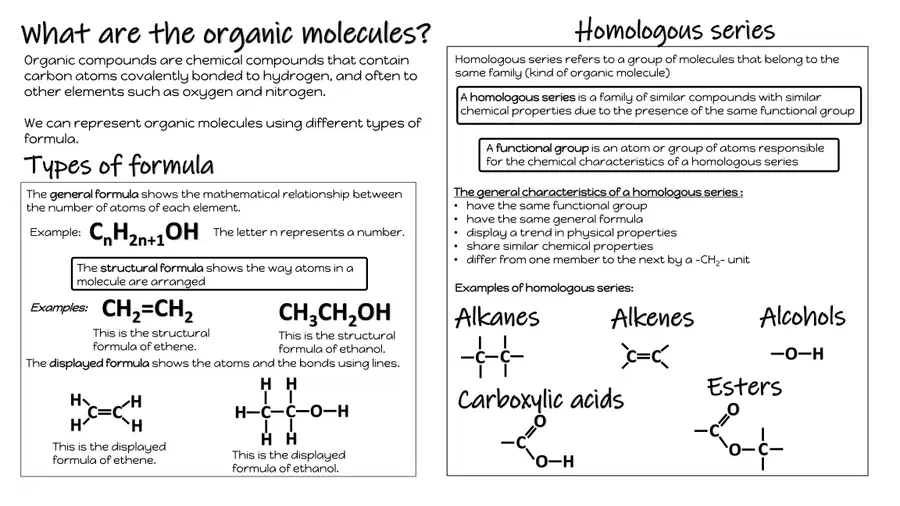
Why is the study of organic chemistry important in understanding the structure and reactions of carbon-containing compounds?
Because it helps us understand the behavior of metals
Because it explains the properties of water
Because it allows us to predict the properties and uses of many everyday substances
Because it focuses only on inorganic compounds
3
4
Open Ended
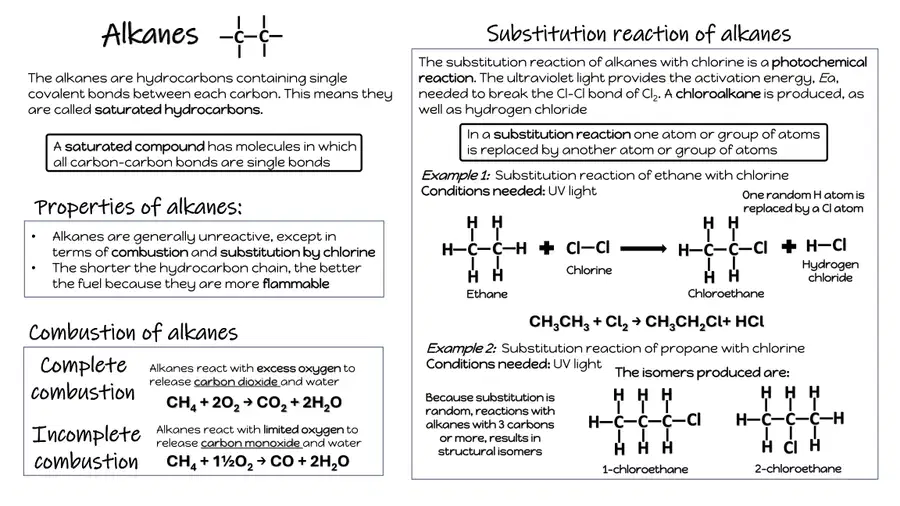
Explain the significance of homologous series in organic chemistry and how they help in predicting the properties of organic molecules.
5
6
Multiple Choice
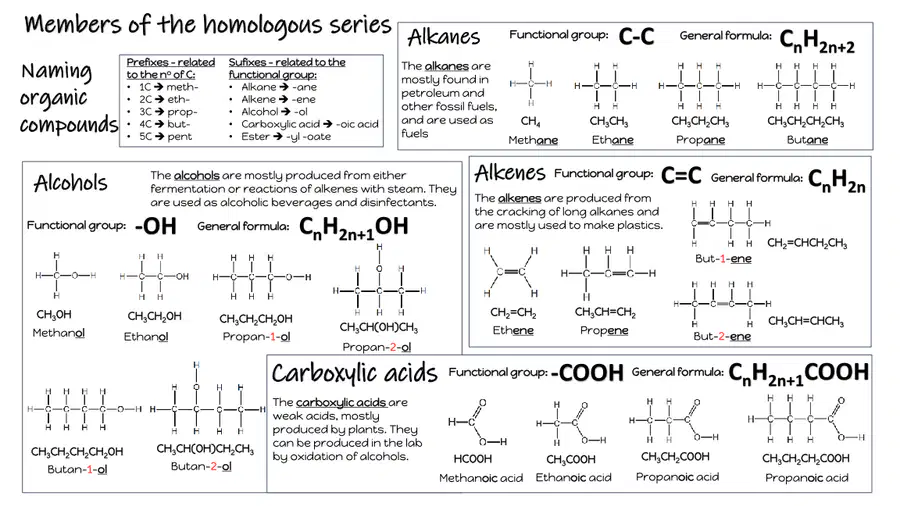
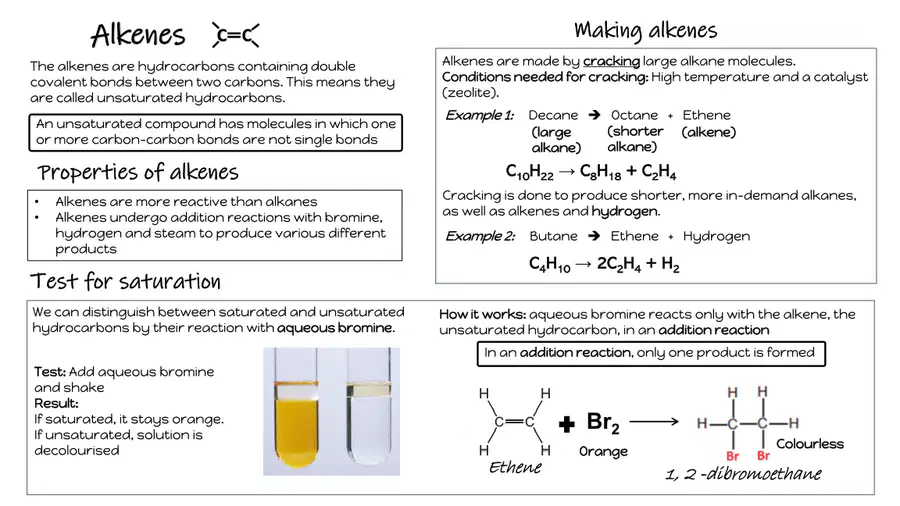
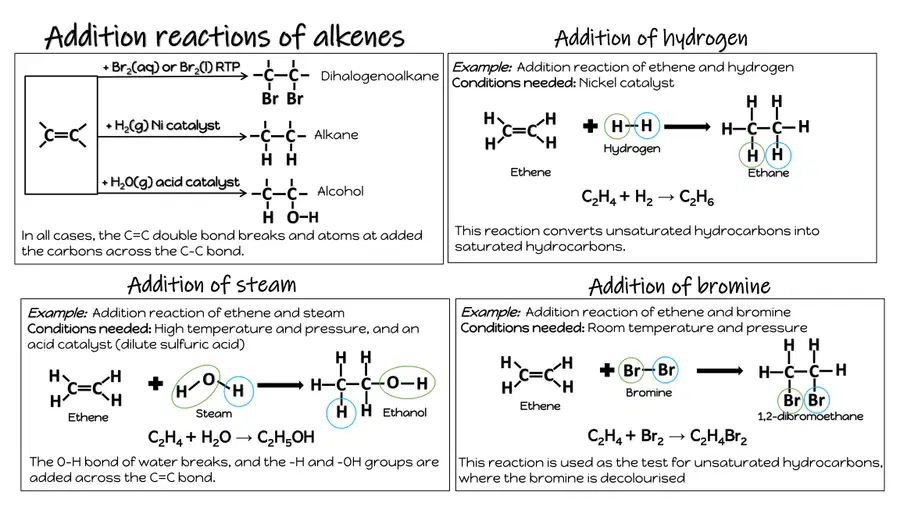
Which of the following statements best explains the difference between alkanes and alkenes based on their bonding and general formula?
Alkanes have double bonds and general formula CnH2n, while alkenes have single bonds and general formula CnH2n+2.
Alkanes have single bonds and general formula CnH2n+2, while alkenes have double bonds and general formula CnH2n.
Alkanes have -OH groups, while alkenes have -COOH groups.
Alkanes are more reactive than alkenes due to their single bonds.
7
Multiple Choice
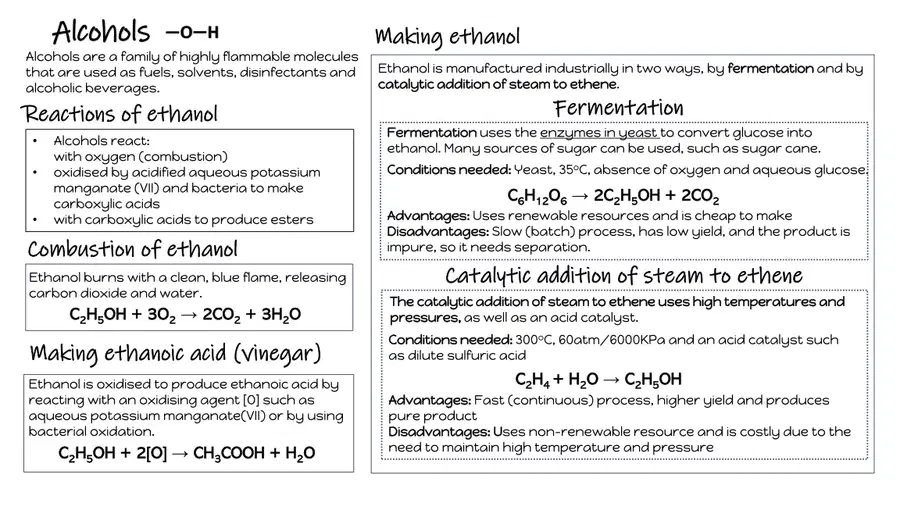
Which functional group is present in all alcohols, and what is the general formula for alcohols?
-COOH, CnH2n+1COOH
-OH, CnH2n+1OH
-C=C-, CnH2n
-C-C-, CnH2n+2
8
9
Open Ended
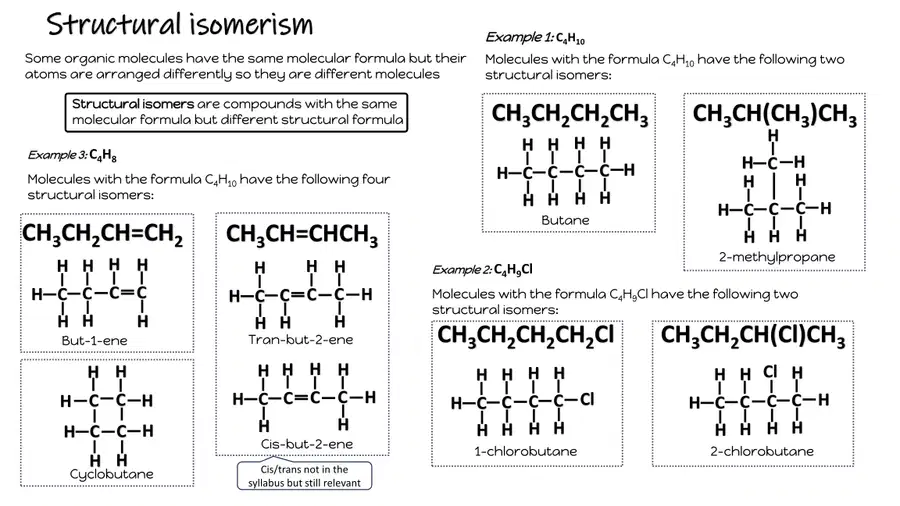
Explain the concept of structural isomerism and provide an example using the molecular formula C4H10.
10
11
Multiple Choice
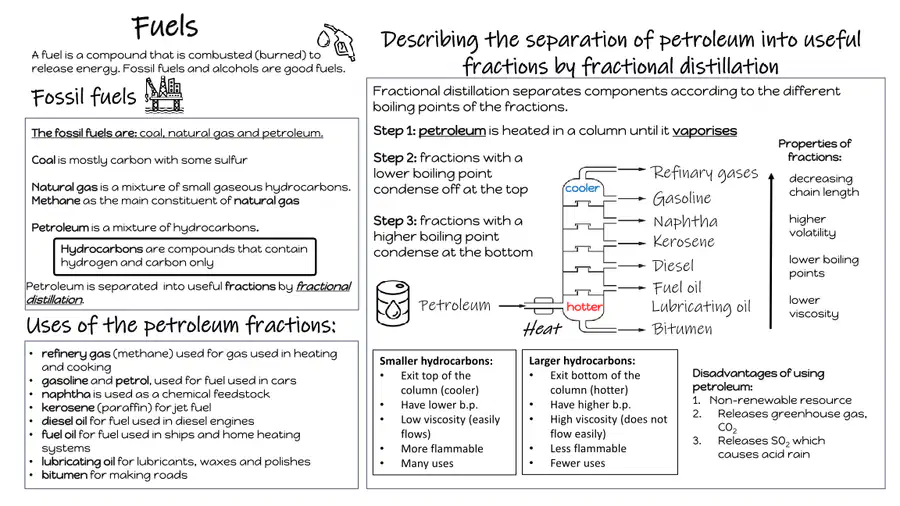
Which of the following is a property of smaller hydrocarbons compared to larger hydrocarbons in fractional distillation?
Higher boiling point and higher viscosity
Exit at the bottom of the column and are less flammable
Exit at the top of the column and are more flammable
Fewer uses and lower volatility
12
Fill in the Blanks
13
14
15
Multiple Choice
Which conditions are required for the cracking of large alkane molecules to produce alkenes?
Low temperature and no catalyst
High temperature and a catalyst
Room temperature and acid catalyst
UV light and chlorine
16
17
18
Multiple Choice
Compare the advantages and disadvantages of producing ethanol by fermentation and by catalytic addition of steam to ethene.
Fermentation uses renewable resources and is cheap, but is slow and has low yield; catalytic addition is fast and produces pure product, but uses non-renewable resources and is costly.
Fermentation is fast and produces pure product, but uses non-renewable resources; catalytic addition is slow and uses renewable resources.
Fermentation and catalytic addition both use renewable resources and are cheap to make.
Fermentation produces higher yield than catalytic addition.
19
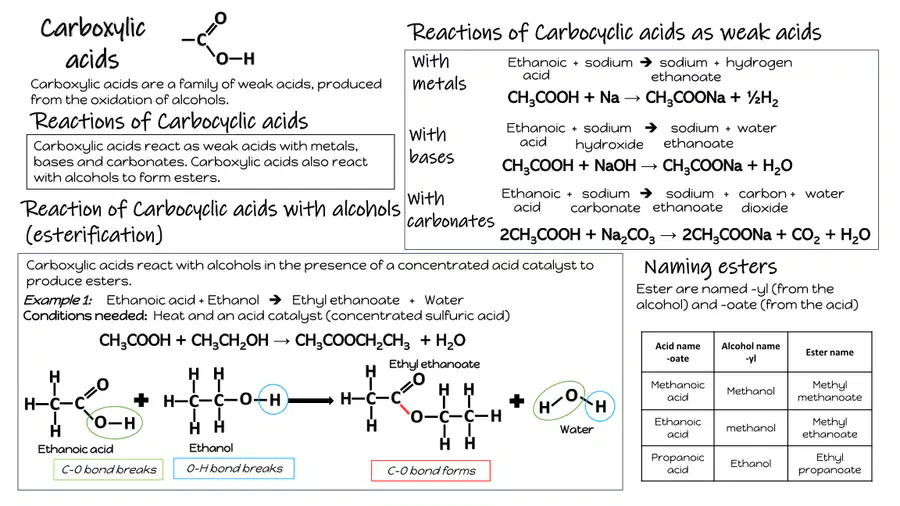
20
Open Ended
Explain the process of esterification, including the reactants, conditions needed, and the products formed.
21
Multiple Choice
Which of the following is NOT a general characteristic of a homologous series?
They have the same functional group
They have the same general formula
They display a trend in physical properties
They differ from one member to the next by a -CH3 unit
22
Open Ended
Summarize one key thing you learned about organic chemistry today and explain how it might be useful in real life.
Show answer
Auto Play
Slide 1 / 22
SLIDE
Similar Resources on Wayground

17 questions
ikatan kovalen
Presentation
•
11th Grade
16 questions
Molar Mass & Avogrados Number
Presentation
•
10th - 12th Grade
17 questions
Atomic Theory and Law of Definite Proportions
Presentation
•
11th Grade
20 questions
Vertical and Horizontal Asymptotes
Presentation
•
11th Grade
16 questions
Periodic Table of Elements Atomic Numbers
Presentation
•
11th Grade
19 questions
Types of Chemical Bonds
Presentation
•
11th - 12th Grade
16 questions
Forces of Attraction Chapter 12 Section 2
Presentation
•
11th - 12th Grade
15 questions
Linear vs Exponential Part 1
Presentation
•
11th Grade
Popular Resources on Wayground
15 questions
Grade 3 Simulation Assessment 1

Quiz
•
3rd Grade
22 questions
HCS Grade 4 Simulation Assessment_1 2526sy
Quiz
•
4th Grade
16 questions
Grade 3 Simulation Assessment 2
Quiz
•
3rd Grade
19 questions
HCS Grade 5 Simulation Assessment_1 2526sy
Quiz
•
5th Grade
17 questions
HCS Grade 4 Simulation Assessment_2 2526sy
Quiz
•
4th Grade
20 questions
Equivalent Fractions
Quiz
•
3rd Grade
24 questions
HCS Grade 5 Simulation Assessment_2 2526sy
Quiz
•
5th Grade
20 questions
Math Review
Quiz
•
3rd Grade
Discover more resources for Chemistry
20 questions
Types of Chemical Reactions
Quiz
•
9th - 12th Grade
20 questions
Redox Reactions
Quiz
•
10th - 12th Grade
20 questions
pH and pOH Calculations
Quiz
•
10th - 11th Grade
36 questions
Unit 4 (Part 2) Solutions
Quiz
•
10th - 12th Grade
30 questions
Final Exam Prep S22: 2.1.A.1 Isotopes
Quiz
•
9th - 12th Grade
25 questions
Stoichiometry Mass to Mass
Quiz
•
10th - 11th Grade
15 questions
Calculating pH and pOH
Quiz
•
10th - 12th Grade
15 questions
Balancing Chemical Equations
Quiz
•
10th - 12th Grade