

Explore the visual language of visual artists

Presentation
•
Arts
•
9th - 12th Grade
•
Easy

Lorelei Macbeth
Used 3+ times
FREE Resource
26 Slides • 12 Questions
1
Visual Language Exploration
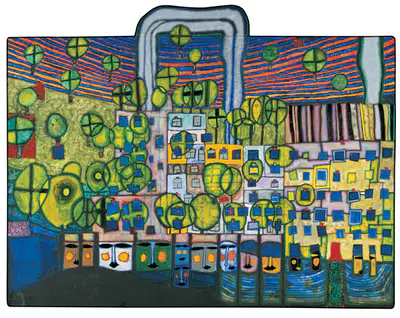
Visual language in art is the system of visual elements (like line, shape, color, texture, space) and principles (like balance, contrast, movement) artists use to communicate ideas, emotions, and stories beyond words, allowing viewers to interpret meaning intuitively and deeply, shaping their understanding of the artwork and the world. It's the unique vocabulary and grammar an artist develops, using recurring symbols (like Kusama's dots or Hundertwasser's lollipop trees) to express personal experiences and universal themes.
2
Explore the visual language of visual artists here.
Look at the following slides. There are 4 groups of slides focusing on four artists. Notice the symbols, mark-making, elements or principles, and other imagery that each artist uses throughout their body of work. You are learning their visual language.
As you head back to your artwork, start to notice your personal visual language
By Lorelei Macbeth
3
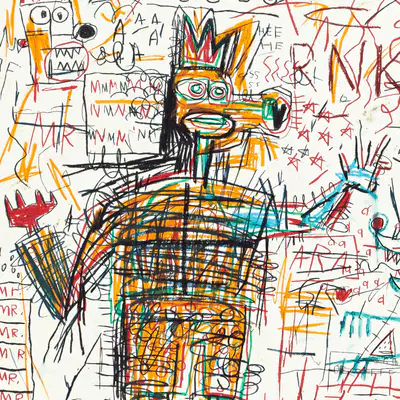
Jean-Michel Basquiat
4

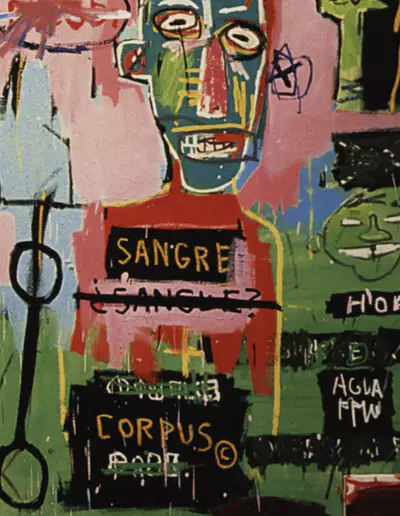
5
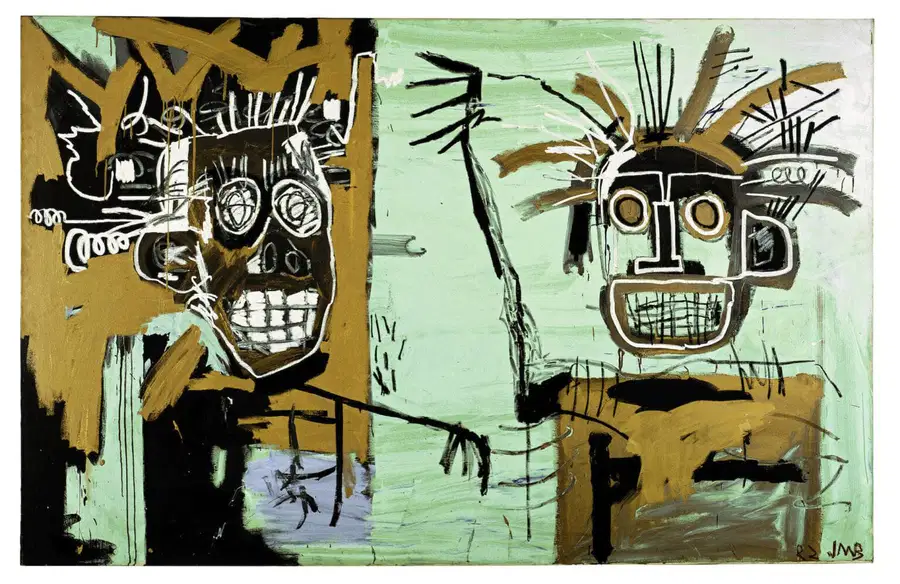
Untitled (Two on Gold), 1982 Acrylic and oilstick on canvas, 203 x 317.5 cm / 80 x 125 inches Photo: Courtesy Galerie Enrico Navarra, Paris Copyright: © The Estate of Jean-Michel Basquiat. Licensed by Artestar, New York
6

Bird On The Money ©
Jean-Michel Basquiat 1981
7
READ: The artwork, titled “In Italian,” was created by Jean-Michel Basquiat in 1983. It utilizes acrylic and crayon on canvas, measuring 225 x 203 cm. Representing the Neo-Expressionism and Street art movements, the piece falls under the genre of figurative art. “In Italian” features a vivid and chaotic composition, characteristic of Basquiat’s distinctive style. Central to the artwork are abstracted human faces and figures rendered in a combination of bright and muted colors, juxtaposed with crudely written text. The piece includes various symbols and phrases, such as “LIBERTY” and “CROWN OF THORNS,” interspersed with bold lines and fragmented elements, evoking a sense of urgency and raw expression. The layered imagery and seemingly disjointed elements come together to form a cohesive commentary on societal themes, infused with Basquiat’s personal symbolism and energetic brushwork.
8
Multiple Choice
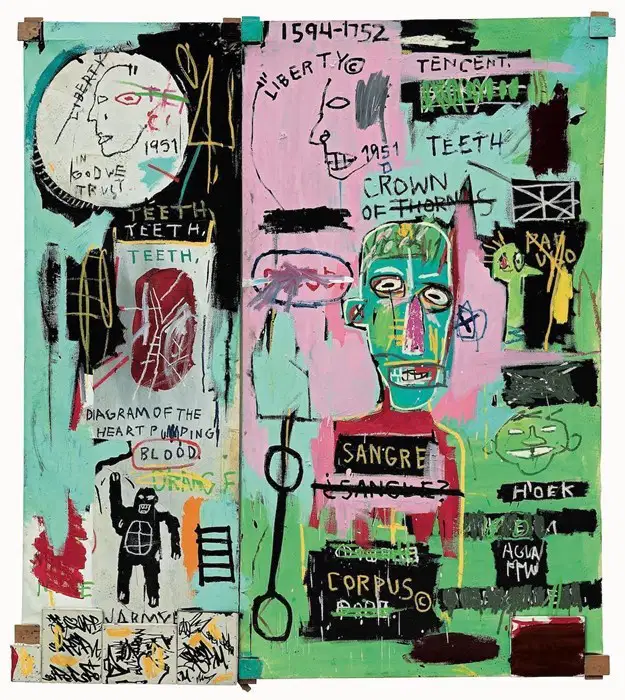
Which phrase is specifically mentioned as appearing in the artwork?
“PEACE NOW”
“FAME”
“LIBERTY”
“THE DREAM”
9
Multiple Select

Choose all of the elements and imagery we call Visual Language that Jean-Michel Basquiat uses in his artwork.
Energetic brushwork
Street art movement
Crudely drawn text
Abstracted figures and faces
10
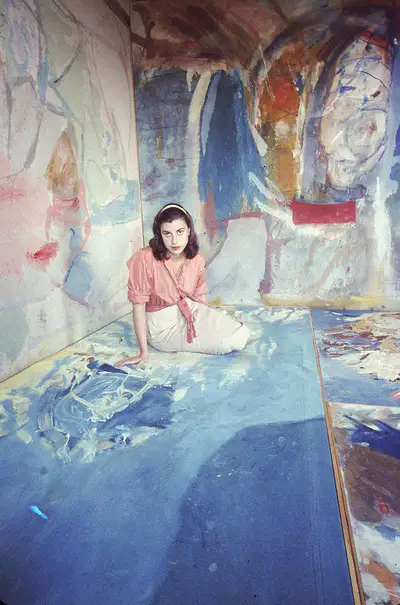
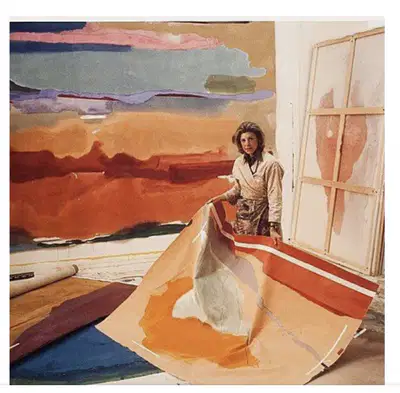
Helen Frankthaler
11
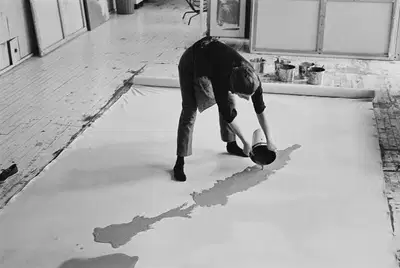
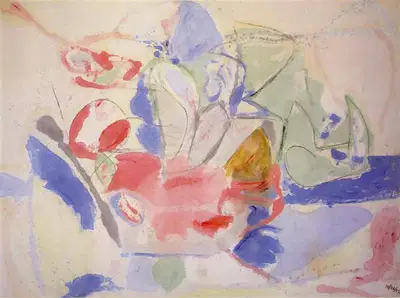
Mountains and Sea, 1952
Frankenthaler poured house paint thinned with turpentine or kerosine on large sheets of unprimed canvas to create large washes and shapes, and then brushed or drew gestural lines.
12
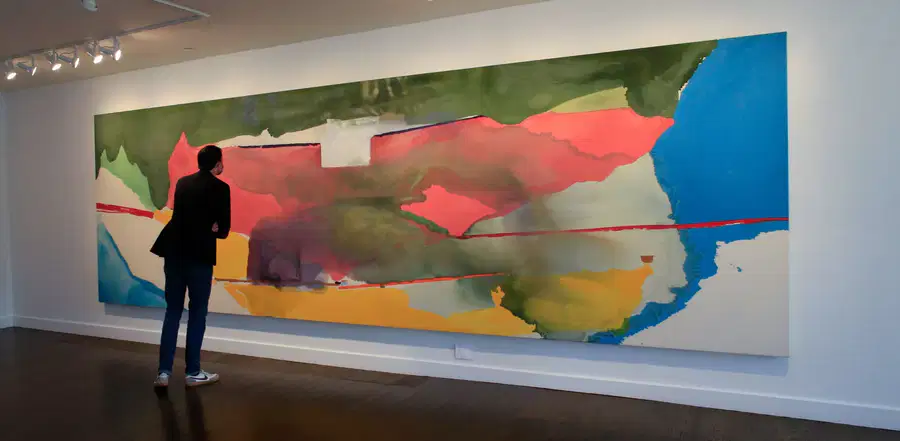
A visitor looks at Helen Frankenthaler's "Off White Square" (1973) at a gallery in Southampton, N.Y.
13

Frankenthaler is identified with:
the use of fluid shapes,
abstract masses,
and lyrical gestures.
14
Multiple Choice
Which is not a Helen Frankenthaler painting?
15
Multiple Select

Describe the visual language used in Helen Frankenthaler's work.
Careful linework
Fluid color
Abstract shapes-
Invoking landscape
16

Friedensreich Hundertwasser
Austrian visual artist and architect
17

Hundertwasser
"End of the Waters"
1979
18


Mushroom top houses
and lollipop trees.
19
20
Multiple Select

What are examples of the Visual Language (elements, symbols, imagery) that Hundertwasser uses in his artwork?
Mushroom top roofs
Straight lines
Saturated colors
Lollipop trees
Repeating windows and simplified houses
21
Nicole Eisenman
...what remains constant throughout her work is the unfailing determination to hold space for resistance, to hold space for community, and to almost always meet the viewer with an anarchic sense of humor.
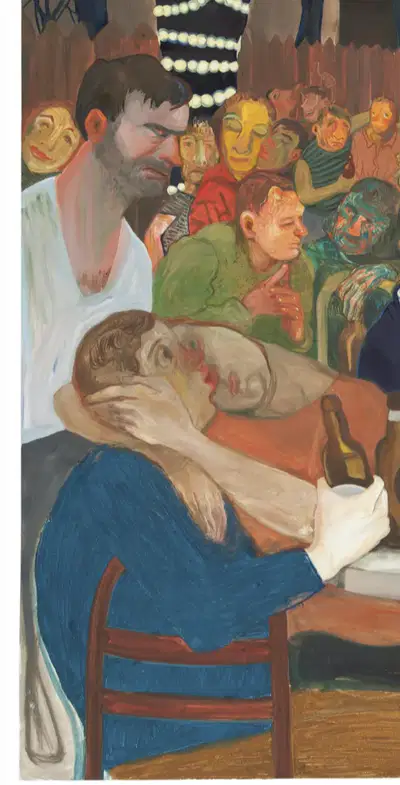
Read about this artist's work on the following screens.
22


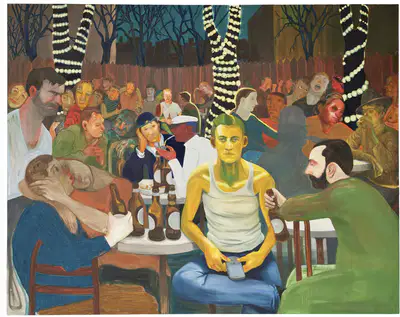
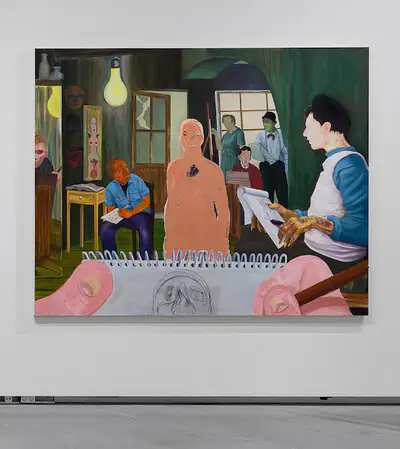
Notice the styles of the faces and figures...
23

Nicole Eisenman (b. 1965, Verdun, France; lives in Brooklyn, NY), Beer Garden with Ulrike and Celeste, 2009. Oil on canvas; 65 × 82 in. (165.1 × 208.3 cm). Hall Collection. Image courtesy Hall Collection.
24
25

26

27

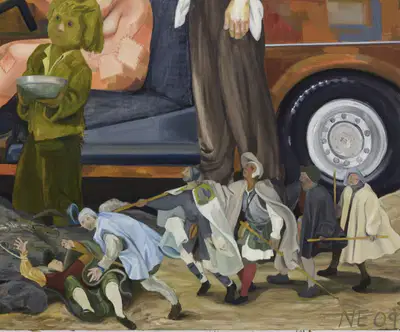
Nicole Eisenman, The Triumph of Poverty, 2009, Oil on canvas.
28
Allegories have long been part of her practice ... In the eight-foot-wide painting "Triumph of Poverty" from 2009, a bedraggled crew of people trudge across the surface of the painting, accompanied by a man in a top hat and tuxedo who is literally ass-backward. A second group of people, lifted directly from Pieter Bruegel’s 1568 painting "The Blind Leading the Blind", parallels their progress in miniature along the bottom edge.
29
The Blind Leading the Blind, By Pieter Brueghel the Elder ; 1568- gallerix.ru, Public Domain, https://commons.wikimedia.org/w/index.php?curid=28885659

NOT Eisenman's artwork!
This is by Pieter Brueghel the Elder in 1568
30
Nicole Eisenman, The Triumph of Poverty, 2009, Oil on canvas.
31
Multiple Select
Read the following statement and choose best summaries of this quote about Eisenman's work: "Eisenman does much more than name-check historical and famous Western painters: she confidently, gleefully marauds through the history of art for techniques, colors, forms, and ways for paint to be deployed and render sensations. She inserts herself in the old boys’ club of masterful painting and proceeds to break the furniture."
Eisenman copies old artworks.
Eisenman borrows elements from "old-master" paintings
Eisenman studies the history of art to inform her own artwork
32
Multiple Select

How might you describe the visual language of Nicole Eisenman?
Realistic figures
A variety of painting styles in one artwork
High contrast and unexpected colors for figures
Distorted faces
33
Multiple Choice
Which artwork is by Helen Frankenthaler?
34
Multiple Choice
Which artwork is by Jean-Michel Basquiat?
35
Multiple Choice
Which artwork is by Friedensreich Hundertwasser?
36
Open Ended
Has your understanding of Visual Language changed?
Choose one artist from today:
Describe what their visual language choices communicate?
37
Multiple Choice
Which artwork is by Nicole Eisenman?
38
Find the assignment: "Visual Language Collections"
Use the links provided in this assignment to choose an artist
Explore their body of work through multiple websites or books, read about them, look, and look.
Fill one sketchbook page with your studies of their artwork.
Like this deck, create ~5 slides with images of their artwork (credit lines please) and a write final brief explanation of the artist's imagery and visual language.
Describe their content. NO "cut and paste."
Make it concise and in your words.
Follow up on terms you do not know.
Now it is your turn:
Visual Language Exploration
Visual language in art is the system of visual elements (like line, shape, color, texture, space) and principles (like balance, contrast, movement) artists use to communicate ideas, emotions, and stories beyond words, allowing viewers to interpret meaning intuitively and deeply, shaping their understanding of the artwork and the world. It's the unique vocabulary and grammar an artist develops, using recurring symbols (like Kusama's dots or Hundertwasser's lollipop trees) to express personal experiences and universal themes.
Show answer
Auto Play
Slide 1 / 38
SLIDE
Similar Resources on Wayground

32 questions
Simile Personification Imagery
Presentation
•
8th - 12th Grade
26 questions
Course Syllabus
Presentation
•
9th - 12th Grade
31 questions
Types of Sources and Evidence
Presentation
•
9th - 12th Grade
34 questions
5.7 DATA MINING
Presentation
•
9th - 12th Grade
38 questions
5.3 Gross and Fine Motor Skills Development
Presentation
•
9th - 12th Grade
31 questions
WHI 9.03 Lesson: Islamic Golden Age
Presentation
•
9th - 12th Grade
33 questions
Islam in India
Presentation
•
8th - 12th Grade
31 questions
Unit IV Chapter Review
Presentation
•
9th - 12th Grade
Popular Resources on Wayground
11 questions
Hallway & Bathroom Expectations

Quiz
•
6th - 8th Grade
10 questions
HCS SCI 03 Summer School Assessment 2
Quiz
•
3rd Grade
11 questions
Home Scope
Quiz
•
7th - 8th Grade
12 questions
2026 TAP Technology in the Classroom
Presentation
•
Professional Development
15 questions
HCS SCI 05 Summer School Assessment 2 Review
Quiz
•
5th Grade
15 questions
HCS SCI 04 Summer School Review 2
Quiz
•
4th Grade
59 questions
Geometry Unit 3 Review
Quiz
•
9th - 12th Grade
14 questions
FAST ELA READING SMAPLE TEST MATERIALS

Passage
•
3rd Grade