

Lesson 5-Electric Potential

Presentation
•
Physics
•
12th Grade
•
Hard

FLORDELIZA MANGALIMAN
Used 4+ times
FREE Resource
32 Slides • 22 Questions
1

2
Multiple Choice
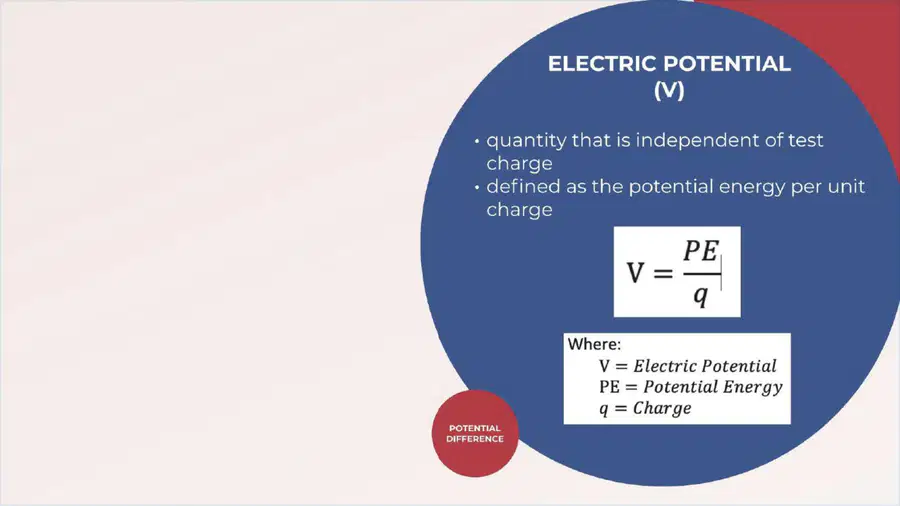
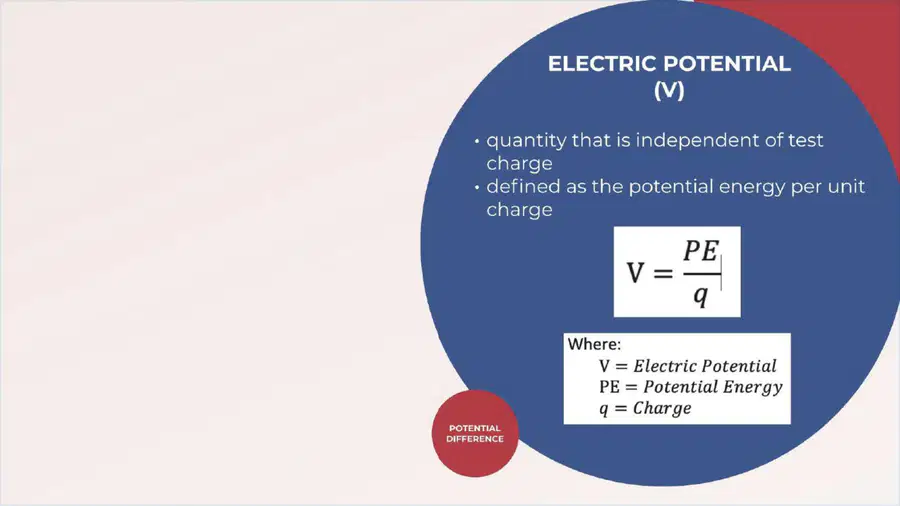
Which of the following best defines electric potential?
The energy required to move a unit charge from one point to another
The force exerted by a charge on another charge
The potential energy per unit charge
The rate of flow of electric charge
3
Multiple Choice
How is the work done to accelerate a positive charge from rest related to the change in potential energy (ΔPE)?
W = ΔPE
W = -ΔPE
W = ΔPE/2
W = 2ΔPE
4
Open Ended
Explain why energy and voltage are not the same thing, even though both are related to electricity.
5
Multiple Choice
Which of the following statements about mechanical energy is correct?
Mechanical energy is only the kinetic energy of a system.
Mechanical energy is only the potential energy of a system.
Mechanical energy is the sum of kinetic and potential energy of a system.
Mechanical energy is the difference between kinetic and potential energy.
6
Fill in the Blanks
7
Multiple Choice
What is the expression for the work done by the electric field to move a positive charge q from a higher potential to a lower potential?
W = qV_AB
W = -qV_AB
W = q(V_B - V_A)
W = -q(V_B - V_A)
8

9

10
11

12

13

14

15

16

17

18
19

20

21

22

23

24
Multiple Choice
What is the relationship between electric field (E) and potential difference (V_AB) in a uniform electric field?
E = V / d
E = d / V
E = V * d
E = d / E
25

26
Open Ended
Explain how the work done by the electric field relates to the change in electric potential when moving a positive charge from one plate to another in a uniform field.
27

28
Fill in the Blanks
Type answer...
29
Multiple Select
Which of the following statements about electric field and potential difference are correct?
The electric field points in the direction of decreasing potential.
The magnitude of E equals the rate of decrease of V with distance.
The faster V decreases over distance, the greater the electric field.
The electric field points in the direction of increasing potential.
30

31

32
Multiple Choice
Which statement best describes the difference between energy and voltage?
Energy and voltage are not the same thing.
Energy and voltage are always equal.
Voltage is always greater than energy.
Energy is measured in volts.
33

34
35
Multiple Choice
What is the formula for the electric potential (V) due to a point charge (Q) at a distance r?
V = kQ / r
V = Q / (kr)
V = kr / Q
V = r / (kQ)
36

37

38
39

40

41

42

43

44

45
Multiple Choice
What is the relationship between electric field and electric potential?
The electric potential is independent of the electric field.
The electric field is the sum of all electric potentials.
The electric field is the negative gradient of the electric potential.
The electric potential is the derivative of the electric field.
46
Multiple Choice
How is electric potential energy defined in the context of electric fields?
Electric potential energy is the energy released when a charge is grounded.
Electric potential energy is the energy stored in a capacitor.
Electric potential energy is the work done to move a charge in an electric field.
Electric potential energy is the charge multiplied by the electric field strength.
47
Multiple Choice
What are equipotential surfaces and how do they relate to electric fields?
Equipotential surfaces are surfaces of constant electric potential, and they are perpendicular to electric fields.
Equipotential surfaces are regions of varying electric charge.
Equipotential surfaces are always parallel to electric fields.
Equipotential surfaces are surfaces of varying electric potential.
48
Multiple Choice
What is the formula for calculating work done by an electric field?
W = m * g * h
W = I * R * t
W = q * ΔV
W = F * d
49
Multiple Choice
What is the significance of equipotential surfaces in electric field analysis?
Equipotential surfaces help visualize that no work is done when moving charges along them.
Equipotential surfaces indicate the direction of electric field lines.
Equipotential surfaces are used to measure electric current in circuits.
Equipotential surfaces are areas where electric potential is highest.
50
Multiple Choice
Describe how voltage is measured and its units.
Voltage is measured in watts (W).
Voltage is measured in ohms (Ω).
Voltage is measured in volts (V).
Voltage is measured in amperes (A).
51
Multiple Choice
What is the unit of electric field strength and how is it defined?
Electric field strength is measured in volts per meter (V/m).
Electric field strength is measured in coulombs (C).
Electric field strength is measured in newtons (N).
Electric field strength is measured in joules (J).
52
Multiple Choice
How does the concept of electric potential relate to energy conservation in electric circuits?
Electric potential only applies to open circuits.
Electric potential indicates energy loss in circuits.
Electric potential is unrelated to energy conservation.
Electric potential represents the energy per unit charge,
53
Multiple Choice
What is the effect of distance on the strength of an electric field produced by a point charge?
The strength of the electric field remains constant regardless of distance.
The strength of the electric field increases with distance from the charge.
The strength of the electric field is directly proportional to the distance from the charge.
The strength of the electric field decreases with the square of the distance from the charge.
54
Multiple Choice
How does the electric field behave inside a conductor in electrostatic equilibrium?
The electric field inside a conductor is zero.
The electric field inside a conductor is uniform and non-zero.
The electric field inside a conductor varies with distance from the surface.
The electric field inside a conductor is equal to the electric field outside.
Show answer
Auto Play
Slide 1 / 54
SLIDE
Similar Resources on Wayground

50 questions
The Executive Branch
Presentation
•
12th Grade
49 questions
Unit 2: Functions Review
Presentation
•
8th Grade
48 questions
Final Grammar Review Book 5 Q3
Presentation
•
University
50 questions
L1: Flowcharts-and-pseudoco
Presentation
•
12th Grade
50 questions
02/26/2025 Shifters of Demand and Supply
Presentation
•
12th Grade - University
48 questions
Static Electricity and Electric Potential
Presentation
•
12th Grade - University
49 questions
Utility Program
Presentation
•
University
47 questions
How a Bill Becomes a Law
Presentation
•
11th - 12th Grade
Popular Resources on Wayground
20 questions
Math Review

Quiz
•
3rd Grade
15 questions
Fast food
Quiz
•
7th Grade
20 questions
Context Clues
Quiz
•
6th Grade
20 questions
Inferences
Quiz
•
4th Grade
19 questions
Classifying Quadrilaterals
Quiz
•
3rd Grade
20 questions
Figurative Language Review
Quiz
•
6th Grade
20 questions
Equivalent Fractions
Quiz
•
3rd Grade
10 questions
Identify Fractions, Mixed Numbers & Improper Fractions
Quiz
•
3rd - 4th Grade