

Unit 6 Trigonometry

Presentation
•
Mathematics
•
11th Grade
•
Easy
+2
Standards-aligned

Jesna Joji
Used 1+ times
FREE Resource
30 Slides • 28 Questions
1
2
Open Ended
Why do you think trigonometry and the unit circle are important in advanced algebra and real-world applications?
3
4
Multiple Choice
Which of the following is NOT a basic trigonometric ratio?
Sine
Cosine
Tangent
Secant
5
6
Multiple Choice
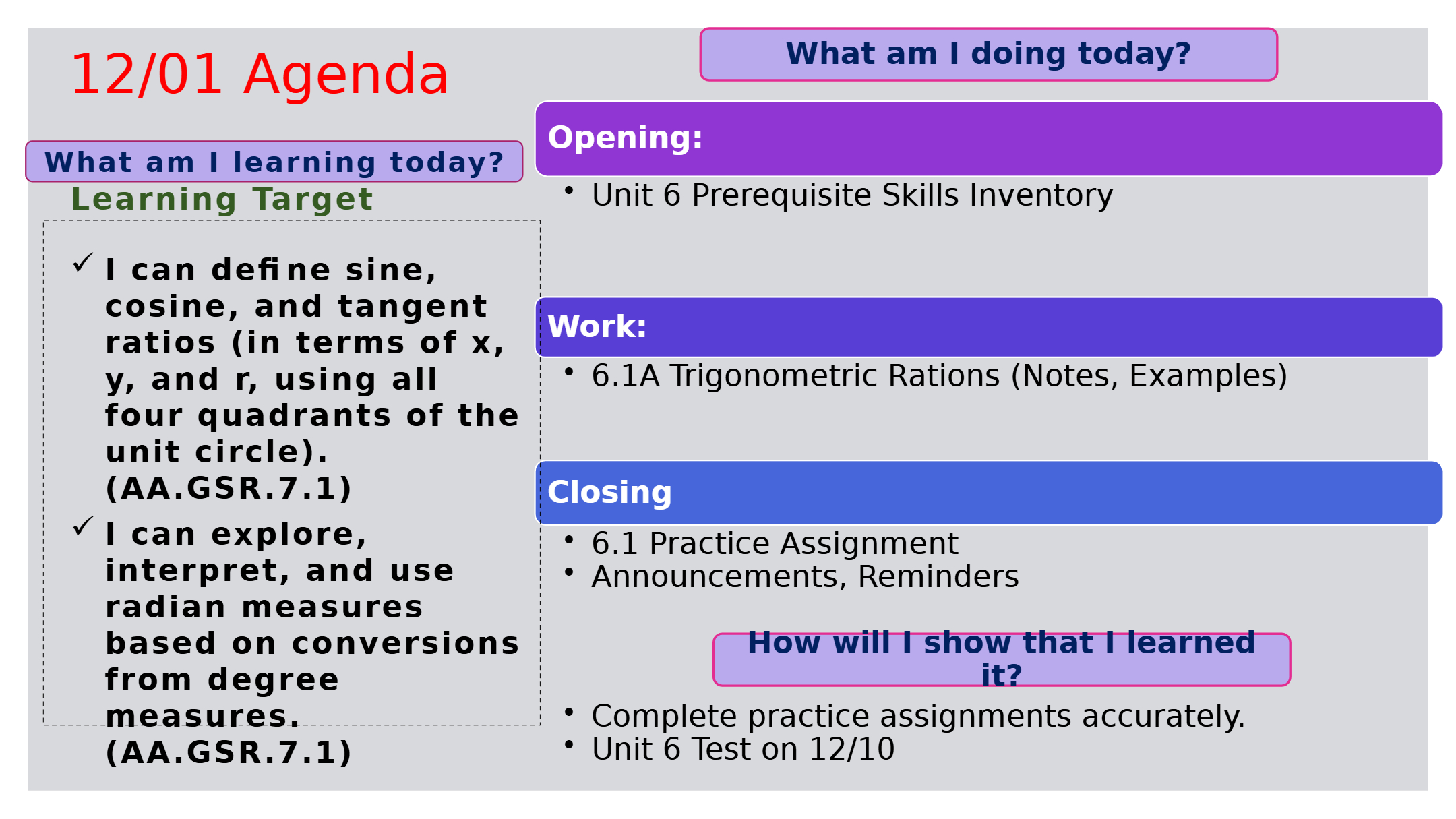
Which of the following is a learning target for this lesson?
I can define sine, cosine, and tangent ratios using all four quadrants of the unit circle.
I can solve quadratic equations by factoring.
I can graph linear equations.
I can find the area of a triangle.
7
8
9
Open Ended
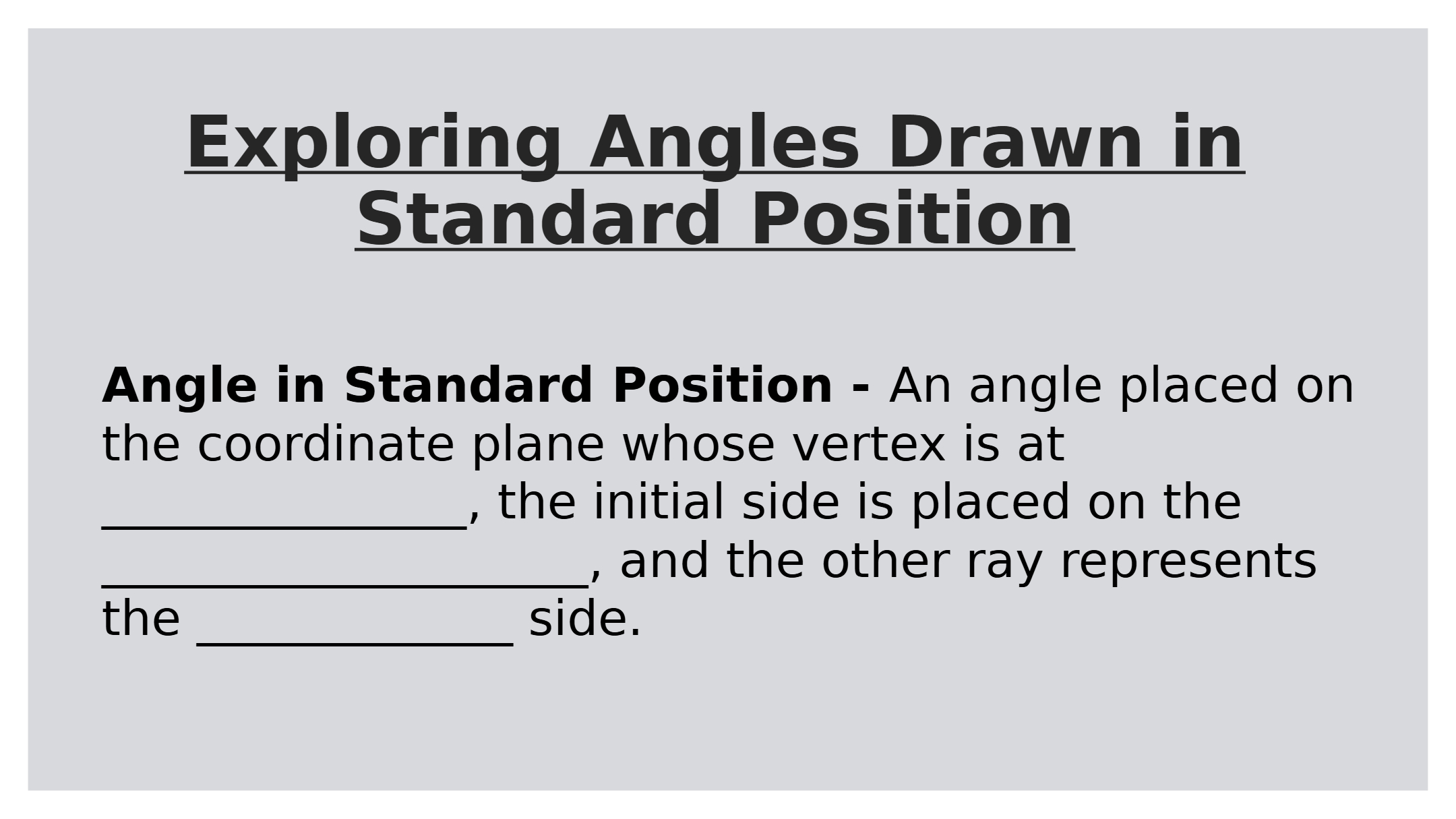
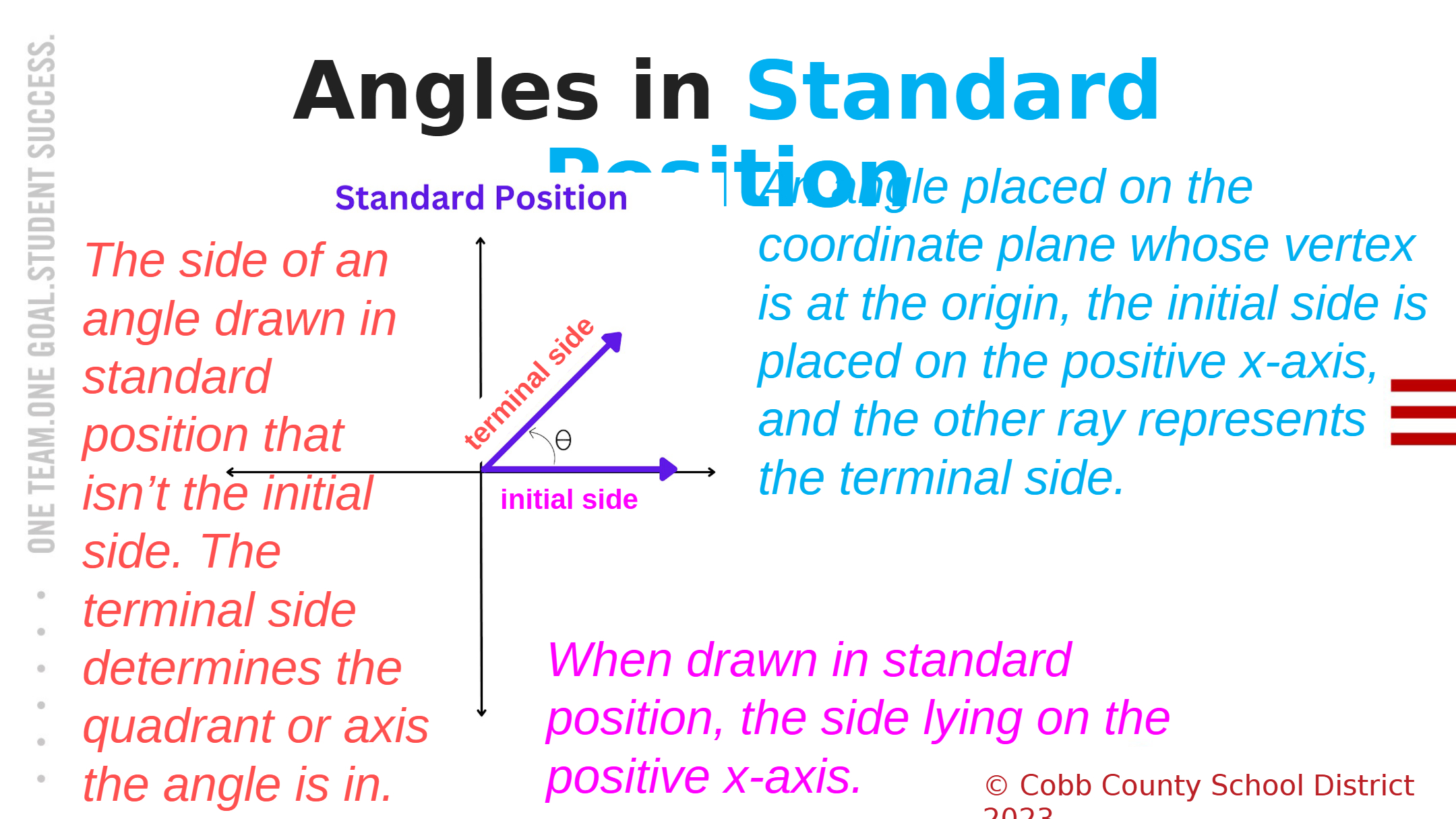
Based on the diagrams and definitions, what is the difference between the initial side and the terminal side of an angle in standard position?
10
Fill in the Blanks
Type answer...
11
12
Multiple Choice
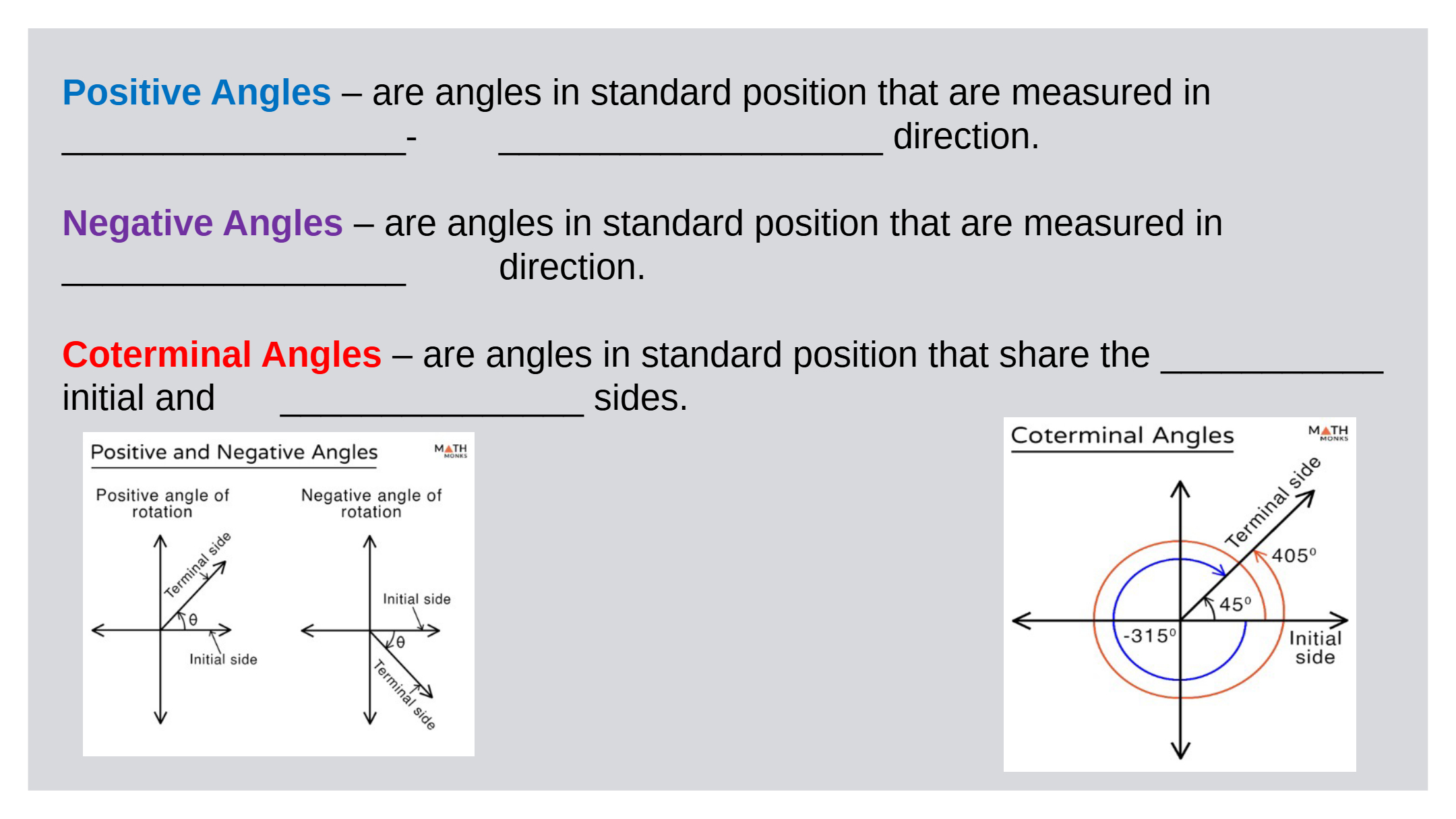
Which of the following statements about positive, negative, and coterminal angles is correct?
Positive angles are measured counterclockwise, negative angles are measured clockwise, and coterminal angles share the same initial and terminal sides.
Positive angles are measured clockwise, negative angles are measured counterclockwise, and coterminal angles have different terminal sides.
Coterminal angles never share the same initial side.
Negative angles are always larger than positive angles.
13
14
Multiple Select
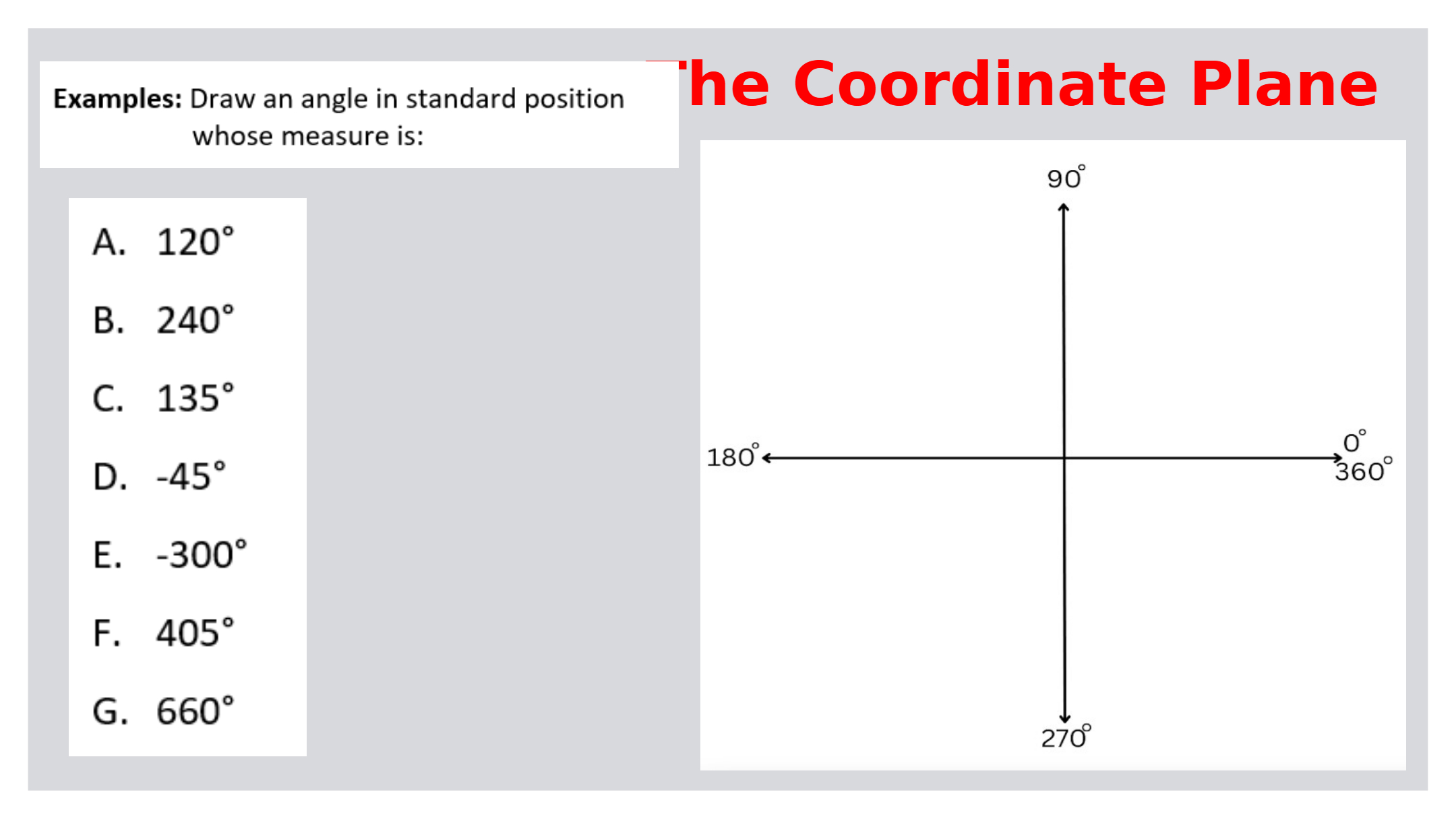
Select all the angles that are coterminal with a 45° angle.
405°
-315°
135°
660°
15
16
Open Ended
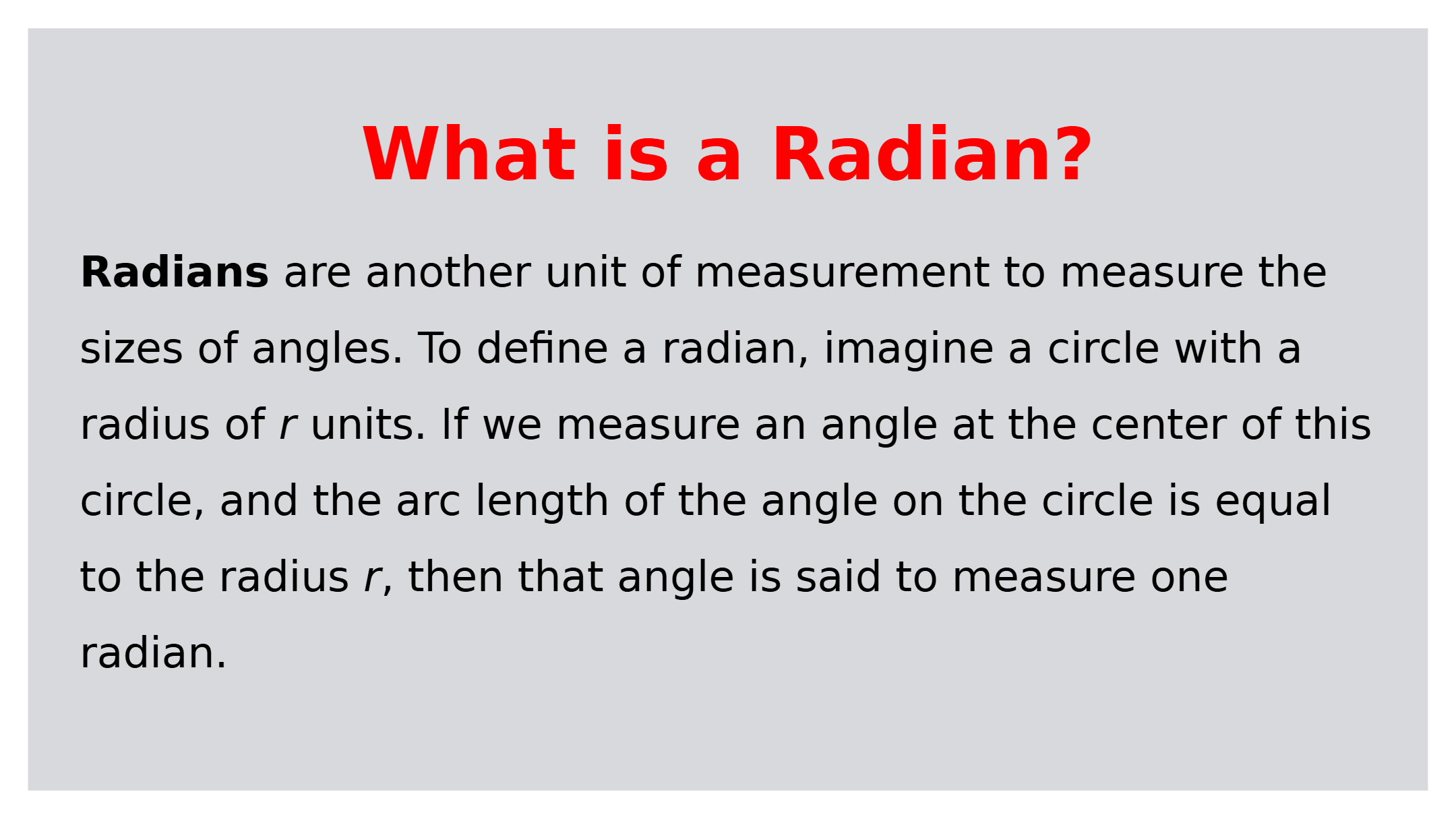
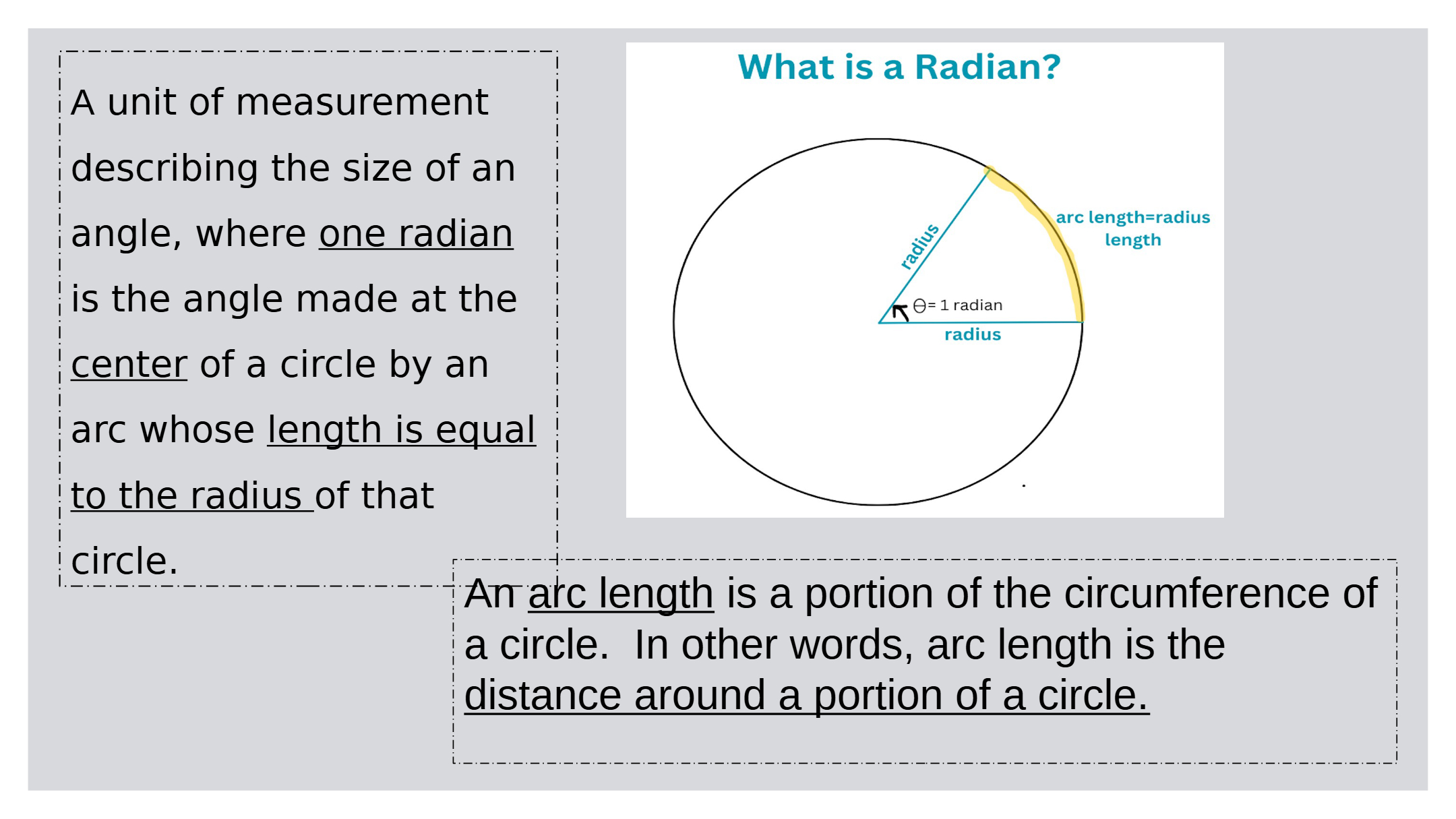
What is a radian, and how is it defined in terms of a circle's radius and arc length?
17
18
Multiple Choice
What is the definition of a radian, and how is it related to the radius and arc length of a circle?
A radian is the angle made at the center of a circle by an arc whose length is equal to the radius of the circle.
A radian is the distance from the center of a circle to its circumference.
A radian is the area of a sector with a radius of 1.
A radian is the circumference of a circle divided by its diameter.
19
20
Multiple Choice
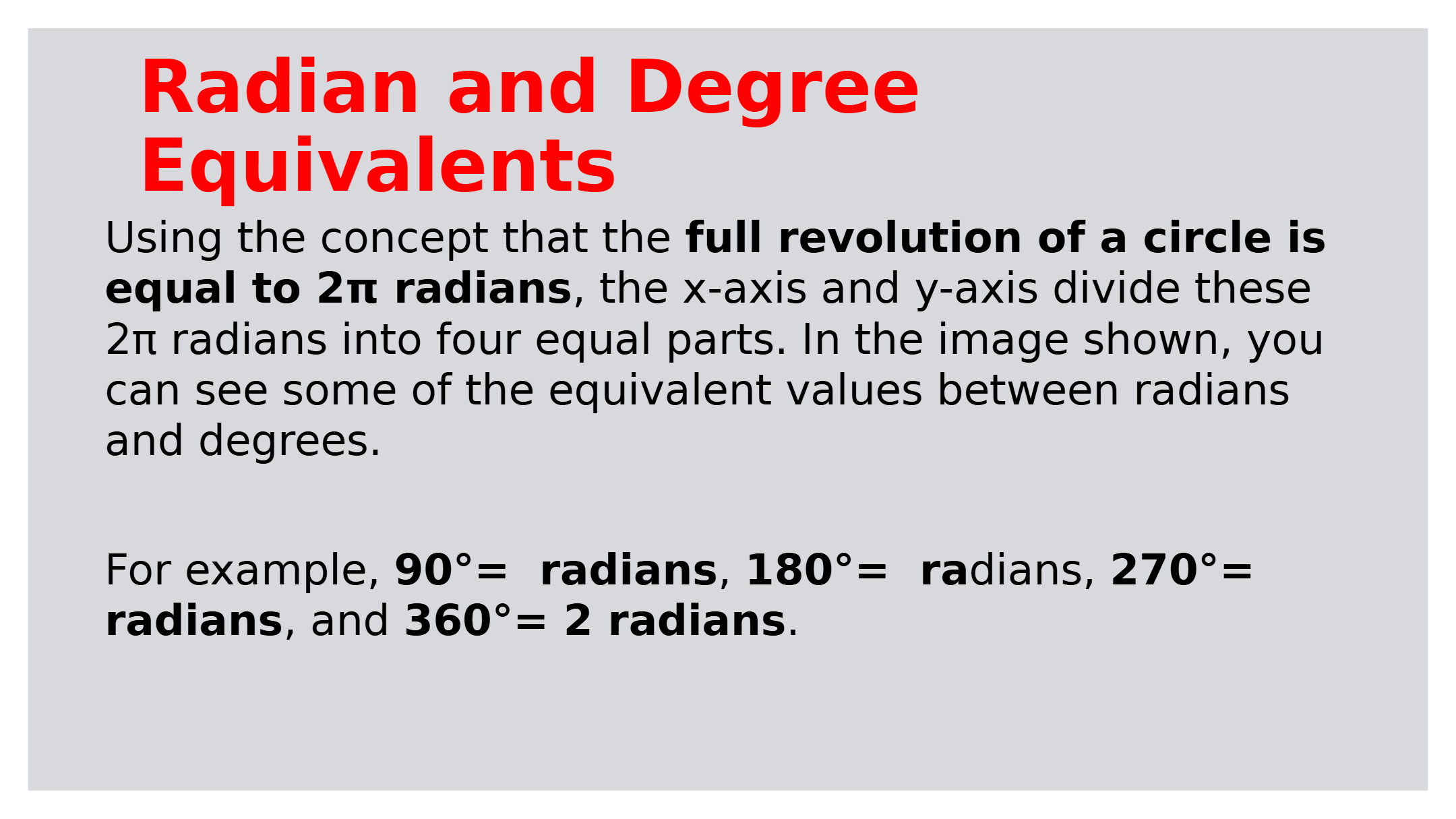
Explain the relationship between radians and degrees, and describe how many radians are in a full revolution of a circle.
A full revolution is 2π radians, which is equal to 360 degrees.
A full revolution is π radians, which is equal to 180 degrees.
A full revolution is 4π radians, which is equal to 720 degrees.
A full revolution is π/2 radians, which is equal to 90 degrees.
21
22
23
Multiple Choice
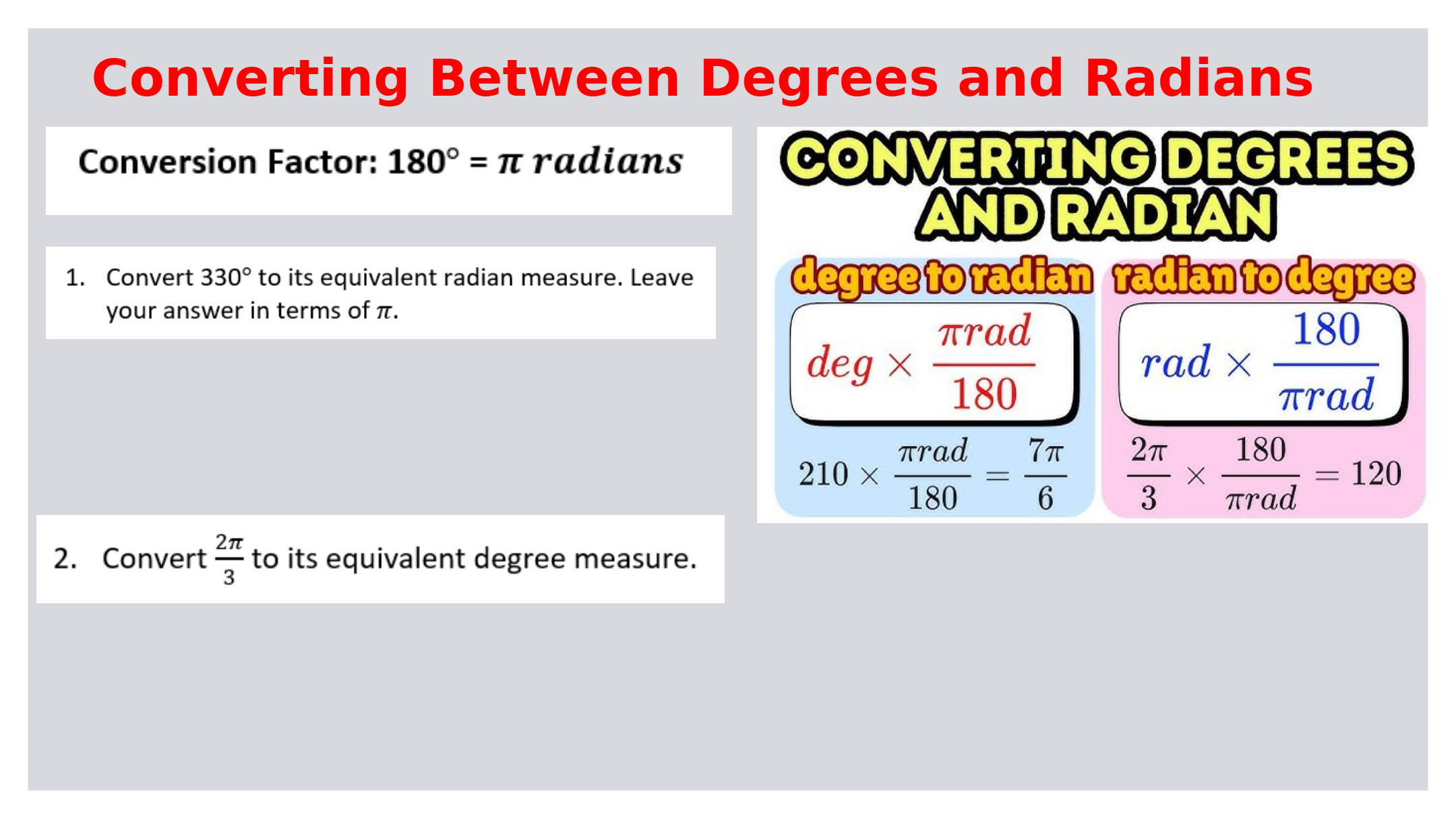
What is the equivalent degree measure for the angle \( \frac{2\pi}{3} \) radians?
120°
90°
180°
60°
24
Fill in the Blanks
Type answer...
25
26
27
Multiple Select
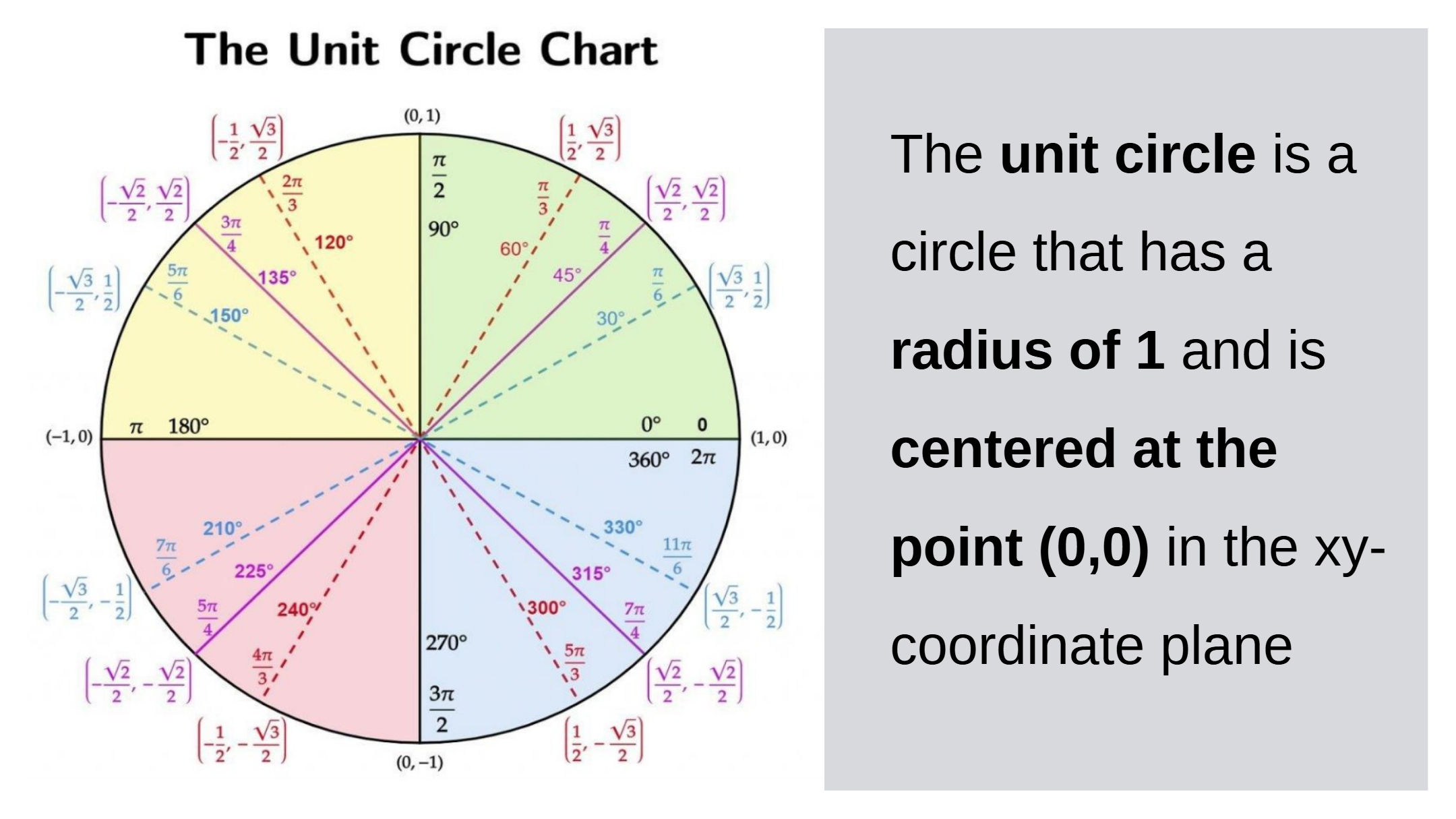
Which of the following are true about the unit circle?
It has a radius of 1.
It is centered at the point (0,0).
It has a circumference of 2π.
It has a diameter of π.
28
Open Ended
Describe the key features of the unit circle and explain why it is important in trigonometry.
29
30
Multiple Choice
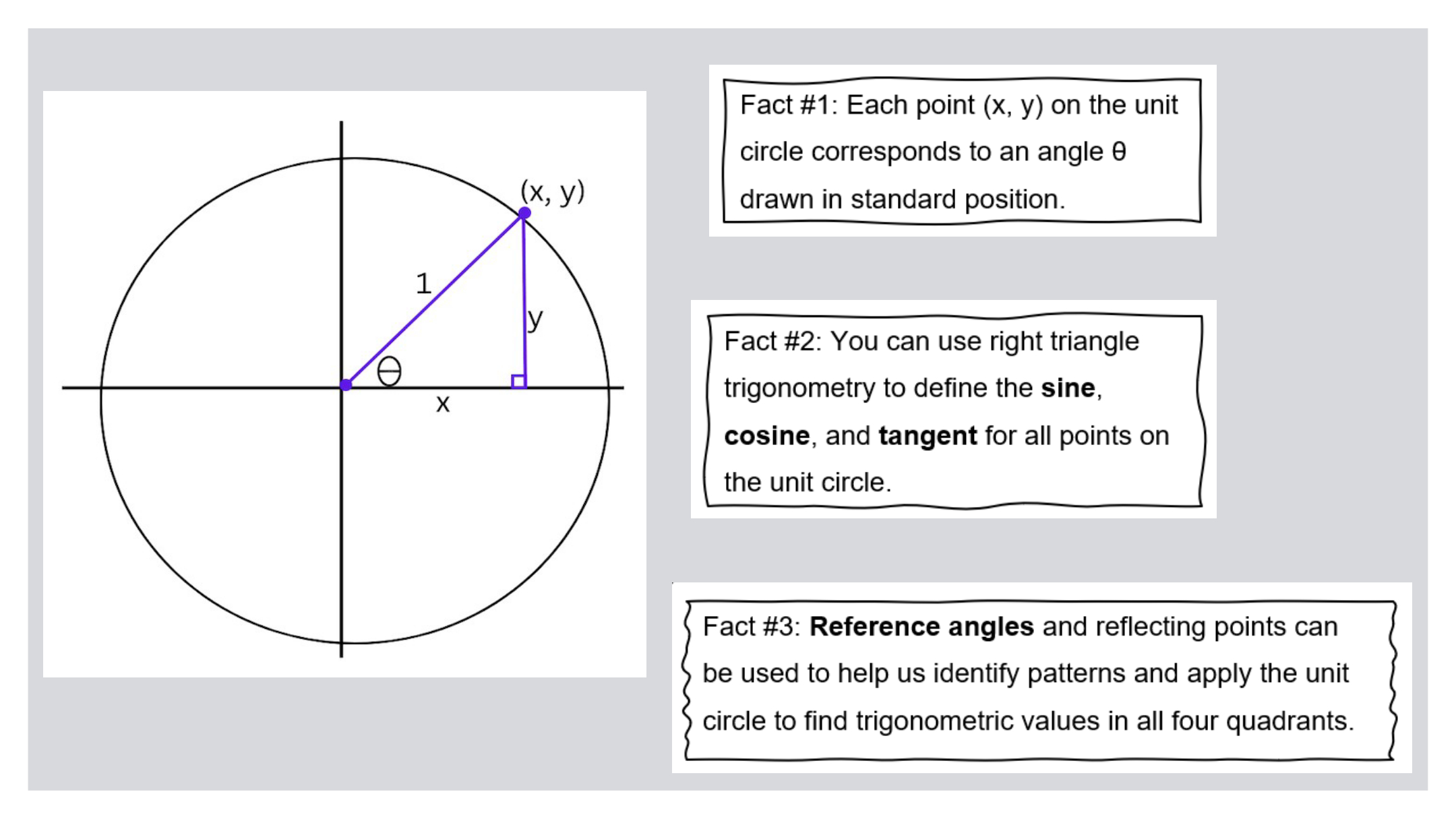
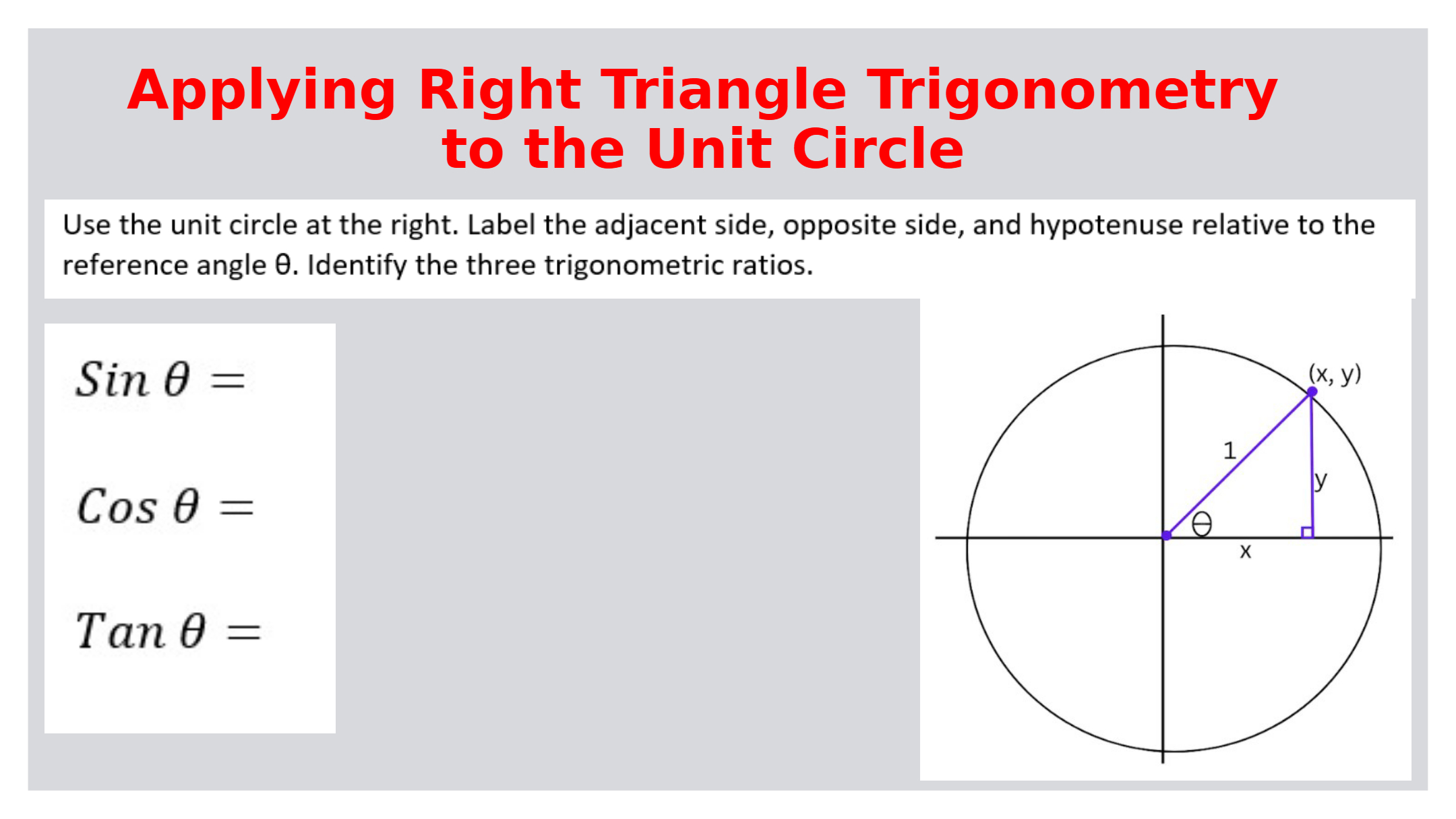
Which of the following statements best describes how sine, cosine, and tangent can be defined using the unit circle and right triangle trigonometry?
They are defined only for angles in the first quadrant.
They are defined using the lengths of the sides of a right triangle inscribed in the unit circle.
They are defined using the area of the triangle formed by the radius and the x-axis.
They are defined using the circumference of the unit circle.
31
32
Multiple Choice
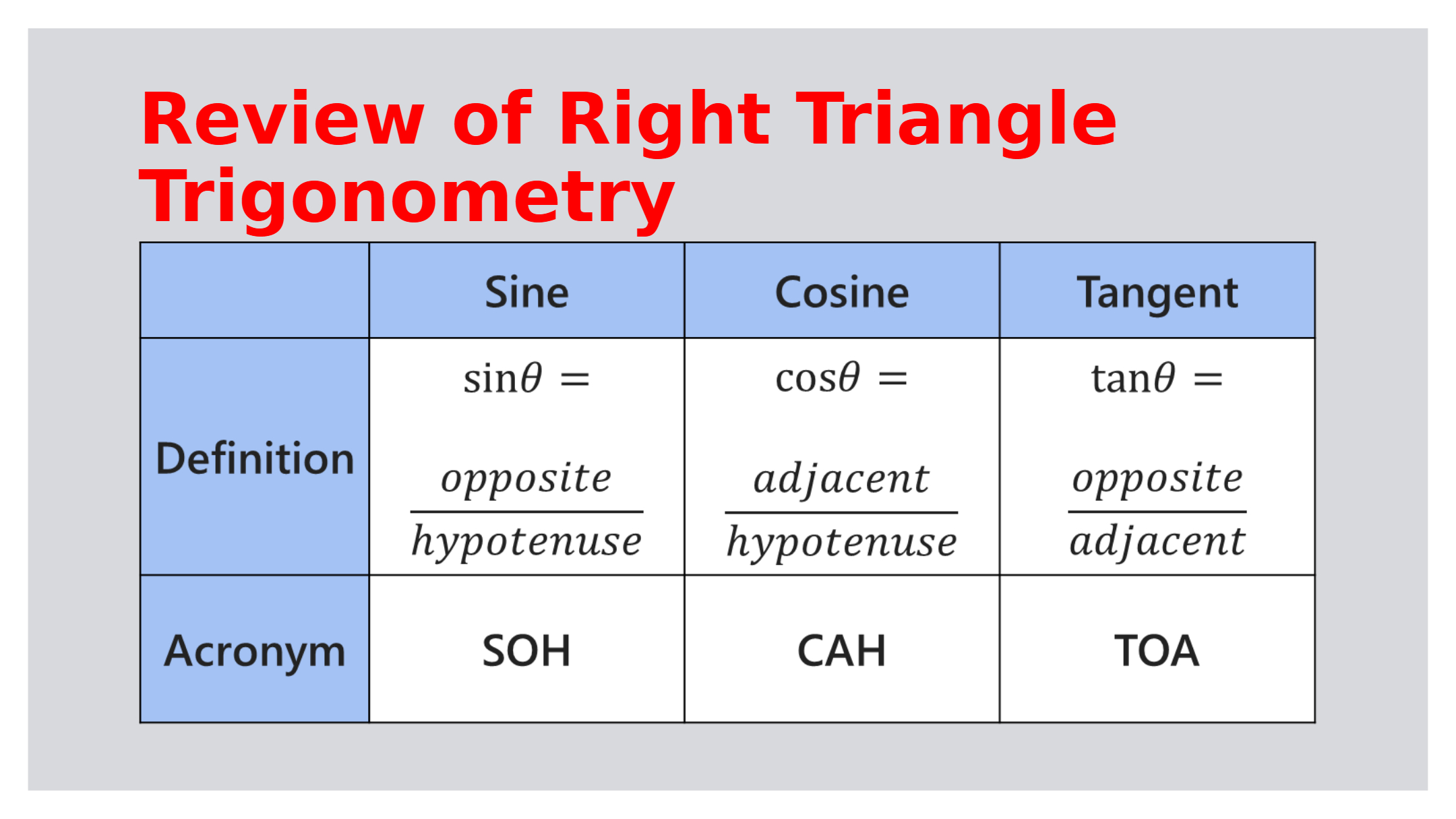
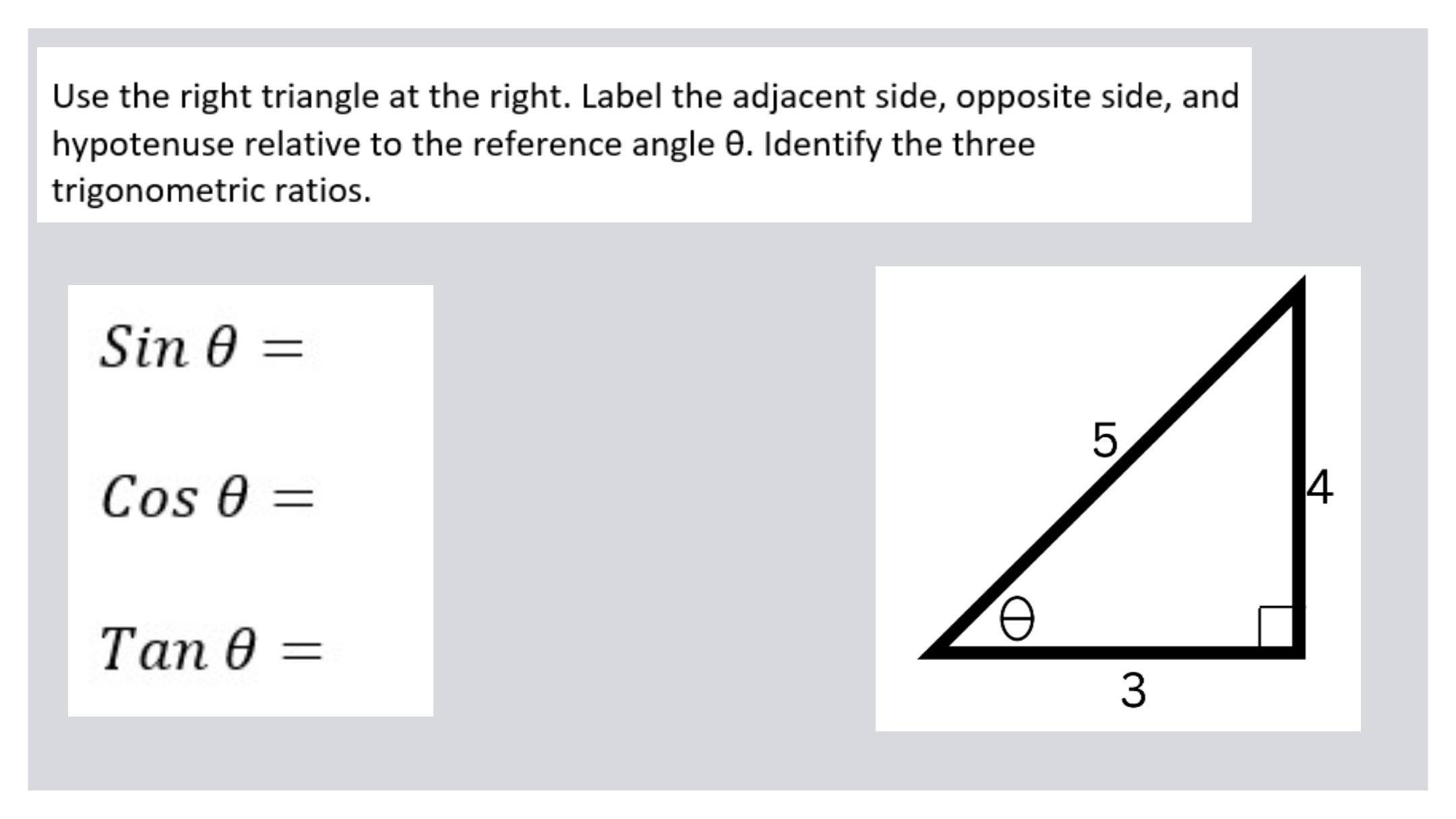
What are the definitions of sine, cosine, and tangent in terms of the sides of a right triangle?
Sine = adjacent/hypotenuse, Cosine = opposite/hypotenuse, Tangent = adjacent/opposite
Sine = opposite/hypotenuse, Cosine = adjacent/hypotenuse, Tangent = opposite/adjacent
Sine = hypotenuse/opposite, Cosine = hypotenuse/adjacent, Tangent = adjacent/opposite
Sine = opposite/adjacent, Cosine = adjacent/opposite, Tangent = hypotenuse/opposite
33
34
35
36
Multiple Select
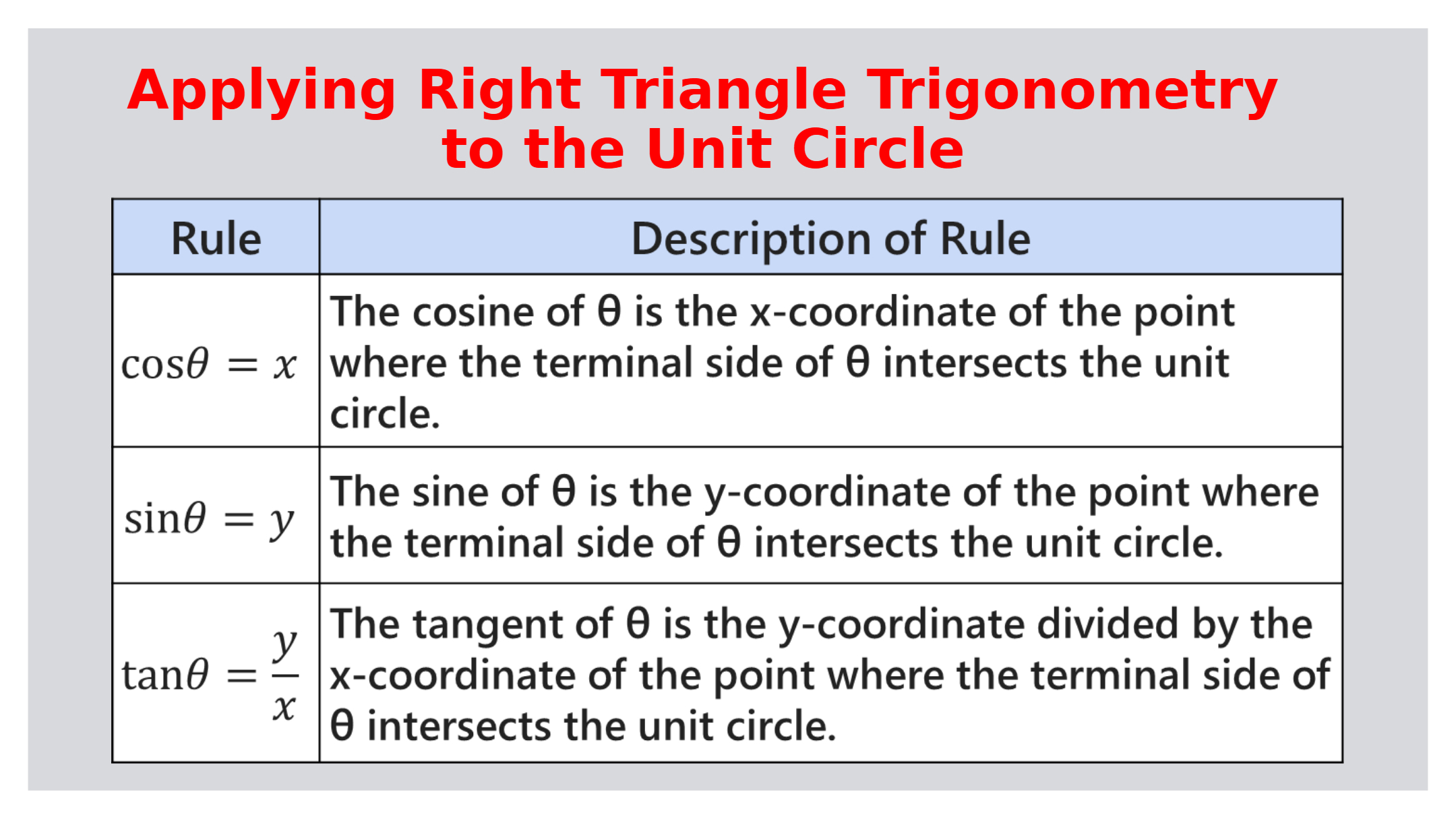
Select all correct statements about the relationship between the coordinates (x, y) on the unit circle and the trigonometric functions sine, cosine, and tangent.
cosθ = x
sinθ = y
tanθ = x/y
tanθ = y/x
37
Fill in the Blanks
Type answer...
38
Open Ended
How do the definitions of sine, cosine, and tangent for a right triangle relate to their definitions on the unit circle?
39
40
Multiple Choice
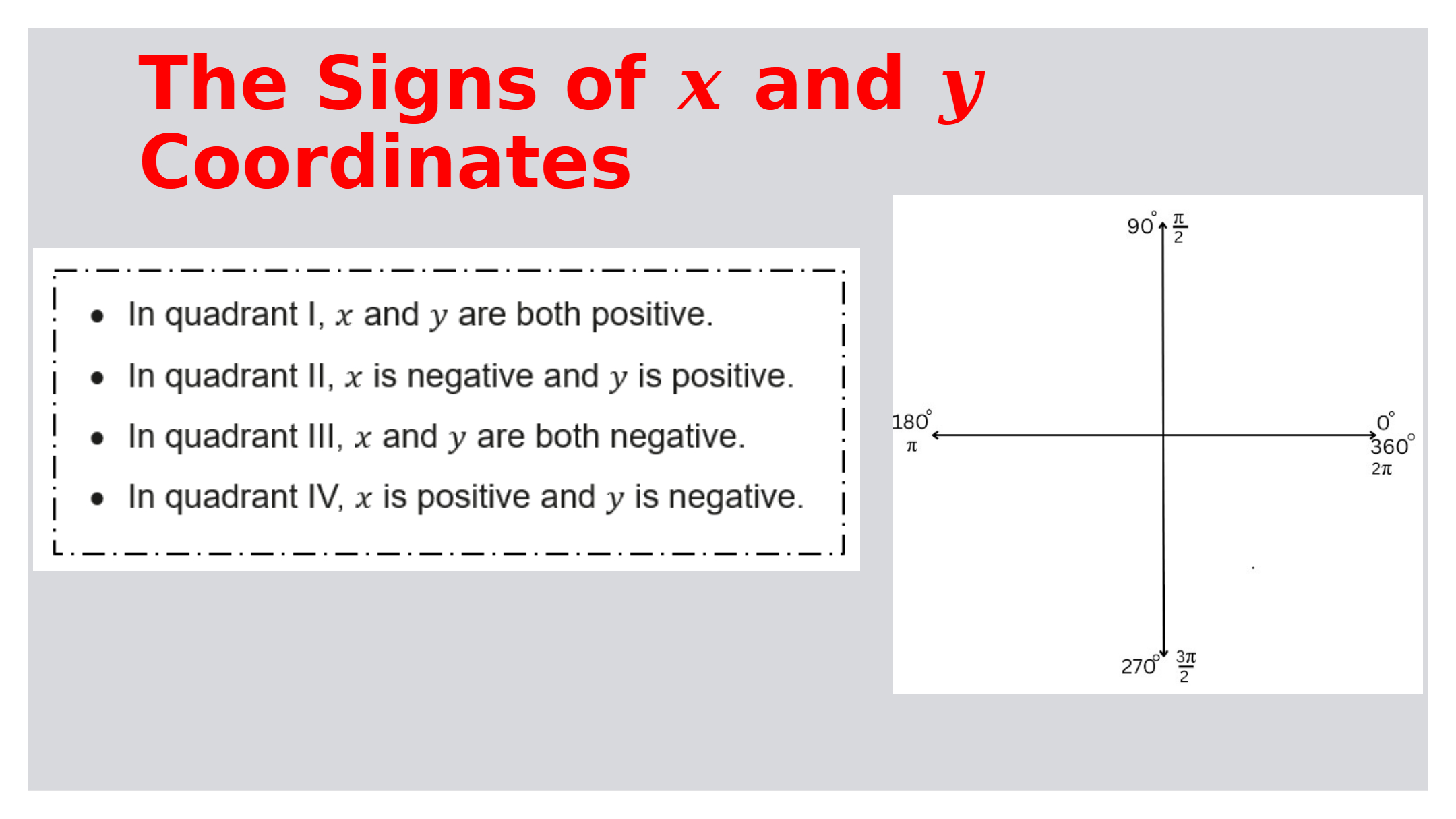
Which of the following statements about the signs of x and y coordinates in the four quadrants is correct?
In quadrant II, both x and y are positive.
In quadrant III, x is positive and y is negative.
In quadrant IV, x is positive and y is negative.
In quadrant I, x is negative and y is positive.
41
42
Multiple Choice
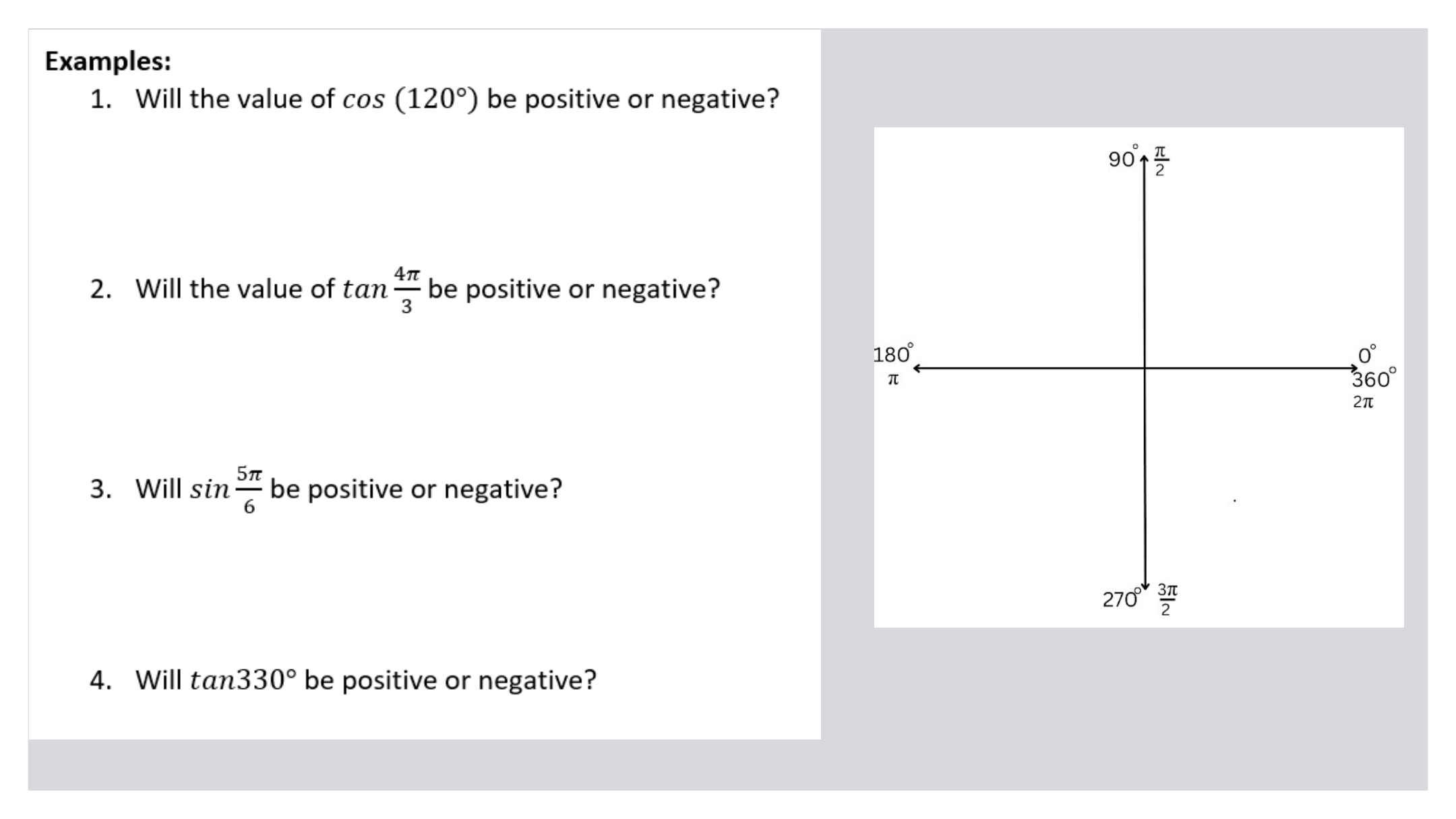
Will tan(330°) be positive or negative?
Positive
Negative
43
Multiple Choice
Will sin(5π/6) be positive or negative?
Positive
Negative
44
Multiple Choice
Will the value of tan(4π/3) be positive or negative?
Positive
Negative
45
Multiple Choice
Will the value of cos(120°) be positive or negative?
Positive
Negative
46
47
Open Ended
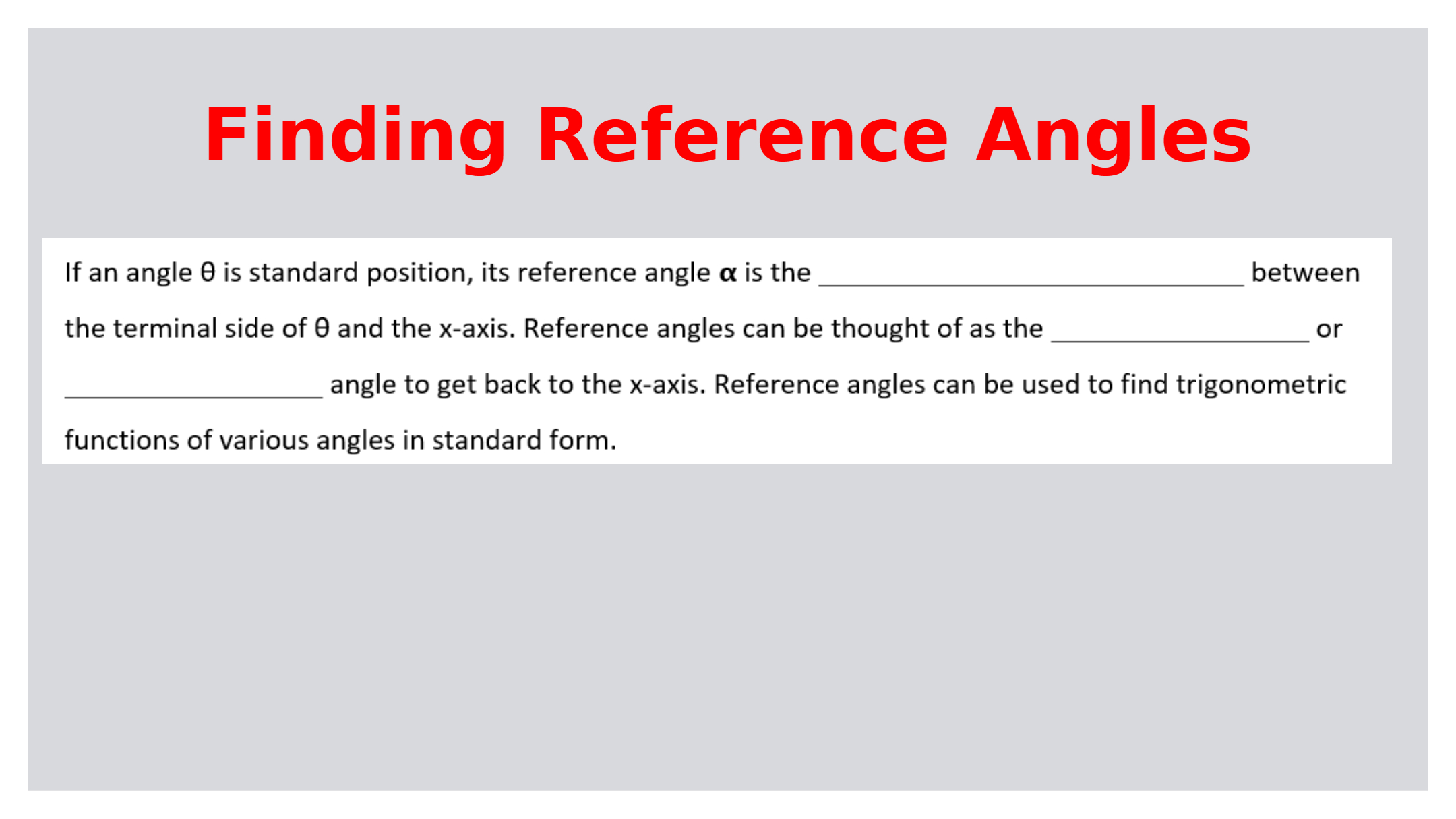
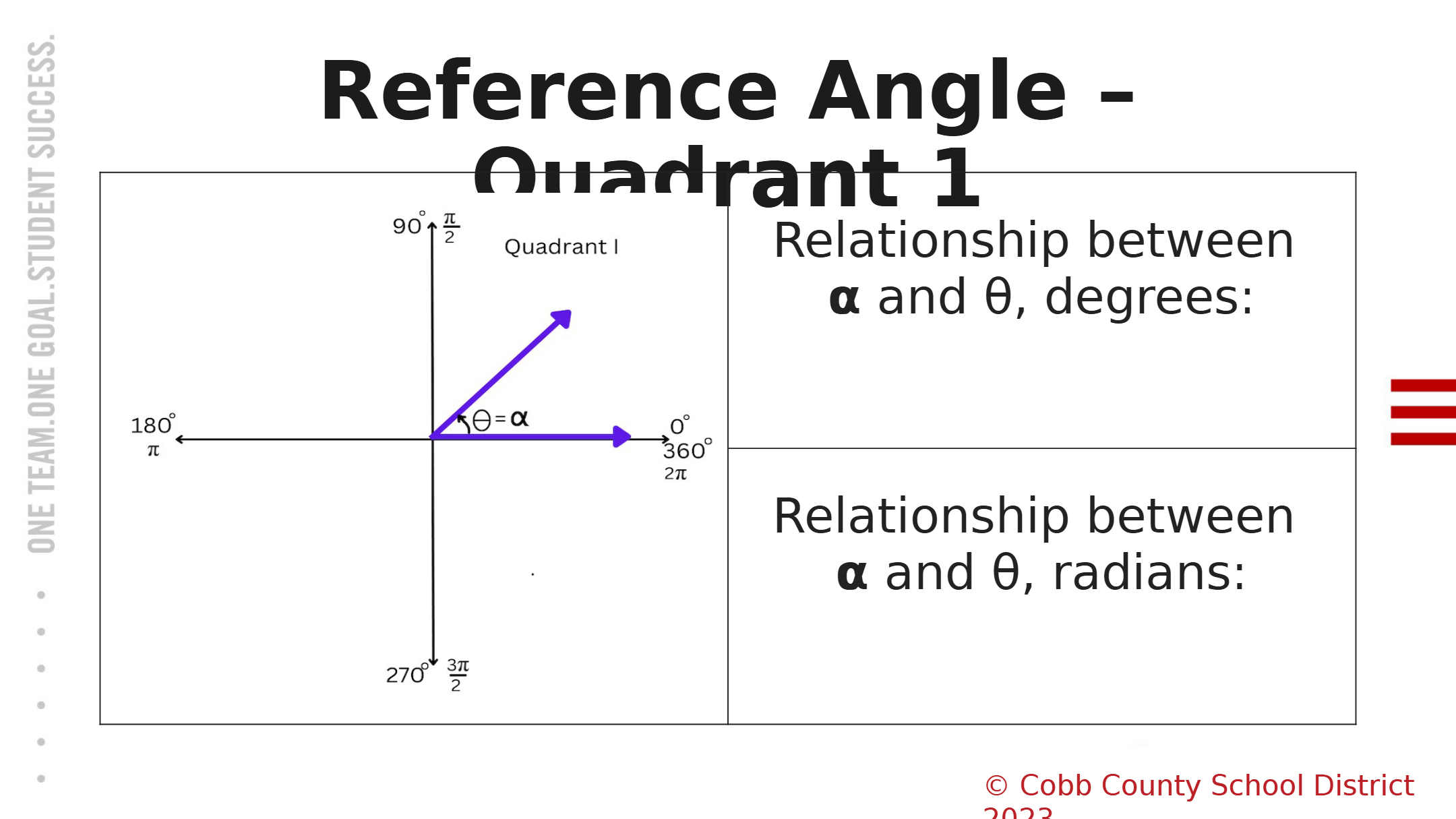
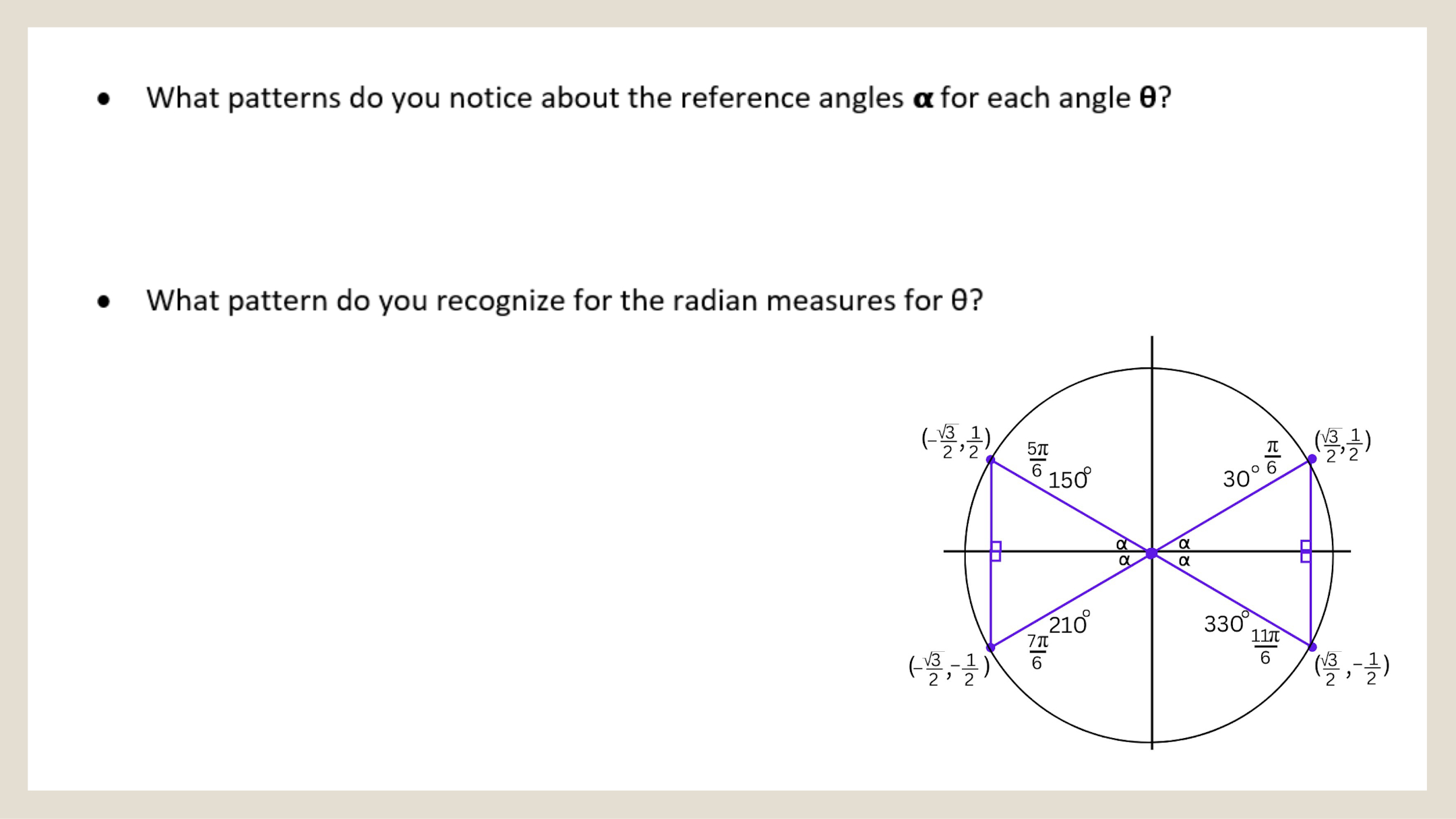
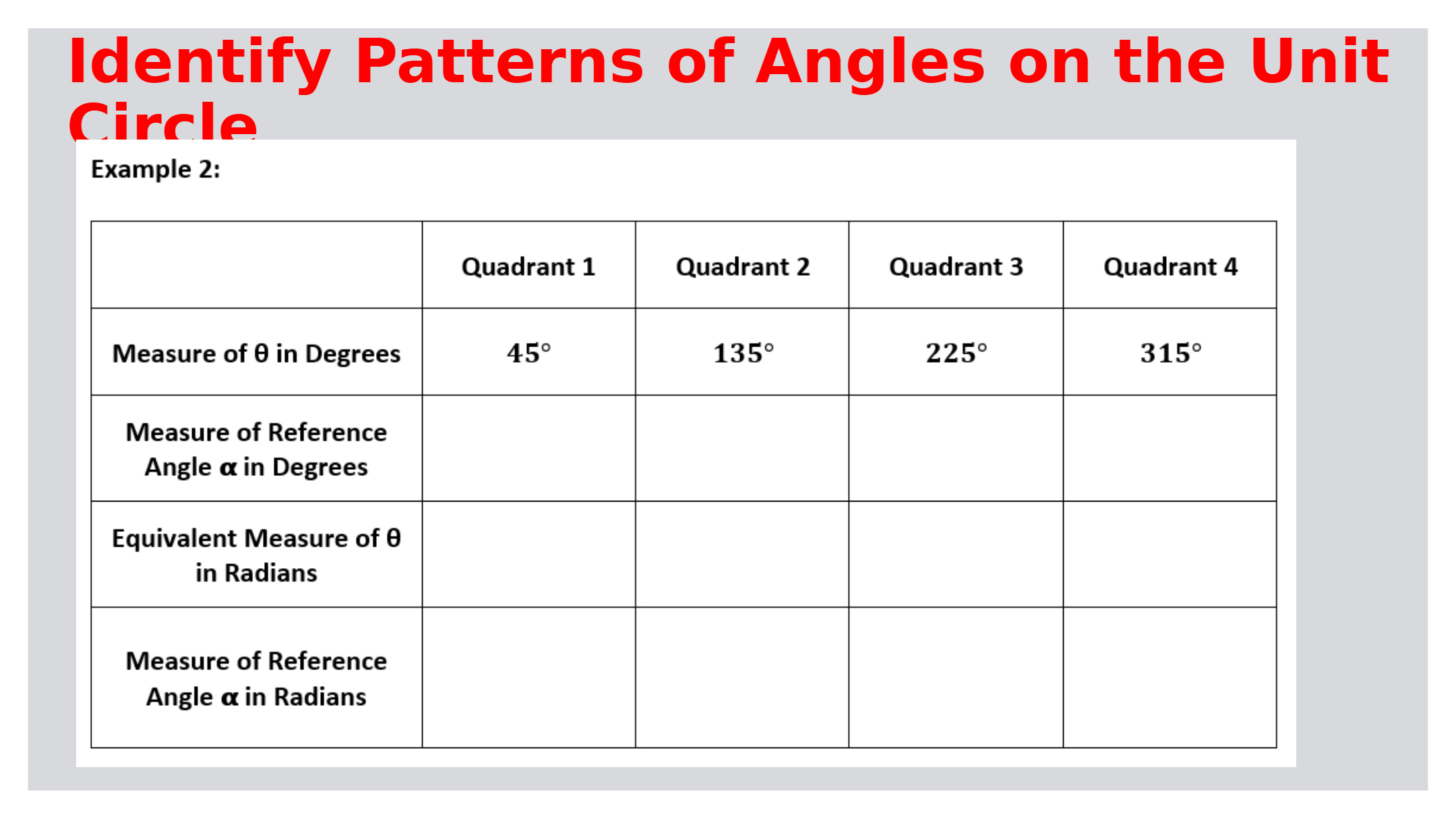
Explain how the reference angle is determined for an angle in standard position. Why is the reference angle important in trigonometry?
48
49
50
Multiple Choice
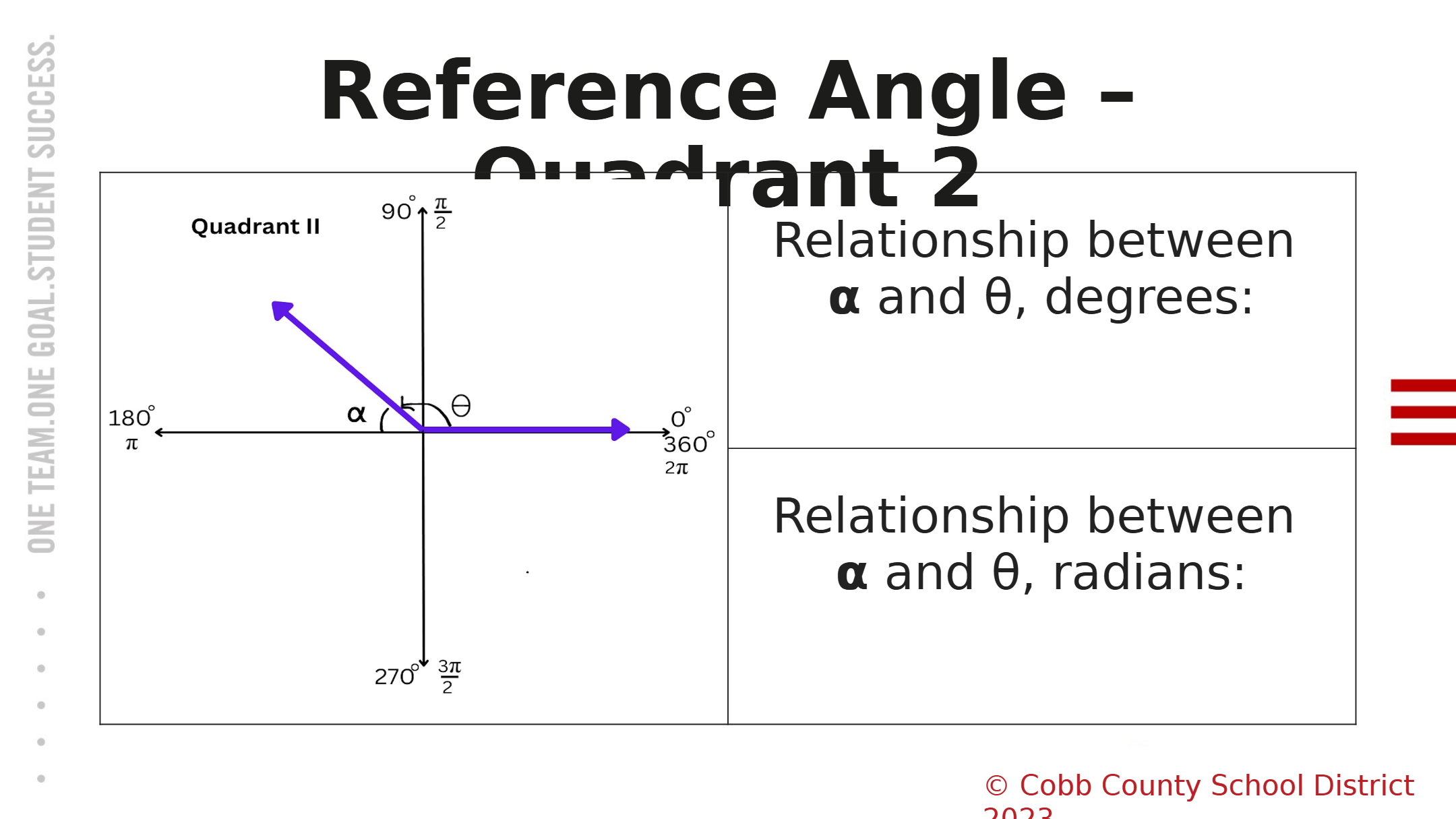
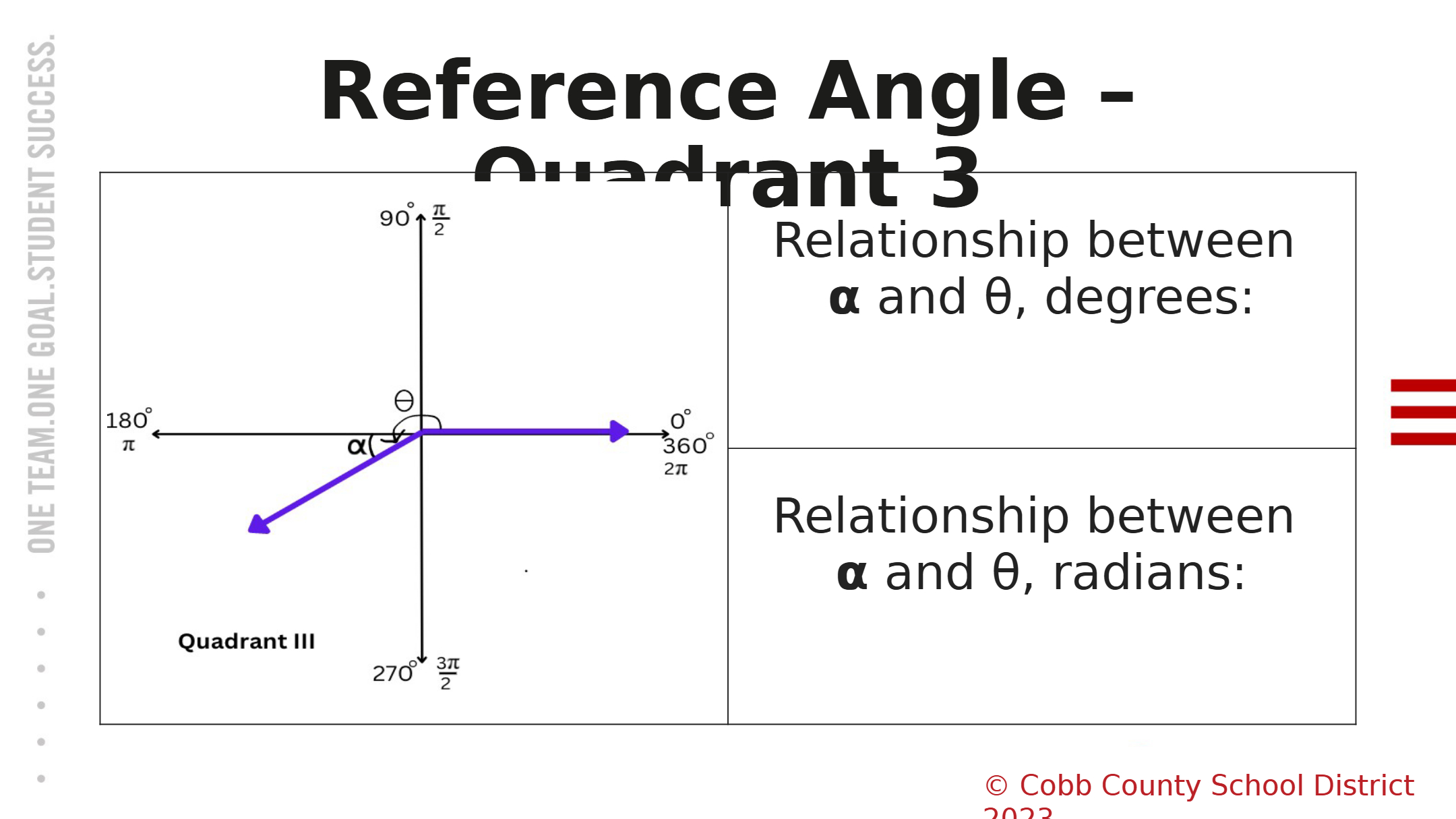
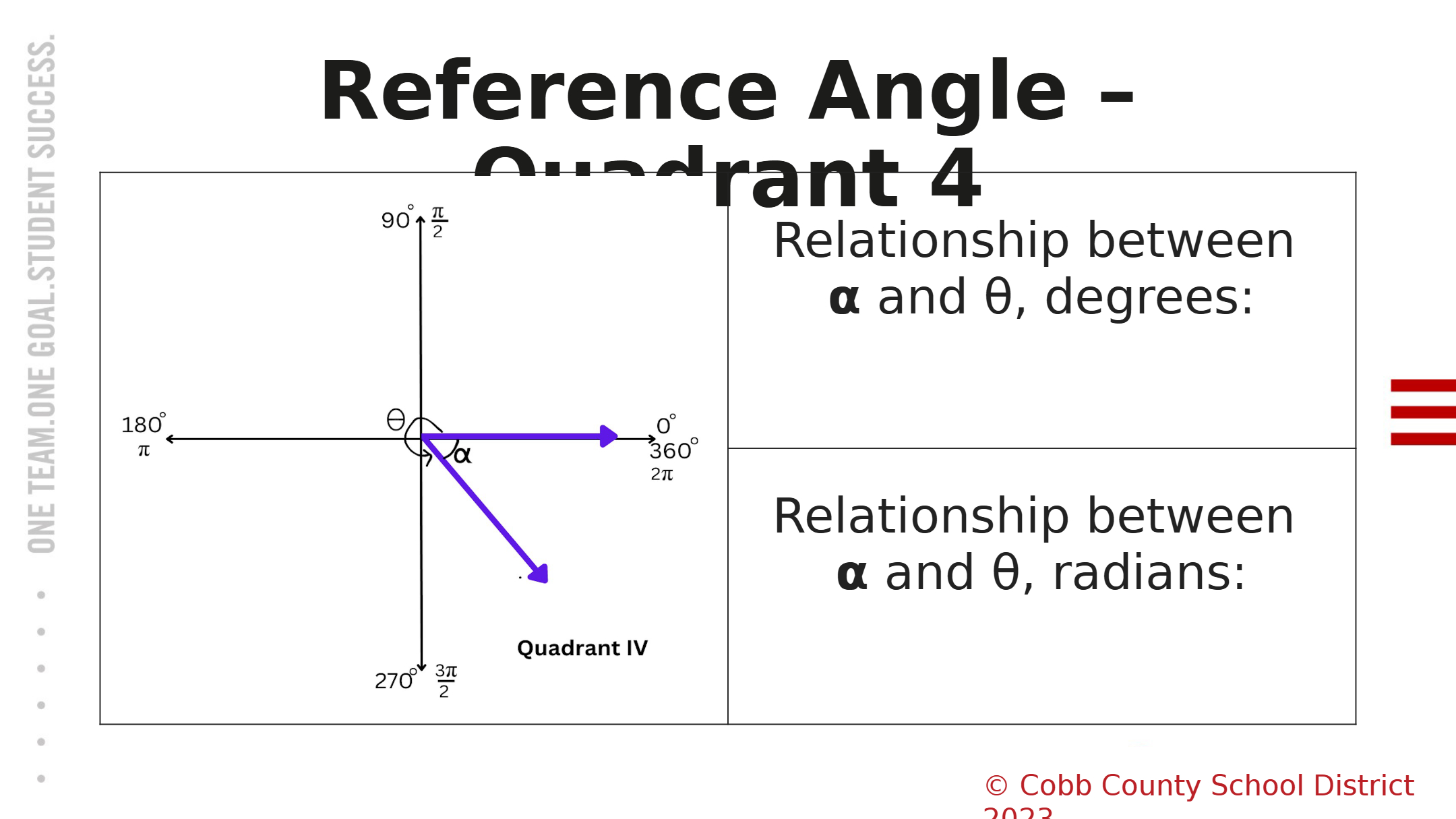
What is the relationship between the reference angle α and θ in degrees for an angle in Quadrant II?
α = θ
α = 180° − θ
α = θ − 180°
α = 360° − θ
51
52
53
54
55
56
57
Open Ended
Trigonometric ratios are used to relate the angles of a triangle to the lengths of its sides. Can you think of a real-world situation where understanding trigonometric ratios would be useful?
58
Open Ended
What questions do you still have about trigonometric ratios or the unit circle after today's lesson?
Show answer
Auto Play
Slide 1 / 58
SLIDE
Similar Resources on Wayground

57 questions
Plant Cell Types
Presentation
•
11th Grade
50 questions
2025 SHS MATHS AND SCIENCE QUIZ
Presentation
•
11th Grade
53 questions
FULL MOCK EXAM PRUEBA SABER 11 SECOND TERM
Presentation
•
11th Grade
52 questions
S2 AFA Stock Market Unit Final Review
Presentation
•
12th Grade
54 questions
Revision c1-c9 Biology Form 4 KSSM
Presentation
•
11th Grade
53 questions
garis dan sudut
Presentation
•
12th Grade
53 questions
Cell Cycle
Presentation
•
11th Grade
50 questions
Hypothesis Testing
Presentation
•
11th Grade
Popular Resources on Wayground
20 questions
"What is the question asking??" Grades 3-5

Quiz
•
1st - 5th Grade
20 questions
“What is the question asking??” Grades 6-8
Quiz
•
6th - 8th Grade
10 questions
Fire Safety Quiz
Quiz
•
12th Grade
20 questions
Equivalent Fractions
Quiz
•
3rd Grade
34 questions
STAAR Review 6th - 8th grade Reading Part 1
Quiz
•
6th - 8th Grade
20 questions
“What is the question asking??” English I-II
Quiz
•
9th - 12th Grade
20 questions
Main Idea and Details
Quiz
•
5th Grade
47 questions
8th Grade Reading STAAR Ultimate Review!
Quiz
•
8th Grade
Discover more resources for Mathematics
15 questions
Exponential Growth and Decay Word Problems Practice
Quiz
•
9th - 12th Grade
15 questions
Converting Between Exponential And Logarithmic Form
Quiz
•
9th - 12th Grade
15 questions
Algebra 1 Vocabulary
Quiz
•
9th - 12th Grade
4 questions
Set It Up: Algebra I EOC Review
Quiz
•
9th - 12th Grade
14 questions
Intro solving quads by graphing/factoring
Presentation
•
9th - 12th Grade
17 questions
Intro To Dilations
Quiz
•
8th - 12th Grade
47 questions
CCG Review Day Probability/Counting Procedures
Quiz
•
9th - 12th Grade
19 questions
Circumference and Area of a Circle
Quiz
•
9th - 11th Grade