

Pharm Chapter 15

Presentation
•
Health Sciences
•
University
•
Medium

brook Williams
Used 1+ times
FREE Resource
24 Slides • 26 Questions
1
2
Multiple Choice
Which of the following are considered impairments of host defense mechanisms?
Breaks in skin and mucous membranes
Suppression of normal flora via antimicrobials
Diabetes mellitus
All of the above
3

4
Multiple Choice
Which of the following is a common cause of inflammation?
Infection
Dehydration
Excessive exercise
Low blood sugar
5
Open Ended
What is the significance of understanding inflammation and its causes in the context of infection and antimicrobial therapy?
6

7

8
Open Ended
How do biological adaptations help microorganisms survive in the host environment?
9
Multiple Choice
Which of the following is NOT a way microorganisms attach and cause infection in a host?
Invade tissues
Multiply
Produce antibodies
Produce infection
10

11
Multiple Select
Which of the following are classifications of microorganisms?
Bacteria
Viruses
Fungi
Parasites
12

13
Fill in the Blanks
Suppression of normal microbial flora can lead to the proliferation of
Type answer...
14

15
Open Ended
Describe two ways in which host defense mechanisms protect against infection.
16

17
18
Fill in the Blanks
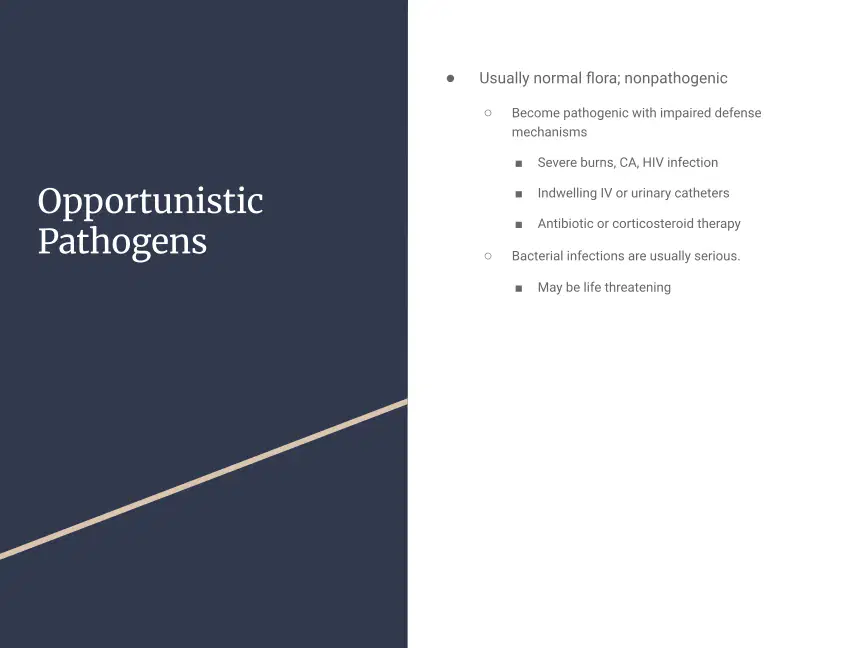
Opportunistic pathogens become pathogenic in individuals with impaired
Type answer...
19

20
Multiple Choice
Which laboratory test is used to detect the presence of microbial DNA in a sample?
Gram's stain
Culture
Serology
Polymerase chain reaction (PCR)
21

22
Open Ended
Explain how antibiotic-resistant microorganisms can lead to increased mortality rates.
23

24
Fill in the Blanks
Antibiotic-resistant microorganisms may emerge during or after
Type answer...
25

26

27
Open Ended
Describe two mechanisms by which microbes can resist the effects of antibiotics.
28
Multiple Choice
Which of the following can contribute to the development of antibiotic-resistant microorganisms?
Broad-spectrum antibiotic use
Interruption of antimicrobial treatment
Modification of ATB binding target
All of the above
29

30
Multiple Choice
Which of the following is NOT included under anti-infective and antimicrobial drugs?
Antibacterials
Antivirals
Antifungals
Analgesics
31

32
Open Ended
What is the difference between broad spectrum and narrow spectrum antimicrobial drugs?
33

34
Multiple Select
Which of the following are mechanisms by which antimicrobials act on pathogens?
Inhibition of bacterial wall synthesis
Inhibition of protein synthesis
Disruption of microbial cell membranes
Stimulation of host cell growth
35

36
Fill in the Blanks
Penicillins, cephalosporins, and vancomycin inhibit the formation of the
Type answer...
37

38
Open Ended
List two goals of antimicrobial therapy.
39

40
Multiple Select
Combination therapy of antimicrobials is recommended for which of the following situations?
Infections caused by a single microbe
Nosocomial infections
Serious infections
Mild viral infections
41

42
Multiple Choice
Which factors should be considered when deciding the administration route for antimicrobial therapy?
Patient's age and gender
Location and severity of infection, ability to take oral medications, available medication dosage forms
Cost of medication
Patient's insurance coverage
43

44
Open Ended
How does the duration of antimicrobial therapy differ for prophylactic use versus treatment of acute infection?
45

46
Multiple Select
Select all guidelines that promote appropriate antimicrobial drug use.
Avoid using antibacterial drugs to treat viral infections.
Use broad-spectrum antibacterial drugs whenever possible.
Give antibacterial drugs only for significant bacterial infections or established prophylaxis.
Collect specimens for culture and Gram’s stain before first antibiotic dose.
47

48
Fill in the Blanks
Follow
Type answer...
49
Fill in the Blanks
Inflammation is often a response to
Type answer...
50
Open Ended
What are the main causes of inflammation and how does the pathophysiology of inflammation contribute to disease processes?
Show answer
Auto Play
Slide 1 / 50
SLIDE
Similar Resources on Wayground

44 questions
DSF - 09 Forensic Tools and Techniques
Presentation
•
University
45 questions
Getting to Know Access
Presentation
•
University
45 questions
Practice Test
Presentation
•
University
46 questions
Electrophysiology
Presentation
•
University
47 questions
Med-Surg Ch. 23
Presentation
•
University
46 questions
Unit-1,2,3-Organizational Communication revision
Presentation
•
University
46 questions
Atoms, Tek 8.5B, and 8.5C
Presentation
•
KG - University
44 questions
B3 week 2
Presentation
•
University
Popular Resources on Wayground
10 questions
Safety Day 2026 – Student Review

Quiz
•
9th Grade
21 questions
Continents and Oceans
Quiz
•
6th Grade
20 questions
Parts of Speech
Quiz
•
5th Grade
16 questions
Subject & Predicate
Quiz
•
5th Grade
25 questions
Multiplication Facts
Quiz
•
5th Grade
12 questions
Map Skills
Quiz
•
3rd Grade
22 questions
Continents and Oceans
Quiz
•
5th Grade
15 questions
Rounding Decimals
Quiz
•
5th Grade
Discover more resources for Health Sciences
20 questions
Disney Trivia
Quiz
•
University
10 questions
Spanish Greetings and Goodbyes!
Presentation
•
6th Grade - University
20 questions
Physical or Chemical Change/Phases
Quiz
•
8th Grade - University
39 questions
Unit 7 Key Terms
Quiz
•
11th Grade - University
25 questions
SER and Subject Pronouns
Quiz
•
8th Grade - University
38 questions
Unit 6 Key Terms
Quiz
•
11th Grade - University
19 questions
Key Concepts in Buddhism
Quiz
•
University
0 questions
Cell Domain Basic Review (Biology)
Quiz
•
University