

Untitled Presentation

Presentation
•
Social Studies
•
12th Grade
•
Hard

LAURA PEREZ
FREE Resource
30 Slides • 28 Questions
1
2
Open Ended
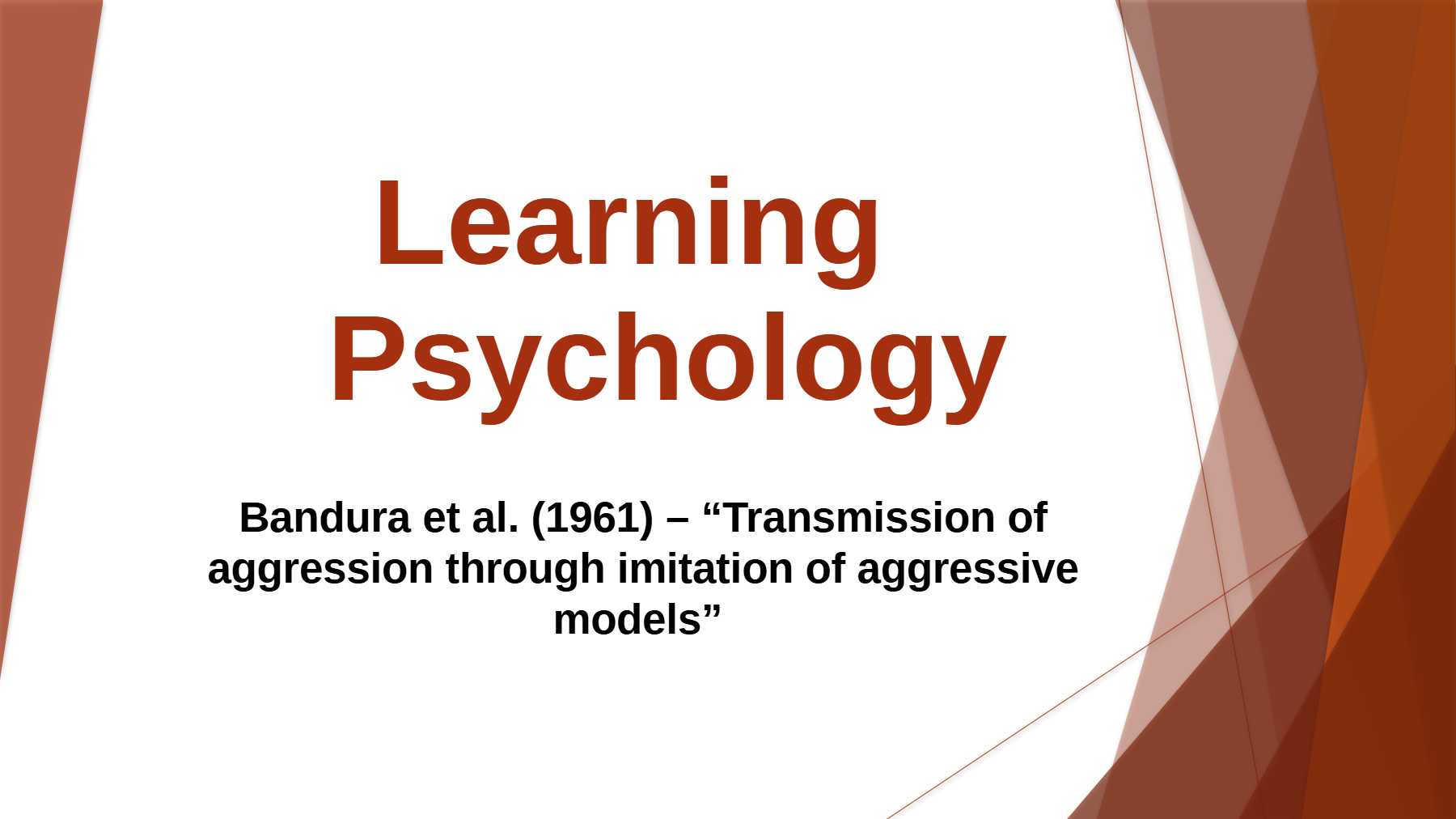
Based on the images and procedures described, what is the main purpose of using different rooms and toy sets in this experiment?
3
4
Multiple Choice
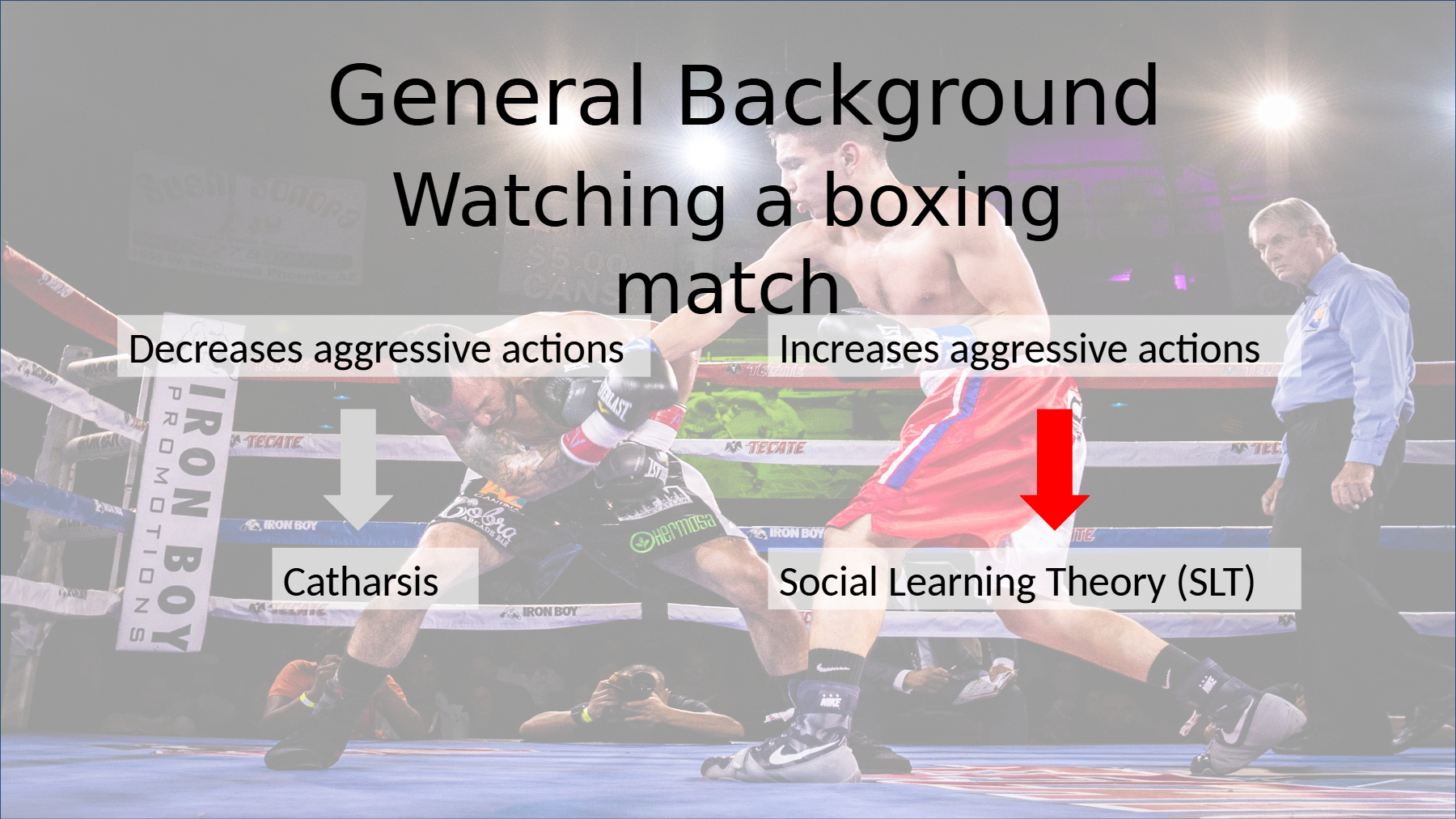
Which psychological theory suggests that observing aggressive actions can increase a person's own aggressive behavior?
Catharsis Theory
Social Learning Theory (SLT)
Cognitive Dissonance Theory
Attachment Theory
5
Open Ended
How might watching aggressive behavior, such as a boxing match, influence a person's own actions according to psychological theories?
6
7
Multiple Choice
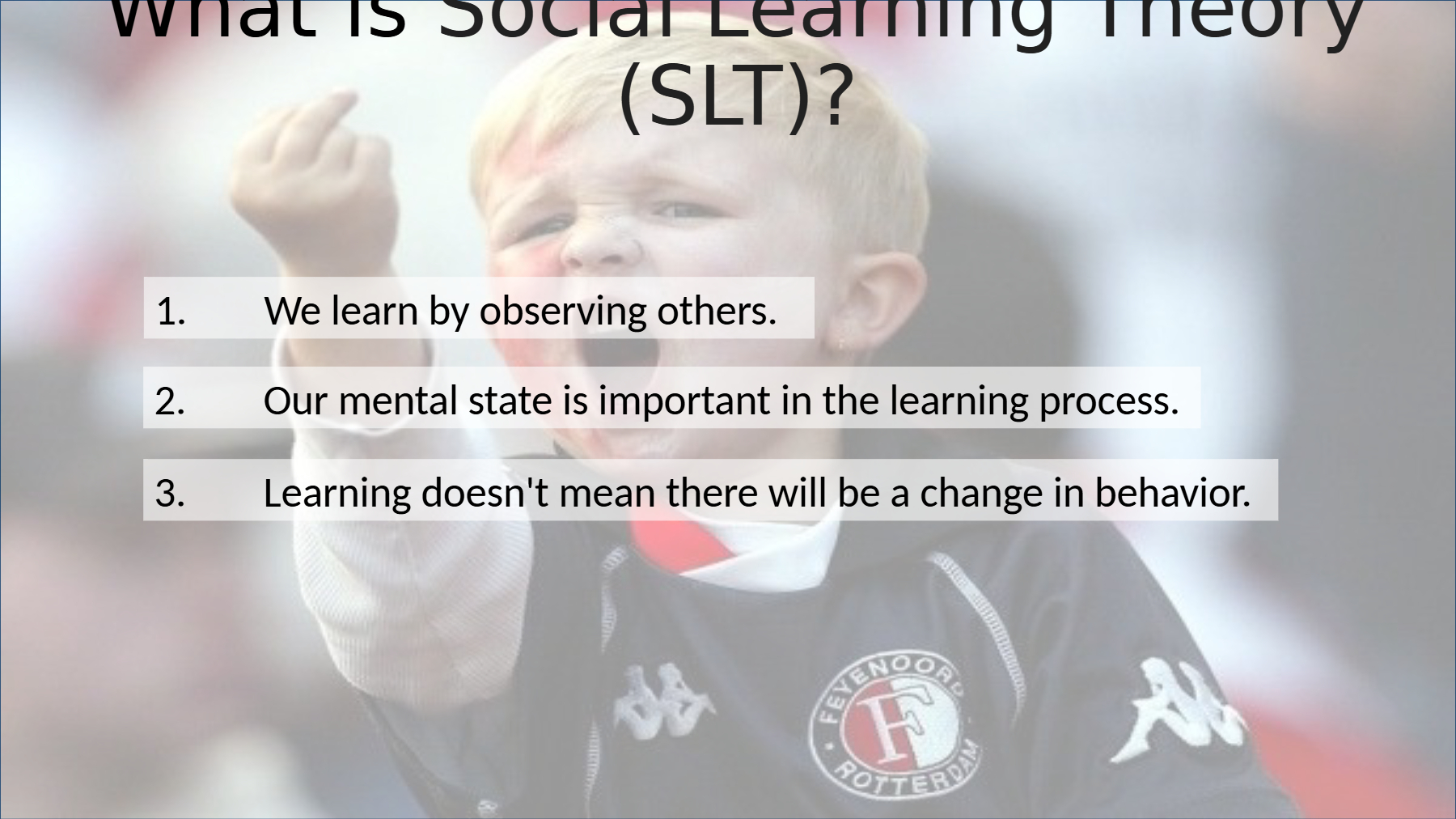
Which of the following is NOT a key principle of Social Learning Theory (SLT) as described in the image?
We learn by observing others.
Our mental state is important in the learning process.
Learning always leads to a change in behavior.
Learning doesn't mean there will be a change in behavior.
8
9
Open Ended
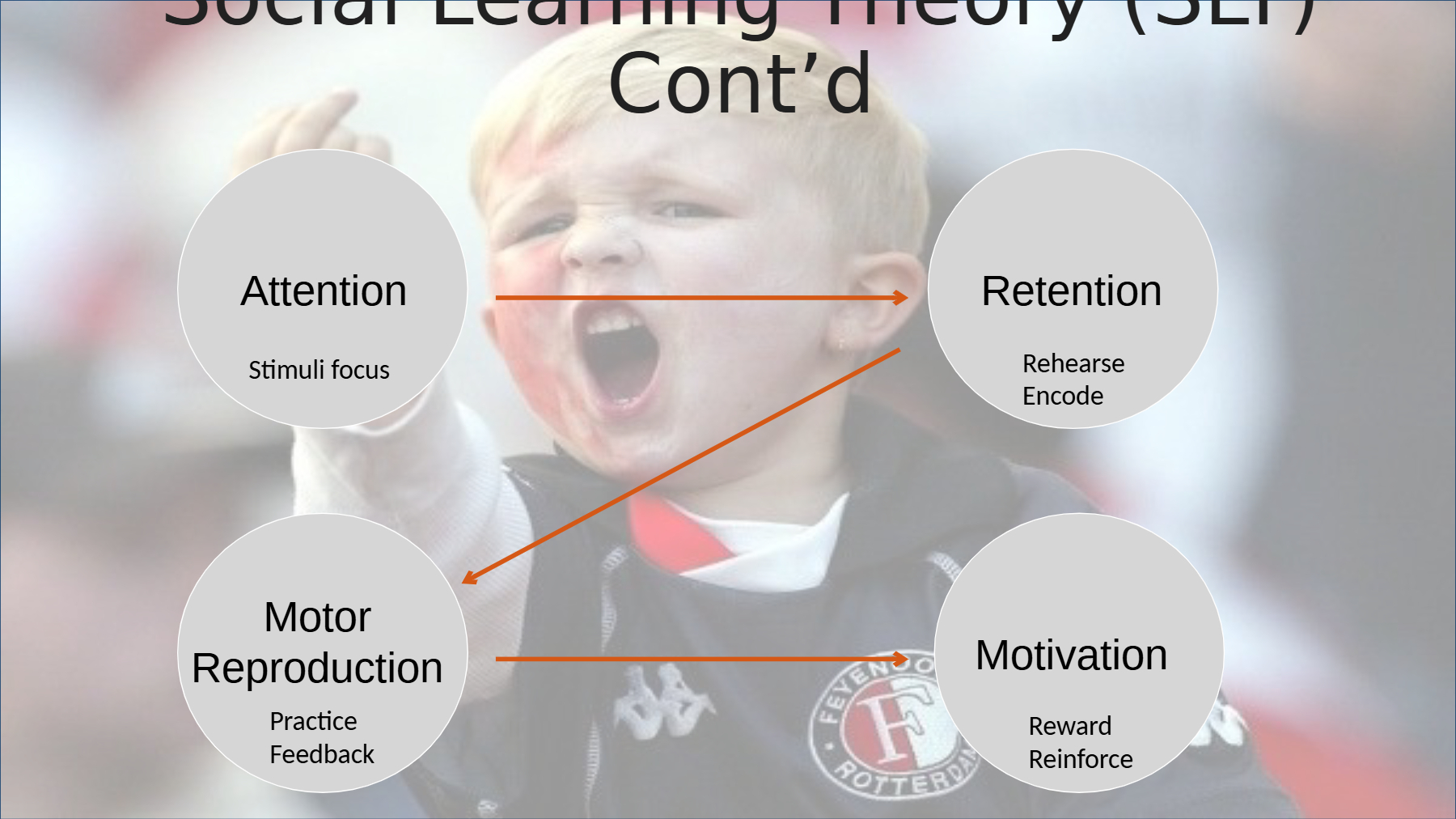
Describe the four main processes involved in Social Learning Theory (SLT) and explain how each contributes to learning.
10
11
Multiple Choice
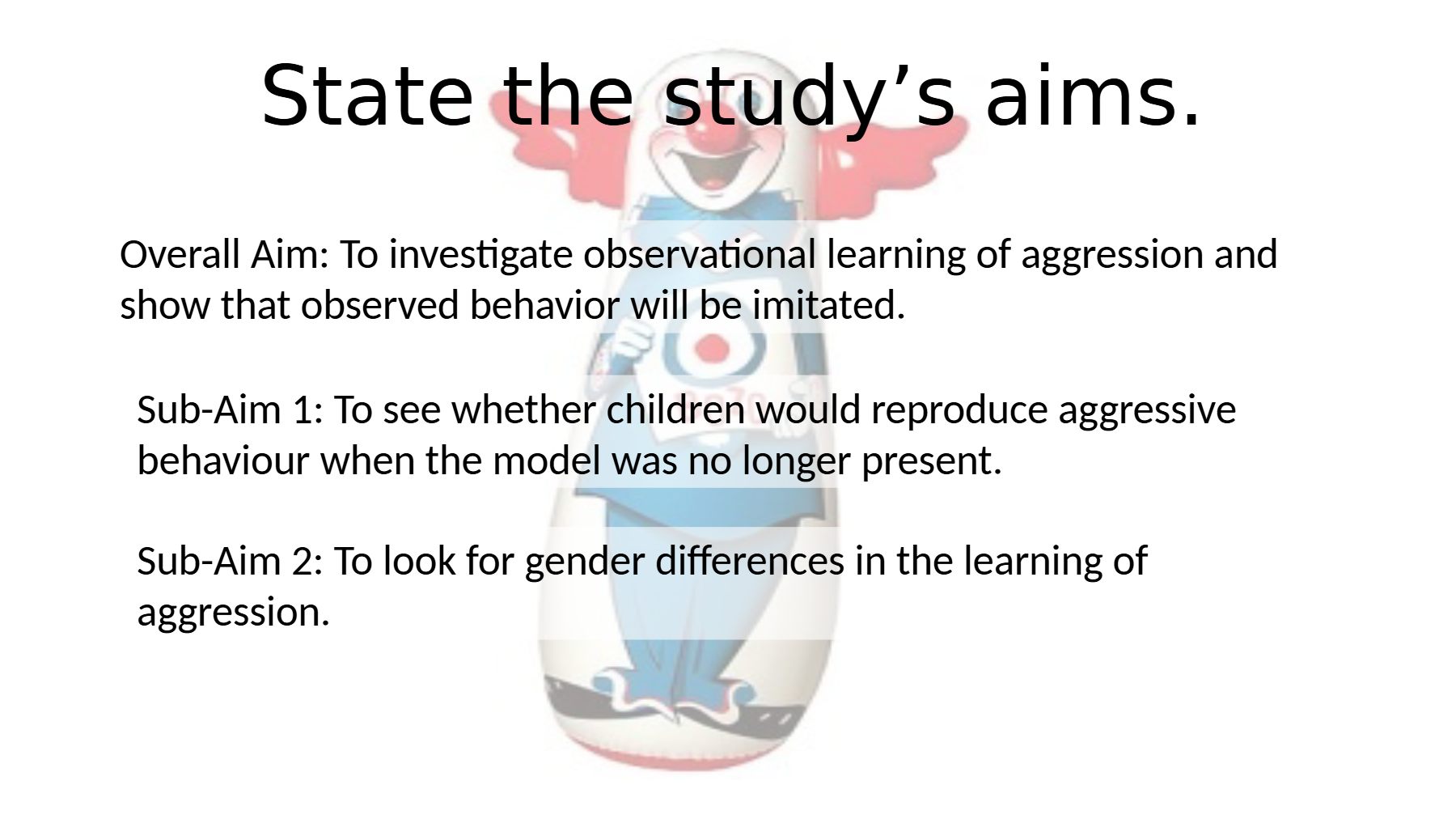
What was the overall aim of the study described in the image?
To investigate observational learning of aggression and show that observed behavior will be imitated.
To study the effects of punishment on children's behavior.
To examine the impact of rewards on learning.
To compare learning outcomes between boys and girls.
12
13
Multiple Select
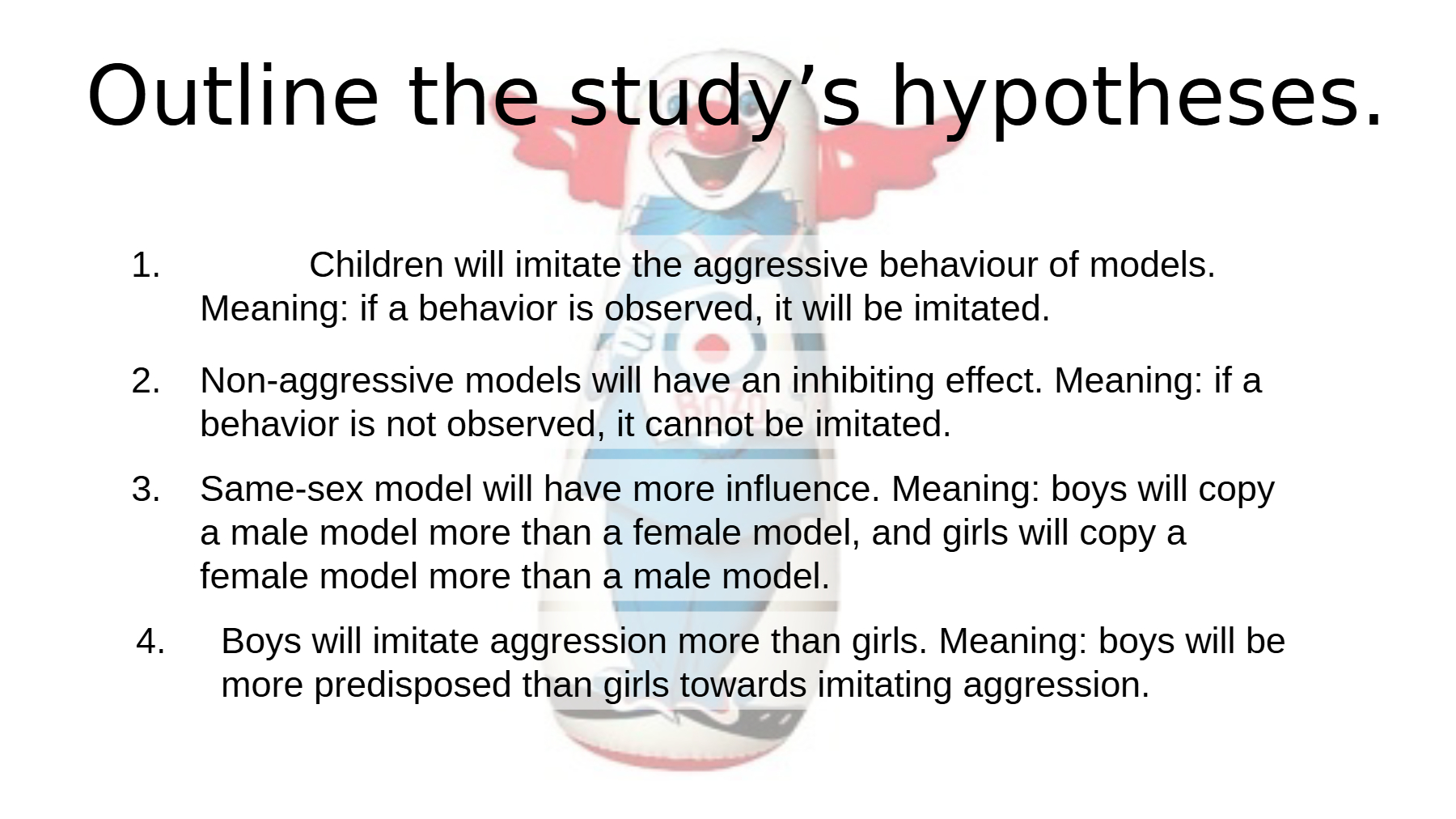
According to the study's hypotheses, which factors influence whether children will imitate aggressive behavior?
Presence of aggressive models
Gender of the model and child
Reward and reinforcement
All of the above
14
15
Fill in the Blanks
Type answer...
16
17
Open Ended
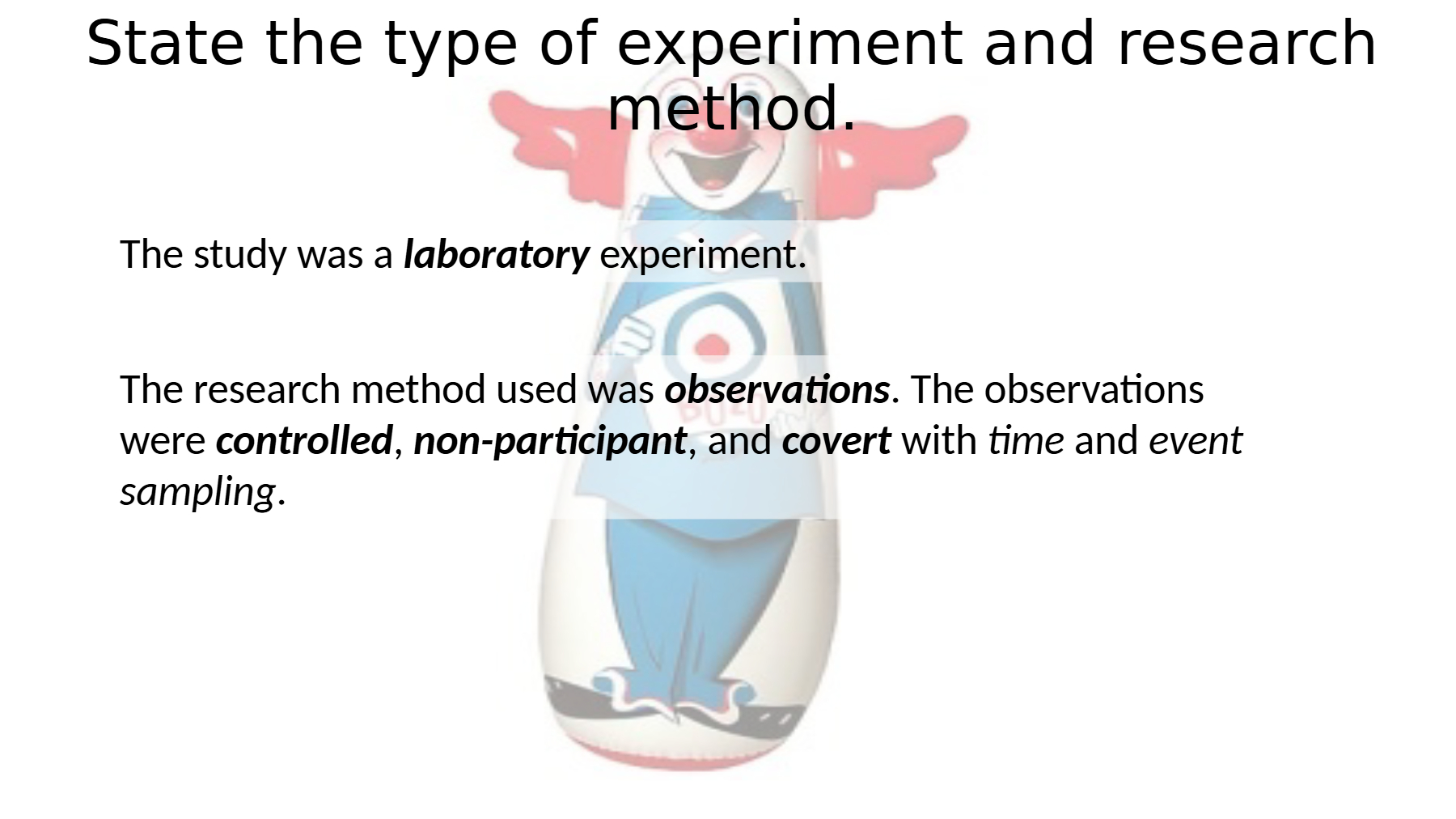
Explain the difference between a laboratory experiment and a field experiment, using the study described as an example.
18
19
Multiple Choice
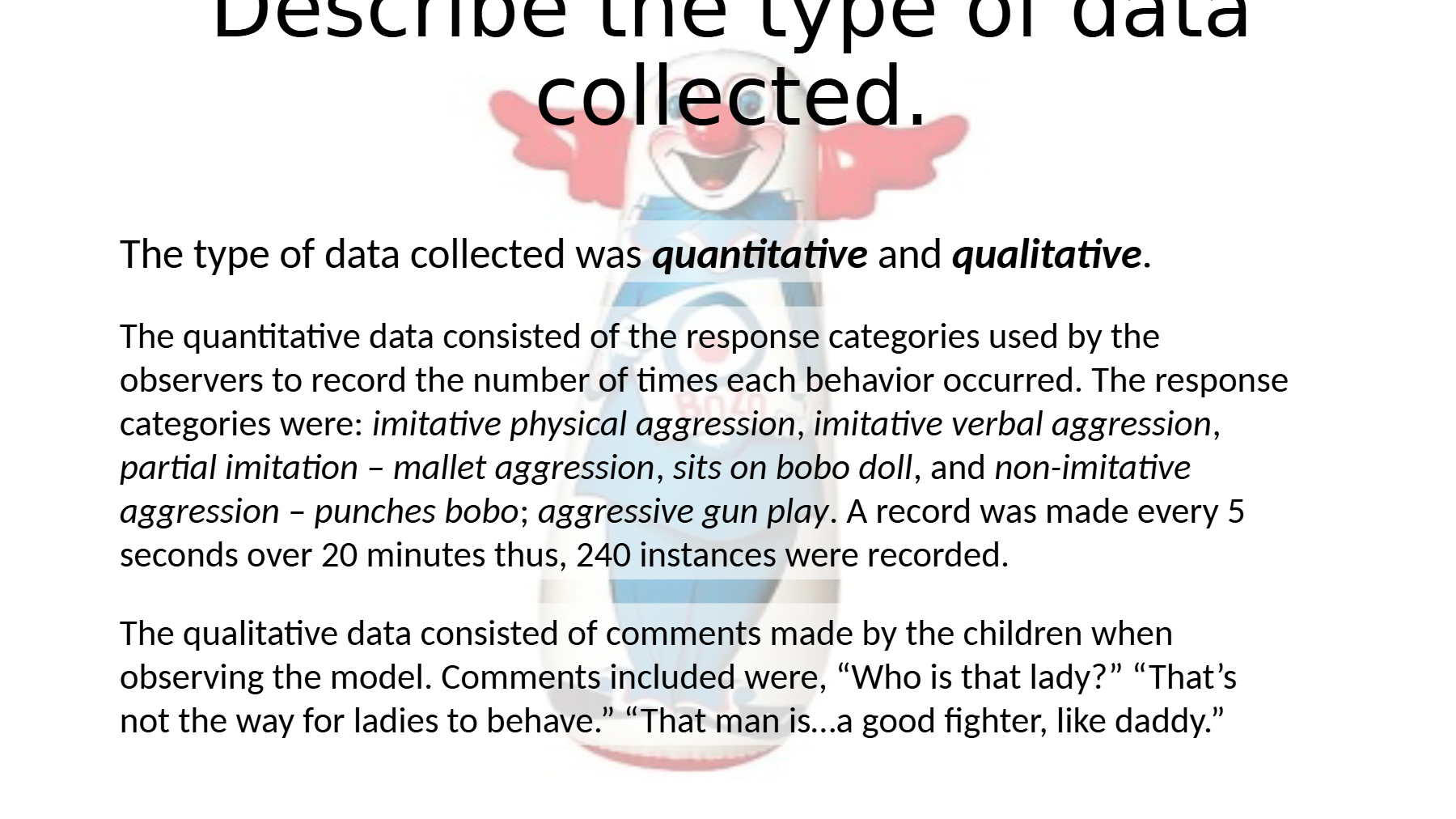
Which types of data were collected in the study, and what is one example of each type?
Quantitative and qualitative; quantitative: number of aggressive acts, qualitative: children's comments
Numerical and categorical; numerical: age of children, categorical: type of toy used
Experimental and observational; experimental: role model type, observational: children's behavior
Physical and verbal; physical: hitting the doll, verbal: saying 'Pow'
20
21
Fill in the Blanks
Type answer...
22
Open Ended
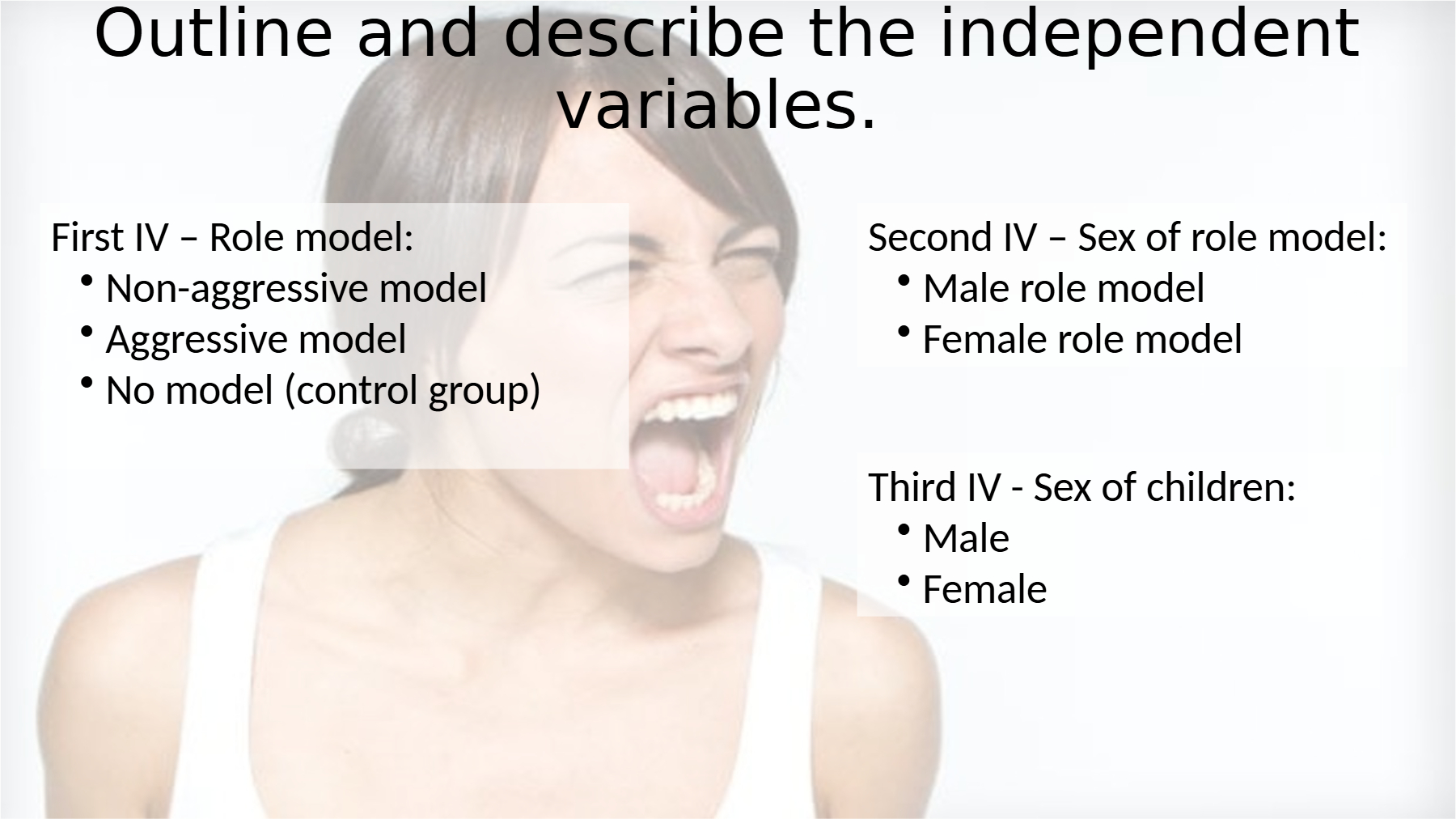
Explain how the independent variables were manipulated in the experiment.
23
24
25
26
Open Ended
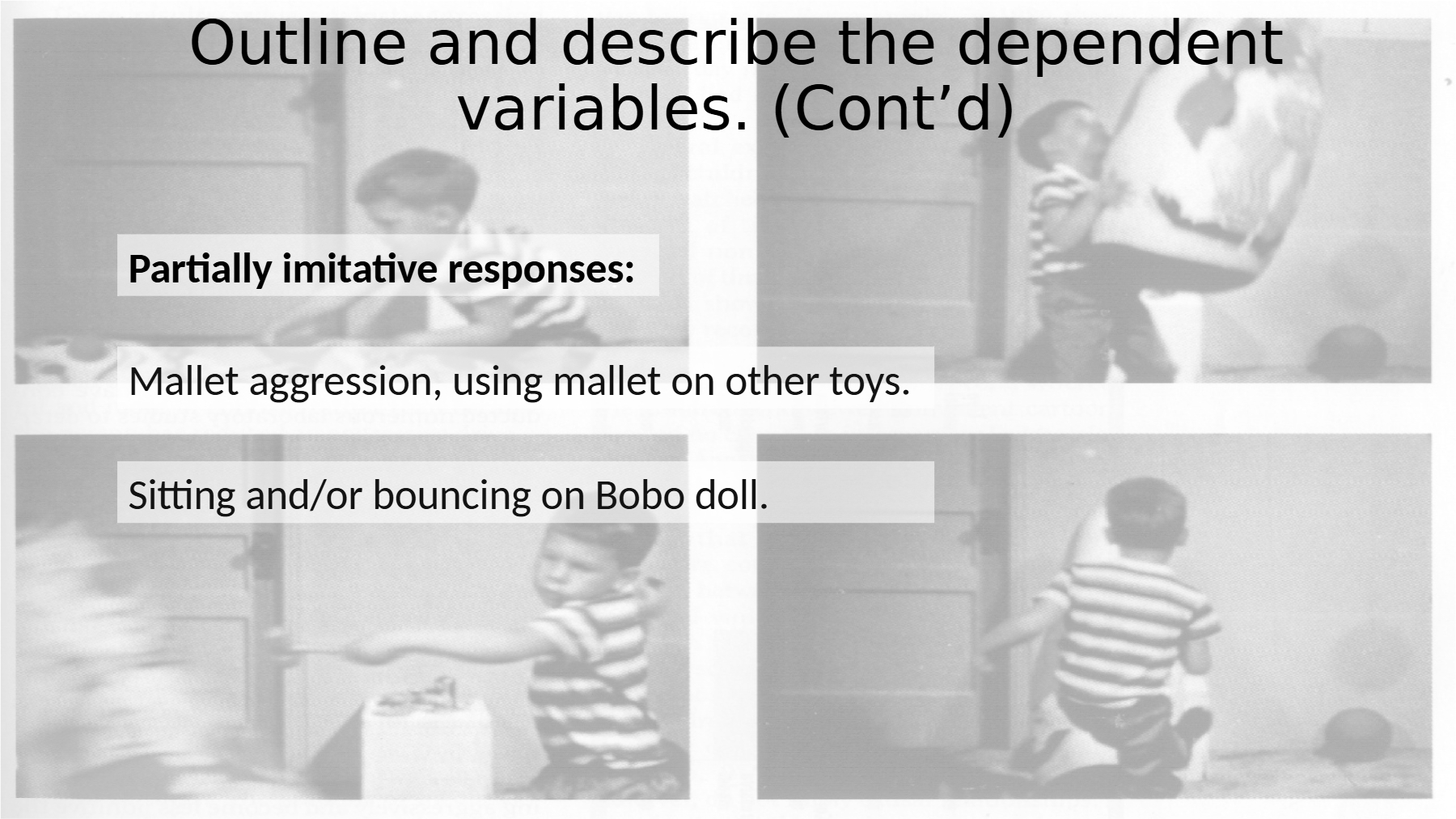
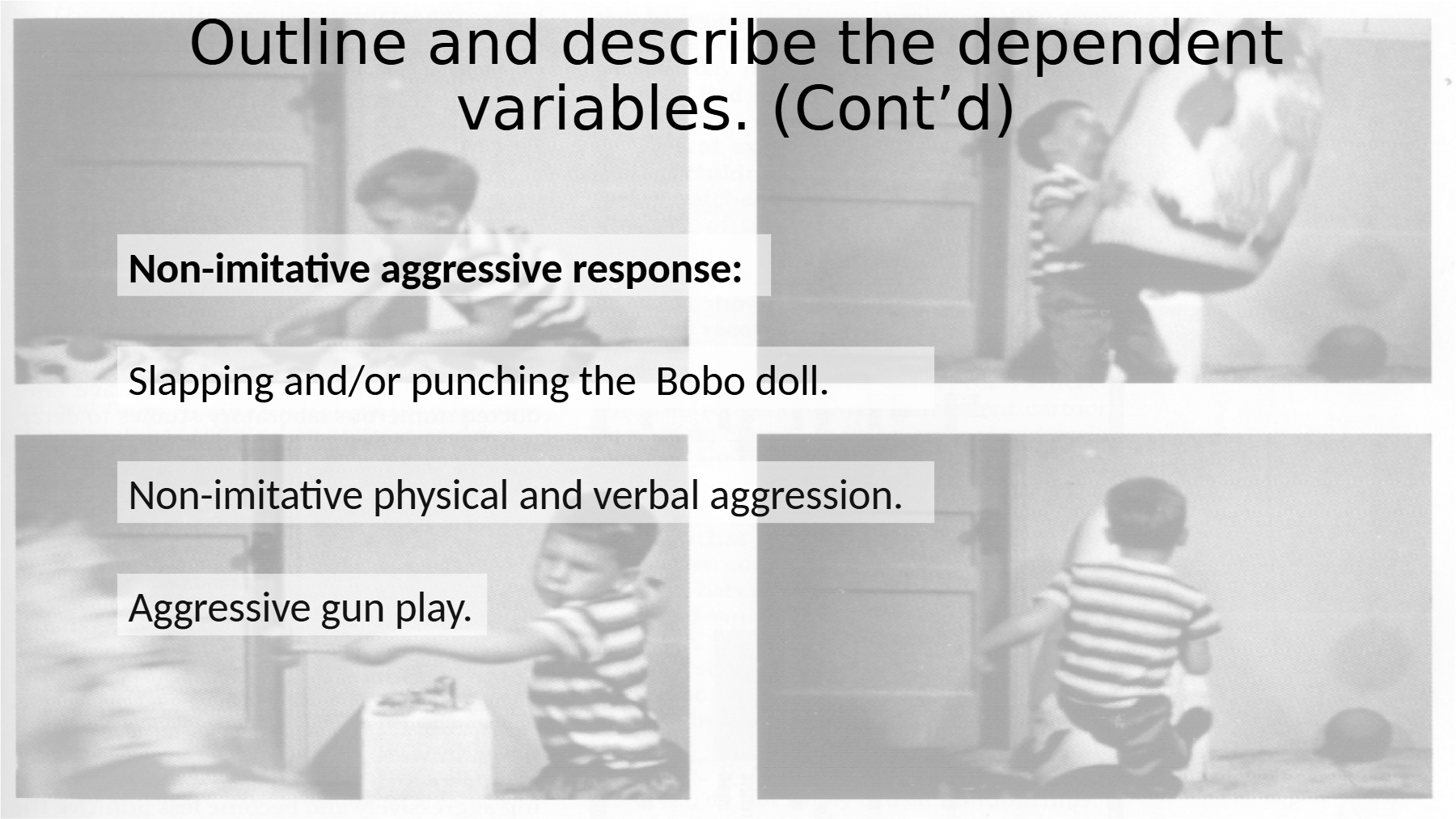
Describe the difference between partially imitative responses and non-imitative aggressive responses in the context of the experiment.
27
Multiple Select
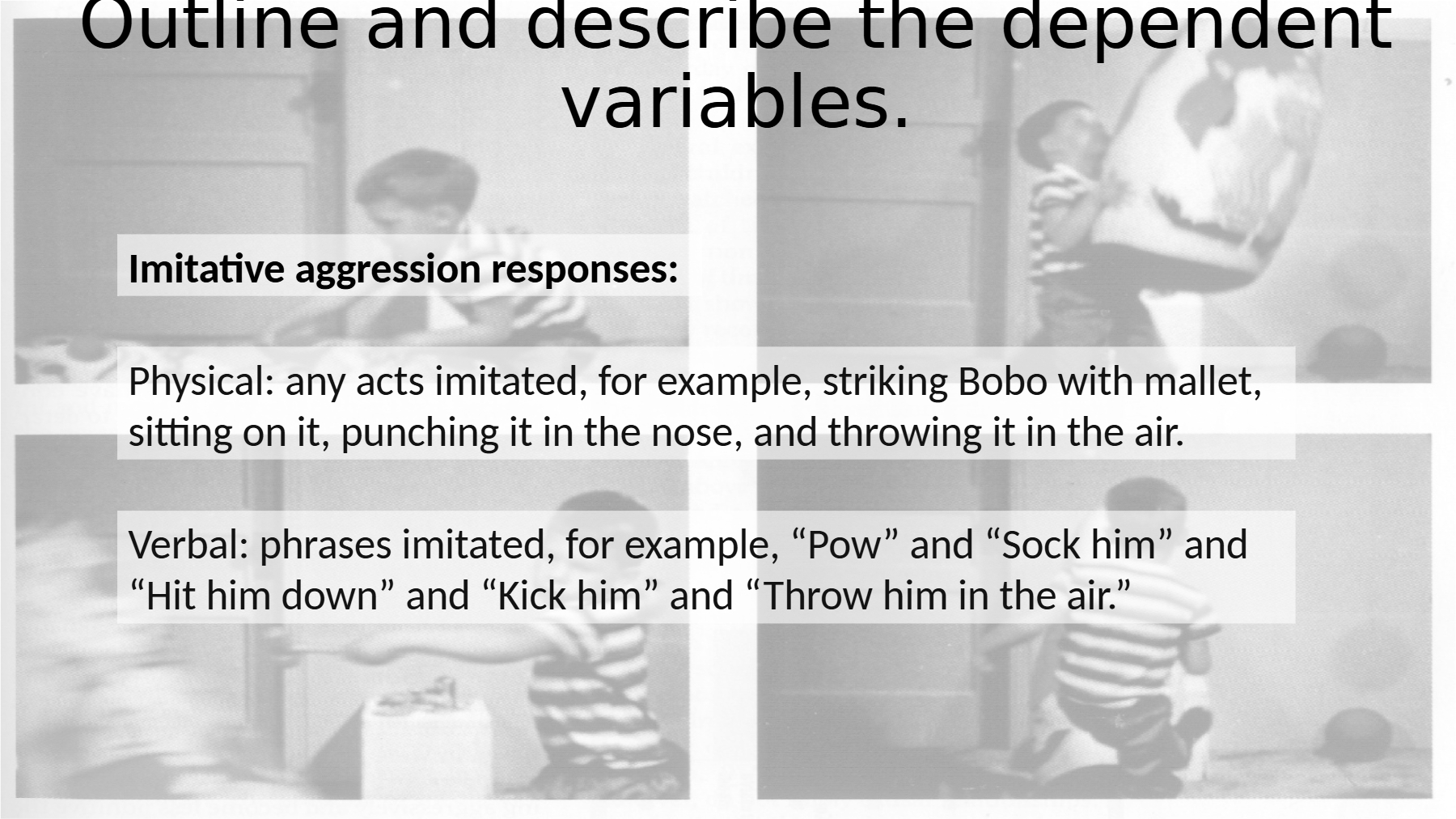
Which of the following are dependent variables measured in the study?
Imitative physical aggression
Imitative verbal aggression
Non-imitative aggression
Sex of role model
28
29
Multiple Select
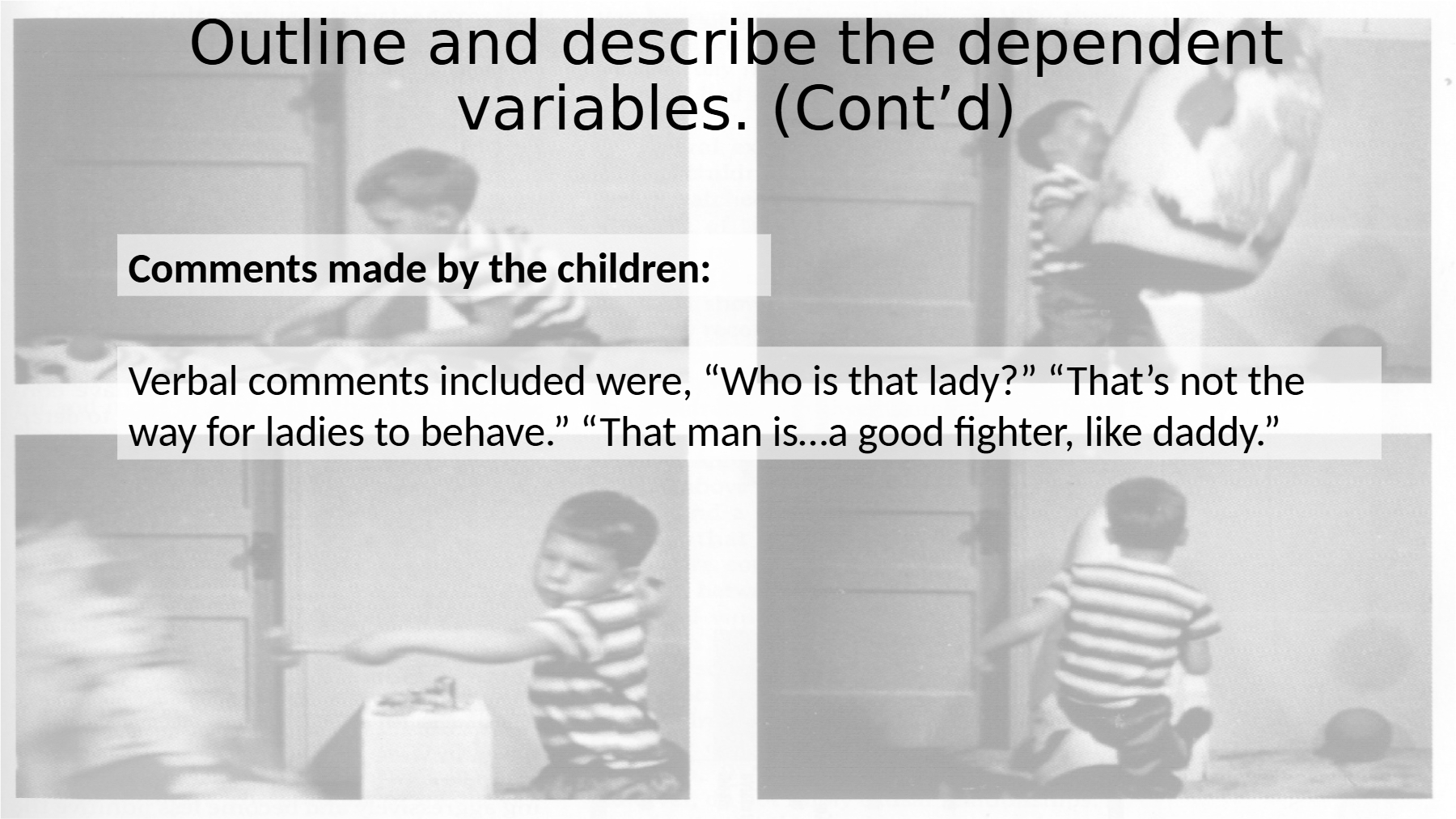
Which of the following comments made by children were considered qualitative data in the study?
Who is that lady?
That man is...a good fighter, like daddy.
Pow!
That's not the way for ladies to behave.
30
31
Multiple Choice
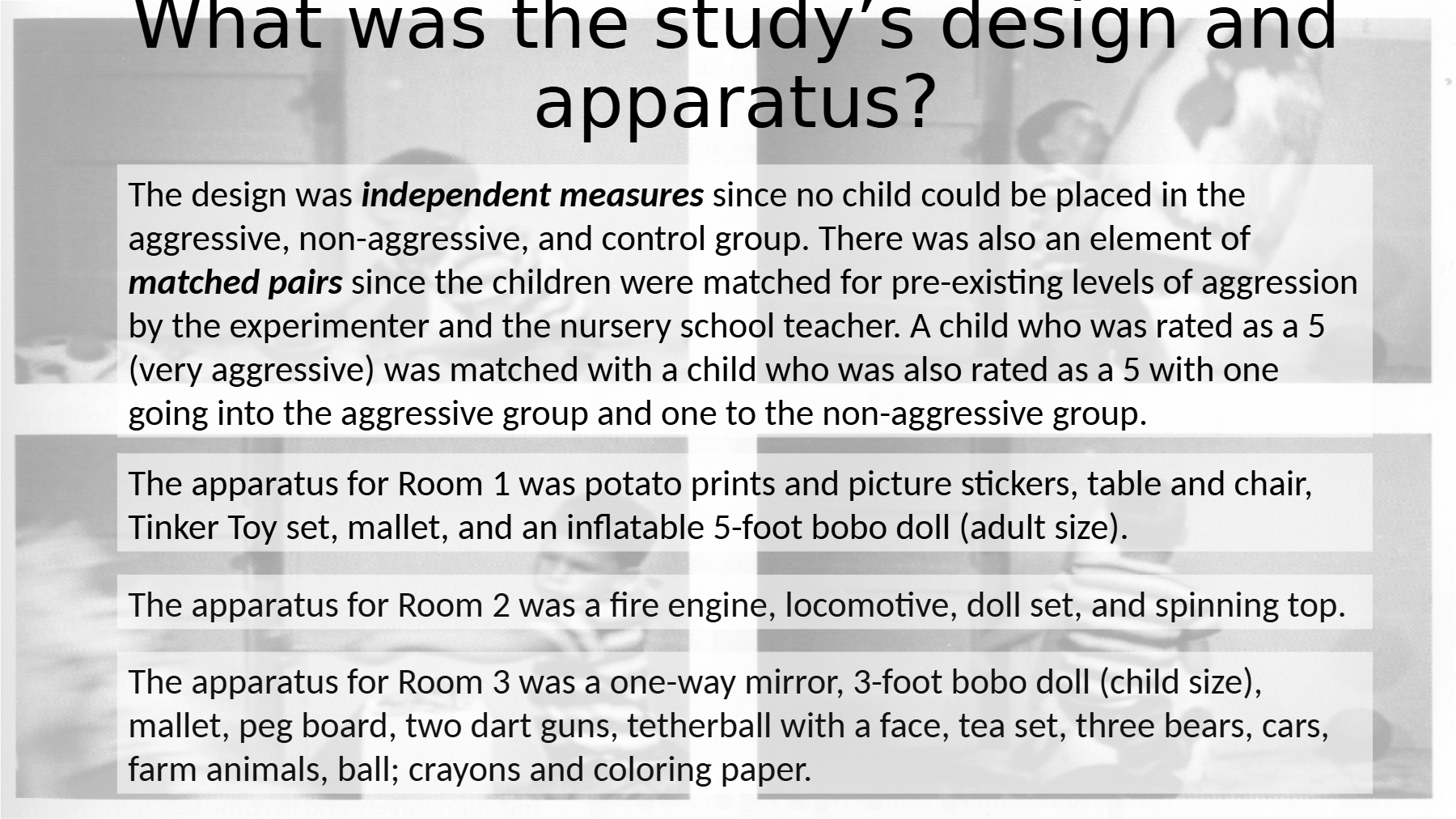
What type of experimental design was used in the study and why was it chosen?
Independent measures design, because children could not be placed in multiple groups
Repeated measures design, because children participated in all conditions
Matched pairs design, because children were matched for age only
Randomized control trial, because children were randomly assigned
32
33
Multiple Choice
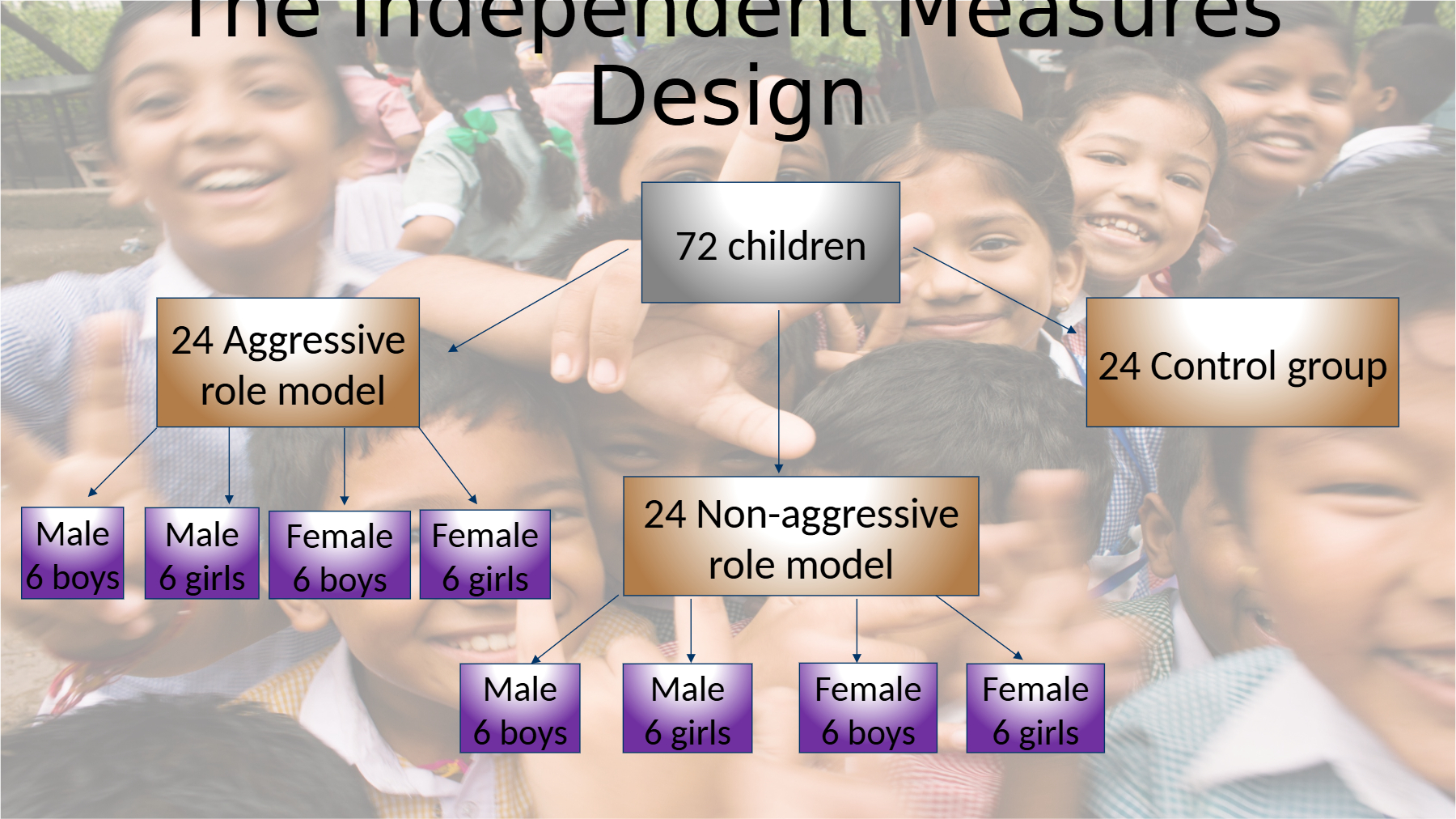
How were the children grouped in the experiment, and what was the composition of each group?
Aggressive, non-aggressive, and control groups with equal numbers of boys and girls
Aggressive and non-aggressive groups only, with more boys than girls
Control group only, with mixed genders
Aggressive, non-aggressive, and control groups, but only boys in each group
34
35
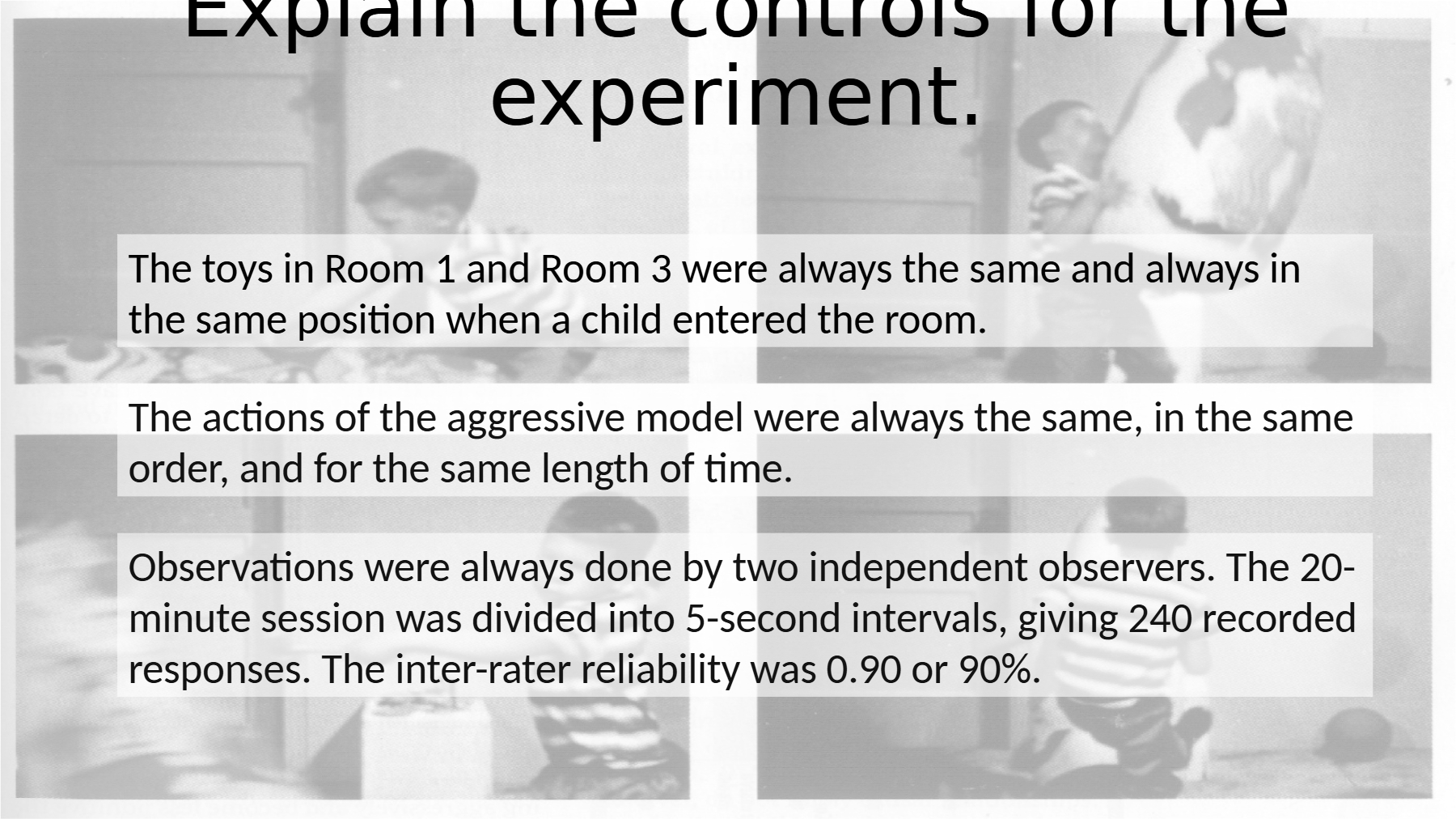
Open Ended
Explain how the experiment controlled for variables that could affect the outcome.
36
37
Fill in the Blanks
Type answer...
38
39
Multiple Choice
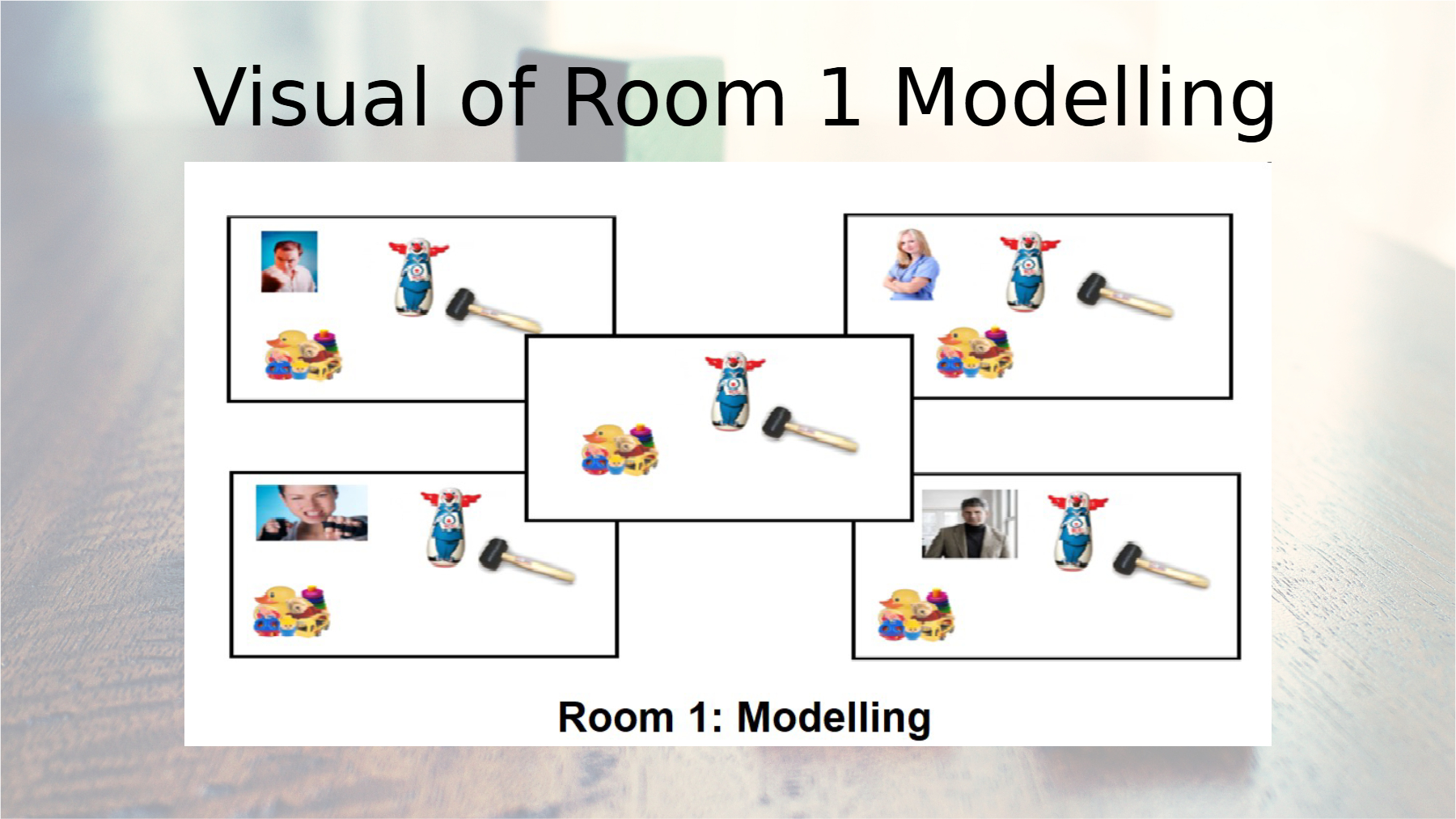
Which of the following best describes the procedure for children exposed to the aggressive model in Room 1?
The child watched a model assemble toys and then attack a bobo doll for nine minutes.
The child played quietly with toys for ten minutes.
The child was not exposed to any model.
The child watched a model ignore the bobo doll.
40
41
Multiple Select
Select all statements that accurately describe the procedure for the non-aggressive and control groups in Room 1.
Children exposed to a non-aggressive model watched the model play quietly and ignore the bobo doll.
Children in the control group were not exposed to any model.
Children exposed to an aggressive model watched the model attack the bobo doll.
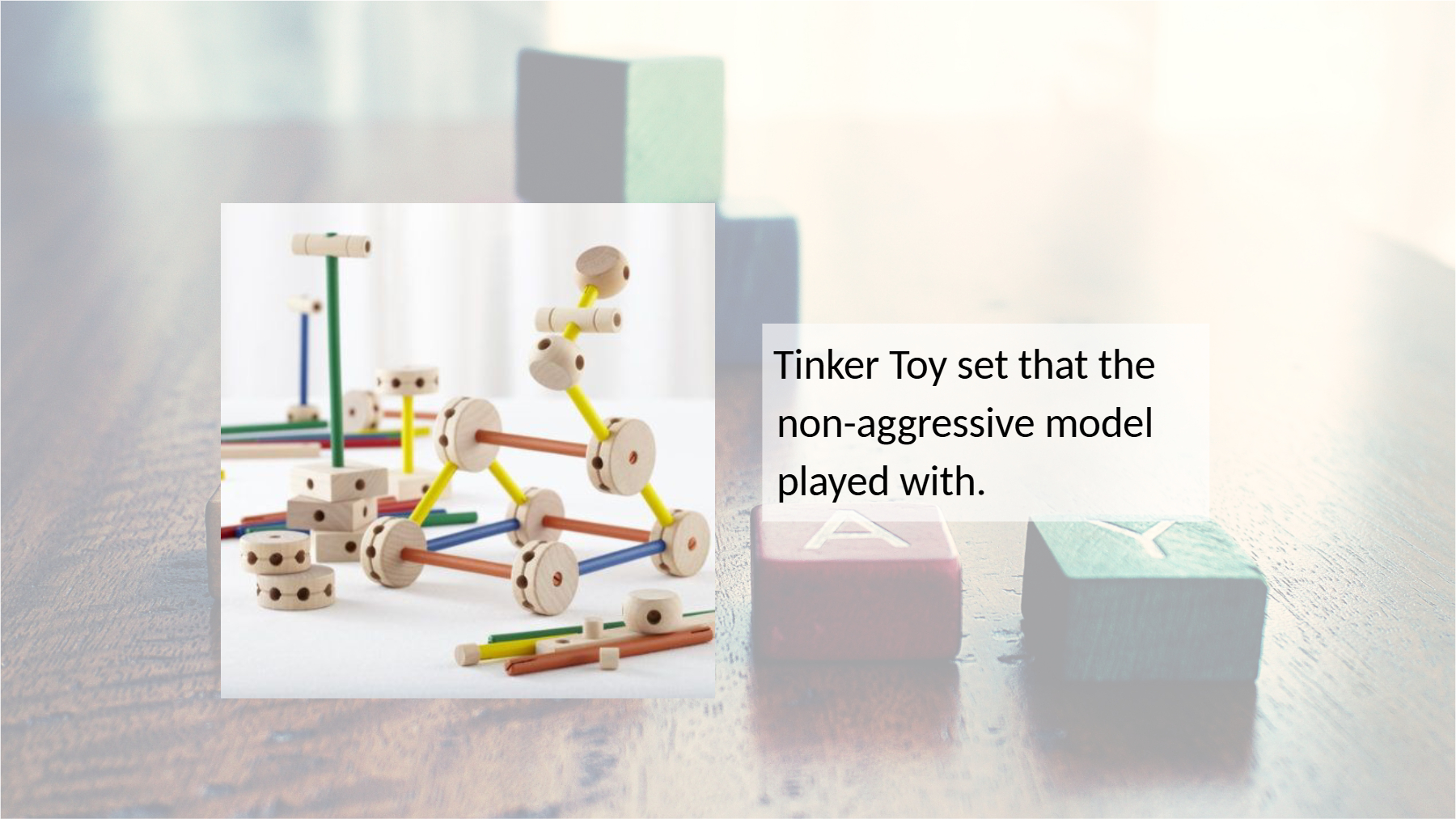
Children in the control group played with the Tinker Toy set.
42
43
44
Multiple Choice
Which toy set did the non-aggressive model play with?
Tinker Toy set
Bobo doll
Dart gun
Tea set
45
46
47
Open Ended
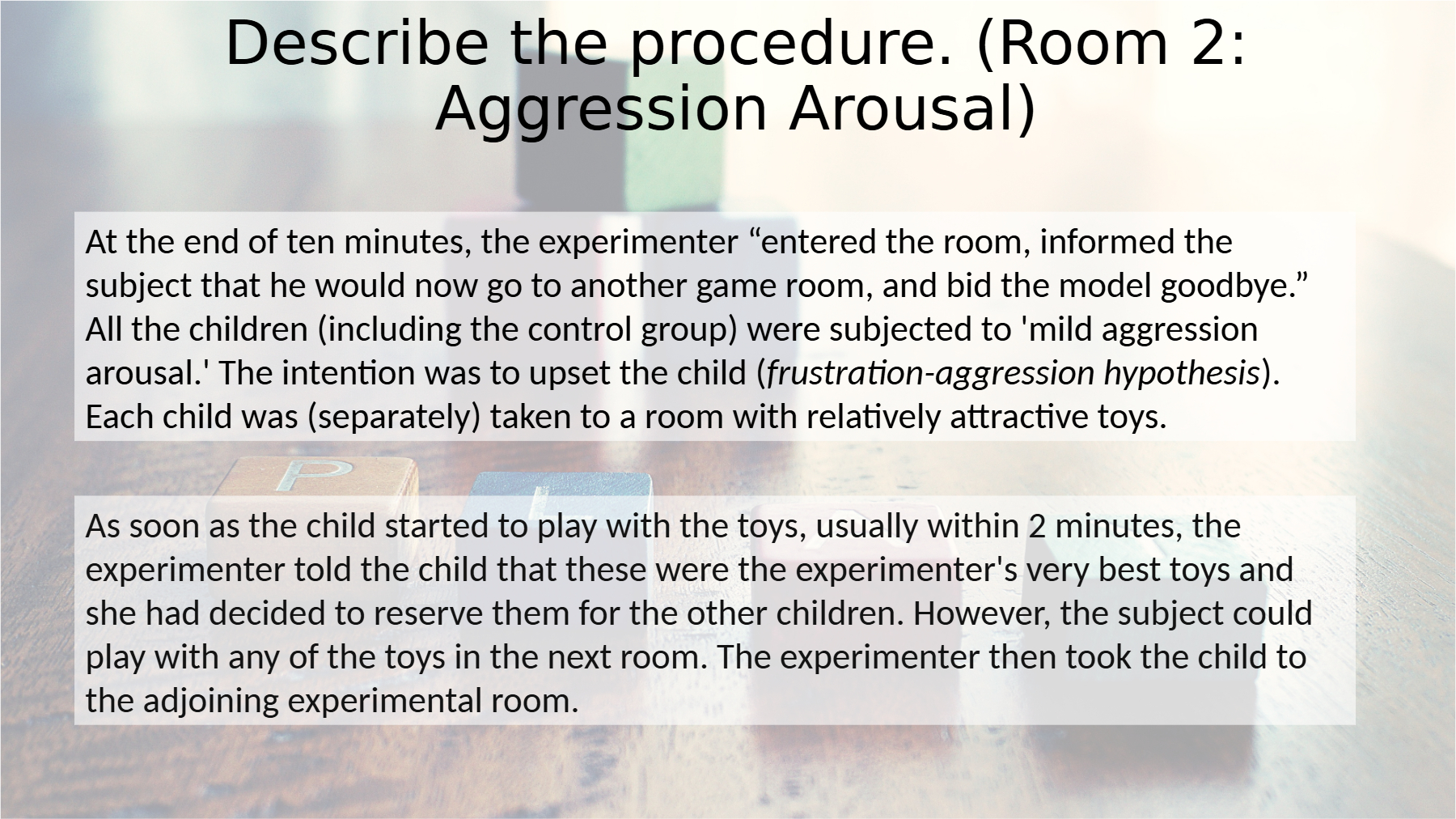
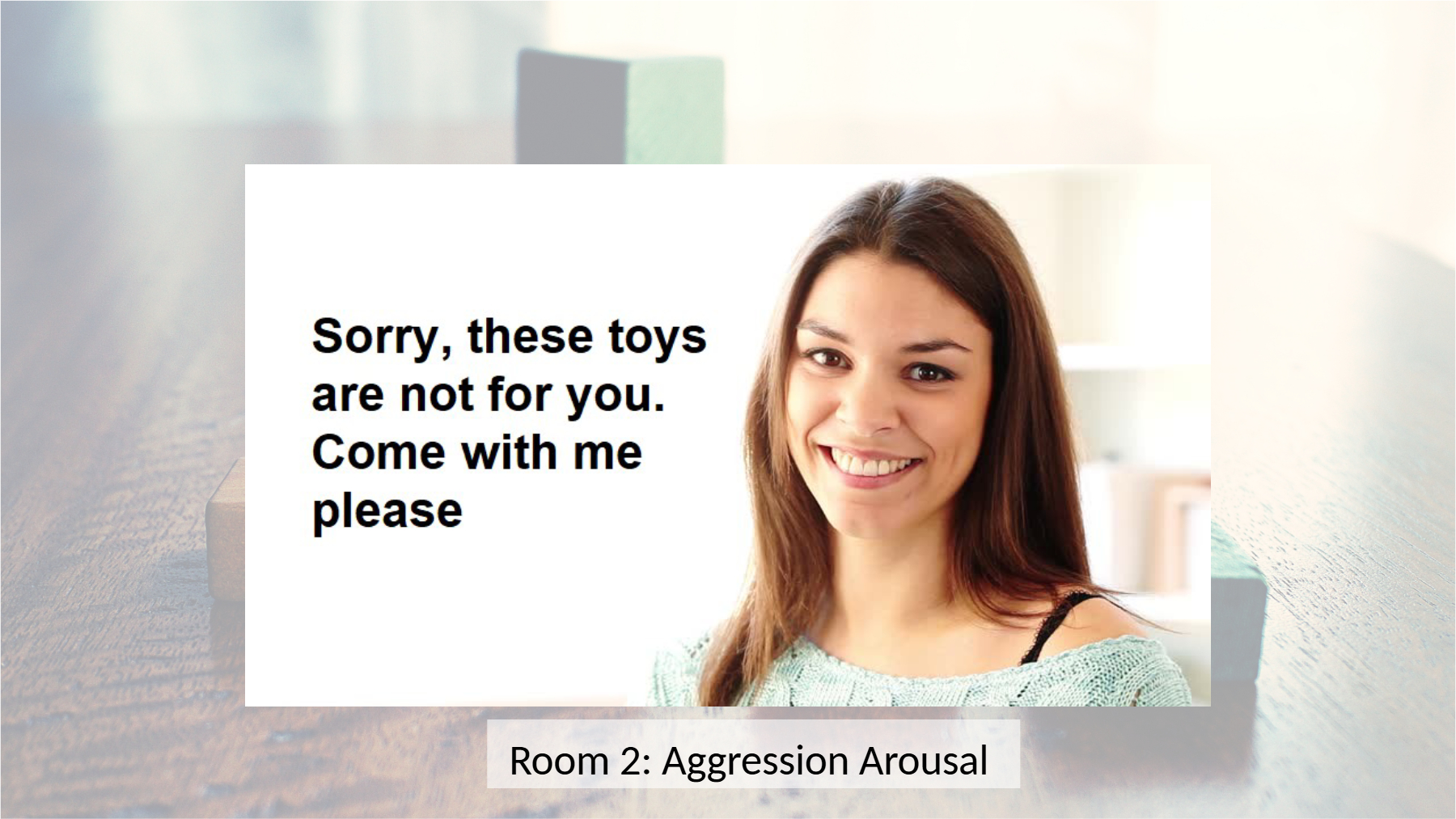
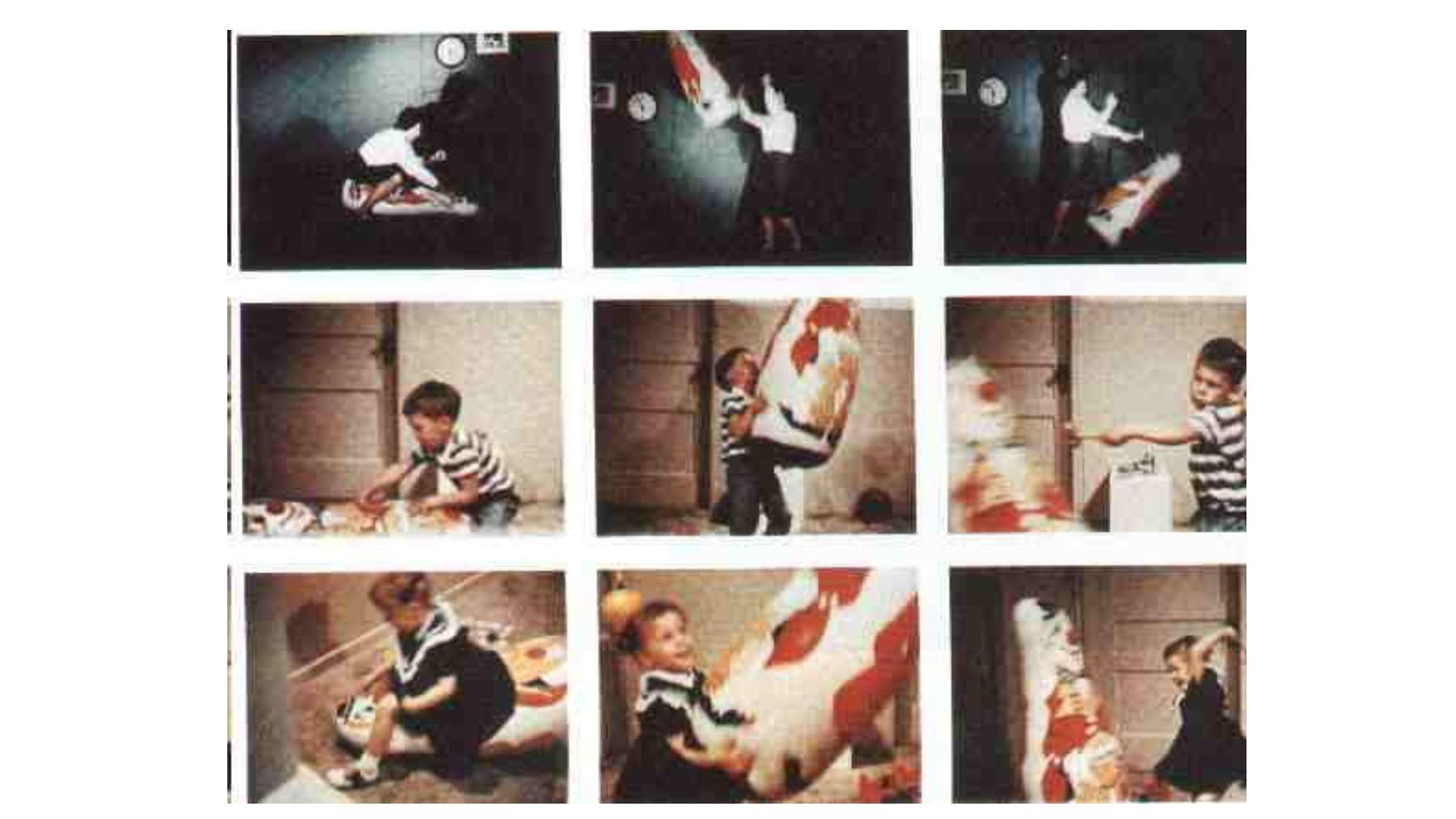
Explain how the frustration-aggression hypothesis was tested in the experiment. Use details from Room 2.
48
49
50
Multiple Select
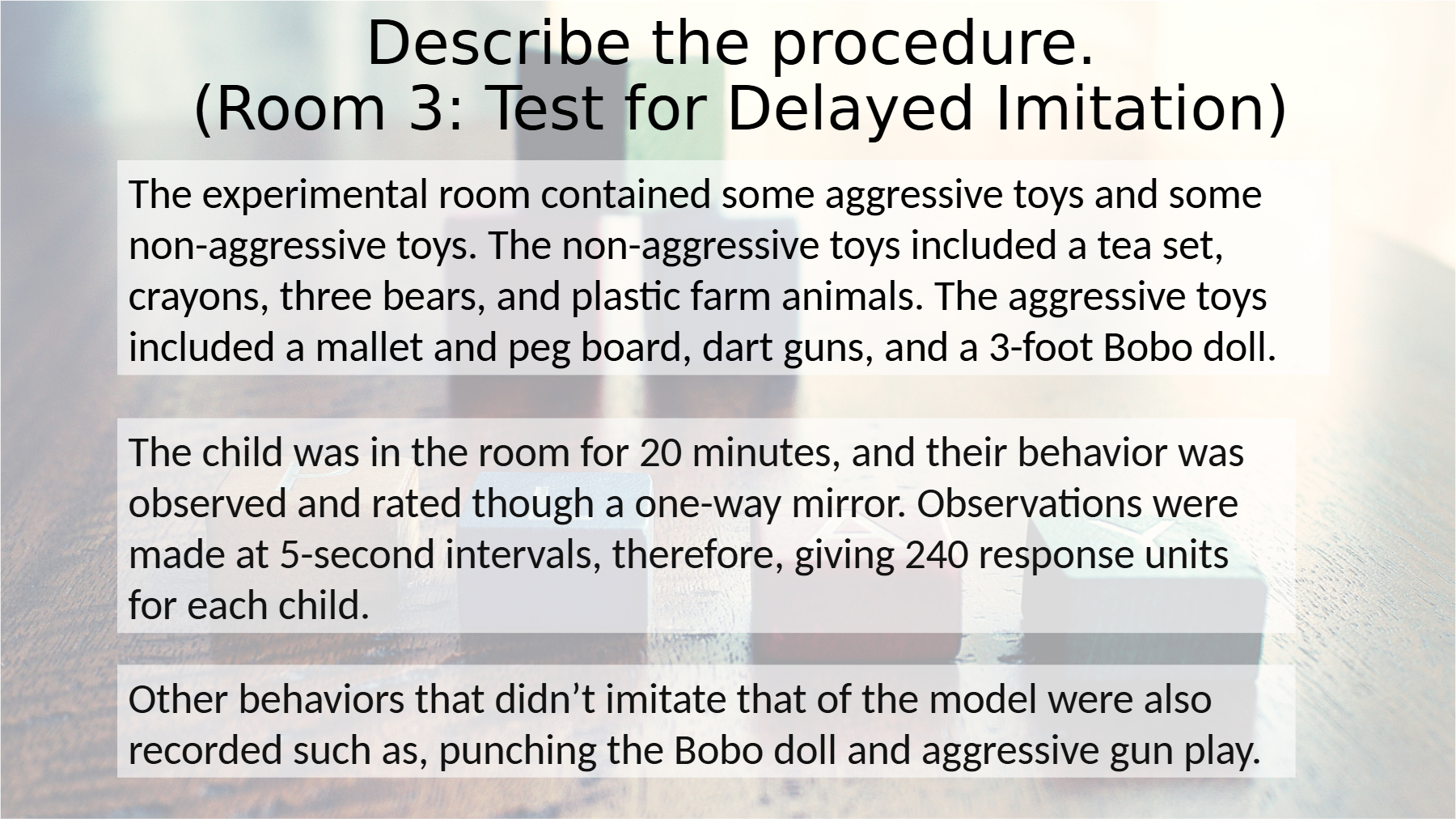
Select all behaviors that were recorded in Room 3 as not imitating the model.
Punching the Bobo doll
Aggressive gun play
Playing with crayons
Playing with plastic farm animals
51
Fill in the Blanks
Type answer...
52
Multiple Choice
Which toys were used as aggressive toys in the experiment described in Room 3?
Mallet and peg board, dart guns, Bobo doll
Tea set, crayons, three bears
Plastic farm animals, crayons, tea set
Dart guns, crayons, tea set
53
54
55
56
57
Open Ended
Reflecting on what you learned about aggression and imitation, how might observing aggressive behavior in media or sports influence people's actions in real life?
58
Multiple Choice
How does Social Learning Theory (SLT) explain the impact of watching a boxing match on aggressive actions?
It suggests watching aggression increases aggressive actions through imitation.
It suggests watching aggression decreases aggressive actions through catharsis.
It suggests watching aggression has no effect on behavior.
It suggests watching aggression leads to confusion about aggression.
Show answer
Auto Play
Slide 1 / 58
SLIDE
Similar Resources on Wayground

51 questions
Supply
Presentation
•
11th - 12th Grade
59 questions
ECONOMICS TOPIC 3 LESSON 7 & 8
Presentation
•
12th Grade
52 questions
Endogenic Processes I
Presentation
•
11th Grade
53 questions
MOMENTUM
Presentation
•
12th Grade
51 questions
EmTechWk2Lesson1.2
Presentation
•
11th - 12th Grade
51 questions
10/17 - 2.7 Market Structures
Presentation
•
12th Grade - University
53 questions
Sensation & Perception - Psychology
Presentation
•
12th Grade
55 questions
Supply
Presentation
•
12th Grade
Popular Resources on Wayground
20 questions
Math Review

Quiz
•
3rd Grade
15 questions
Fast food
Quiz
•
7th Grade
20 questions
Context Clues
Quiz
•
6th Grade
20 questions
Inferences
Quiz
•
4th Grade
19 questions
Classifying Quadrilaterals
Quiz
•
3rd Grade
20 questions
Figurative Language Review
Quiz
•
6th Grade
20 questions
Equivalent Fractions
Quiz
•
3rd Grade
10 questions
Identify Fractions, Mixed Numbers & Improper Fractions
Quiz
•
3rd - 4th Grade
Discover more resources for Social Studies
10 questions
Fact Check Ice Breaker: Two truths and a lie
Quiz
•
5th - 12th Grade
10 questions
Video Games
Quiz
•
6th - 12th Grade
15 questions
Memorial Day Trivia
Quiz
•
KG - 12th Grade
12 questions
Name that Candy
Quiz
•
KG - 12th Grade
22 questions
Regular Preterite -AR-ER-IR-
Quiz
•
12th Grade
20 questions
Guess The App
Quiz
•
KG - Professional Dev...
30 questions
K/H Final Review Part 1
Quiz
•
9th - 12th Grade
40 questions
NCFE Earth and Environmental Science Released Test
Quiz
•
9th - 12th Grade