

Rotational Motion + Gravity

Presentation
•
Physics
•
9th - 12th Grade
•
Hard
+4
Standards-aligned

Benjamin Toner
FREE Resource
87 Slides • 19 Questions
1

2
3
Multiple Choice
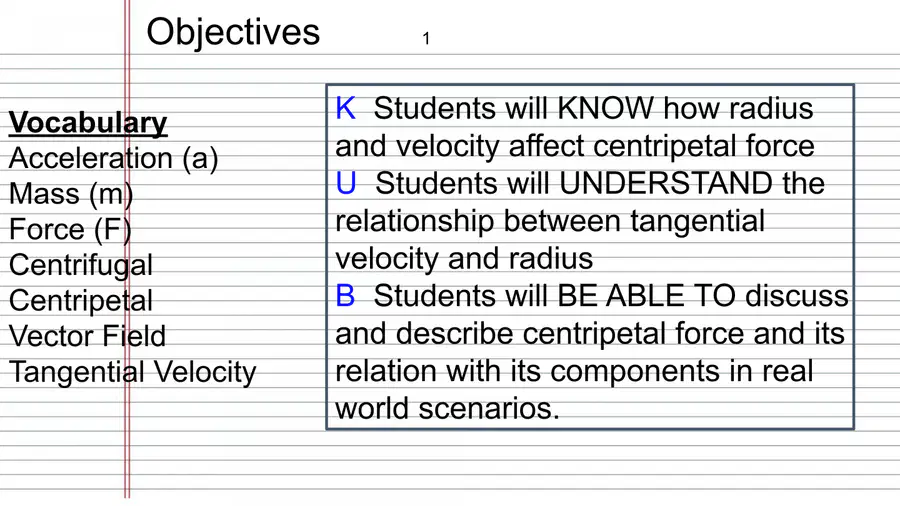
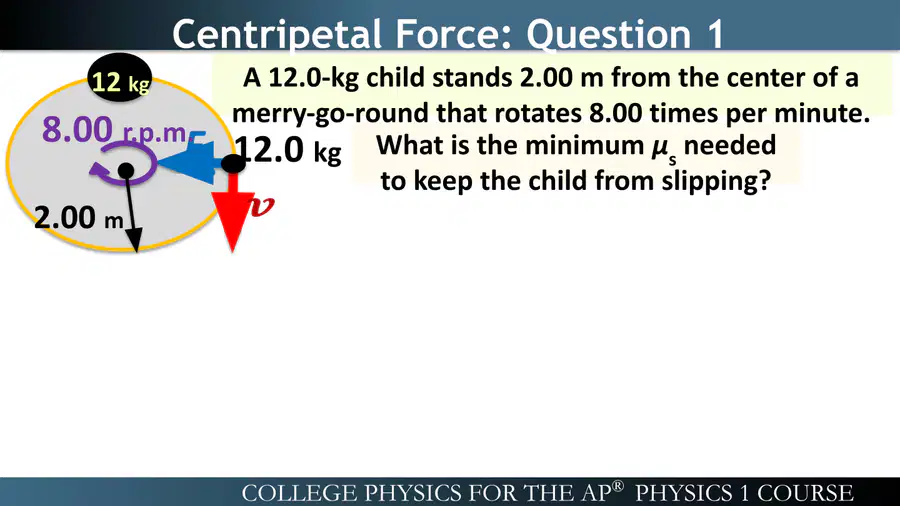
Which of the following best describes the relationship between tangential velocity and radius in circular motion?
As tangential velocity increases, radius must decrease for the same centripetal force.
Tangential velocity and radius are unrelated in circular motion.
As radius increases, tangential velocity must decrease for the same centripetal force.
Both tangential velocity and radius increase together for the same centripetal force.
4

5

6

7
Multiple Choice
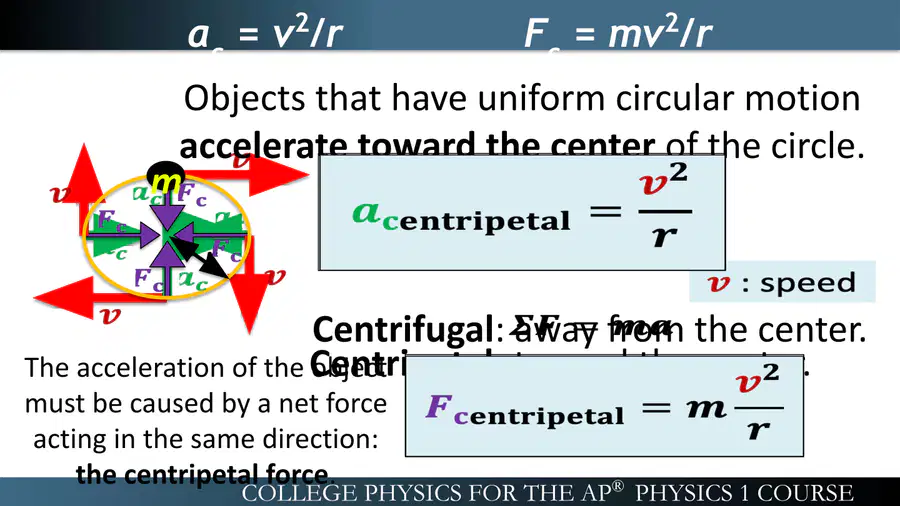
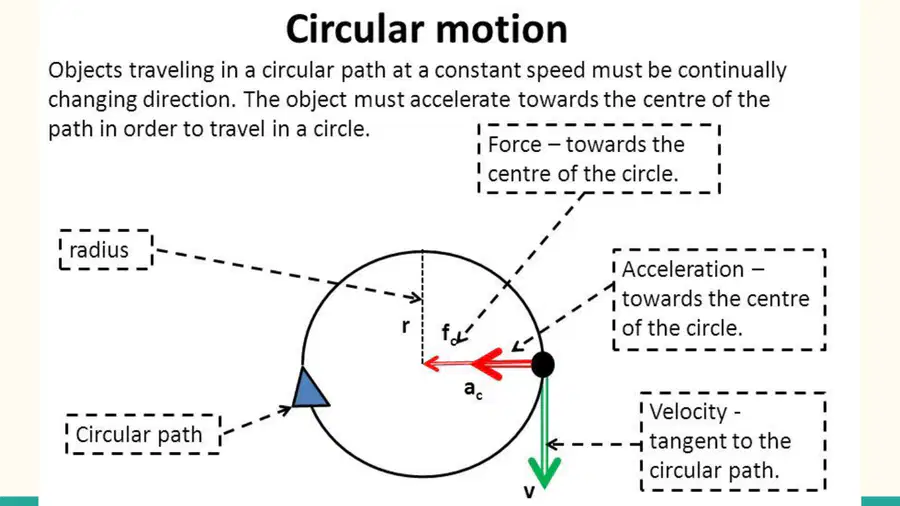
What is the direction of centripetal acceleration for an object in uniform circular motion?
Toward the center of the circle
Away from the center of the circle
Tangent to the circle
In the direction of velocity
8
9
Multiple Choice
Which of the following formulas correctly represents the centripetal acceleration?
a = v^2/r
a = r/v^2
a = v/r^2
a = r^2/v
10
11
Fill in the Blanks
Fill in the blank: In circular motion, the force that acts toward the center of the circle is called the
Type answer...
12
13
Multiple Choice
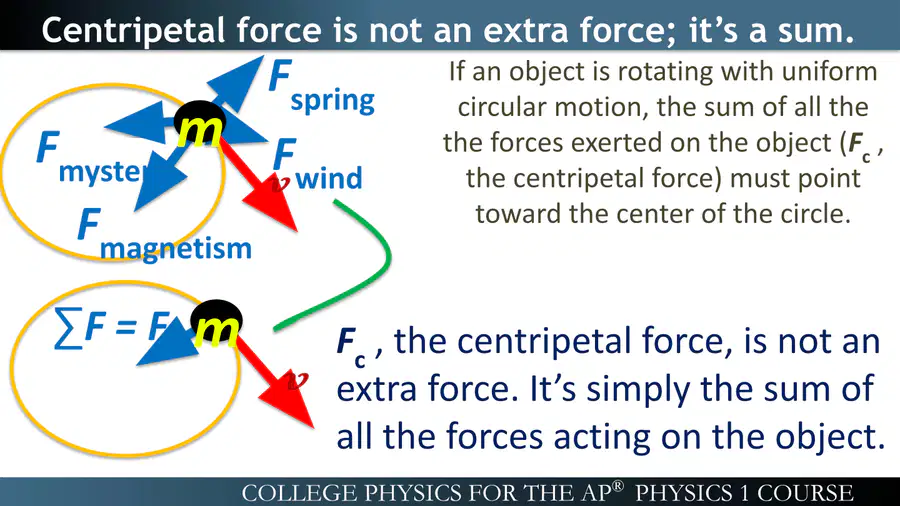
Which of the following statements about centripetal force are correct?
It is the sum of all forces acting toward the center.
It is an extra force acting on the object.
It always points away from the center.
It is only due to gravity.
14
15
Multiple Choice
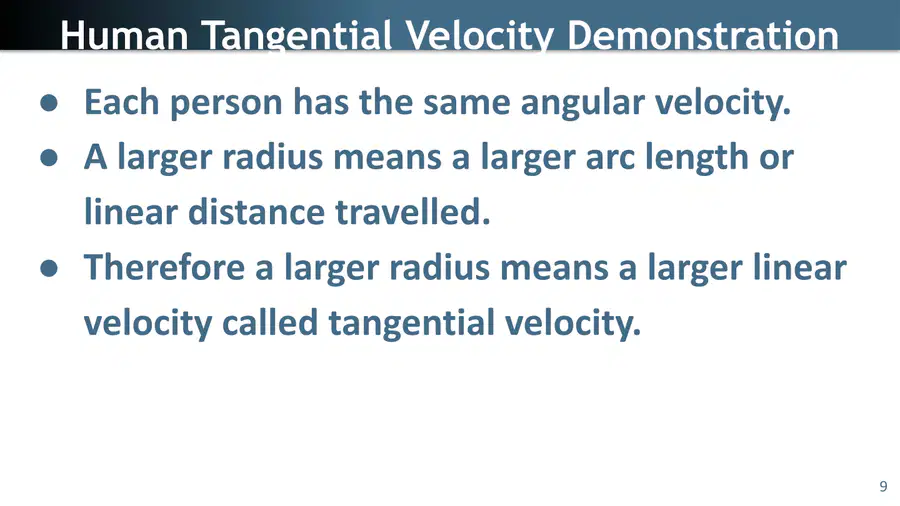
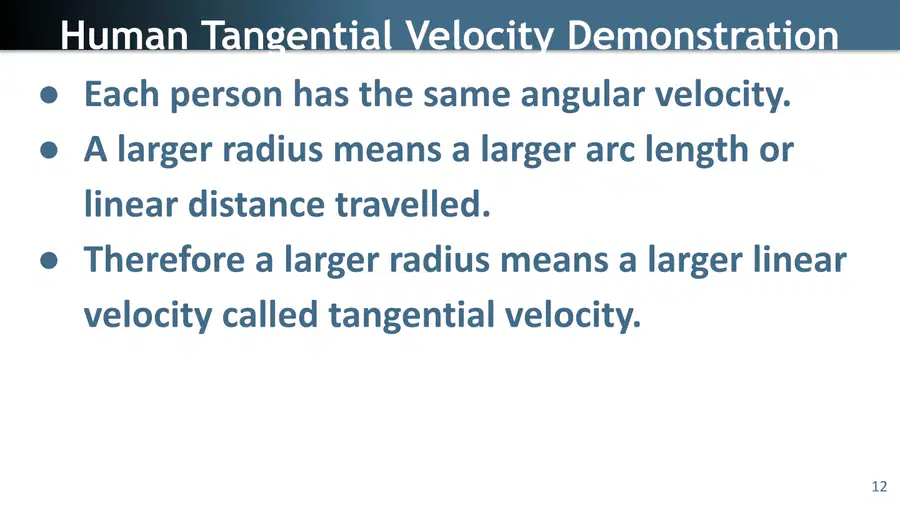
If two people are on a rotating platform at different distances from the center, but both have the same angular velocity, who will have the greater tangential velocity?
The person closer to the center
The person farther from the center
Both have the same tangential velocity
Tangential velocity does not depend on distance
16
17
18
19
Multiple Select
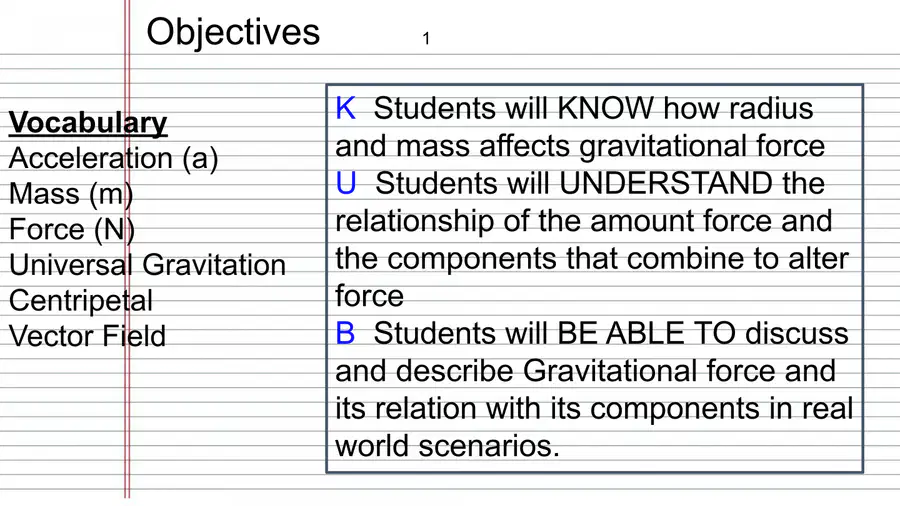
Which of the following are components that affect gravitational force, as described in the lesson objectives?
Radius
Mass
Acceleration
Temperature
20

21
Fill in the Blanks
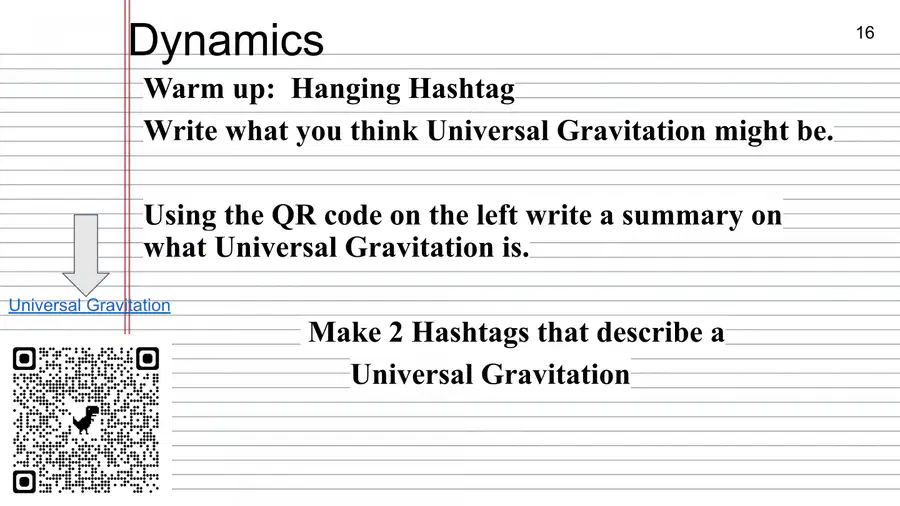
Sir Isaac Newton's Universal Law of Gravitation states that all objects attract each other with a force that depends on their
Type answer...
22
23
Multiple Select
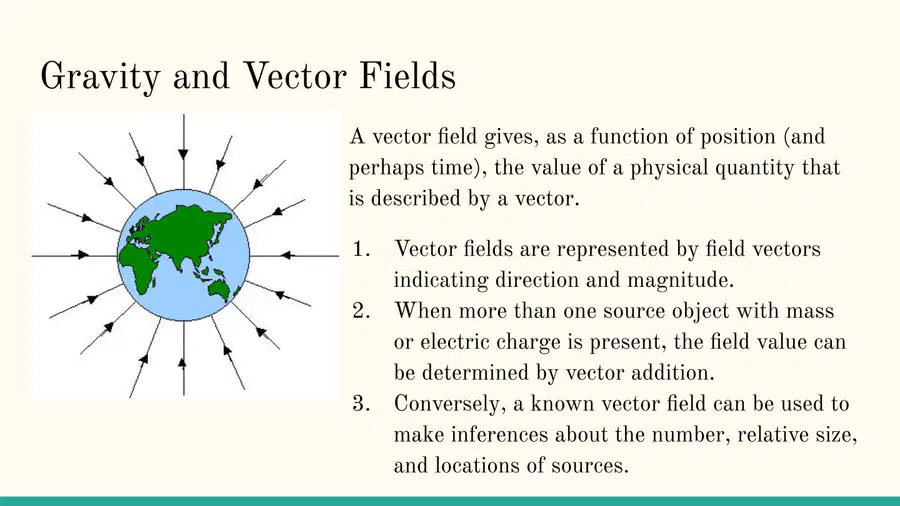
Based on the objectives and the concept of vector fields, which of the following statements are true?
Vector fields can represent gravitational forces.
The direction of a vector field shows the direction of the force.
Vector fields only apply to electric charges.
The magnitude of a vector field can change with position.
24
25
Multiple Choice
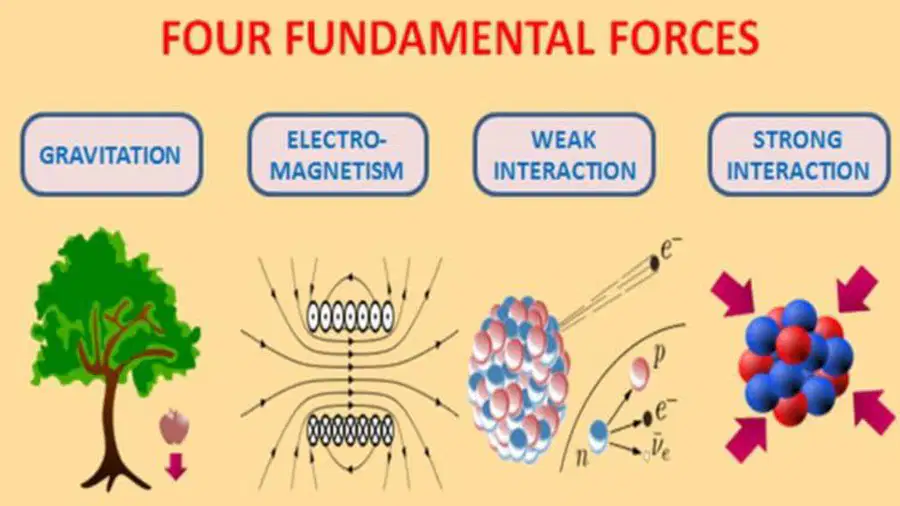
Which of the following is NOT one of the four fundamental forces shown in the image?
Gravitation
Electromagnetism
Friction
Strong Interaction
26
27
Fill in the Blanks
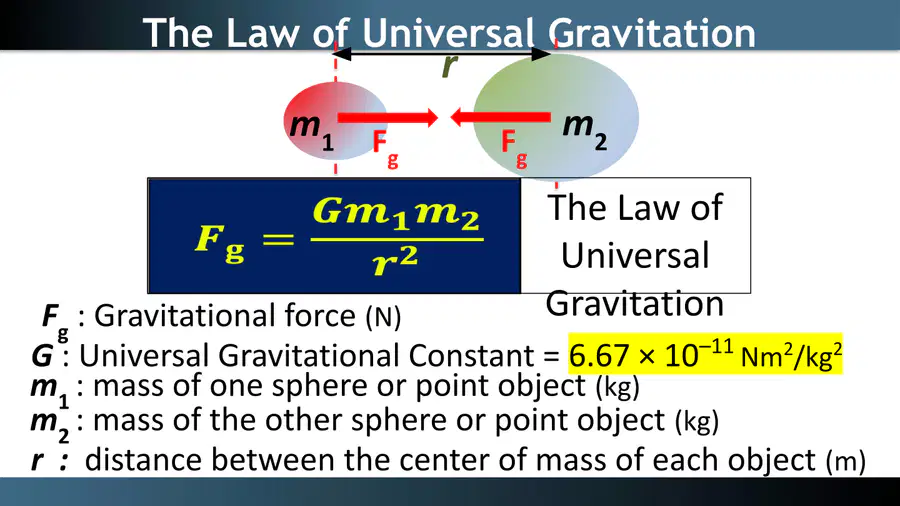
The value of the Universal Gravitational Constant is
Type answer...
28
Multiple Choice
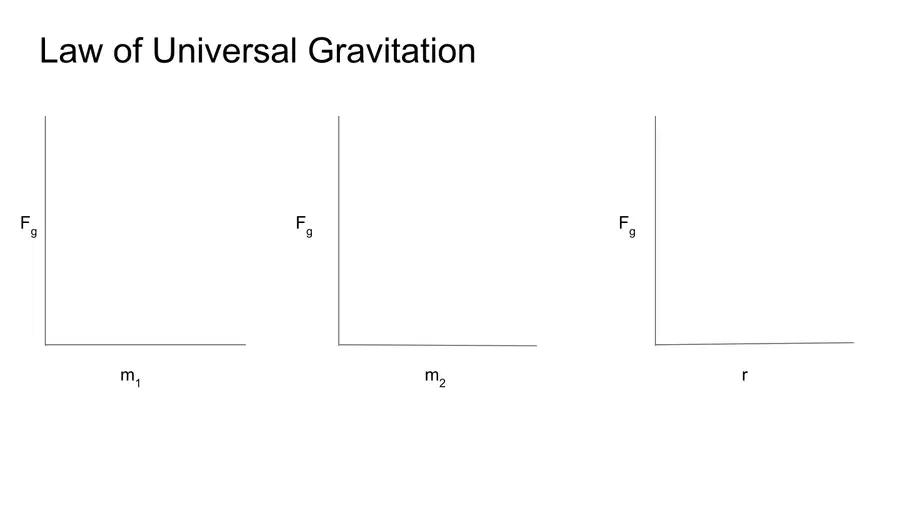
According to the Law of Universal Gravitation, what happens to the gravitational force if the distance between two objects is doubled?
It becomes four times stronger
It becomes half as strong
It becomes one-fourth as strong
It remains the same
29
30
31
Multiple Choice
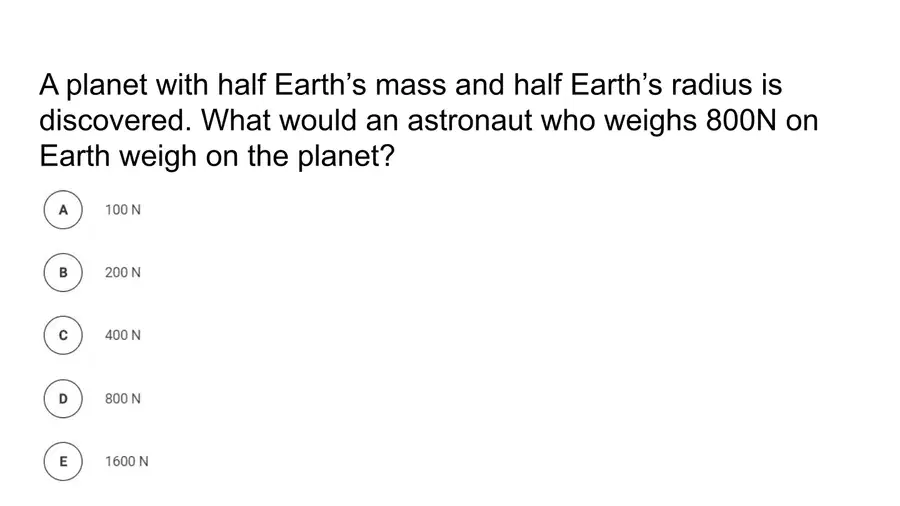
A planet with half Earth’s mass and half Earth’s radius is discovered. What would an astronaut who weighs 800N on Earth weigh on the planet?
100 N
200 N
400 N
800 N
1600 N
32
33
Multiple Choice
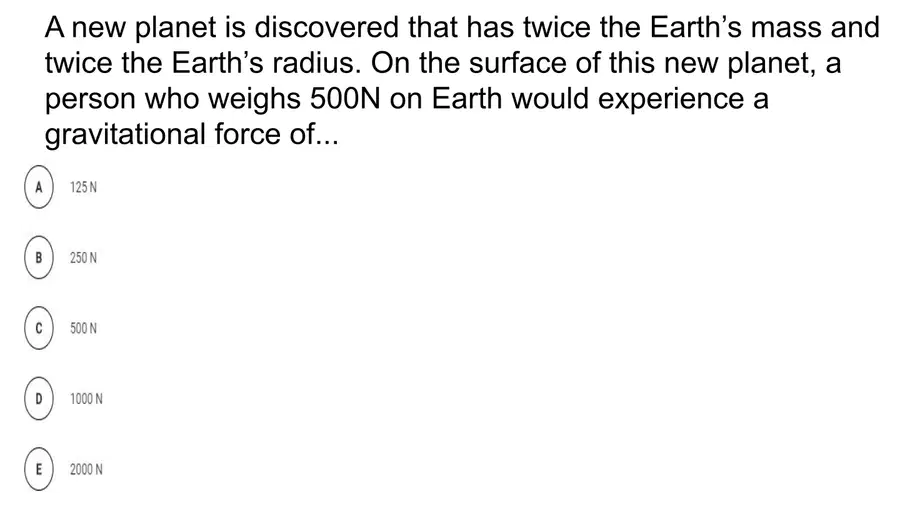
A new planet is discovered that has twice the Earth’s mass and twice the Earth’s radius. On the surface of this new planet, a person who weighs 500N on Earth would experience a gravitational force of...
125 N
250 N
500 N
1000 N
2000 N
34
35
36
Multiple Choice
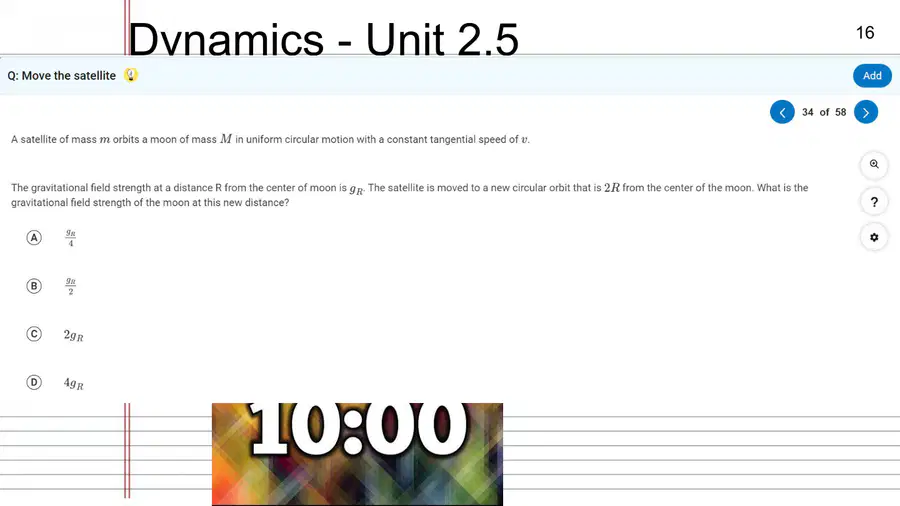
What is the gravitational field strength of the moon at a distance of 2R from its center, given that the field strength at R is g_R?
g_R/4
g_R/2
2g_R
4g_R
37
38

39
Multiple Choice
Which physical principles are illustrated by the motion of the roller coaster in the image?
Conservation of energy and centripetal force
Electromagnetic induction
Thermal expansion
Buoyancy
40
41
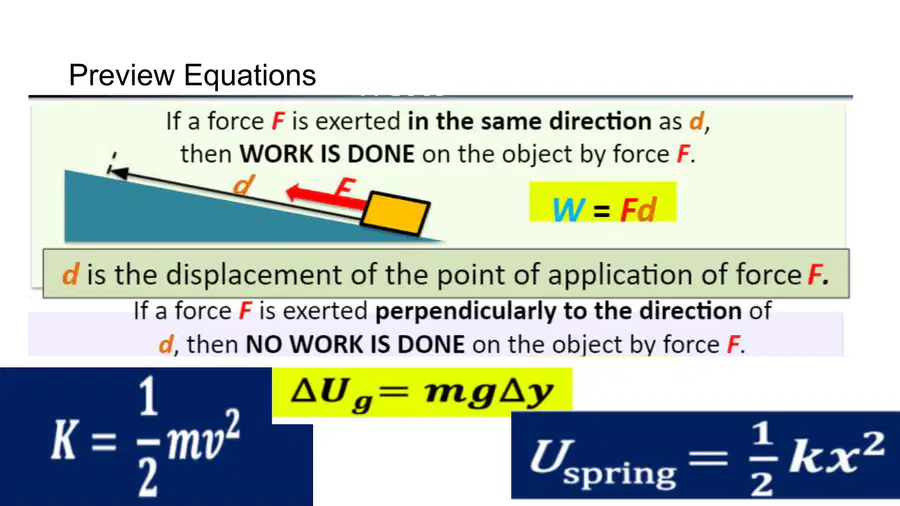
Fill in the Blanks
Fill in the blank: The equation for work done by a force in the same direction as displacement is W =
Type answer...
42

43
44
45
46
47
48
49
50
51
52

53
54
55
56
57
58
59
60
61
62
63

64
65

66
67
68

69
70
71
72
73
74
75
76
77
78
79
80
81
82
Fill in the Blanks
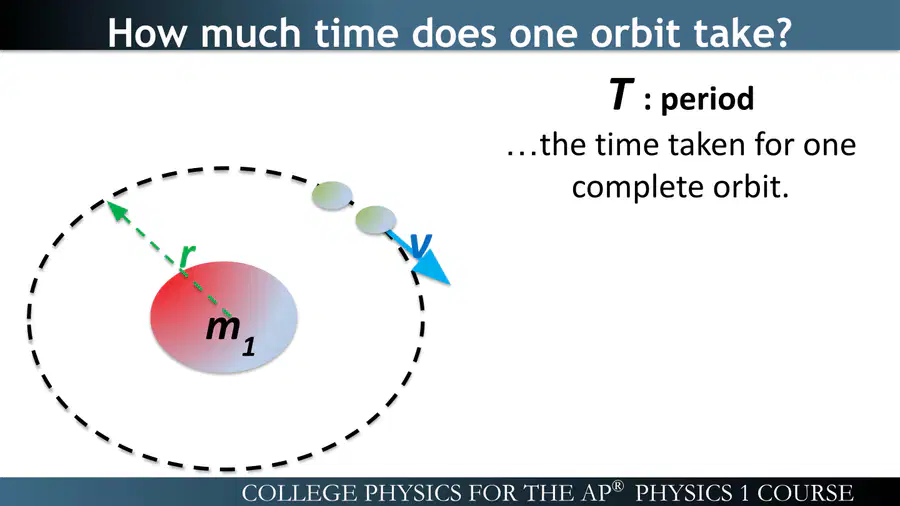
Fill in the blank: The period (T) is the time taken for one complete
Type answer...
83
84
85
86
87
88
89
Multiple Choice
How do radius and velocity affect centripetal force?
Radius increases centripetal force, velocity decreases it
Both radius and velocity increase centripetal force
Radius decreases centripetal force, velocity increases it
Both radius and velocity decrease centripetal force
90
91
92
93
94
95
96
97
98
99
100
101
102
103
104
105
106
Show answer
Auto Play
Slide 1 / 106
SLIDE
Similar Resources on Wayground

96 questions
Выпускной 3 год
Presentation
•
9th - 12th Grade
94 questions
CH. 17 ~ 1990's - US History
Presentation
•
9th Grade - University
94 questions
AP12 Respiratory System Lecture
Presentation
•
9th - 12th Grade
105 questions
Exposition Text and Modals for Grade 10 CJ
Presentation
•
10th Grade
101 questions
100 illustrated ways to pass the earth science regents
Presentation
•
9th - 12th Grade
99 questions
Covalent (Molecular) Compounds lesson
Presentation
•
9th - 12th Grade
101 questions
3.1 Enzymes
Presentation
•
10th - 12th Grade
97 questions
LEVEL 1e Alternatives to 4-Year College
Presentation
•
9th - 12th Grade
Popular Resources on Wayground
10 questions
Safety Day 2026 – Student Review

Quiz
•
9th Grade
21 questions
Continents and Oceans
Quiz
•
6th Grade
20 questions
Parts of Speech
Quiz
•
5th Grade
16 questions
Subject & Predicate
Quiz
•
5th Grade
25 questions
Multiplication Facts
Quiz
•
5th Grade
12 questions
Map Skills
Quiz
•
3rd Grade
22 questions
Continents and Oceans
Quiz
•
5th Grade
15 questions
Rounding Decimals
Quiz
•
5th Grade
Discover more resources for Physics
20 questions
Position vs. Time Graphs
Quiz
•
9th Grade
10 questions
Exit Check 5.1 - Forms of Energy
Quiz
•
9th Grade
11 questions
Electricity Explained

Interactive video
•
9th - 12th Grade
87 questions
25-26 Unit 1.2 Review - Radioactivity & Earth's Age
Quiz
•
8th - 10th Grade
15 questions
Position vs. Time and Velocity vs. Time Graphs
Quiz
•
10th - 12th Grade
18 questions
Quiz #8 Practice: Forces on an Incline
Quiz
•
9th Grade
25 questions
Newton's Laws of Motion
Quiz
•
9th Grade