PLTW ROBOTICS summative review
Presentation
•
Computers
•
8th Grade
•
Practice Problem
•
Easy
Matthew Molloy
Used 4+ times
FREE Resource
16 Slides • 46 Questions
1
PLTW Robotics UNIT 1
By Matthew Molloy
2
Any Slides that do not have a question attached are notes. WRITE THEM DOWN/DRAW THEM IN YOUR NOTEBOOK!
P.S. There will be a vocabulary test as part of the retesting after we review
3
A Driving Gear may also be called an input Gear since It inputs power into the system
A driven Gear call also be called an output gear since it takes power out of the system to do work
4
5
Labelling
Identify the driving gear, the driven gear, and the idler.
Idler Gear
Driven/Output Gear
Driving/input gear
6
Open Ended
How can you identify the input and output of a mechanical system?
7
Open Ended
How can you identify the input Gears and output gears of a mechanical system?
8
Open Ended
What is the purpose of an idler gear?
9
Open Ended
In the gear train image below, what direction will the driven gear turn—clockwise or counterclockwise? In the same direction as the driving gear or opposite?
10
11
Open Ended
Summarize this client summary/design brief
12
Open Ended
How are build guides, images, and written directions used to communicate designs? Give an example.
13
14
15
Open Ended
Give two examples of an input device.
16
Open Ended
Give two examples of an output device.
17
Open Ended
Write the name of this class in CamelCase
18
Open Ended
Why is it important to label your motors when setting up devices on VEXCode? (instead of leaving them as "motor1", "motor2", ect.)
19
20
Open Ended
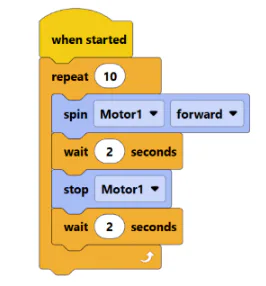
What will this program do when you run it?
21
Open Ended
Analyze this code and explain what it will do when run.
22
23
Open Ended
Why is testing a robotic design necessary and important?
24
Open Ended
What is the value of incrementally building and programming solutions? Why might this approach be helpful for engineers and software developers when they design and build solutions?
25
26
27
Open Ended
Reflect on the videos.
What is the role of the Driver?
What is the role of the Navigator?
Name two important skills that you should practice when using pair programming.
28
Open Ended
How does flowcharting help you think through an algorithm?
29
Open Ended
How many times will this loop?
30
Open Ended
How many times will this loop?
31
Open Ended
Reflect on the loops to answer the following questions:
What actions will both loops do while the loop is running?
How many times will the robot move forward in the repeat loop?
For how long will the robot move forward with one execution of the loop?
32
Open Ended
How are loops useful in coding?
33
Open Ended
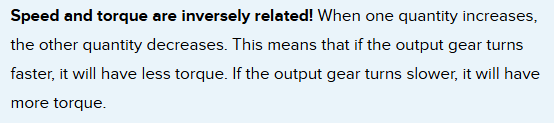
What is the relationship between the size of the gears and the resulting output speed of the system? For example, how do you cause the resulting output speed to be faster, slower, or the same as the input speed?
34
35
Open Ended
Which gear ratios will cause the right-hand gears to rotate faster than the left-hand gears?
36
Open Ended
You are a designer and have been asked to create a prototype of an electric fan that spins at least 300 rpm. Your materials for the prototype include an electric motor that spins at 150 rpm and a variety of gear sizes. Describe a gear train that you might create to meet the requirement.
37
Open Ended
Does the output speed increase, decrease, or stay the same?
please label as 1, 2, and 3
38
Multiple Choice
A 36 tooth driving gear (connected to the motor) is moving a 12 tooth driven gear. What is the gear ratio?... It has a speed advantage.
3:1
1:3
3:3
1:1
39
Multiple Choice
A 12 Tooth driving gear (connected to the motor) is connected to a 36 tooth driven gear. What is the gear ratio and mechanical advantage?
3 : 1 Torque Advantage
3 : 1 Speed Advantage
no Mechanical Advantage
1 : 3 Torque Advantage
40
Multiple Choice
A 12 Tooth driving gear (connected to the motor) is connected to a 36 tooth driven gear. What is the gear ratio and mechanical advantage?
3 : 1 Torque Advantage
3 : 1 Speed Advantage
no Mechanical Advantage
1 : 3 Torque Advantage
41
Multiple Choice
Looking at the picture, what is the gear ratio?
The arrow indicates how the motor is turning the gear.
6 : 10
5 : 3
10 : 6
3 : 5
42
Multiple Choice
What's the ratio?
Make sure ratio is reduced
1:1
84 : 60
60 : 36
5 : 3
43
Multiple Choice
What's the ratio?
Make sure ratio is reduced
7 : 1
12 : 84
84 : 12
1 : 7
44
Multiple Choice
When gears are equal in size, what is the gear ratio?
There is no gear ratio when sizes are equal
1:3
2:5
1:1
45
Multiple Choice
What is the gear ratio with a driving gear with 40 teeth and a driven gear with 8 teeth?
Make sure ratio is reduced to lowest terms
8 : 40
1 : 5
5 : 1
40 : 8
46
Multiple Choice
What is the Gear Ratio of a driven gear with 8 teeth and a driving gear with 32 teeth?
Make sure ratio is reduced to lowest terms
8 : 32
32 : 8
1 : 4
4 : 1
47
Multiple Choice
The input gear has 6 teeth.
The output gear has 48 teeth. The gear ratio is...
Make sure ratio is reduced to lowest terms
1 : 8
8 : 1
6 : 48
48 : 6
48
Multiple Choice
# of teeth output gear = 30
# of teeth input gear = 60
What is the gear ratio (in lowest terms)?
1 : 2
30 : 60
2 : 1
60 : 30
49
Multiple Choice
# of teeth input gear = 25
# of teeth output gear = 75
What is the gear ratio (in lowest terms)?
3 : 1
1 : 3
25 : 75
75 : 25
50
Multiple Choice
# of teeth input gear = 20
# of teeth output gear = 80
What is the gear ratio (in lowest terms)?
80 : 20
1 : 4
4 : 1
20 : 80
51
52
53
Open Ended
answer question in picture
54
Open Ended
Describe two benefits of using a design process when solving a problem.
55
56
Open Ended
Describe what is happening in the following code.
57
Open Ended
Analyze and describe what is happening in the flowchart.
58
Open Ended
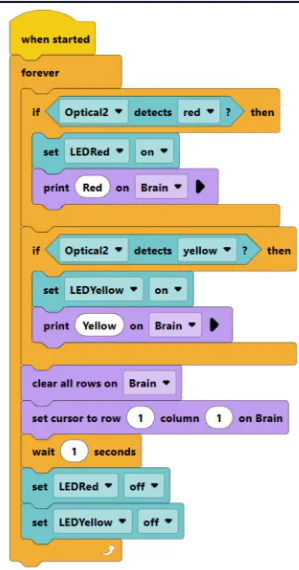
A group of interns is using the code below. They are not able to get print displays on their brain. Using the brain display, they have verified that the colored cubes are being detected, and the sensor is connected to the correct port. They know it must be a programming error, but they cannot find it. Help them identify the bug in their code, and explain how they can modify their program to see the colors printed to the brain.
59
60
Open Ended
How does the chain drive cause a bicycle to move forward?
61
Open Ended
How has your perspective of computer science changed throughout this course? Describe how your perceptions have changed or explain why your perceptions have not changed.
62
Open Ended
In this unit, you used the skills of collaboration, problem-solving, communication, and creative thinking. How might you use these skills in your daily life? How might you use these skills in your dream job?
PLTW Robotics UNIT 1
By Matthew Molloy
Show answer
Auto Play
Slide 1 / 62
SLIDE

Similar Resources on Wayground
56 questions
Unit 5 Adaptations
Presentation
•
7th Grade
55 questions
Poetry Unit Introduction
Presentation
•
7th Grade
59 questions
N5 Software
Presentation
•
8th Grade
55 questions
Upwellings and Currents
Presentation
•
8th Grade
59 questions
Energy
Presentation
•
8th Grade
57 questions
Jaringan Komputer
Presentation
•
8th Grade
57 questions
Ordenando Múltiplas Listas
Presentation
•
8th Grade
56 questions
Lembaga Sosial IPS 8
Presentation
•
8th Grade
Popular Resources on Wayground
20 questions
STAAR Review Quiz #3
Quiz
•
8th Grade
20 questions
Equivalent Fractions
Quiz
•
3rd Grade
6 questions
Marshmallow Farm Quiz
Quiz
•
2nd - 5th Grade
20 questions
Main Idea and Details
Quiz
•
5th Grade
20 questions
Context Clues
Quiz
•
6th Grade
20 questions
Inferences
Quiz
•
4th Grade
19 questions
Classifying Quadrilaterals
Quiz
•
3rd Grade
12 questions
What makes Nebraska's government unique?
Quiz
•
4th - 5th Grade
Discover more resources for Computers
20 questions
STAAR Review Quiz #3
Quiz
•
8th Grade
8 questions
Amoeba Sister Asexual vs Sexual Reproduction
Interactive video
•
8th Grade
15 questions
Pythagorean Theorem Word Problems Quizizz
Quiz
•
8th Grade
20 questions
Graphing Inequalities on a Number Line
Quiz
•
6th - 9th Grade
4 questions
Spring Break rest and recharge
Presentation
•
6th - 8th Grade
20 questions
Scatter Plots and Line of Best Fit
Quiz
•
8th Grade
19 questions
Introduction to Properties of Waves
Presentation
•
6th - 8th Grade
16 questions
Interactions within Ecosystems
Presentation
•
6th - 8th Grade