

AP Biology Lesson: Topic 1.1: Prop. of Water

Presentation
•
Biology
•
9th - 12th Grade
•
Practice Problem
•
Easy
+4
Standards-aligned

James Franks
Used 1+ times
FREE Resource
9 Slides • 41 Questions
1

2

3

4
Hotspot
Click on the partial negative area of H2O.
5
Multiple Choice
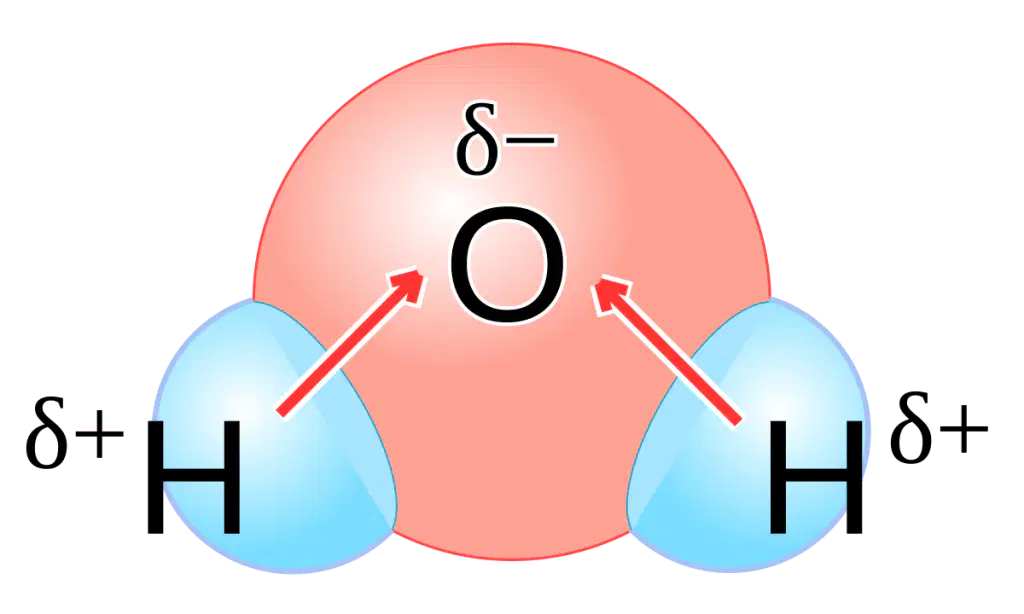
The bond formed by the sharing of electrons between the slightly negative Oxygen atom and the slightly positive Hydrogen atom within the same water molecule is called:
Polar Covalent bond
Ionic bond
Polar bond
Hydrogen bond
Nonpolar Covalent bond
6
Multiple Choice
Which of the following best describes the nature of a polar covalent bond found within a water molecule?
A bond formed when an oxygen atom completely transfers an electron to a hydrogen atom, creating ions.
A bond formed when electrons are shared equally between oxygen and hydrogen atoms, resulting in a neutral charge.
A bond formed when electrons are shared unequally, with the oxygen atom exerting a stronger pull on the electrons than the hydrogen atom.
A weak interaction formed between the oxygen atom of one water molecule and the hydrogen atom of a neighboring water molecule.
7
Multiple Choice
A student is drawing a model of a water molecule ($H_2O$) to illustrate its polarity. Which of the following descriptions accurately represents how the partial charges and bonds should be labeled in the diagram?
The bond between O and H should be labeled "Hydrogen Bond," and both atoms should be labeled with a partial positive charge.
The oxygen atom should be labeled with a partial positive charge because it has more protons than hydrogen.
The oxygen atom should be labeled with a partial negative charge, and the hydrogen atoms should be labeled with a partial positive charge.
The bonds should be labeled "Ionic Bonds," with the oxygen labeled negative (-1) and hydrogens labeled positive (+1).
8
Multiple Choice
Which scientific explanation best justifies why water is classified as a polar molecule?
Water is polar because the oxygen atom is highly electronegative, pulling shared electrons toward itself and creating an asymmetric distribution of charge.
Water is polar because it contains two hydrogen atoms for every one oxygen atom, creating a charge imbalance based on atomic mass.
Water is polar because it is able to dissolve nonpolar substances like lipids through hydrogen bonding.
Water is polar because the electrons are transferred completely from the hydrogen atoms to the oxygen atom, resulting in full electrostatic charges.
9

10
Match
Match the following
A strong bond formed within a single water molecule where electrons are shared unequally between the oxygen atom and a hydrogen atom.
The overall property of a molecule (like water) having opposite partial charges on opposite ends, caused by the unequal distribution of electrons.
A weak intermolecular attraction formed between the slightly positive hydrogen atom of one water molecule and the slightly negative oxygen atom of a neighboring water molecule.
Polar covalent bond
Polarity
Hydrogen bond
Polar covalent bond
Polarity
Hydrogen bond
11
Multiple Choice

Attractions between the negative Oxygen atom of one water molecule and the positive Hydrogen atom of another water molecule are called
(H...O)
12
Multiple Choice
Which of the following correctly defines a hydrogen bond in a biological context?
A weak electrostatic attraction between a partially positive hydrogen atom of one molecule and a highly electronegative atom (like oxygen) of another molecule.
A nonpolar interaction that occurs when two hydrogen atoms from different molecules repel each other.
A strong covalent bond formed by the sharing of electrons between a hydrogen atom and an oxygen atom within a single water molecule.
An ionic bond formed when a hydrogen atom transfers an electron completely to an oxygen atom.
13
Multiple Choice
If you were looking at a sample of liquid water, where would you locate the hydrogen bonds?
Between the hydrogen atoms of two adjacent water molecules.
Between the oxygen atom of one water molecule and the hydrogen atom of an adjacent water molecule.
Between the oxygen atom and the hydrogen atoms within a single water molecule.
Between the oxygen atom of one water molecule and the oxygen atom of an adjacent water molecule.
14
Multiple Select

Which is correct about this drawing? Choose 2 answers.
A is pointing to a covalent bond
B is pointing to a hydrogen bond
A is pointing to a hydrogen bond
B is pointing to a covalent bond
A would take more energy to break compared to B
B would take more energy to break compared to A
15
Ice is Less Dense than Liquid Water
Liquid water: hydrogen bonds break and reform constantly, allowing molecules to slide close together.
Ice: hydrogen bonds become stable and hold the molecules apart in a fixed, honeycomb-like structure (crystalline lattice).
Extra space makes ice less dense than water, causing it to float.
This floating layer insulates the water below, preventing it from freezing solid.

16
Multiple Choice
In freshwater ecosystems, the top layer of a lake freezes during the winter, yet the water underneath remains liquid, allowing aquatic life to survive. Which statement best explains the molecular mechanism responsible for this?
As water cools to freezing, the hydrogen bonds break, allowing water molecules to pack tightly together to form a dense,
In the solid state, hydrogen bonds stabilize and lock water molecules into a spacious crystalline lattice, making ice less dense than liquid water so it floats and insulates the water below.
When water freezes, the covalent bonds between oxygen and hydrogen expand, causing the ice to become nonpolar and float on top of the polar liquid water.
The high surface tension of cold water prevents the ice crystals from sinking, keeping the solid layer at the top to reflect sunlight.
17
18
Match
Match the following
A strong bond formed within a single water molecule where electrons are shared unequally between the oxygen atom and a hydrogen atom.
The overall property of a molecule (like water) having opposite partial charges on opposite ends, caused by the unequal distribution of electrons.
A weak intermolecular attraction formed between the slightly positive hydrogen atom of one water molecule and the slightly negative oxygen atom of a neighboring water molecule.
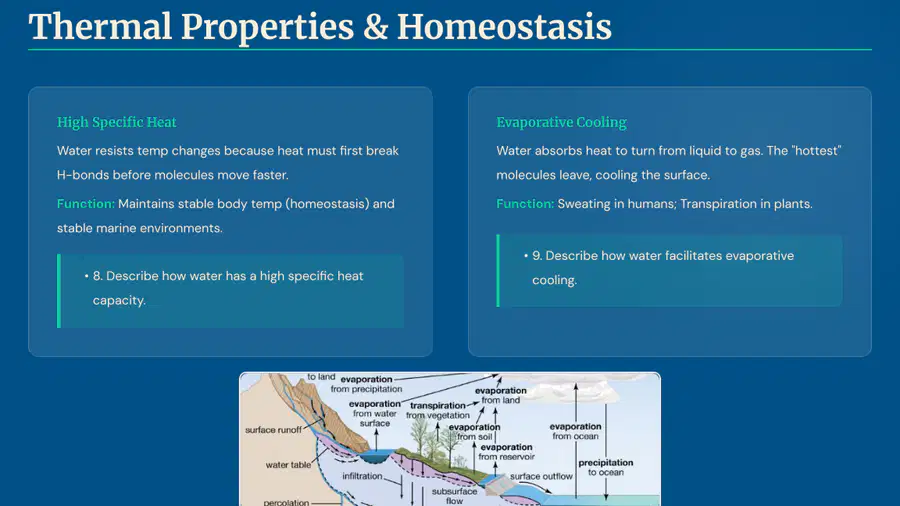
The property whereby water resists changing its temperature because a significant amount of heat energy must be absorbed to break hydrogen bonds before the molecules can move faster.
The process in which the surface of an object becomes cooler during evaporation because the molecules with the greatest kinetic energy change from liquid to gas and leave the surface.
Polar covalent bond
Polarity
Hydrogen bond
High specific heat
Evaporative cooling
Polar covalent bond
Polarity
Hydrogen bond
High specific heat
Evaporative cooling
19
Fill in the Blanks
20
Multiple Choice
Which of the following best explains why water has a high specific heat capacity?
Because of hydrogen bonding between water molecules
Because water molecules are nonpolar
Because water has ionic bonds
Because water is a gas at room temperature
21
Multiple Choice
Large bodies of water, such as lakes and oceans, can absorb and store huge amounts of heat from the sun while only warming up a few degrees. Which molecular explanation best accounts for this high specific heat capacity?
Heat energy must first be used to break the hydrogen bonds between water molecules before the molecules can move faster and increase temperature.
Heat energy is rapidly reflected off the surface of the water due to the surface tension created by cohesion.
The covalent bonds between oxygen and hydrogen atoms absorb the heat energy, preventing the water molecules from vibrating.
Water molecules are nonpolar, making them resistant to changes in kinetic energy when exposed to heat sources.
22
Multiple Choice
During a hot day, humans sweat and plants transpire to lower their internal temperature. How does the molecular behavior of water facilitate this "evaporative cooling" process?
Water molecules on the surface absorb heat and condense into a solid layer, blocking further heat absorption.
The water molecules with the highest kinetic energy break their hydrogen bonds and escape as gas, lowering the average kinetic energy (temperature) of the remaining liquid.
The hydrogen bonds between water molecules strengthen as they heat up, pulling the surface of the organism tighter to squeeze out heat.
Water breaks down into hydrogen and oxygen gas, a chemical reaction that consumes heat energy from the surroundings.
23
24
Match
Match the following
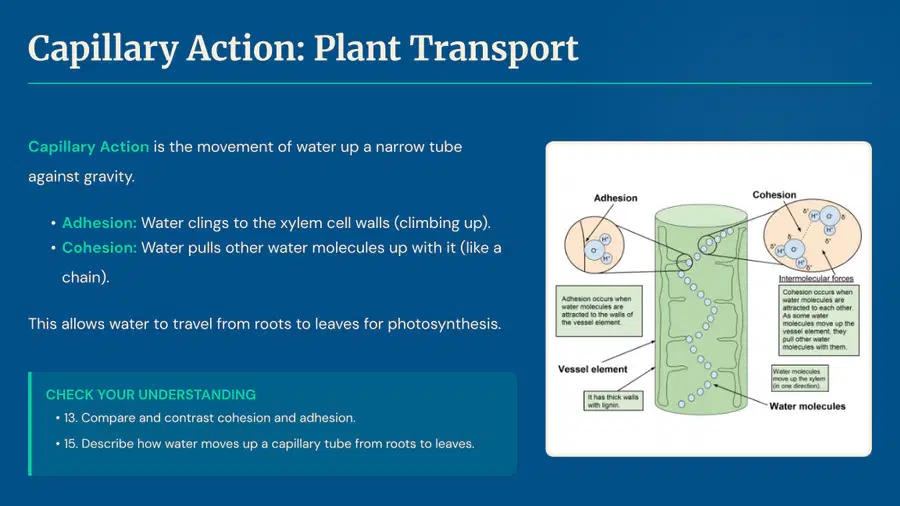
The attraction between water molecules and other polar surfaces, such as water clinging to the cell walls of xylem in plants to resist the pull of gravity.
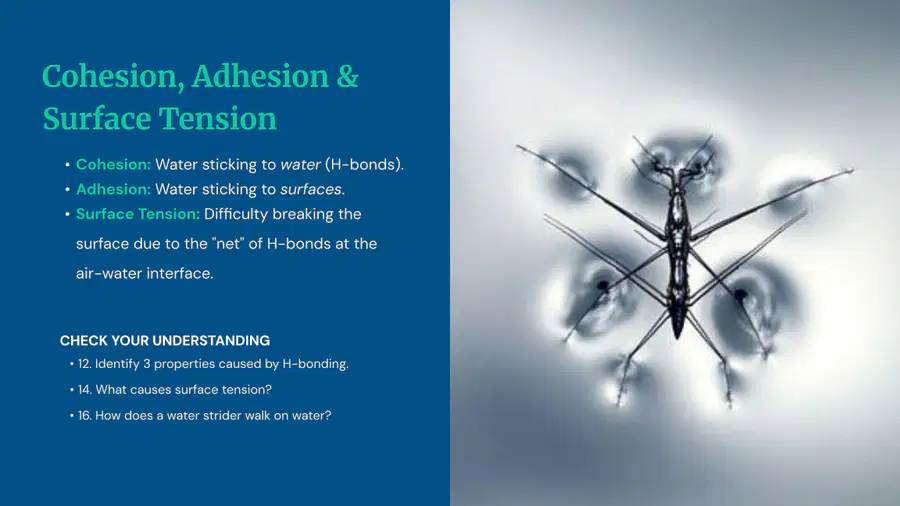
A measure of how difficult it is to break the surface of a liquid. It allows small insects, like water striders, to walk across a pond without sinking.
The attraction of water molecules to other water molecules due to hydrogen bonding, creating a continuous water column from roots to leaves.
adhesion
surface tension
cohesion
adhesion
surface tension
cohesion
25
Multiple Choice
Which of the following sets of properties are all direct results of hydrogen bonding?
Ionic conductivity, Low boiling point, Nonpolar solubility
Adhesion, Magnetism, High Density as solid
Cohesion, Surface Tension, High Specific Heat
Covalent bonding, Radioactivity, Acidity
26
Multiple Choice
Which molecular interaction is primarily responsible for creating surface tension?
High density of liquid water pushing upwards
Adhesive forces between water and air
Cohesive hydrogen bonds forming a network at the surface
Covalent bonds between surface molecules
27
Multiple Choice
Which statement best explains the physical mechanism allowing a water strider to stay atop the water?
The water strider is less dense than water, so it floats like a piece of ice.
The water strider's legs are hydrophobic (repel water), allowing it to press down on the surface without breaking the cohesive hydrogen bonds of the water.
The water strider actively pumps air bubbles under its feet to create buoyancy.
The water strider forms temporary ionic bonds with the surface water molecules, anchoring it in place.
28
29
Multiple Choice
Which of the following statements best distinguishes between the properties of cohesion and adhesion?
Cohesion is the attraction of water molecules to other water molecules via hydrogen bonding, whereas adhesion is the attraction of water molecules to other polar surfaces.
Cohesion causes water to cling to the walls of plant vessels, whereas adhesion causes water molecules to pull each other up the vessel.
Cohesion occurs only when water is in a solid state (ice), whereas adhesion occurs only when water is in a liquid state.
Cohesion is the formation of covalent bonds between water molecules, whereas adhesion is the formation of hydrogen bonds between water and a surface.
30
Multiple Choice
In tall plants, water is transported against gravity through xylem. Which description accurately identifies the roles of cohesion and adhesion?
Adhesion creates a nonpolar surface inside the xylem, while cohesion allows water to dissolve nutrients for transport.
Adhesion allows water to stick to the walls of the xylem to resist gravity, while cohesion keeps the water molecules connected in a continuous chain.
Adhesion pulls water molecules toward each other to form droplets, while cohesion attaches the water to the hydrophobic xylem walls.
Adhesion provides the energy for evaporation at the leaf surface, while cohesion prevents the water from freezing in the stem.
31
Multiple Choice
If you place a very narrow glass tube into a beaker of water, the water level inside the tube rises higher than the water level in the beaker. Why does this occur?
If you place a very narrow glass tube into a beaker of water, the water level inside the tube rises higher than the water level in the beaker. Why does this occur?
The adhesive forces between the water molecules and the glass are stronger than the gravity pulling the water down, allowing the water to climb.
The adhesive forces between the water molecules and the glass are stronger than the gravity pulling the water down, allowing the water to climb.
The surface tension of the water creates a seal that prevents air from entering the tube, creating a vacuum.
32
Multiple Choice
Why is the structure of water and hydrogen bonding significant for biological systems?
Because it allows water to dissolve many substances essential for life
Because it makes water a good conductor of electricity
Because it causes water to freeze at a lower temperature than other liquids
Because it prevents water from interacting with other molecules
33
Match
Match the following
the attraction between water molecules and other polar surfaces, such as water clinging to the cell walls of xylem in plants to resist the pull of gravity.
a measure of how difficult it is to break the surface of a liquid. It allows small insects, like water striders, to walk across a pond without sinking.
the attraction of water molecules to other water molecules due to hydrogen bonding, creating a continuous water column from roots to leaves.
thermal property allows water to absorb a significant amount of heat energy before its temperature rises, helping organisms maintain a stable internal body temperature (homeostasis)
occurs when water absorbs heat to change from a liquid to a gas, removing excess heat from an organism (e.g., sweating or transpiration) to prevent overheating.
adhesion
surface tension
cohesion
high specific heat capacity
evaporative cooling
adhesion
surface tension
cohesion
high specific heat capacity
evaporative cooling
34
35
Open Ended
Describe the chemical bond responsible for the property of surface tension.
36
Open Ended
Explain why water molecules at the surface of a pond behave differently than water molecules in the bulk liquid, creating a "skin" that can support a water strider.
37
Open Ended
Explain how the properties of cohesion and adhesion work together to facilitate the movement of water from the roots to the leaves of a tall tree, as modeled by the capillary tubes.
38
Open Ended

Use the data in Table 1 to describe the relationship between the diameter of the tube and the height of the water column.
39
Open Ended
Predict what would happen to the water strider if a surfactant (such as soap), which disrupts hydrogen bonds, were added to the pond water.
Justify your prediction.
40
Multiple Choice
The bonds that are broken when water vaporizes are
hydrogen bonds between water molecules
covalent bonds between atoms within water molecules
polar covalent bonds
nonpolarcovalent bonds
ionic bonds
41
Multiple Choice
Many mammals control their body temperature by sweating. Which property of water is most directly responsible for the ability of sweat to lower body temperature?
water's change in density when it condenses
water's ability to dissolve molecules in the air
the release of heat by the formation of hydrogen bonds
water's high surface tension
the absorption of heat by the breaking of hydrogen bonds
42
Multiple Choice
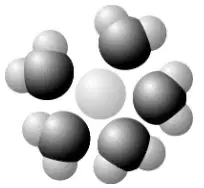
Based on your knowledge of the polarity of water molecules, the solute molecule depicted here is most likely
negatively charged
without charge
hydrophobic
nonpolar
positively charged
43
Multiple Choice
If the cytoplasm of a cell is at pH 7, and the mitochondrial matrix is at pH 8, this means that
the concentration of H+ ions is tenfold higher in the cytoplasm than in the mitochondrial matrix.
the concentration of H+ ions is tenfold higher in the mitochondrial matrix than in the cytoplasm.
the mitochondrial matrix is more acidic than the cytoplasm.
the concentration of H+ ions in the cytoplasm is 8/7 the concentration in the mitochondrial matrix.
the concentration of H+ ions in the cytoplasm is 7/8 the concentration in the mitochondrial matrix.
44
Multiple Choice
Why does ice float in liquid water?
The high surface tension of liquid water keeps the ice on top.
The ionic bonds between the molecules in ice prevent the ice from sinking.
Ice always has air bubbles that keep it afloat.
Hydrogen bonds stabilize and keep the molecules of ice farther apart than the water molecules of liquid water.
The crystalline lattice of ice causes it to be denser than liquid water.
45
Multiple Choice
Why does evaporation of water from a surface cause cooling of the surface?
The breaking of bonds between water molecules absorbs heat.
The water molecules with the most heat energy evaporate more readily.
The solute molecules left behind absorb heat.
Water molecules absorb heat from the surface in order to acquire enough energy to evaporate.
The expansion of water vapor extracts heat from the surface.
46
Multiple Choice
Liquid water's high specific heat is mainly a consequence of the
small size of the water molecules.
high specific heat of oxygen and hydrogen atoms.
absorption and release of heat when hydrogen bonds break and form.
fact that water is a poor heat conductor.
higher density of liquid water than solid water (ice).
47
Multiple Choice
Water molecules are able to form hydrogen bonds with
compounds that have polar covalent bonds.
oils.
oxygen gas (O2) molecules.
chloride ions.
any compound that is not soluble in water.
48
Multiple Choice
The partial negative charge in a molecule of water occurs because
the oxygen atom acquires an additional electron.
the electrons shared between the oxygen and hydrogen atoms spend more time around the oxygen atom nucleus than around the hydrogen atom nucleus.
the oxygen atom has two pairs of electrons in its valence shell that are not neutralized by hydrogen atoms.
the oxygen atom forms hybrid orbitals that distribute electrons unequally around the oxygen nucleus.
one of the hydrogen atoms donates an electron to the oxygen atom.
49
Multiple Choice
The slight negative charge at one end of one water molecule is attracted to the slight positive charge of another water molecule. What is this attraction called?
a hydrogen bond
an ionic bond
a hydrophilic bond
a van der Waals interaction
a covalent bond
50
Multiple Choice
In a single molecule of water, two hydrogen atoms are bonded to a single oxygen atom by
nonpolar covalent bonds.
polar covalent bonds.
ionic bonds.
van der Waals interactions.
hydrogen bonds.
Show answer
Auto Play
Slide 1 / 50
SLIDE
Similar Resources on Wayground

45 questions
Intro to Ecology
Presentation
•
9th - 12th Grade
46 questions
Matrices; 11.2
Presentation
•
9th - 12th Grade
45 questions
Unit 7 Cell cycle and DNA Replication
Presentation
•
9th - 12th Grade
44 questions
Nonmendelian Genetics Lesson
Presentation
•
9th - 12th Grade
43 questions
AAC Transcription and Translation
Presentation
•
9th - 12th Grade
44 questions
STAAR review vocabulary terms 2
Presentation
•
9th - 12th Grade
43 questions
Unit 4 Review - Genetics & Biotechnology
Presentation
•
9th - 12th Grade
45 questions
Synthetic Materials Tutorial
Presentation
•
9th - 12th Grade
Popular Resources on Wayground
10 questions
HCS SCI 03 Summer School Assessment 1

Quiz
•
3rd Grade
15 questions
HCS SCI 05 Summer School Assessment 1 Review
Quiz
•
5th Grade
22 questions
Day 9 Equations and Inequalities Review
Quiz
•
9th Grade
10 questions
Writing and Identifying Ratios Practice
Quiz
•
5th - 6th Grade
7 questions
PYRAMID PERSPECTIVES part 1
Presentation
•
9th - 12th Grade
12 questions
Understanding the Fourth of July
Quiz
•
9th Grade
15 questions
Soccer World Cup Quiz Questions
Quiz
•
7th Grade