Search Header Logo
Intro to DNA Replication

Intro to DNA Replication

Assessment

Presentation

•

Biology

•

9th Grade

•

Hard

•
NGSS
HS-LS1-1, HS-LS3-1, HS-LS3-2

+1

Standards-aligned

Created by

John Hall

FREE Resource

12 Slides • 26 Questions

1

media

2

media

3

Multiple Choice

Question image
Why is DNA important?
1
it is very small and very complicated
2
it's in everything
3
it serves as the blueprint for traits of all living things
4
because we eat it every day for energy

4

media

5

Multiple Choice

Question image
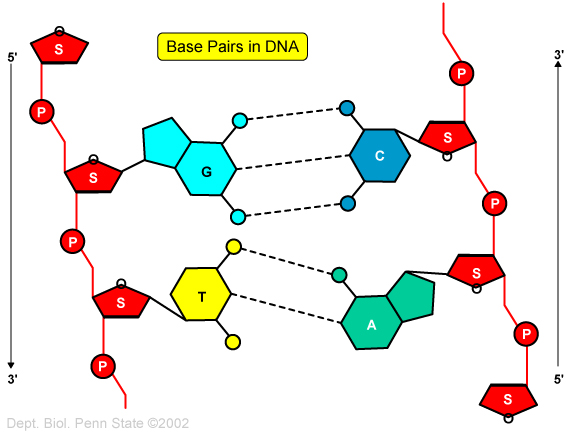
Nitrogenous bases are joined by which type of bond?
1
polar bonds
2
ionic bonds
3
covalent bonds
4
hydrogen bonds

6

Multiple Choice

Question image

Which DNA base pair is connected by three hydrogen bonds?

1

Adenine-Thymine

2

Cytosine-Guanine

3

Adenine-Guanine

4

Thymine-Cytosine

7

media

8

Multiple Choice

Why is DNA replication considered fundamental to heredity?

1

Because it ensures genetic information is passed to the next generation

2

Because it creates new proteins directly

3

Because it determines eye color only

4

Because it only occurs in plants

9

Multiple Choice

Question image
What determines the code, or information, of a DNA molecule?
1
the shape (structure) of the nitrogen bases
2
the order (sequence) of the nitrogen bases
3
the color of the nitrogen bases
4
the frequency (number) of nitrogen bases

10

Multiple Choice

Question image
In a molecule of double-stranded DNA, the amount of Adenine present is always equal to the amount of
1
cytosine
2
guanine
3
thymine
4
uracil

11

Open Ended

Why is the complementary relationship between DNA bases important for genetic fidelity?

12

media

13

14

Multiple Choice

Question image

DNA replication is __________.

1

Ligase

2

Helicase

3

Semiconservative

4

Conservative

15

Multiple Choice

Question image

What does it mean for DNA replication to be semi-conservative?

1

-1 old and 1 new

-The result is that there is 1 new identical DNA molecule

2

-2 old and 3 new

-The result is that there is 1 new identical DNA molecule

3

-4 old and 4 new

-The result is that there is 1 new identical DNA molecule

4

-3 old and 2 new

-The result is that there is 1 new identical DNA molecule

16

Fill in the Blank

Fill in the blank: During DNA replication, each new strand is synthesized using the ___ strand as a template.

17

media
media
media
media

18

Multiple Select

Which of the following are stages of DNA replication?

1

Initiation

2

Elongation

3

Termination

4

Translation

19

Multiple Choice

Question image

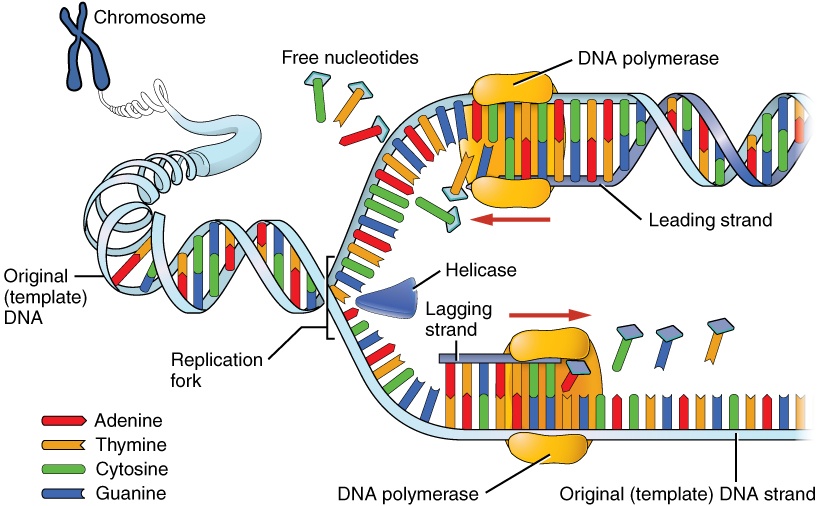
What are the 3 steps of DNA Replication?

1

-double stranded

-it is a double helix

-a polymer made of small, repeating monomers (nucleotides)

2

1. Enzymes unzip/unwind DNA double helix

2. Single free nucleotides floating in the nucleus pair with open strands of A, T, C, and G

3. Two, complete identical DNA molecules are formed

3

Adenine (A)

Guanine (G)

Cytosine (C )

Thymine (T)

4

There are not 3 steps of DNA Replication

20

media

21

Multiple Choice

What is the main function of DNA helicase during DNA replication?

1

Synthesizing new DNA strands

2

Separating DNA strands

3

Adding RNA primers

4

Repairing DNA damage

22

media

23

Open Ended

Explain the role of DNA primase in the process of DNA replication.

24

media

25

Multiple Choice

Question image

What is the role of Polymerase?

1

Polymerase has no role in DNA

2

Unzip/Unwinds the DNA double helix

3

Joins individual nucleotides to make DNA

4

Fixes, glues, or repairs DNA fragments to complete strands

26

media

27

Multiple Choice

Question image

What is the role of Ligase?

1

Joins individual nucleotides to make DNA

2

Fixes, glues, or repairs DNA fragments to complete strands

3

Ligase has no role in DNA replication

4

Unzip/Unwinds the DNA double helix

28

Multiple Choice

What enzymes are involved in DNA Replication?

1

-Helicase

-Polymerase 

-DNA

2

-Helicase

-DNA

-Ligase

3

-DNA

-Polymerase 

-Ligase

4

-Helicase

-Polymerase 

-Ligase

29

Multiple Choice

Which enzyme is primarily responsible for synthesizing new DNA strands during DNA replication?

1

DNA Polymerase

2

DNA Ligase

3

DNA Helicase

4

RNA Primase

30

media

31

Open Ended

DNA is responsible for passing on hereditary information from one generation to the next. What is one thing you learned today about how DNA accomplishes this?

32

Multiple Choice

Question image
Replicate the following strand of DNA: 
AATCATGGA
1
AATCATGGA
2
TTAGTACCT
3
UUAGUACCU
4
GGATAUCUA

33

Multiple Select

Question image

What happens during DNA replication?

Select all correct answers.

1

DNA is copied

2

mRNA is made

3

Base-pairing rules are utilized

4

DNA leaves the nucleus

5

The 2 DNA strands are separated

34

Multiple Choice

Before DNA can replicate it has to...
1
Separate the two strands
2
Find 4 new strands
3
Ask its mom

35

Multiple Choice

How is the lagging strand synthesized?

1

Continuously

2

Discontinuously

3

Semi-continuously

4

Not synthesized

36

Multiple Choice

How is the leading strand synthesized?

1

Continuously

2

Discontinuously

3

Semi-continuously

4

Not synthesized

37

Multiple Choice

Question image
What is the complement to the DNA strand below:
5'-ATGCCAT-3'
1
5'-TACGGTA-3'
2
3'-TACGGTA-5'
3
3'-ATGGCAT-5'
4
5'-ATGGCAT-3'

38

Multiple Choice

Question image
order of replication
1
3, 2, 1, 4
2
2, 1, 4, 3
3
2, 3, 1, 4
4
3, 4, 1, 2
media

Show answer

Auto Play

Slide 1 / 38

SLIDE