

Transcription and Translation

Presentation
•
Science
•
9th - 12th Grade
•
Practice Problem
•
Medium
Standards-aligned

Summer King
Used 9+ times
FREE Resource
24 Slides • 22 Questions
1
2
3
Drag and Drop
4
Multiple Choice
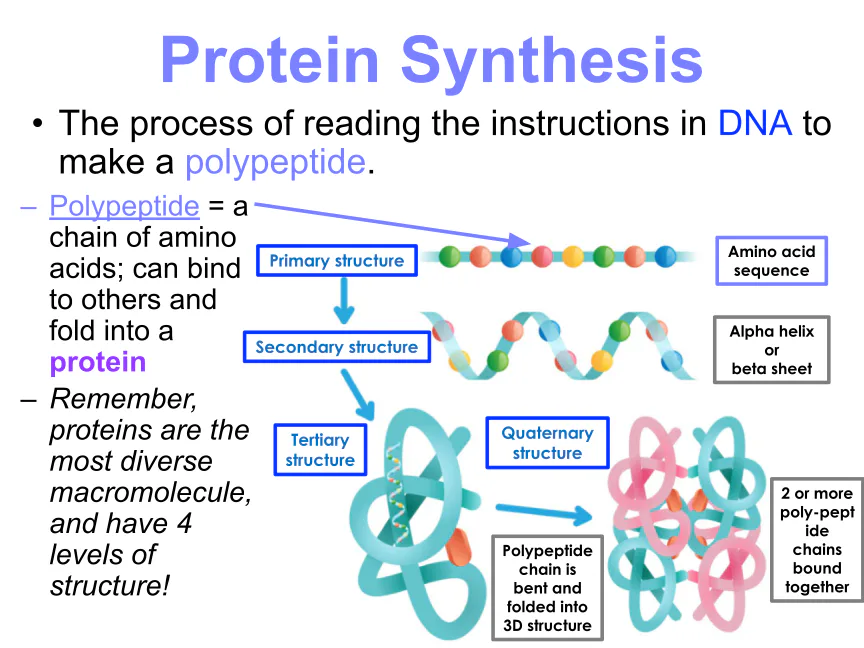
Which of the following best describes a polypeptide?
A chain of amino acids that can fold into a protein
A type of carbohydrate used for energy storage
A lipid molecule that forms cell membranes
A nucleic acid that stores genetic information
5
6
Multiple Choice
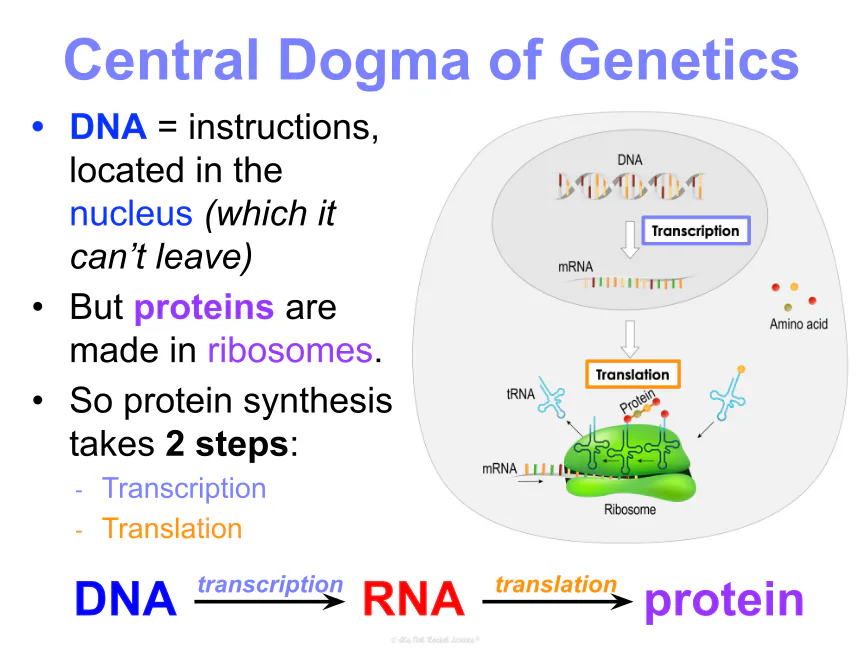
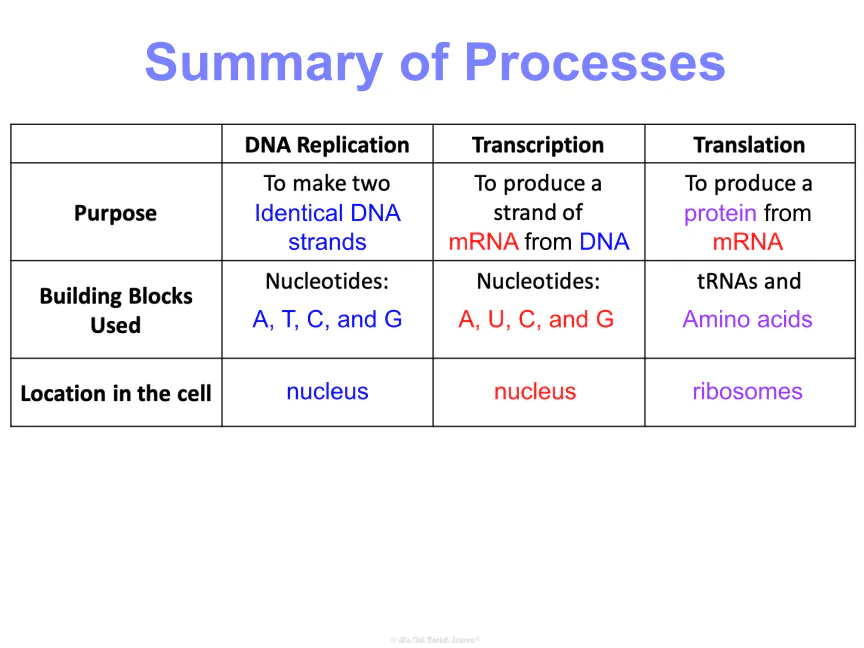
Which two main steps are involved in protein synthesis according to the central dogma of genetics?
Replication and transcription
Transcription and translation
Translation and replication
Transcription and duplication
7
Multiple Select
Why does DNA have to be transcribed into RNA?
DNA has the instructions for proteins but can't leave the nucleus
Proteins are made in ribosomes
RNA has the instructions for proteins but can't leave the nucleus
Proteins are made in the nucleus
8
9
Multiple Choice
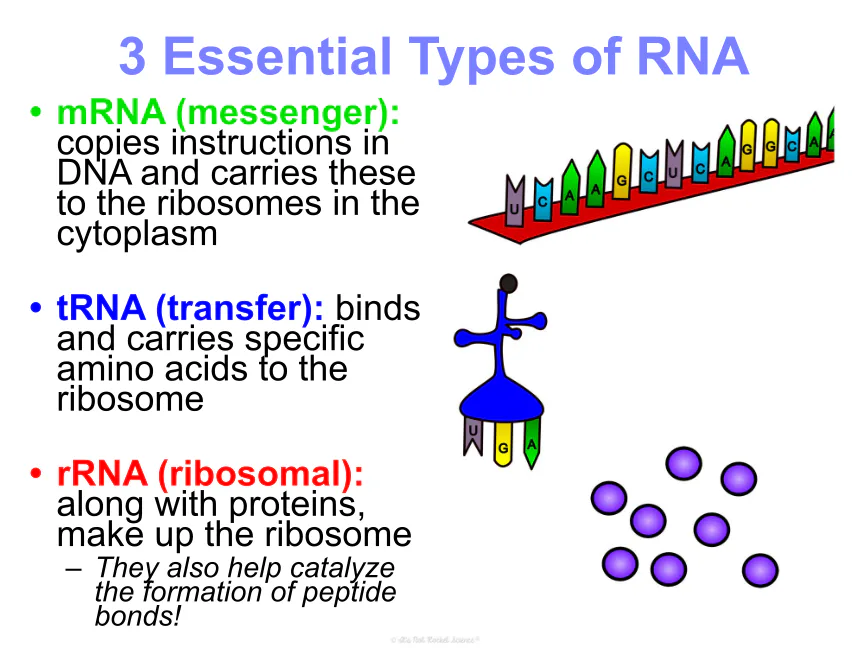
What does rRNA do?
carry info from genes to ribosomes
carry amino acids to ribosomes
help with RNA splicing
make up ribosomes
10
Multiple Choice
Which of the following type of RNA is responsible for transferring over the correct amino acid?
tRNA
mRNA
rRNA
DNA
11
Multiple Choice
12
13
Multiple Select
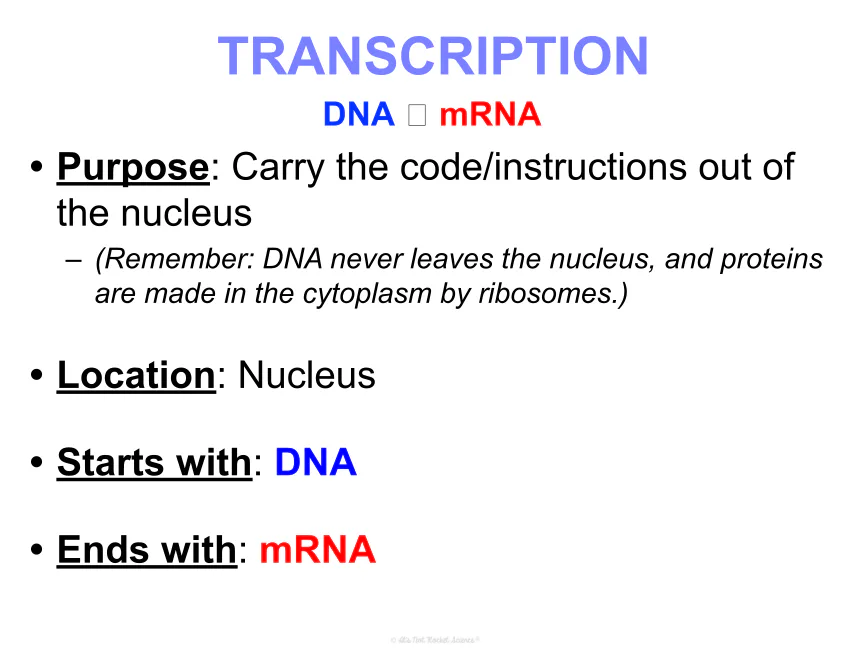
Which of the following statements about transcription is/are correct?
Transcription occurs in the cytoplasm.
Transcription starts with DNA and ends with mRNA.
Transcription produces proteins directly.
Transcription requires complementary base-pairing rules.
14
Multiple Choice
15
16
Multiple Choice
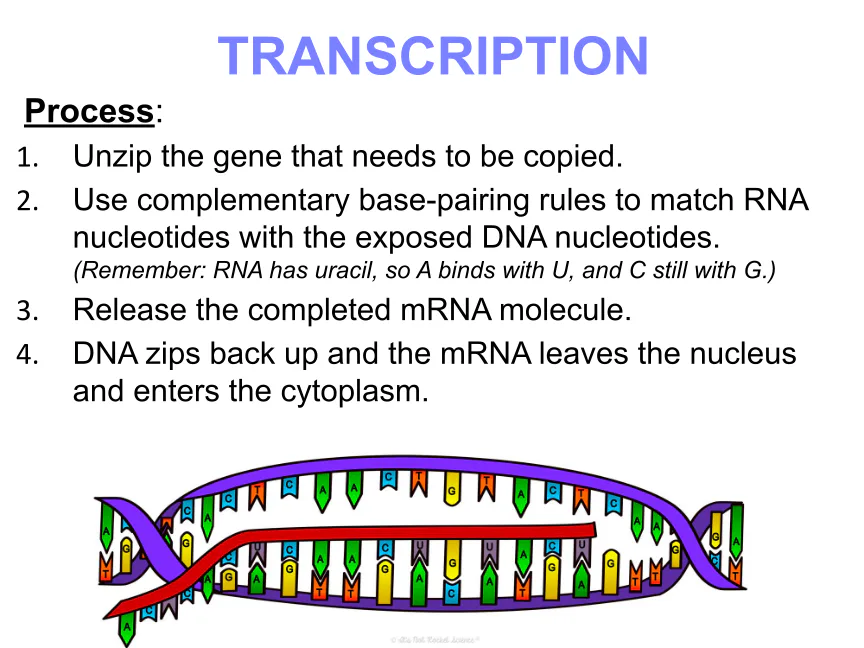
What nitrogen base bonds with A in transcription?
T
C
G
U
17
Multiple Choice
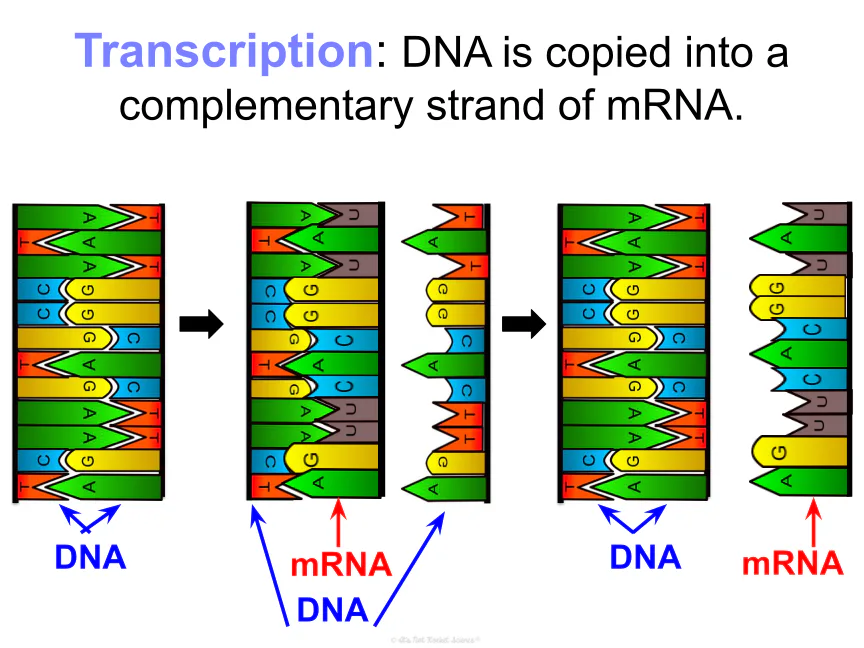
What happens in transcription?
DNA is used as a template to make a chromosome
DNA translates to RNA to make protein
DNA is used as a template to make mRNA
RNA is used as a template to make tRNA
18
Multiple Choice
Where does mRNA go after transcription?
cyctoplasm
nucleus
lysosome
vacuole
19
20
21
Multiple Choice
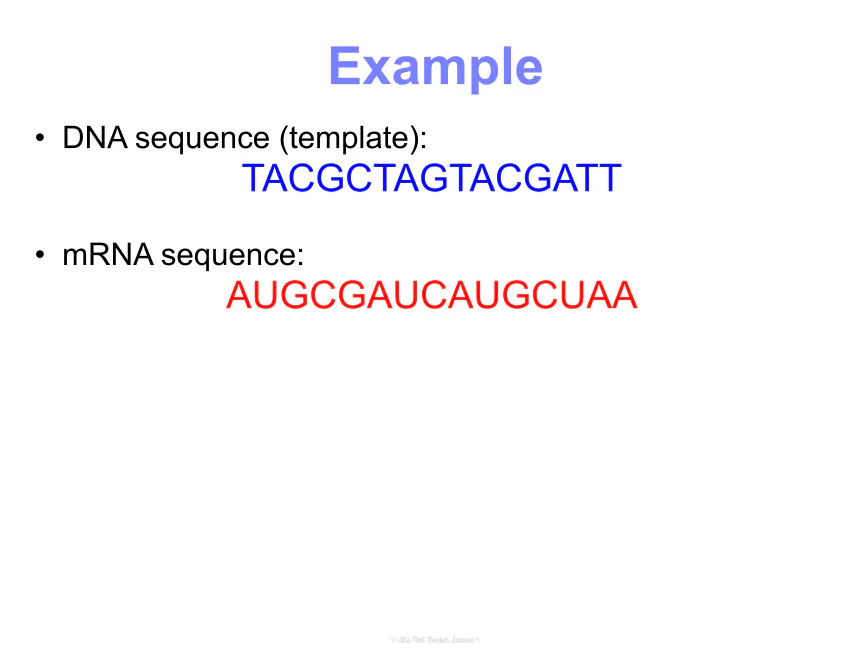
A section of DNA has these bases: TAG CAG TAC. What mRNA sequence is produced fro this DNA section?
ATC GTC ATG
AUC GUC AUG
AUG CUG AUC
UTC GTC UTG
22
Multiple Choice

23
24
Match
Match the following:
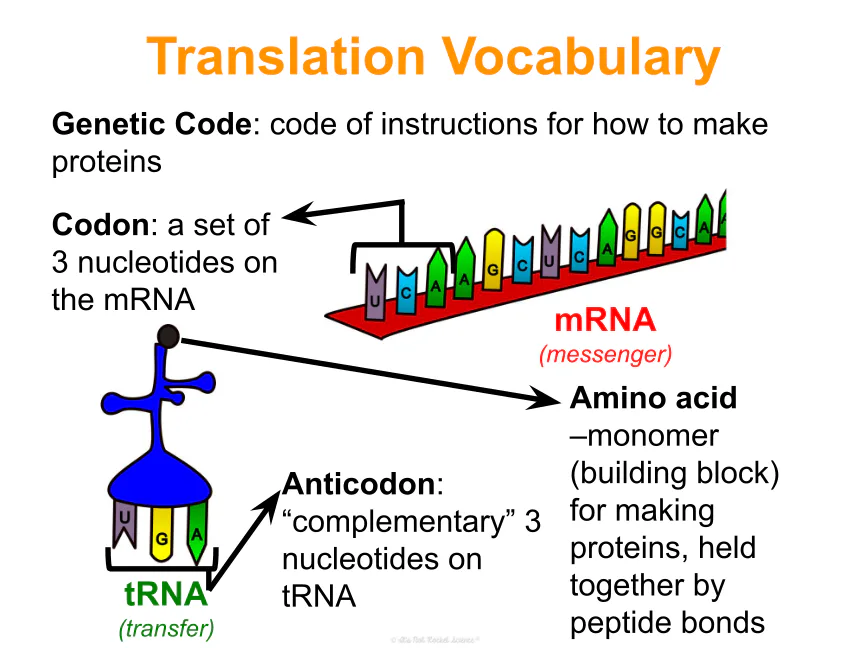
genetic code
codon
amino acid
anticodon
code of instructions for making proteins
a set of 3 nucleotides on the mRNA
monomer (building block) for making pro
complementary 3 nucleotides on the tRNA
code of instructions for making proteins
a set of 3 nucleotides on the mRNA
monomer (building block) for making pro
complementary 3 nucleotides on the tRNA
25
26
Multiple Choice
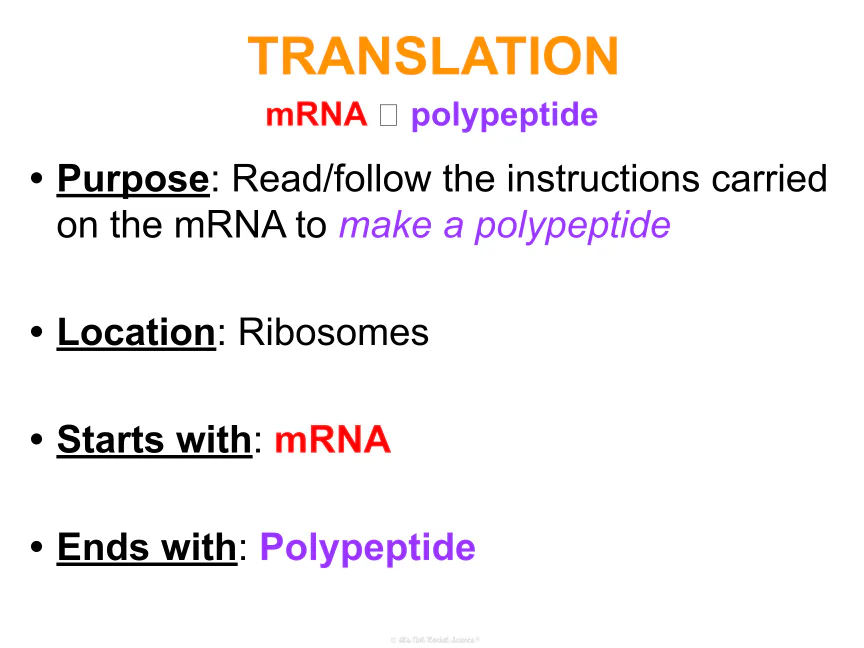
Where does translation occur?
nucleus
ribosomes
vacuole
cytoplasm
27
Multiple Choice
What does translation start and end with?
Starts with mRNA; ends with polypeptide
Starts with polypeptide; ends with mRNA
Starts with DNA; ends with mRNA
Starts with ribososme; ends with polypeptide
28
29
Multiple Select
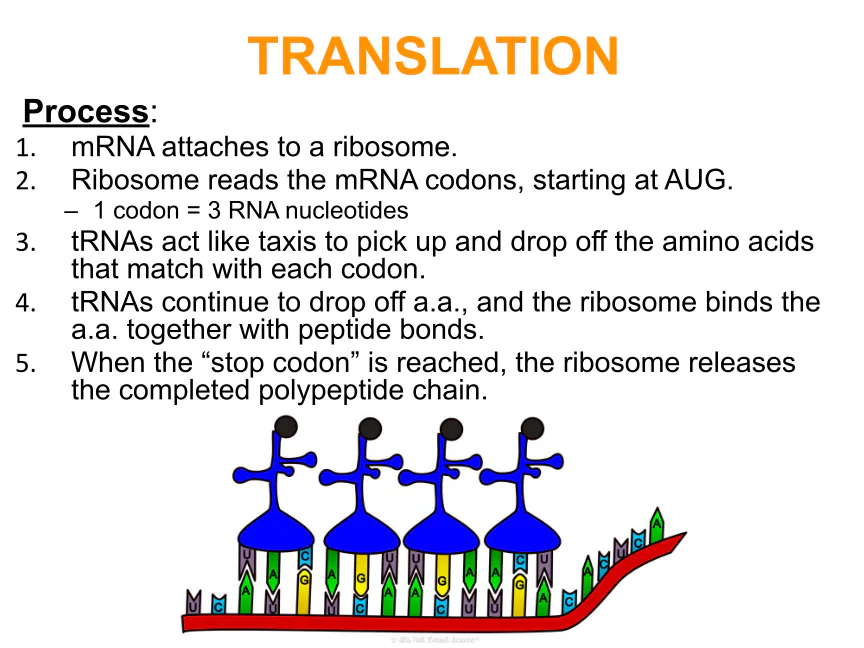
Which steps are involved in the process of translation? Select all that apply.
mRNA attaches to a ribosome
tRNAs drop off amino acids at the ribosome
DNA is replicated
Ribosome binds amino acids together with peptide bonds
30
31
Fill in the Blanks
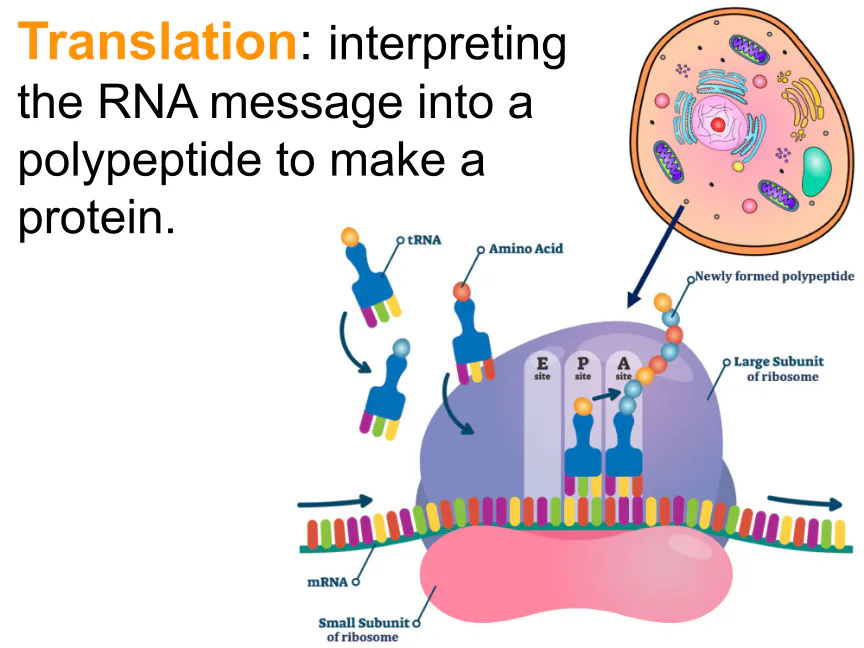
Translation is the process of interpreting the RNA message into a
32
Codons
Codons are instructions for making proteins.
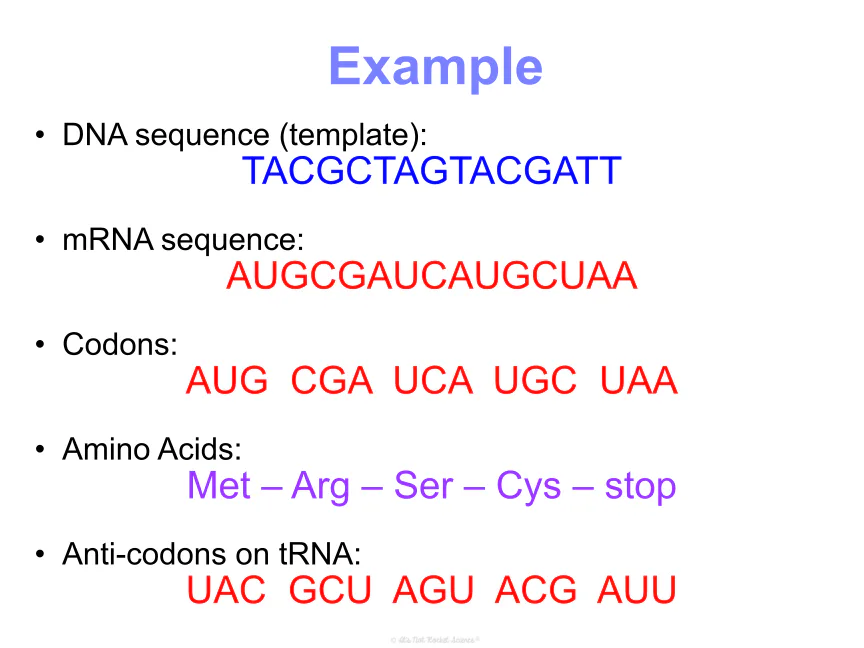
A codon is a sequence of 3 RNA bases on mRNA
Each codon codes for one amino acid or a stop signal
Codons are read during translation at the ribosome
Key Rules to Remember
Codons are read on mRNA, not DNA
RNA bases:
A, U, C, G
Bases are read in groups of three, starting at a start codon
33
Important Codons
Start codon: AUG
Codes for Methionine (Met)
Signals where translation begins
Stop codons: UAA, UAG, UGA
Signal where translation ends
Do not code for an amino acid
34
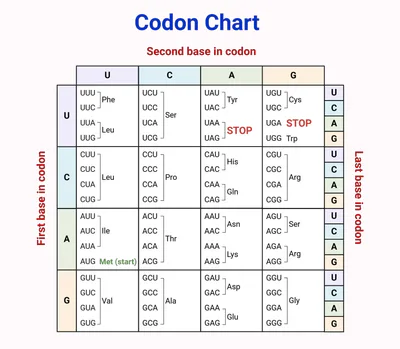
How to Read a Codon Chart (Step-by-Step)
A codon chart shows which amino acid each mRNA codon codes for.
Step-by-Step Example
Codon: AUG
First letter → find A on the left side of the chart
Second letter → find U across the top
Third letter → find G on the right side
The box where they meet tells you the amino acid:
→ Methionine (Met)
Amino acid: Phenylalanine (Phe)
Important Reminder
Codon charts are written for mRNA
If given DNA, convert it to mRNA first before using the chart
35
36
Practice example
Codon: UUU
First letter: U
Second letter: U
Third letter: U
37
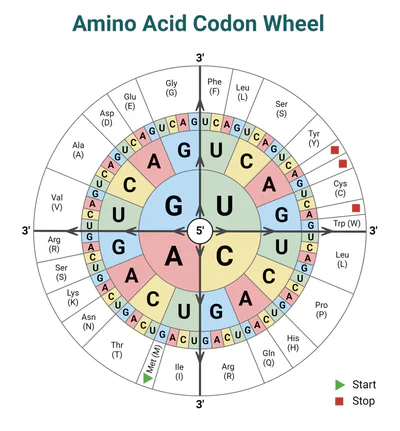
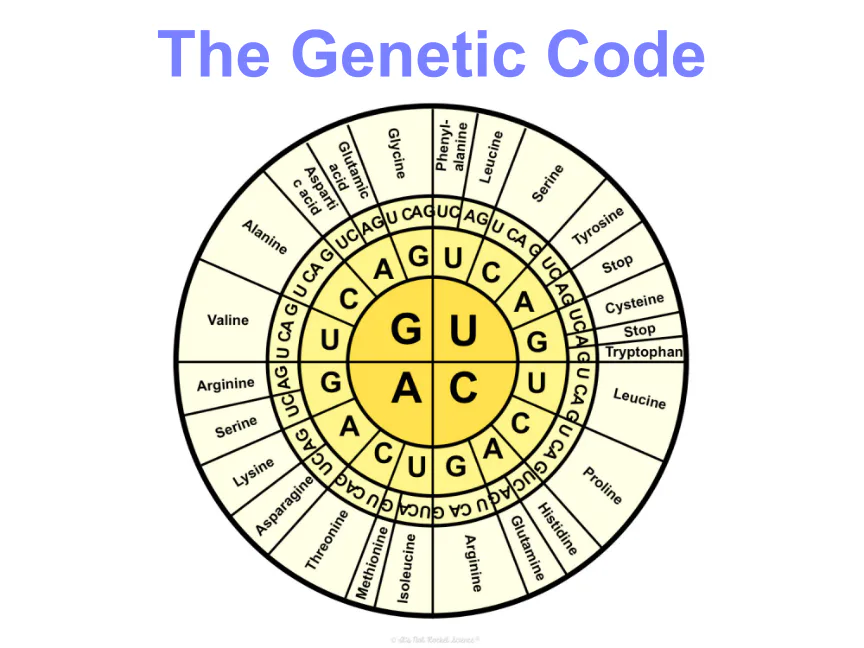
What Is a Codon Wheel?
A codon wheel is another way to determine which amino acid a codon codes for.
Like a codon chart, it is used for mRNA codons
It is read from the center outward
Each ring represents one base of the codon
Codon Wheel Rules
Always start with the 1st base in the center
Move outward to the 2nd base
End with the 3rd base on the outside
The final section names the amino acid
38
Practice
Example Codon: AUG
Start in the center of the wheel
→ Find AMove to the second ring
→ Find UMove to the outer ring
→ Find GThe section you land on tells you the amino acid:
Methionine (Met)
39
40
41
Multiple Choice
Using the genetic code chart, what amino acid is coded by the mRNA codon UGC?
Cysteine
Serine
Methionine
Leucine
42
43
44
Multiple Choice
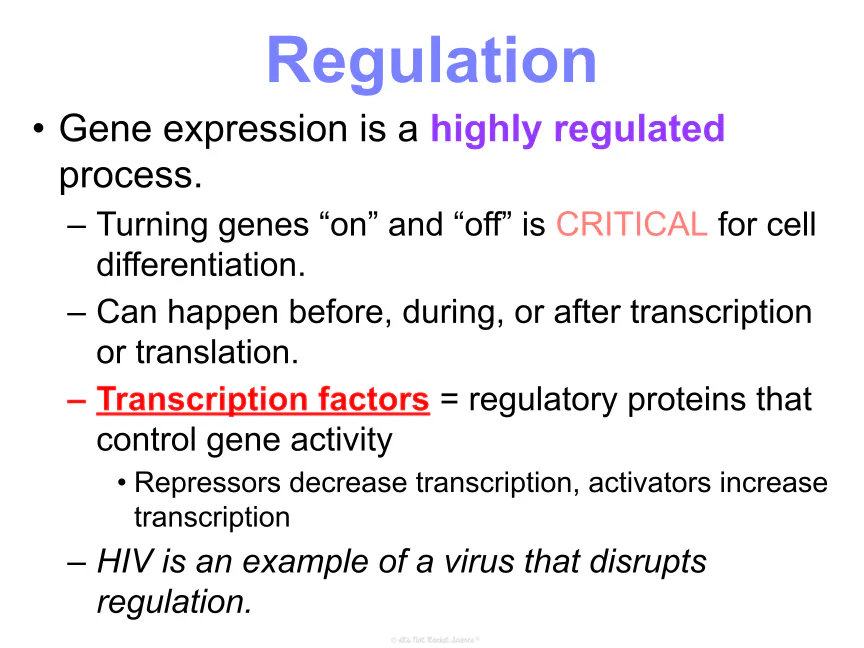
Which of the following statements about gene regulation is correct?
Transcription factors are regulatory proteins that control gene activity.
Gene regulation only happens after translation.
Repressors increase transcription.
Gene expression is not important for cell differentiation.
45
46
Fill in the Blanks
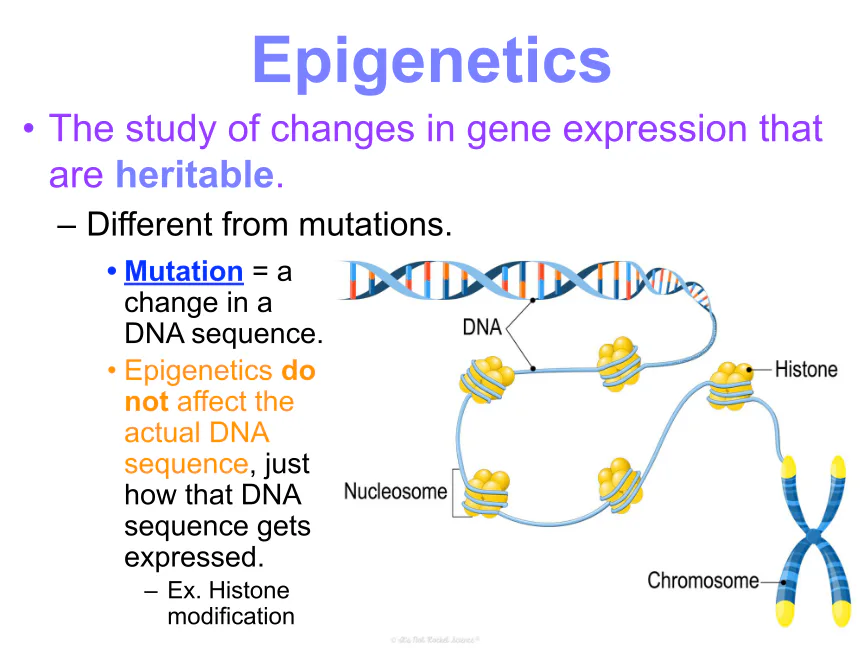
Epigenetics do not affect the actual
Show answer
Auto Play
Slide 1 / 46
SLIDE
Similar Resources on Wayground

41 questions
Unit 5- Lesson 4- Powers of Congress
Presentation
•
9th - 12th Grade
38 questions
The Carbon Cycle
Presentation
•
9th - 12th Grade
40 questions
2.19
Presentation
•
9th - 12th Grade
40 questions
PHET_ Energy
Presentation
•
9th - 12th Grade
42 questions
Lab Equipment
Presentation
•
8th - 12th Grade
45 questions
Synthetic Materials Tutorial
Presentation
•
9th - 12th Grade
40 questions
Intro to acid , bases and pH
Presentation
•
9th - 12th Grade
41 questions
AgApps Obj. 4.03 - Digestion & Nutrition
Presentation
•
9th - 12th Grade
Popular Resources on Wayground
10 questions
How much do you know about our Portrait of an Eagle?

Quiz
•
10th Grade
10 questions
Fast Food Slogans
Quiz
•
6th - 8th Grade
21 questions
Continents and Oceans
Quiz
•
6th Grade
20 questions
Parts of Speech
Quiz
•
5th Grade
16 questions
Subject & Predicate
Quiz
•
5th Grade
25 questions
Multiplication Facts
Quiz
•
5th Grade
12 questions
Map Skills
Quiz
•
3rd Grade
22 questions
Continents and Oceans
Quiz
•
5th Grade
Discover more resources for Science
10 questions
Exploring Chemical and Physical Changes

Interactive video
•
6th - 10th Grade
20 questions
Atomic Structure
Quiz
•
9th Grade
10 questions
Decoding the Periodic Table of Elements
Interactive video
•
6th - 10th Grade
10 questions
Exploring the Periodic Table
Interactive video
•
6th - 10th Grade
14 questions
Physical and Chemical Changes
Quiz
•
10th Grade
22 questions
Periodic Table Review
Quiz
•
9th - 12th Grade
20 questions
Observation vs. Inference
Quiz
•
7th - 9th Grade
14 questions
Periodic Trends
Interactive video
•
11th Grade