
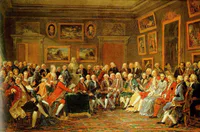
5.1 The Enlightenment

Presentation
•
Social Studies
•
10th - 12th Grade
•
Practice Problem
•
Easy

Isiah Jones
Used 1+ times
FREE Resource
4 Slides • 6 Questions
1
By Isiah Jones
2
Open Ended
Is it better to follow the rules as they are, or to question them if you think they are unfair?
3
The Enlightenment: Questioning Everything
Essential Question: How did the Enlightenment shape the intellectual and ideological thinking that affected reform and revolution after 1750?
Historical Thinking Skill: CAUSATION
Key Concept
5.1.II: Enlightenment philosophies applied new ways of understanding and empiricist approaches to both the natural world and human relationships; they also reexamined the role that religion played in public life and emphasized the importance of reason.
4
Enlightenment: An intellectual movement in the 17th and 18th centuries that emphasized reason, individualism, and freedom/liberty over tradition and authority.
Social Contract: A theory that government is an agreement between the people and the government/ruler, in which people give up some freedoms in exchange for order and protection.
Natural Rights: Rights that all people are born with, such as life, liberty, and property, according to philosopher John Locke.
Laissez-faire: An economic philosophy advocating for minimal government intervention in the economy; a French term meaning "leave alone."
Nationalism: A feeling of intense loyalty to a group of people who share a common language and culture, often leading to the desire for an independent nation-state.
5
Multiple Choice
The Enlightenment philosopher John Locke argued that if a government violates the people's natural rights, the social contract is broken. Based on this definition, what is the most likely consequence Locke would support?
6
Multiple Choice
If a government strictly followed a policy of laissez-faire during the early Industrial Revolution, how would it most likely respond to reports of unsafe working conditions in factories?
7
Multiple Choice
In the 19th century, the rise of nationalism within the multiethnic Austrian Empire would most directly encourage which of the following developments?
8
🖍️ Annotation Expectation
Highlight Enlightenment ideas or arguments
Label ideas with:
C = Cause → the idea or belief
E = Effect → what changed or happened after 1750For every E (Effect):
👉 Explain the effect briefly in your own words
📝 Worksheet Reminder
Directions: Fill in the chart for each Enlightenment thinker using your annotations:
Key Idea (C)
Effect after 1750 (E, in your own words)
AP Theme (GOV / CDI / SIO)
9
Open Ended
How did the Enlightenment critiques of traditional authority (monarchy, church) and advocacy for natural rights directly cause revolutionary movements in the Atlantic World (e.g., America, France)?
10
Open Ended
Was the Enlightenment fundamentally a movement of elite intellectuals, or did its ideas genuinely empower broader populations (workers, women, enslaved people) to seek reform and revolution? Defend your argument.
(Skill: Argumentation)
By Isiah Jones
Show answer
Auto Play
Slide 1 / 10
SLIDE
Similar Resources on Wayground

7 questions
Creativity with Mind Mapping
Presentation
•
9th - 12th Grade
8 questions
💻 Unit 8 Civil Rights Notes pt.3
Presentation
•
9th - 12th Grade
7 questions
Westward Expansion
Presentation
•
11th - 12th Grade
7 questions
Community Helpers
Presentation
•
KG
6 questions
AP Psych Unit 1.6
Presentation
•
10th - 12th Grade
8 questions
MLA Format In Text Citations
Presentation
•
9th - 12th Grade
7 questions
💻 Unit 8 Civil Rights Notes pt.4
Presentation
•
9th - 12th Grade
9 questions
X EKONOMI
Presentation
•
10th - 12th Grade
Popular Resources on Wayground
10 questions
How much do you know about our Portrait of an Eagle?

Quiz
•
10th Grade
10 questions
Fast Food Slogans
Quiz
•
6th - 8th Grade
21 questions
Continents and Oceans
Quiz
•
6th Grade
20 questions
Parts of Speech
Quiz
•
5th Grade
16 questions
Subject & Predicate
Quiz
•
5th Grade
25 questions
Multiplication Facts
Quiz
•
5th Grade
12 questions
Map Skills
Quiz
•
3rd Grade
22 questions
Continents and Oceans
Quiz
•
5th Grade
Discover more resources for Social Studies
10 questions
Exploring the Age of Exploration: Key Events and Figures

Interactive video
•
6th - 10th Grade
17 questions
1.3 Review
Presentation
•
11th Grade
10 questions
Exploring the 13 Colonies Regions
Interactive video
•
6th - 10th Grade
8 questions
Smith Unit 5 Quick Check #1 Big Business, Monopolies &Technology
Quiz
•
11th Grade
46 questions
Unit 1 Test REVIEW Ancient Greece and Rome
Quiz
•
9th - 12th Grade
10 questions
Exploring Ancient Mesopotamia Through Song
Interactive video
•
6th - 10th Grade
27 questions
Supply & Demand Test Review
Quiz
•
12th Grade
36 questions
Unit 5 Key Terms
Quiz
•
11th Grade - University