AS 6.4 TE 1.3-1.4
Presentation
•
Science
•
6th Grade
•
Practice Problem
•
Medium
+5
Standards-aligned
Jordan Cox
Used 4+ times
FREE Resource
57 Slides • 18 Questions
1
2
3
4
5
6
7
9
10
11
Multiple Choice
What is a molecule?
A group of atoms joined together in a particular way
A single atom
A type of energy
A type of cell
12
13
14
15
Fill in the Blanks
Type answer...
16
17
18
Multiple Select
Select all the statements that are true based on the Sim and its explanation.
The Sim shows a small number of molecules for easy observation.
Everything around us is made up of billions of molecules.
The Sim shows the exact number of molecules in real life.
Molecules are too small to ever be seen in any way.
19
20
Open Ended
What did you observe in the investigation?
=====
For example, in which cup did the food coloring spread out the fastest?
21
Open Ended
What could have caused the difference between how the food coloring moved in the two cups?
22
23
24
Simulating Hot and Cold Water
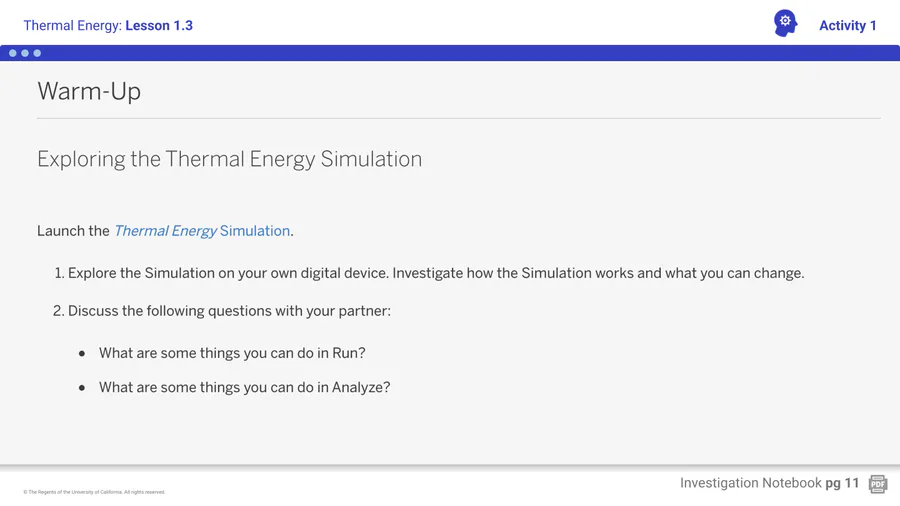
Open the Simulation from the next slide.
Add two same-sized samples.
Make one sample hot and one sample cold.
Observe the differences in the two samples.
25
26
Open Ended
What do you notice about the movement of the molecules of the two samples?
27
Open Ended
Use what you saw in the Simulation to explain why the food coloring spreads faster in warmer water.
28
29
30
Open Ended
Use the evidence from the Sim to try to answer our question...
=====
How is something different when it is warmer or cooler?
31
32
33
34
35
Poll
Which image best shows the difference in molecule speed between hot and cold water?
=====
(HINT: Refer to the key above the images.)
A
B
C
D
36
37
38
Drag and Drop
=====
When a thing gets colder, its molecules are moving
39
40
41
42
Multiple Choice
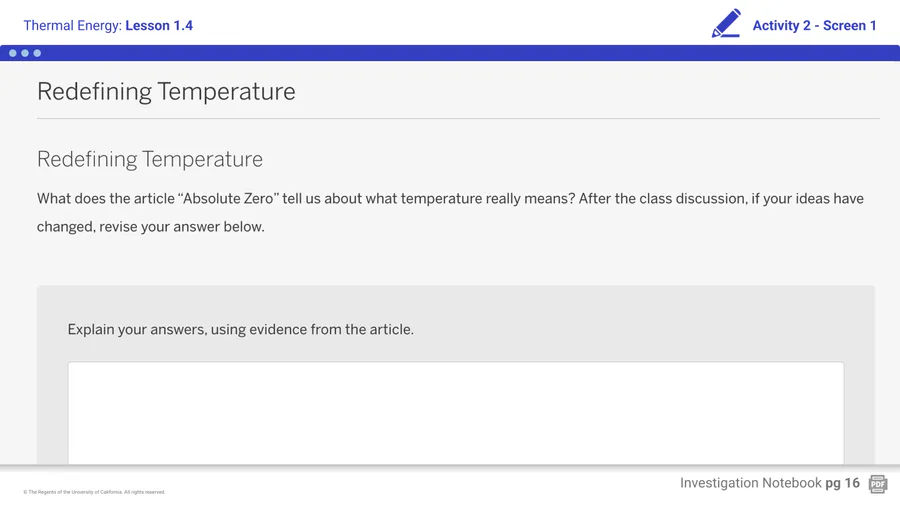
Read the following quote from the article “Absolute Zero” and answer the question below.
=====
"This is because temperature is a measure of average molecular movement, and there is a limit to how slowly something can move. After all, if something slows down completely, it just stops moving."
=====
Is there a limit to how cold things can get?
Yes, there is.
No, there is not.
43
44
45
46
47
Fill in the Blanks
Type answer...
48
49
50
51
52
53
54
55
56
57
Fill in the Blanks
58
Fill in the Blanks
59
Multiple Choice
What can you tell about the temperature of the things in these diagrams by calculating the average speed of the molecules?
The thing in Diagram 1 has a higher temperature than the thing in Diagram 2.
The thing in Diagram 2 has a higher temperature than the thing in Diagram 1.
The things in both diagrams have the same temperature.
60
61
62
63
64
65
66
67
68
Draw
Goal: Create a model that shows the difference between warmer and cooler air.
69
70
71
72
Open Ended
Consider the molecules in the two proposed systems. How are they the same and how are they different?
73
Poll
At this point, I think the ___
will warm Riverdale School more.
water heater system (Proposal #1)
groundwater system (Proposal #2)
74
75
Show answer
Auto Play
Slide 1 / 75
SLIDE

Similar Resources on Wayground
70 questions
1.3 The elements of group 1
Presentation
•
7th Grade
70 questions
The Sun and Water
Presentation
•
5th Grade
72 questions
SCIENCE FORM 1 WITH CIKGU REENA
Presentation
•
6th Grade
68 questions
Earth's Temperature
Presentation
•
6th Grade
73 questions
Digestive System
Presentation
•
6th Grade
68 questions
Europe's Environmental Issues
Presentation
•
6th Grade
73 questions
SOL6.5 Study Guide
Presentation
•
6th Grade
68 questions
Science Doodle Review Page One
Presentation
•
5th Grade
Popular Resources on Wayground
20 questions
"What is the question asking??" Grades 3-5
Quiz
•
1st - 5th Grade
20 questions
“What is the question asking??” Grades 6-8
Quiz
•
6th - 8th Grade
10 questions
Fire Safety Quiz
Quiz
•
12th Grade
20 questions
Equivalent Fractions
Quiz
•
3rd Grade
34 questions
STAAR Review 6th - 8th grade Reading Part 1
Quiz
•
6th - 8th Grade
20 questions
“What is the question asking??” English I-II
Quiz
•
9th - 12th Grade
20 questions
Main Idea and Details
Quiz
•
5th Grade
47 questions
8th Grade Reading STAAR Ultimate Review!
Quiz
•
8th Grade
Discover more resources for Science
19 questions
Introduction to Properties of Waves
Presentation
•
6th - 8th Grade
16 questions
Interactions within Ecosystems
Presentation
•
6th - 8th Grade
20 questions
Rocks and The Rock Cycle
Quiz
•
6th Grade
10 questions
Ecosystem levels of organization
Quiz
•
6th Grade
15 questions
Punnett Squares
Quiz
•
6th Grade
15 questions
Symbiotic Relationships
Quiz
•
6th - 8th Grade
21 questions
Asexual vs Sexual Reproduction
Quiz
•
6th - 7th Grade
20 questions
Cells! Cell Theory and Characteristics of Eukaryotes/Prokaryotes
Quiz
•
6th Grade