

Ancient Greece Lesson 1

Presentation
•
Social Studies
•
6th Grade
•
Practice Problem
•
Easy

Craig Kirkdoffer
Used 6+ times
FREE Resource
29 Slides • 10 Questions
1

2
Why might historians consider ancient Greece the first Western civilization?
In this module you will study Greece—home to one of the great ancient civilizations. Greece was not an easy place to live. The mountains made farming difficult, so the Greeks found a way to make a living from the sea. Some Greeks became fishermen, and others became traders. Over time, people from Greek city-states began to set up colonies in distant lands. Although the colonies were independent, they kept ties with Greece and traded with the city-states on the Greek mainland. Some city-states, like Athens, became great trading centers. Greece was home to the world’s first democracy. The ancient Greeks also made lasting contributions to architecture, philosophy, science, the arts, and military strategy that spread around the world.
3
4
Open Ended
What was the role of the Agora in ancient Greece?
5
Geography and the Early Greeks
Greece’s geography and its nearness to the sea strongly influenced the development of trade and the growth of city-states.
6
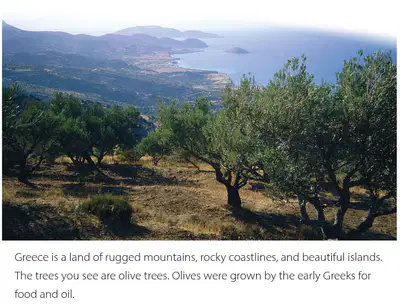
The Greeks lived on rocky, mountainous lands surrounded by water. The mainland of Greece is a peninsula, an area of land that is surrounded on three sides by water. But the Greek peninsula is very irregular. It’s one big peninsula made up of a series of smaller peninsulas. The land and sea intertwine like your hand and fingers in a bowl of water. In addition, there are many islands. Look at the map of Greece and notice the rugged coastline.
7
8
Mountains and Settlements
The Greeks lived in villages and towns separated by mountains and seas. Because mountains cover much of Greece, there are few flat areas for farmland. However, villages still thrived where people could use the landscape to their advantage. People in the mountains settled in the flat areas of the river valleys that they could use for farmland. Others found flat areas along the coast. Travel across the mountains and seas was difficult, so communities were isolated from one another. As a result, the people created their own governments and ways of life. Even though they spoke the same language, Greek communities saw themselves as separate countries.
9
Multiple Choice

What bodies of water surround Greece?
Ionian, Black, and Aegean Seas
Ionian, Mediterranean, and Aegean Seas
Mediterranean Sea, Aegean Sea, and Atlantic Ocean
Black Sea, Mediterranean Sea, and Atlantic Ocean
10
Seas and Ships
Since travel inland across the rugged mountains was so difficult, the early Greeks turned to the seas. On the south was the huge Mediterranean Sea, to the west was the Ionian (eye-OH-nee-uhn) Sea, and to the east was the Aegean (ee-JEE-uhn) Sea. It’s not surprising that the early Greeks used the sea as a source for food and as a way of trading with other communities.
11
Around 3000 BC, civilizations began to develop near the Aegean Sea, in the area that would later become known as Greece. Because of the natural geography of this region, these civilizations were relatively isolated from one another.

12
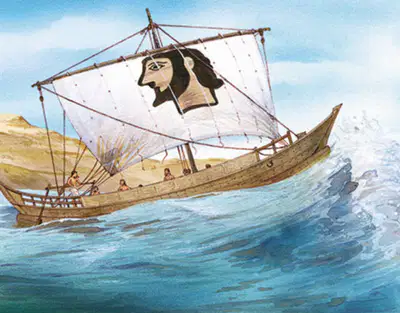
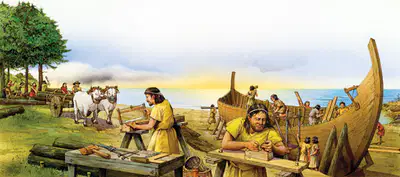
Because the region was so mountainous, these cultures turned to the sea for travel and trade. By about 2000 BC, the civilizations living in this region had become skilled shipbuilders and sailors, and trade flourished.
13

Through trade and communication with neighboring countries and civilizations, ancient Greece grew in size and strength. By the year 750 BC, what historians today consider to be ancient Greek culture had begun to take shape.
14
The Greeks became skilled shipbuilders and sailors. Their ships sailed to Asia Minor (present-day Turkey), to Egypt, and to the islands of the Mediterranean and Aegean seas. As they traveled around these seas, they found sources of food and other products they needed. They also exchanged ideas with other cultures.
15
Open Ended
Why was travel difficult in ancient Greece?
16
Open Ended
How did mountains affect the location of Greek settlements?
17
Trading Cultures Develop
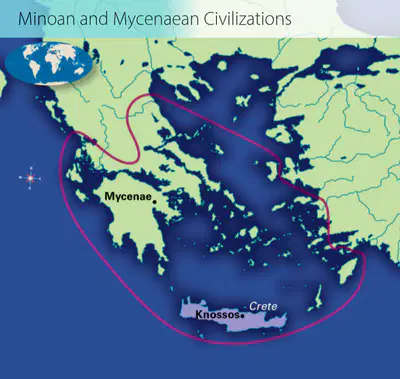
Many cultures settled and developed in Greece. Two of the earliest were the Minoans (muh-NOH-uhnz) and the Mycenaeans (my-suh-NEE-uhns). By 2000 BC the Minoans had built an advanced society on the island of Crete. Crete lay south of the Aegean in the eastern Mediterranean. Later, the Mycenaeans built towns on the Greek mainland. These civilizations influenced the Aegean region and helped shape later cultures in Greece.
18
The Minoan Palace at Knossos
One of the earliest civilizations in Greece, the Minoan civilization, developed on the island of Crete. It was named after the legendary king of Crete, King Minos. In about 2000 BC, the Minoans began building cities. In each city, there was a large and richly decorated palace. Inside, the palaces seemed like mazes, with many rooms and winding passages. The palace was the heart of Minoan social life. The largest palace was built in the city of Knossos. Originally built around 1950 BC, the palace was rebuilt around 1700 BC after an earthquake. The palace covered more then three acres and was at least three stories high.
19
These are the ruins of the palace at Knossos, on the island of Crete.

20
Trade made the Minoans rich enough to build magnificent buildings. The palace at Knossos served as the city’s center for economic, governmental, and religious activity.

21
The Minoans
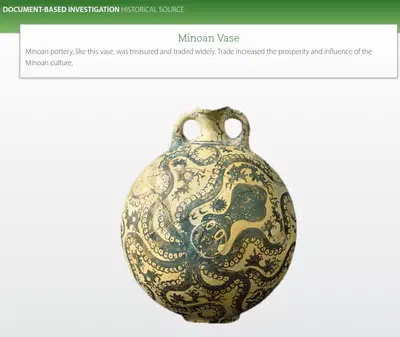
Because they lived on an island, the Minoans spent much of their time at sea. They were among the best shipbuilders of their time. Minoan ships carried goods such as wood, olive oil, and pottery all around the eastern Mediterranean. They traded these goods for copper, gold, silver, and jewels.
22
Open Ended
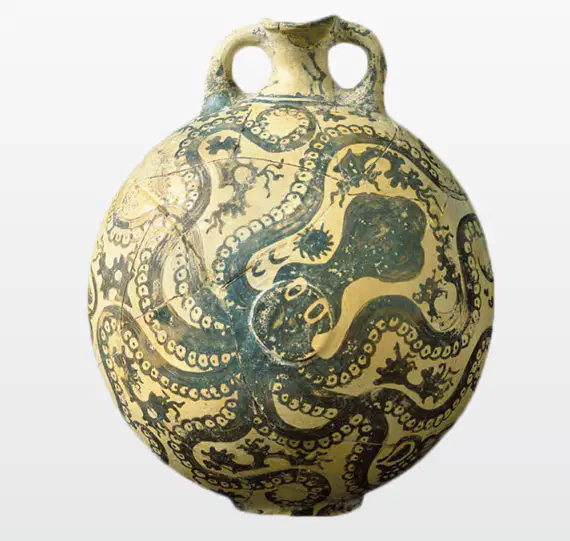
What can you infer about the geography of the Minoan culture from the vase?
23
Although Crete’s location was excellent for Minoan traders, its geography had its dangers. Sometime in the 1600s BC a huge volcano erupted just north of Crete. This eruption created a giant wave that flooded much of Crete. In addition, the eruption threw up huge clouds of ash, ruining crops and burying cities. This eruption may have led to the end of Minoan civilization. Nature is a powerful force. Throughout history, great natural disasters have affected civilizations. One natural disaster was so devastating that it may have contributed to the destruction of the entire Minoan civilization. In the 1600s BC, a volcano on the Greek island of Thera erupted. The colossal explosion was one of the largest in history. It was so powerful that people could see and hear it from hundreds of miles away. In a moment of nature’s fury, the history of the Mediterranean world was changed forever.

24
Open Ended
What do you think the impact of the tsunamis was?
25
The Mycenaeans
Although they lived in what is now Greece and influenced Greek society, historians don’t consider the Minoans to be Greek. This is because the Minoans didn’t speak the Greek language. The first people to speak Greek, and therefore the first to be considered Greek, were the Mycenaeans.
26
Multiple Choice
In what direct would the Mycenaeans have had to travel to reach the Minoan civilization?
northeast
northwest
southwest
southeast
27
While the Minoans were sailing the Mediterranean, the Mycenaeans were building fortresses all over the Greek mainland. The largest and most powerful fortress was Mycenae (my-SEE-nee), after which the Mycenaeans were named. By the mid-1400s, Minoan society had declined. That decline allowed the Mycenaeans to take over Crete and become the major traders in the eastern Mediterranean. They set up colonies in northern Greece and Italy from which they shipped goods to markets around the Mediterranean and Black Seas. The Mycenaeans didn’t think trade had to be conducted peacefully. They often attacked other kingdoms. Some historians think the Mycenaeans attacked the city of Troy, possibly starting the legendary Trojan War, which is featured in many works of literature.
28
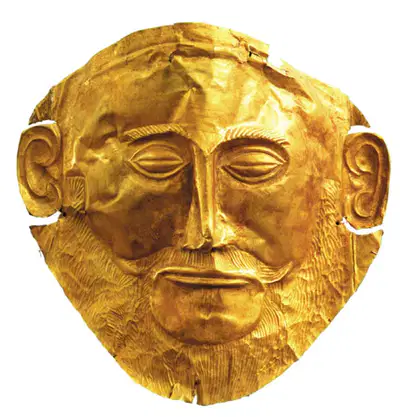
After Minoan civilization declined, the Mycenaeans became the major traders in the eastern Mediterranean. This beautiful gold mask was found in a tomb in Mycenae.
Mycenaean society began to fall apart in the 1200s BC when invaders from Europe swept into Greece. At the same time, earthquakes destroyed many cities. As Mycenaean civilization crumbled, Greece slid into a period of warfare and disorder, a period called the Dark Age.
29
Open Ended
To what regions did Minoan and Mycenaean traders travel?
30
Greeks Create City-States
The Greeks of the Dark Age left no written records. All that we know about the period comes from archaeological findings. About three hundred years after the Mycenaean civilization crumbled, the
Greeks started to join together in small
groups for protection and stability. Over
time, these groups set up independent
city-states. The creation of the polis
(PAH-luhs) marked the beginning of
what is known as Greece’s classical era.
During this era, the number and size of
civilizations around the world began to
increase. In Greece, this era saw the rise
of dominant city-states.
31
Life in a City-State
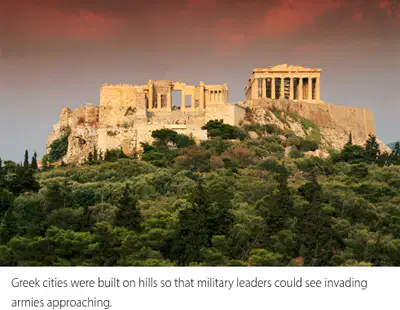
A Greek city was usually built around a strong fortress. This fortress often stood on top of an acropolis (uh-KRAH-puh-luhs). The town around the acropolis was surrounded by walls for added protection.
Not everyone who lived in the city-state actually lived inside the city walls. Farmers, for example, usually lived near their fields outside the walls. In times of war, however, women, children, and elderly people all gathered inside the city walls for protection. As a result, they remained safe while the men of the polis formed an army to fight off its enemies.
Life in the city often focused on the marketplace, or agora (a-guh-ruh) in Greek. Farmers brought their crops to the market to trade for goods made by craftsmen in the town. Because it was a large open space, the market also served as a meeting place. People held both political and religious assemblies in the market. It often contained shops as well.
32

The agora of Athens was located below the Acropolis. It was the center of commercial and political life.
33
The city-state became the foundation of Greek civilization. Besides providing security for its people, the city gave them an identity. People thought of themselves as residents of a city, not as Greeks. Because the city-state was so central to their lives, the Greeks expected people to participate in its affairs, especially in its economy and its government.
34
City-States and Colonization 600 BC
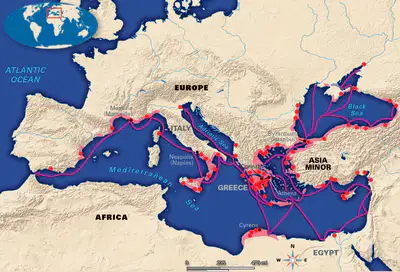
Life in Greece eventually became more settled. People no longer had to fear raiders swooping down on their cities. As a result, they were free to think about things other than defense. Some Greeks began to dream of becoming rich through trade. Others became curious
about neighboring lands around
the Mediterranean Sea. Some also
worried about how to deal with
Greece’s growing population.
Despite their different reasons, all
these people eventually reached
the same idea: the Greeks should
establish colonies.
35
Multiple Choice
Near which geographic feature were many Greek city-states and colonies located?
Mountains
Water
Valleys
Plains
36
Before long, groups from city-states around Greece began to set up colonies in distant lands. Afterwards, Greek colonies became independent. In other words, each colony became a new polis. In fact, some cities that began as colonies began to create colonies of their own. This meant that Greece continued to expand. This territorial expansion increased opportunities for trade, so Greece’s economy grew as well. Eventually, Greek colonies spread all around the Mediterranean and Black Seas. Many big cities around the Mediterranean today began as Greek colonies. Among them are Istanbul (is-tahn-BOOL) in Turkey, Marseille (mahr-SAY) in France, and Naples in Italy.
37
Patterns of Trade
Although the colonies were independent, they often traded with city-states in Greece. This trade was based on the supply and demand of certain goods with uniform, or agreed upon, value. For example, the colonies’ location gave them access to resources that the city-states wanted. The colonies specialized in the production of metals, such as copper and iron, that were sent to mainland Greece. In return, the Greek city-states sent wine, olive oil, and other products to the colonies. Trade made the city-states much richer. Because of their locations, some city-states became great trading centers. By 550 BC the Greeks had become the greatest traders in the whole Aegean region. Greek ships sailed to Egypt and cities around the Black Sea.
38
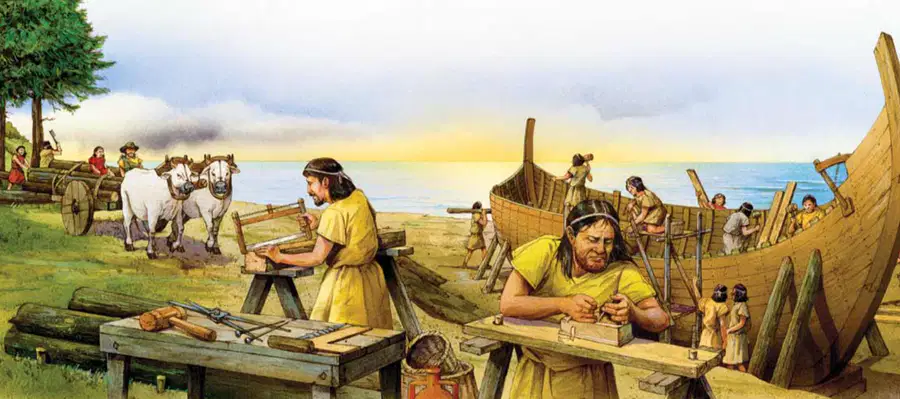
The early Greeks used the sea as a source of food and as a way of trading with other communities.
39
Open Ended
Why did the Greeks develop city-states
Show answer
Auto Play
Slide 1 / 39
SLIDE
Similar Resources on Wayground

36 questions
Elements and Compounds Review Quiz
Presentation
•
6th Grade
35 questions
Mesopotamian Empires Part 2
Presentation
•
6th Grade
30 questions
SS6E7: European Economic Systems
Presentation
•
6th Grade
30 questions
The Katipunan
Presentation
•
6th Grade
38 questions
South America: People and Culture - LIVE LESSON
Presentation
•
6th Grade
33 questions
Lesson 1: The Katipunan
Presentation
•
6th Grade
33 questions
NC Check In 3 Review - 6th Grade
Presentation
•
6th Grade
35 questions
World Religions Islam
Presentation
•
6th Grade
Popular Resources on Wayground
10 questions
How much do you know about our Portrait of an Eagle?

Quiz
•
10th Grade
10 questions
Fast Food Slogans
Quiz
•
6th - 8th Grade
21 questions
Continents and Oceans
Quiz
•
6th Grade
20 questions
Parts of Speech
Quiz
•
5th Grade
16 questions
Subject & Predicate
Quiz
•
5th Grade
25 questions
Multiplication Facts
Quiz
•
5th Grade
12 questions
Map Skills
Quiz
•
3rd Grade
22 questions
Continents and Oceans
Quiz
•
5th Grade
Discover more resources for Social Studies
10 questions
Exploring the Age of Exploration: Key Events and Figures

Interactive video
•
6th - 10th Grade
13 questions
13 Colonies Map Quiz
Quiz
•
6th - 8th Grade
12 questions
7 Continents and 5 Major Oceans
Quiz
•
6th Grade
10 questions
Pillars of Free Enterprise
Quiz
•
6th - 8th Grade
26 questions
QA 1 Review
Quiz
•
6th - 8th Grade
8 questions
Geography of Mesopotamia
Presentation
•
6th Grade
10 questions
Exploring the 13 Colonies Regions
Interactive video
•
6th - 10th Grade
20 questions
Latitude and Longitude Practice
Quiz
•
6th Grade