Search Header Logo
7.PS1.2-Mixtures, Reactions, and Changes in Matter-notes/slides

7.PS1.2-Mixtures, Reactions, and Changes in Matter-notes/slides

Assessment

Presentation

Science

7th Grade

Hard

NGSS
MS-PS1-2, MS-PS1-5, MS-PS1-1

+14

Standards-aligned

Created by

Jessica Freeman

FREE Resource

69 Slides • 70 Questions

2

media

3

​Mixtures

Mixtures are physical combinations of two or more substances.

media
media

​Hetero = different

​Homo = same

4

media

General properties of a mixture:

● The components of a mixture can be easily separated

● The components each keep their original properties

Characteristics of Mixtures

5

Multiple Select

Which of the following are examples of Mixtures?

1

The atmosphere

(N + O + Ar + H2O...)

2

Carbon Dioxide (CO2)

3

Oxygen

(O2)

4

Lemonade

(sugar, lemon juice, water)

5

Anything on the Periodic Table

6

Multiple Choice

Mixtures

1

are made of two different types of atoms chemically bonded together

2

Are only liquids

3

Cannot be separated

4

Can be separated using physical properties

7

Types of Mixtures

Heterogenous Mixture

- Heterogeneous mixtures have distinct components that can be easily seen and sorted.
- Heterogeneous mixtures can have uneven distribution of components.


Examples: Trail Mix, Salad, Spaghetti and Meatballs

media

8

Types of Mixtures

Homogenous Mixtures

- Homogeneous mixtures have a uniform appearance throughout the entire mixture, making it difficult to distinguish their different components.

Examples: saltwater, honey, and soy sauce

media

9

Multiple Choice

Lucky Charms

1

Heterogeneous

2

Homogeneous

10

Multiple Choice

Freshly brewed black coffee

1

Heterogeneous

2

Homogeneous

11

Multiple Choice

Dirt

1

Heterogeneous

2

Homogeneous

12

Multiple Choice

Air

1

Heterogeneous

2

Homogeneous

13

Multiple Choice

Trail Mix

1

Heterogeneous

2

Homogeneous

14

media

15

16

Multiple Choice

Question image

How many different types of particles are in this model? 

1

Only 1 type of particle.

2

2 types of particles.

3

3 types of particles.

4

4 types of particles.

17

Multiple Choice

Question image

Is this a pure substance or a mixture?

1

pure substance

2

mixture

18

Multiple Choice

Question image

How many different types of particles are in this model? 

1

Only 1 type of particle.

2

2 types of particles.

3

3 types of particles.

4

4 types of particles.

19

Multiple Choice

Question image

Is this a pure substance or a mixture?

1

pure substance

2

mixture

20

Multiple Choice

Question image

How many different types of particles are in this model? 

1

Only 1 type of particle.

2

2 types of particles.

3

3 types of particles.

4

4 types of particles.

21

Multiple Choice

Question image

Is this a pure substance or a mixture?

1

pure substance

2

mixture

22

23

Multiple Choice

Which of the following is a mixture?

1

gold

2

cookie dough

3

water

4

salt

24

Fill in the Blank

A mixture contains _____ or more substances that are not bonded together.

25

26

Multiple Choice

Imagine you mix sand and water in a beaker.

How could you separate the sand and water?

1
2
3
4

27

Multiple Choice

How could you separate a mixture of iron and sand?

1
2
3
4

28

29

Multiple Choice

Question image

Why is it possible to separate iron and sand after they have been mixed?

1

The properties of iron and sand become identical once they are mixed.

2

The properties of iron and sand change once they are mixed.

3

The properties of iron and sand do not change once they are mixed.

30

Multiple Choice

Question image

Imagine you have a mixture of sand and plastic beads you want to separate. You add water to the mixture. The beads float to the top and the sand sinks to the bottom.

Which of the following is true?

1

The beads and the sand kept their original densities after they mix.

2

The density of the beads and sand changed after they mix.

3

The density of the beads and sand become the same after they mix.

31

32

Multiple Choice

Which of the following is a mixture?

1
2
3

33

Multiple Choice

Which of the following is a mixture?

1
2
3

34

Multiple Choice

Which of the following is a mixture?

1
2
3

35

media

mixture

component

NOT

physical

properties

salt

water

36

37

media

In science, properties are ​the characteristics that enable us to differentiate one material from another.

A synonym is characteristic or trait.​

What is a property?

38

media

39

Separation of Mixtures

How do we separate Homogeneous and Heterogeneous mixtures??

media

40

Multiple Choice

A combination that can be separated by physical processes is a .....

1

Pure Substance

2

Glucose

3

Element

4

Mixture

41

media

42

media

43

media

44

Chromatography

Chromatography SEPARATES substances as they are drawn across a barrier.


Chromatography happens when different colors from an ink pen spread out on a paper towel.

media

45

Distillation

Separates mixtures based on differences in substances' boiling points.


Distillation is used to process crude oil into its many different parts such as gasoline.

media

46

media

47

media

48

Multiple Choice

If a solid doesn't dissolve in a liquid we say that it is

1

Soluble

2

A solvent

3

Insoluble

4

Undissolveable

49

Multiple Choice

What happens when salty water is boiled?

1

The salt becomes a new compound and water evaporates as it has a low boiling point

2

The water evaporates and the salt remains in the beaker as it has a high melting point

3

The water becomes a new compound and evaporates while salt remains in the beaker

4

The water will disappear and the salt remains in the beaker as it is a solid

50

Multiple Choice

The process used to separate heterogeneous mixtures of solids and liquids is called

1

filtration

2

crystallization

3

distillation

4

chromatography

51

Multiple Choice

Question image

If you spilled nails in a sandbox, what separation tool/method could you use to clean out the sandbox so it would be safe for children to play in?

1

Filter

2

Screen

3

Magnet

4

Evaporation

52

Multiple Choice

Question image

This type of paper allows liquid to pass through it. What tool is it?

1

sieve

2

filter

53

Multiple Choice

Mixtures can be separated .......................

1

Physically

2

Chemically

54

media

55

media

56

media

57

media

58

Physical Properties of Matter

Think of the different ways you can describe an object....

media

59

media

60

media

61

media

62

media

63

media

64

Multiple Choice

Any measurable or observable attribute that describes matter

1

Physical Property

2

Chemical Property

65

media

66

Multiple Choice

The ability of a substance to be pressed or pounded into a thin sheet.

1

magnetism

2

conductivity

3

ductility

4

malleability

67

Multiple Choice

The ability of a substance to be pulled into a thin strand.

1

ductility

2

melting point

3

buoyancy

4

density

68

media

69

media

70

media

71

Multiple Choice

Question image

The ability of a substance to dissolve is called...

1

malleability

2

ductility

3

solubility

72

Multiple Choice

An attractive force for some metals.

1

Conductivity

2

Solubility

3

Magnetism

4

Mass

73

Multiple Choice

The ability of matter to conduct electric current or heat

1

Solubility

2

Mass

3

Weight

4

Conductivity

74

Multiple Choice

Question image

Which box has a higher density?

1

Box A

2

Box B

3

cannot be determined

4

they are the same

75

Multiple Choice

Properties that can be measured or observed without matter changing to an entirely different substance.

1

Chemical Properties of Matter

2

Physical Properties of Matter

3

Physical Change

4

Chemical Change

76

Multiple Choice

Density can be used as a physical property of identification of a substance because the density of a substance ___.

1

stays the same no matter the size of the sample

2

changes with each different amount of a substance

3

is determined by the substance's height

4

is also a chemical property

77

Multiple Choice

When a solid reaches the temperatures of its ___, it can become a liquid.

1

melting point

2

freezing point

3

boiling point

4

density

78

Multiple Choice

What is the state of matter that has a fixed volume but not a fixed shape?

1

Solid

2

Liquid

3

Gas

79

Multiple Choice

The temperature at which a substance changes from a liquid to a gas

1

Melting point

2

Boiling point

3

Freezing point

4

Condensation point

80

media

physical

property

color

mass

density

data

substances

81

media

82

media

83

media

84

media

85

Chemical Reactions

media

86

media

87

Multiple Choice

When a new substance forms as a result of a chemical reaction, what type of change has occurred?

1

Chemical Change

2

Physical Change

88

media

89

Multiple Choice

Which is NOT an indication of a chemical change?

1

Temperature Change

2

Shape Change

3

Formation of a precipitate

4

Production of light

90

media

91

media

92

Open Ended

Question image

Explain what is happening in the following image.

93

media

94

media

95

Open Ended

Explain how the properties of salt are different from the elements that form it.

96

media

97

How can you tell a chemical reaction is happening?

  • A change of color occurs during the reaction

  • A gas is produced during the reaction.

  • A solid product called a precipitate is produced during the reaction.

  • A transfer of energy occurs as a result of the reaction.

98

Example 1: Color Change

A solution of potassium permanganate is added to a solution of sodium hydroxide and sugar.

Notice how the colors change as the reaction continues 

99

Poll

When food coloring is added to water, is a chemical reaction taking place?

Yes

No

100

A chemical reaction is NOT taking place? WHY???


  • Your reactants are food coloring and water and the product is food coloring and water.

  • There were no other signs of a chemical reaction taking place

  • The color change of water (went from clear to the color of the food coloring) was predictable.  Often the color change in a chemical reaction are not necessarily predictable (as in the video) 

101

Example 2: gas production

When zinc reacts with nitric acid, the reaction bubbles vigorously as Nitrogen gas is produced. The production of a gas is also an indication that a chemical reaction is occurring.


102

Example 3: precipitate formation

When a colorless solution of lead(II) nitrate is added to a colorless solution of potassium iodide, a yellow solid called a precipitate is instantly produced.

103

Transfer of Energy

  • All chemical changes involve a transfer of energy. 

  • Energy/heat can be absorbed =Endothermic reaction.

  • Or

  • Energy/heat can be given off=Exothermic reaction

104

Example 4: Energy Transfer

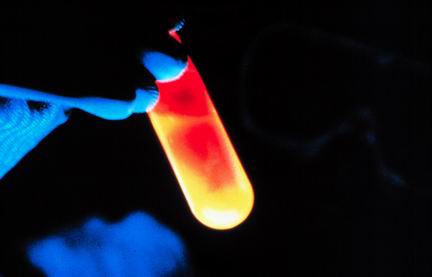
Sodium and water produce an explosion. Energy/heat is being released. This is an exothermic reaction.

105

Open Ended

In two minutes,

write the four indicators of a chemical change.

106

Multiple Choice

Which of the following describes changes in energy during a chemical reaction?

1

Changes in energy do not occur during a chemical reaction.

2

Energy is always released during a reaction.

3

Energy may be either absorbed or released during a reaction.

4

Energy is always released during a reaction.

107

Multiple Select

Which of the following indicated a chemical change/chemical reaction?

1

Precipitate formation

2

Transfer of heat energy

108

Open Ended

Two reactants are mixed in a test tube, and the test tube becomes very warm. This is a sign of a transfer of ______ taking place.

109

Multiple Select

What state of matters, when produced, is a sign that a chemical reaction is occuring?

1

gas

2

liquid

3

solid

4

plasma

110

Multiple Choice

When a color change happens, a chemical reaction must have occurred.

1

false

2

true

111

Poll

Lesson Reflection: How confident do you feel in your ability to determine if a chemical change has occurred?

very confident

confident

partly confident

not confident at all

112

media

113

media

chemical

reaction

identity

different

gas formation

temperature change

color change

114

media

115

media

116

Drag and Drop

Question image
Four students performed four different investigations by combining different substances. Their results are shown in the table to the left. In ​ ​
, a chemical reaction took place. The other experiments ​
result in a chemical reaction.
Drag these tiles and drop them in the correct blank above
Experiment 1
Experiment 2
Experiment 3
Experiment 4
did not
did

117

Hotspot

Which observations are evidence that a chemical reaction took place?

118

Drag and Drop

Question image
Four students performed four different investigations by combining different substances. Their results are shown in the table to the left. In ​ ​
, a chemical reaction took place. The other experiments ​
result in a chemical reaction.
Drag these tiles and drop them in the correct blank above
Experiment 1

Experiment 2

Experiment 3

Experiment 4

did not

did

119

Drag and Drop

Rusting is a ​
. What EVIDENCE supports this claim​
?
Drag these tiles and drop them in the correct blank above
chemical reaction
unexpected color change
physical change
expected color change

120

Match

Match the observations with their evidence that a chemical change has occurred

a reaction goes from 40 degrees to 70 degrees

A baggie puffs up when 2 substances are mixed inside

rust on a nail

meat has gone bad

milk turns chunky after being left out for days

temperature change

gas production

color change

odor produced

formation of a precipitate

121

Dropdown

The only sure evidence of a chemical reaction is....

122

Dropdown

The only sure evidence of a chemical reaction is....

123

Multiple Choice

Question image
Which of the following is NOT evidence that that a chemical reaction has occurred?
1
produces light/heat
2
production of a gas
3
formation of a precipitate
4
melting

124

media

125

media

126

Multiple Choice

Question image

A student was doing an investigation. Below are the observations before and after the investigation.


Which observation provides evidence that a new substance formed in the beaker after the investigation?

1

Observation 1

2

Observation 1 & 4

3

Observation 2 & 3

4

A new substance was not formed

127

Multiple Choice

Question image

In the example provided, what evidence of a chemical change do you see?

1

Color change

2

Precipitate formation

3

Water production

4

Gas evolution

128

Multiple Choice

Question image

Based on their observations, can the students correctly conclude that a chemical reaction occurred?

1

No, because the metal strip was still visible

2

Yes, because a new material of a different color formed on part of the metal strip

3

No, because the solution stayed blue

4

Yes, because the volume of the blue solution stayed the same

129

Multiple Choice

Question image

Burning a candle is a chemical change. What is the primary evidence that burning the candle is a chemical reaction?

1

change in color

2

change in odor

3

formation of a solid

4

temperature change

130

Multiple Choice

Question image

What evidence of a chemical reaction do you see in the picture?

1

bubbling (bubbles)

2

color change

3

precipitate

4

heat

131

Multiple Choice

Question image

Production of Gas or Bubbles is evidence of a

1

Physical Change

2

Chemical Change

132

Multiple Choice

Question image

Question 7: Hoey


Dr. Hoey develops an experiment to investigate how different substances react when they are mixed with water. Before mixing the materials together, she measured the mass and temperature of the substances. During the experiment, Dr. Hoey mixes calcium and water in a glass with a plastic rod. Then, she mixes baking soda and water in a glass with a plastic rod. The results of the experiment are below.


Which of the following claims can Dr. Hoey make based on her investigation?

1

Solution A is a new substance because after the calcium and water mixed, the temperature increased and the color changed.

2

Solution B is a new substance because after the baking soda and water mixed, the solution was cloudy and the temperature remained the same.

3

Solution B is a new substance because after the baking soda and water mixed, the mass of the solution is equal to the mass of the baking soda and water before they were mixed.

4

Solution A and B are new substances because each solution stayed the same when they were mixed together.

133

Multiple Choice

Question image

A blue liquid was added to a clear liquid. Which evidence that a chemical reaction may have occurred?

1

the solution turned light blue

2

the temperature remained the same

3

solid particles formed

4

the volume increased

134

Multiple Choice

Question image

Students performed a lab investigation on chemical reactions. The

students put on goggles and plastic gloves and then followed these

steps. Which observation would indicate that a chemical reaction

occurred?

1

The vinegar took the shape of the container in step 1.

2

The steel wool sank into the vinegar in step 3.

3

The temperature of the vinegar increased during step 4.

4

The steel wool changed shape during step 6.

135

media

136

media

before

​after

physical

evidence

chemical

137

media

138

media

139

media

Show answer

Auto Play

Slide 1 / 139

SLIDE