

Evolution Day 2: Natural Selection Terms and Conditions

Presentation
•
Science
•
9th - 12th Grade
•
Medium
+6
Standards-aligned

Rachael Stark
Used 3+ times
FREE Resource
12 Slides • 19 Questions
1
2
Multiple Choice
3
Multiple Choice
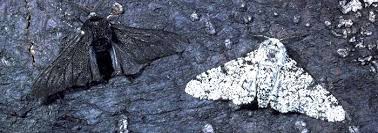
Which moth coloration is being selected FOR by natural selection?
4
Multiple Choice
5
Multiple Choice
3. Scientists have discovered bacteria that can survive in the hot temperatures found in the lava of volcanoes. Which statement best explains how bacteria could survive in this environment?
A.Bacteria are small enough not to be killed by heat.
B.Bacteria are simple organisms and can live in any conditions.
C.Bacteria have mutated and those suited to the environment survive there.
D. Bacteria grow faster in hot conditions and so are suited to the environment.
6
Multiple Choice

During his trip to the Galapagos Islands, Charles Darwin observed that finches on different islands had different features. Ultimately, how did this observation contribute to Darwin’s theory of natural selection?
A.He concluded that every instance of species variation results in a beneficial mutation.
B.He concluded that mutation inhibits the chance that an organism will adapt to its environment.
C. He concluded that species develop mutations exclusively because of electromagnetic radiation.
D. He concluded that traits well suited to an organism’s environment are more likely to be passed on to successive generations.
7
Multiple Choice
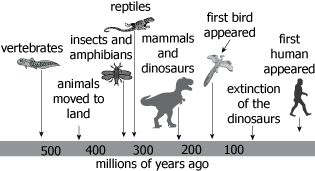
The geologic time scale is a record of
the thickness of sedimentary layers
the rate of fossil formation
the life forms and geologic events in Earth's history
the time since the evolution of dinosaurs
8
Multiple Choice
9
Multiple Choice

Which of these enables the calf in the picture to look different to its Mum?
Adaptation
Inheritance
Evolution
10
Drag and Drop
11
Multiple Choice
12
Drag and Drop

13
Drag and Drop
14
Drag and Drop
15
What even is Natural Selection
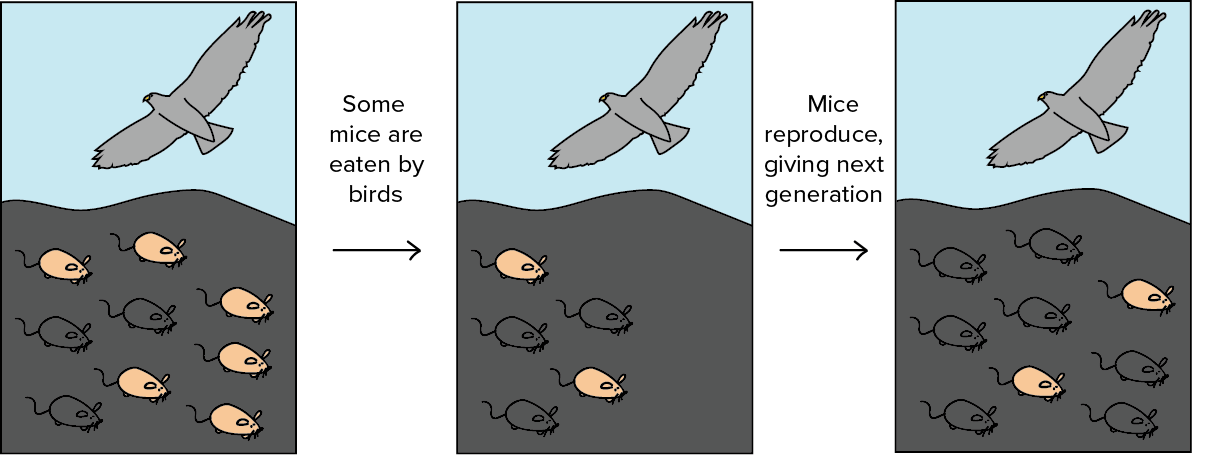
Darwin reasoned that natural selection results in favorable traits being represented more and more and unfavorable ones less and less in ensuing generations of organisms.
These traits can be selected for/against by several factors in the natural environment.

16
The Factors Doing the Selecting
Overproduction: Within a population, more offspring are produced than can survive due to limitations of food and living space
Competition: Individuals compete for food, shelter, and opportunities to reproduce!
Remember Thomas Malthus? #1 and #2 were his whole deal.Variation: Some individuals are better able to survive than others due to natural differences
Survival of the Fittest: Individuals better fit to survive are more likely to live long enough to reproduce

17

18


19
The Factors Doing the Selecting
Transmission of Favorable Variations: Favorable characteristics that allow for survival and reproduction will be passed on to the next generation. Characteristics that reduce an organisms chance of survival will decrease over time (descent with modification)
-
Evolution of a New Species: Accumulation of advantageous variations will eventually lead to the evolution of a new species better adapted to the environment.

Panthers are just jaguars/leopards with a condition called Melanism (their body makes a lot of melanin, which makes them a darker color). It's rare to see in nature because it makes them stand out, not favorable.
20
Multiple Choice
21
Multiple Choice
22
Multiple Choice
23
Drag and Drop
24
Multiple Choice
25
Multiple Choice
26
What causes variations?
Changes in the genes in gametes of sexually reproducing organisms can be passed onto offspring (aka mutations in the DNA of SEX CELLS, like sperm and eggs). Mutations in body cells will NEVER be passed onto offspring. The mutations MUST occur in the DNA of SEX CELLS. There are two ways that an organism can have gene combinations that differ from the parent:

1. Genetic Shuffling
The sorting and recombination of genes during meiosis and fertilization results in new combination of genes
This is the major source of variation is sexually reproducing species. For example, a human couple could produce an estimated 70 trillion genetically unique offspring!
Think about how crossing over and independent assortment (during Meiosis) can make new genetic combinations by mixing maternal and paternal genetic material on each chromatid
27
What causes variations?
2. Random Mutations
Change in the nucleotide base sequence (ATCG) of a DNA molecule - Mutations are random and unpredictable. They can be due to random error in transcription/translation or caused by a mutagen (UV light, X rays, cigarette smoke, some chemicals).
- Mutations are important sources of new genes
- Mutations in body cells cannot be passed on, but ONLY mutations in sex cells (sperm & egg) can be passed on. Mutations in sex cells are the basis of evolutionary changes
- Most mutations are harmful, but a few can be beneficial and could lead to a new species

28
Table Talk
On your whiteboards, come up with an answer to the following:
Why must the cause of variations occur in gametes/sex cells to pass onto offspring?
29
SOME IMPORTANT CONTEXT
Acquired Traits/Characteristics are NOT a source of genetic variation (Sorry Lamark) because they are developed in body (somatic) cells and are not based on genetics.
The environment does NOT induce adaptation.
Individuals BORN with advantageous phenotypes SURVIVE TO REPRODUCE.
30
Why do we care?
If environmental conditions change, organisms that have become adapted to those conditions may die! Genetic diversity or variations of organisms allows the species to survive. Once diversity is lost it is impossible to get it back


31

Show answer
Auto Play
Slide 1 / 31
SLIDE
Similar Resources on Wayground

24 questions
7.1 Evolution of Earth's Atmosphere
Presentation
•
9th - 12th Grade
22 questions
Evolution
Presentation
•
9th - 12th Grade
26 questions
Homeostasis 1
Presentation
•
9th - 12th Grade
24 questions
Chemical Reactions - Balancing and Writing Chemical Equations
Presentation
•
9th - 12th Grade
25 questions
Light Independent Reaction Lesson
Presentation
•
9th - 12th Grade
22 questions
Ecological Succession EOC Review
Presentation
•
9th - 12th Grade
24 questions
Engineering Design Process
Presentation
•
8th - 12th Grade
21 questions
Unit 7: Energy Transformations
Presentation
•
9th - 12th Grade
Popular Resources on Wayground
10 questions
Safety Day 2026 – Student Review

Quiz
•
9th Grade
21 questions
Continents and Oceans
Quiz
•
6th Grade
20 questions
Parts of Speech
Quiz
•
5th Grade
16 questions
Subject & Predicate
Quiz
•
5th Grade
25 questions
Multiplication Facts
Quiz
•
5th Grade
12 questions
Map Skills
Quiz
•
3rd Grade
22 questions
Continents and Oceans
Quiz
•
5th Grade
15 questions
Rounding Decimals
Quiz
•
5th Grade
Discover more resources for Science
10 questions
Exploring Chemical and Physical Changes

Interactive video
•
6th - 10th Grade
20 questions
Atomic Structure
Quiz
•
9th Grade
10 questions
Exploring the Electromagnetic Spectrum for Middle School Science
Interactive video
•
6th - 10th Grade
10 questions
Exploring Force and Motion Concepts
Interactive video
•
6th - 10th Grade
10 questions
Exploring Air Masses and Weather Fronts
Interactive video
•
6th - 10th Grade
14 questions
Periodic Trends
Interactive video
•
11th Grade
10 questions
Exploring the States of Matter
Interactive video
•
6th - 10th Grade
10 questions
Exploring Forces: Net Force, Normal Force, Gravity, and Friction
Interactive video
•
6th - 10th Grade