

Principles and Methods of Training Level 2

Presentation
•
Physical Ed
•
6th - 8th Grade
•
Practice Problem
•
Easy

Roger Springer
Used 2+ times
FREE Resource
21 Slides • 21 Questions
1

2

3
Multiple Choice
Which of the following is a key objective when learning about training methods?
To explain the principles of training
To memorize sports rules
To describe different methods of training
To apply training to different sports and people
4
Open Ended
Why is it important to understand the principles and methods of training when aiming for healthy exercise?
5

6
Multiple Choice
Which of the following is NOT a benefit of training?
Improve health
Develop fitness
Increase risk of injury
Prepare for sport or activity
7

8
Multiple Choice
Which principles are represented by the acronym SPORT in training?
Specificity, Progression, Overload, Reversibility, Tedium
Strength, Power, Organization, Recovery, Technique
Speed, Performance, Overload, Recovery, Training
Stamina, Progression, Overload, Repetition, Technique
9
Open Ended
Explain how the principles of training (SPORT) help ensure training is safe, effective, and appropriate.
10

11
Fill in the Blanks
Type answer...
12

13
Multiple Choice
What is an example of progression in training?
Running the same distance every day
Increasing a run from 10 minutes to 20 minutes over several weeks
Lifting the same weight repeatedly
Stopping training for a month
14

15

16
Open Ended
Describe what happens to fitness levels if training stops, according to the principle of reversibility.
17

18
Multiple Choice
Why is it important to vary your training routine instead of doing the same workout every day?
To avoid tedium and keep motivation high
To increase muscle size rapidly
To reduce the risk of injury
To improve flexibility only
19

20
Open Ended
Match the following training principles to their examples: Increasing weights each week, Training football skills for football, Losing fitness after 3 weeks off, Getting bored of the same routine.
21

22
Multiple Select
Which of the following are common methods of training mentioned in the slides?
Continuous training
Weight training
HIIT
Yoga
23

24
Fill in the Blanks
Type answer...
25

26

27
Multiple Select
Interval training is most effective for improving which of the following?
Speed
Power
Cardiovascular fitness
Flexibility
28

29
Multiple Choice
Which of the following is NOT an example of a station in circuit training?
Press-ups
Squats
Jump squats
Sit-ups
30

31
32
33
Fill in the Blanks
Type answer...
34
Multiple Select
Which training methods would be most suitable for improving speed and power for a sprinter?
Circuit training and HIIT
Plyometric training and HIIT
Weight training and circuit training
Plyometric training and weight training
35
36
Open Ended
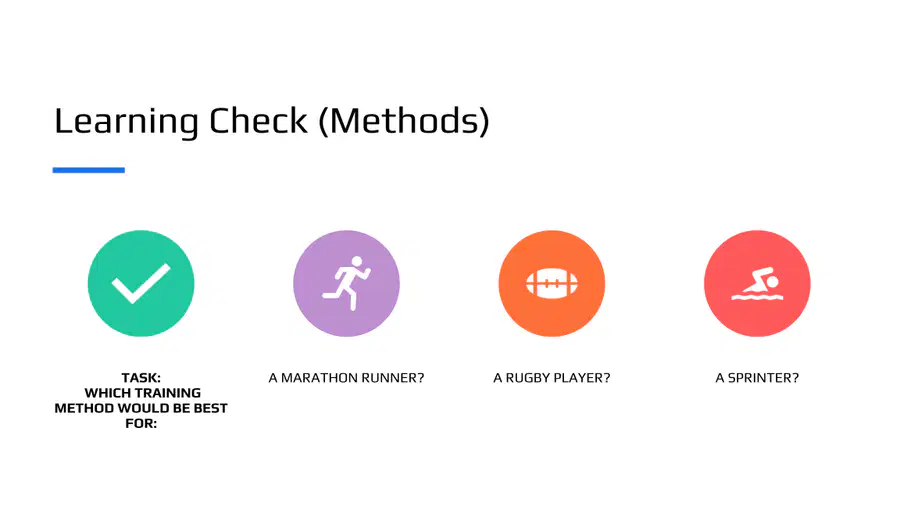
Which training method would be best for a marathon runner, a rugby player, and a sprinter? Explain your choices.
37

38
Open Ended
Explain two principles of training and describe one training method for a football player.
39
40
Open Ended
How do you think the principles and methods of training can be adapted for different sports or individuals?
41
Multiple Choice
Which of the following is NOT a learning objective for this session on Principles & Methods of Training?
Explain the principles of training
Describe different methods of training
Apply training to different sports and people
List famous athletes and their training routines
42
Open Ended
Design a simple training plan for a 16-year-old beginner who wants to improve fitness. Include one principle, one training method, and one safety point.
Show answer
Auto Play
Slide 1 / 42
SLIDE
Similar Resources on Wayground

37 questions
Intro to Combining Like Terms
Presentation
•
7th - 8th Grade
37 questions
Domains and Kingdoms
Presentation
•
6th - 8th Grade
37 questions
Parts of Speech Review
Presentation
•
6th - 8th Grade
36 questions
Integer Operations Lesson
Presentation
•
6th - 8th Grade
38 questions
Los Saludos ***
Presentation
•
6th - 8th Grade
35 questions
The Cell
Presentation
•
6th - 8th Grade
35 questions
Earth, Sun, and Moon System
Presentation
•
6th - 8th Grade
35 questions
Absolute Value and Additive Inverse Review
Presentation
•
6th - 7th Grade
Popular Resources on Wayground
10 questions
Factors 4th grade

Quiz
•
4th Grade
10 questions
Cinco de Mayo Trivia Questions

Interactive video
•
3rd - 5th Grade
13 questions
Cinco de mayo
Interactive video
•
6th - 8th Grade
20 questions
Math Review
Quiz
•
3rd Grade
20 questions
Main Idea and Details
Quiz
•
5th Grade
20 questions
Context Clues
Quiz
•
6th Grade
20 questions
Inferences
Quiz
•
4th Grade
19 questions
Classifying Quadrilaterals
Quiz
•
3rd Grade