

WH Chapter 8, Part B

Presentation
•
Social Studies
•
9th Grade
•
Practice Problem
•
Easy

Beth Harrison
Used 1+ times
FREE Resource
11 Slides • 10 Questions
1
2
3
Multiple Choice
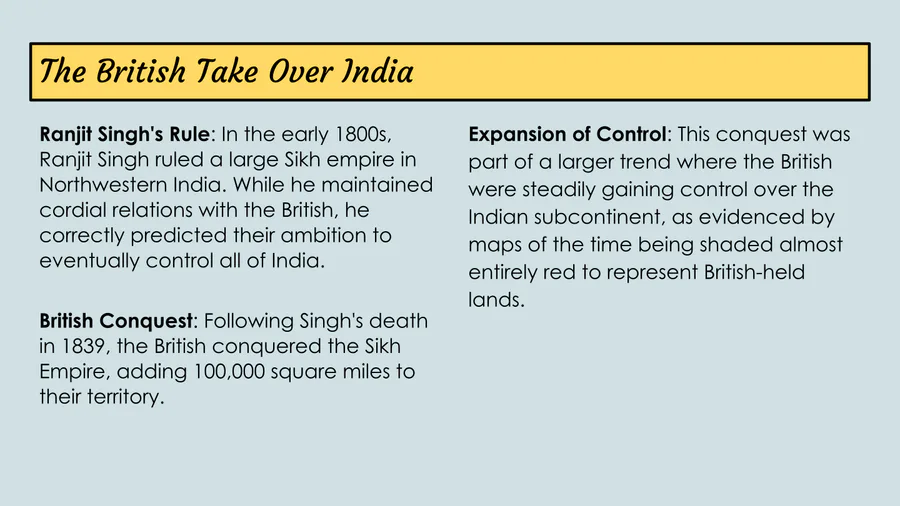
What was Ranjit Singh’s perspective regarding British intentions in India during the early 1800s?
He believed the British were only interested in establishing fair trading rights.
He correctly predicted that the British aimed to eventually control the entire Indian subcontinent.
He sought to form a permanent military alliance with the British to expand his own empire.
He believed the British would leave India voluntarily after the decline of the Mughal Empire.
4
5
Multiple Choice
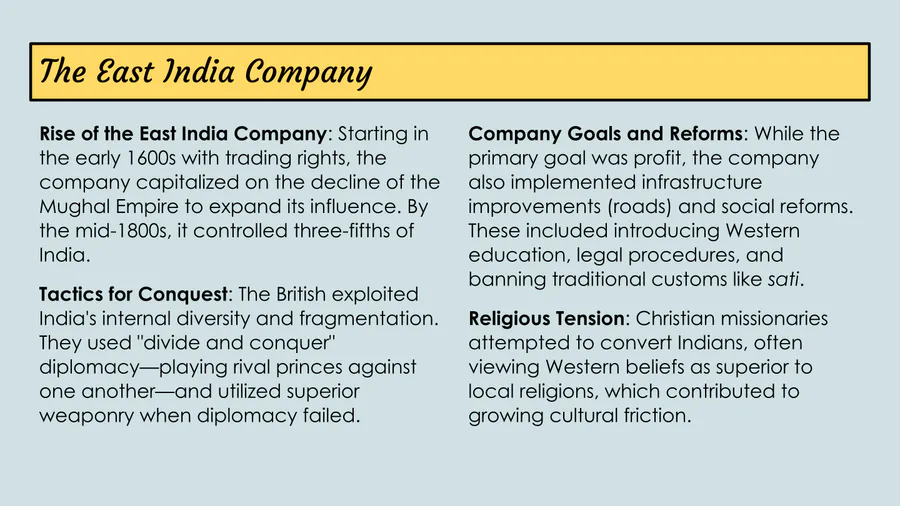
Which of the following was a tactic used by the British East India Company to expand its influence in India?
Divide and conquer diplomacy
Religious tolerance
Non-violent protest
Isolationism
6
7
Multiple Choice
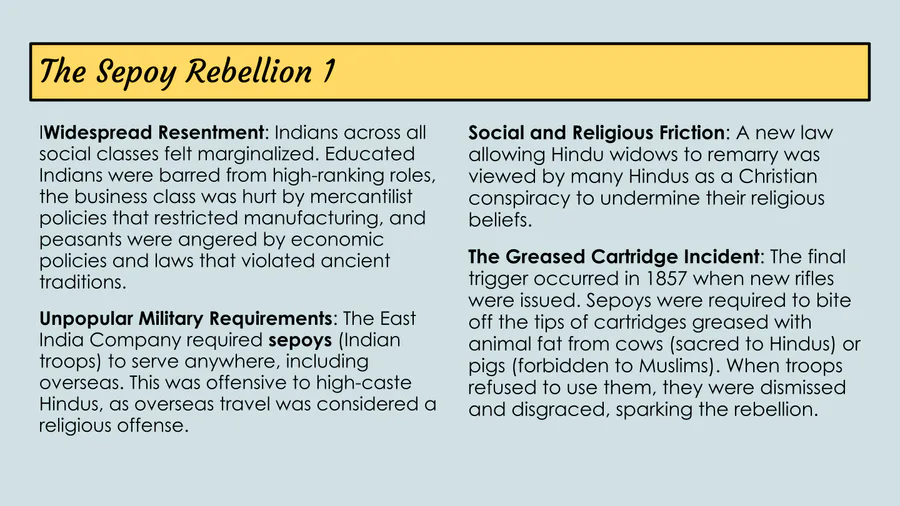
What was the immediate "trigger" or final cause that sparked the Sepoy Rebellion in 1857?
The British Parliament passing a law that banned all traditional Indian manufacturing.
A new requirement for sepoys to travel overseas, which violated high-caste Hindu religious beliefs.
The issuance of new rifles using cartridges greased with animal fat from cows and pigs
The appointment of a British viceroy to replace the last remaining Mughal ruler in Delhi.
8
9
Multiple Select
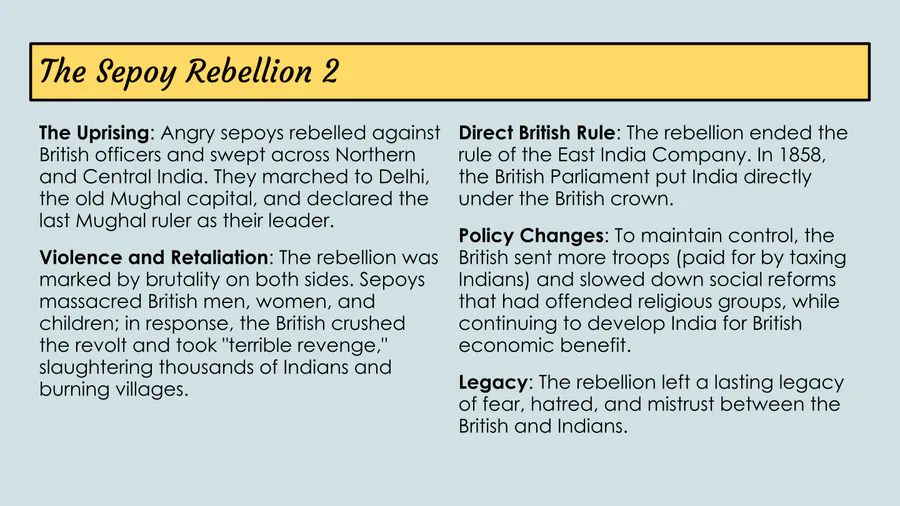
Which of the following were direct consequences of the Sepoy Rebellion of 1857?
End of East India Company rule
Direct British crown rule
Immediate Indian independence
Policy changes to slow social reforms
10
11
Fill in the Blanks
12
13
Multiple Choice
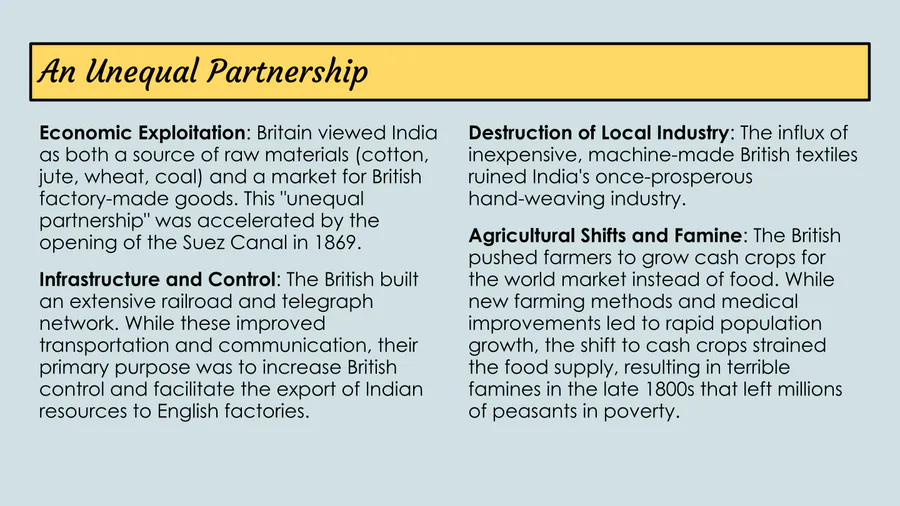
How did the "unequal partnership" between Britain and India affect India's local textile industry?
The introduction of the telegraph allowed Indian weavers to export their goods more efficiently to Europe.
The British government provided subsidies to local weavers to help them compete with global markets.
The influx of inexpensive, machine-made British textiles ruined India's once-prosperous hand-weaving industry.
The opening of the Suez Canal led to a massive increase in the global demand for handmade Indian clothing.
14
15
Multiple Select
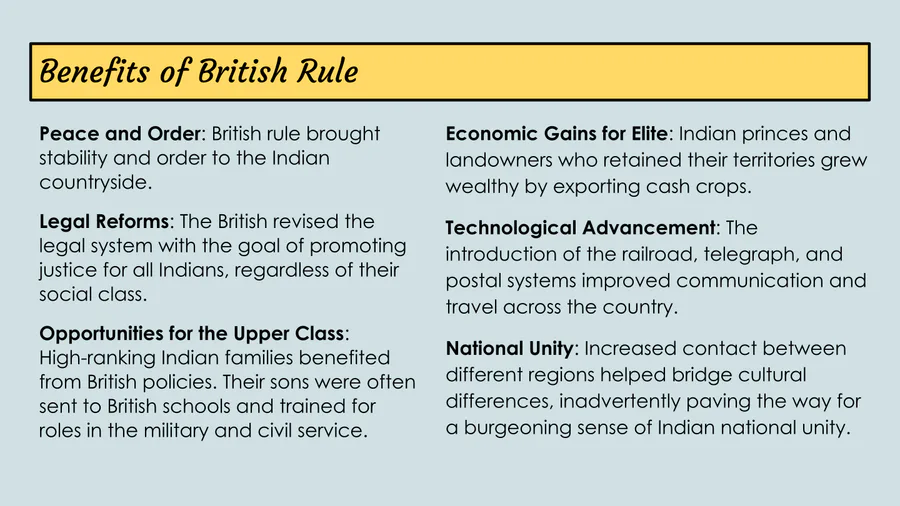
Which of the following were considered benefits of British rule in India according to the provided content?
Peace and order
Legal reforms
Technological advancement
Universal suffrage
16
17
Multiple Choice
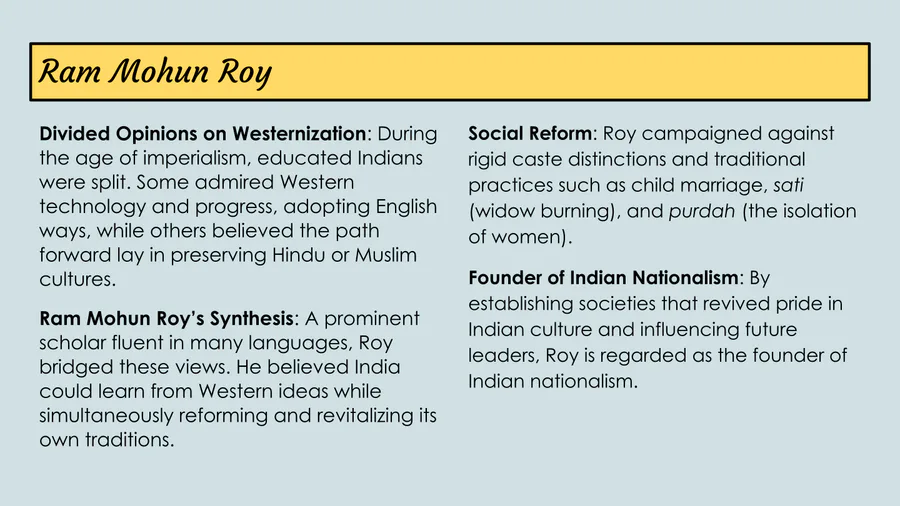
How did Ram Mohun Roy's approach to Westernization differ from the divided opinions among educated Indians during the age of imperialism?
He rejected all Western ideas and focused only on Indian traditions.
He believed India should adopt Western ideas while also reforming its own traditions.
He supported only Hindu traditions and rejected Muslim and Western influences.
He advocated for isolation from all foreign influences.
18
19
Multiple Choice
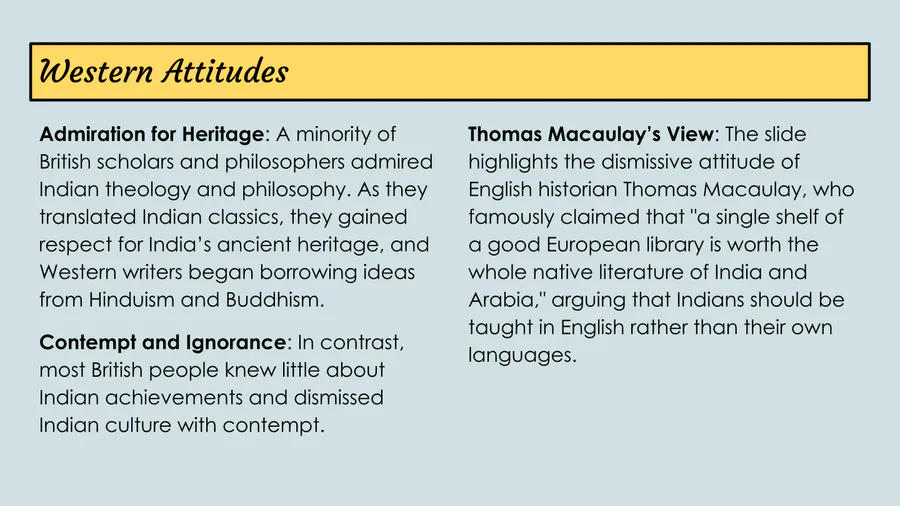
What was Thomas Macaulay’s attitude toward Indian culture and education?
He believed that Indian theology and philosophy were superior to Western science.
He argued that Indians should be educated in their own native languages to preserve their heritage.
He dismissively claimed that a single shelf of a good European library was worth more than all of Indian and Arabian literature.
He encouraged British scholars to translate Indian classics to help modernize English literature.
20
21
Multiple Select
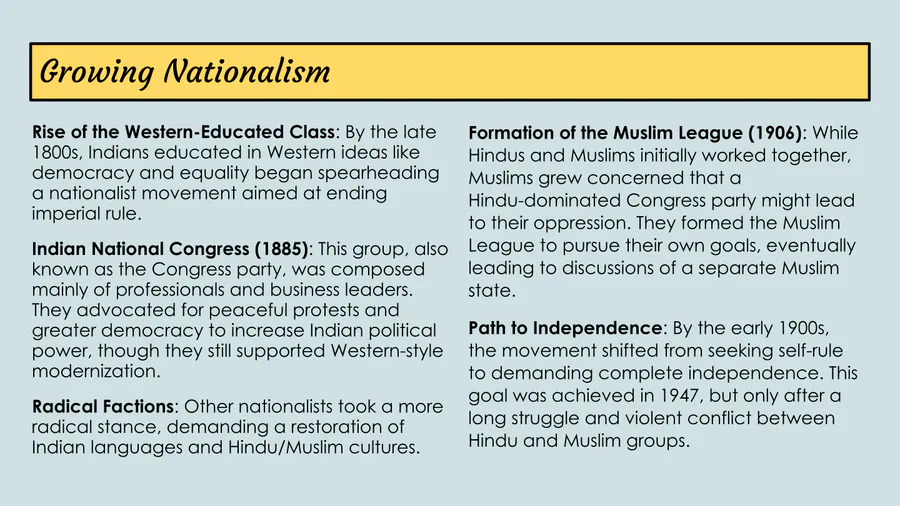
Which of the following were significant developments in the growth of Indian nationalism in the late 1800s and early 1900s?
Formation of the Indian National Congress
Establishment of the Muslim League
Demand for restoration of Indian languages and cultures
Introduction of Western-style modernization
Show answer
Auto Play
Slide 1 / 21
SLIDE
Popular Resources on Wayground

15 questions
Grade 3 Simulation Assessment 1

Quiz
•
3rd Grade
22 questions
HCS Grade 4 Simulation Assessment_1 2526sy
Quiz
•
4th Grade
16 questions
Grade 3 Simulation Assessment 2
Quiz
•
3rd Grade
19 questions
HCS Grade 5 Simulation Assessment_1 2526sy
Quiz
•
5th Grade
17 questions
HCS Grade 4 Simulation Assessment_2 2526sy
Quiz
•
4th Grade
20 questions
Equivalent Fractions
Quiz
•
3rd Grade
24 questions
HCS Grade 5 Simulation Assessment_2 2526sy
Quiz
•
5th Grade
20 questions
Math Review
Quiz
•
3rd Grade
Discover more resources for Social Studies
50 questions
US History EOC Review
Quiz
•
9th - 12th Grade
83 questions
AP Human Geography Unit 4 Review
Quiz
•
9th Grade
16 questions
LHS - Africa Review
Quiz
•
9th Grade
40 questions
Stuffa
Quiz
•
9th - 12th Grade
20 questions
Renewable vs. Nonrenewable Resources
Quiz
•
9th Grade
23 questions
Unit 5: Executive Branch
Quiz
•
9th - 12th Grade
29 questions
Test Review – South Asia
Quiz
•
9th Grade
27 questions
27 Amendments
Quiz
•
5th - 9th Grade