

Untitled Presentation

Presentation
•
Life Skills
•
12th Grade
•
Practice Problem
•
Hard

Dodi Dadou
FREE Resource
15 Slides • 17 Questions
1

2
3
Multiple Choice
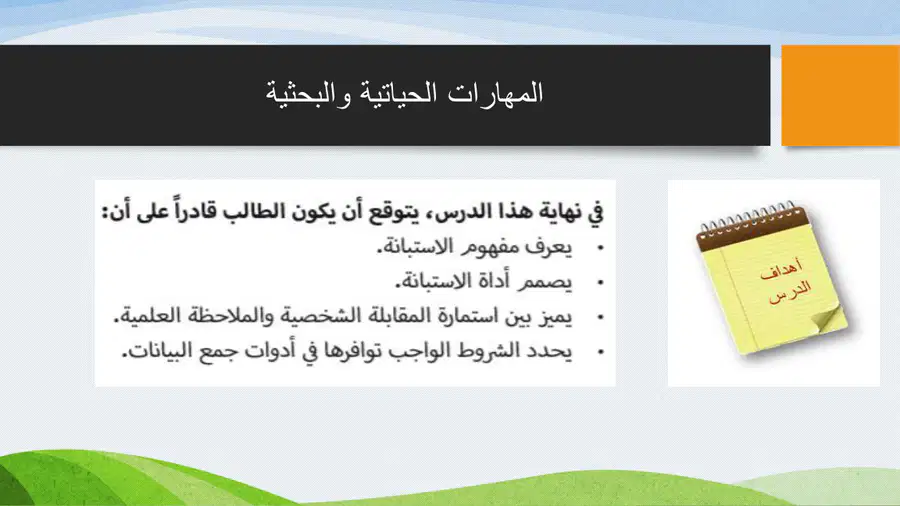
What is triangulation in qualitative research?
Using multiple data sources to validate findings
Conducting three separate studies
Using a triangular graph to present data
Focusing on three main themes
4

5
Multiple Choice
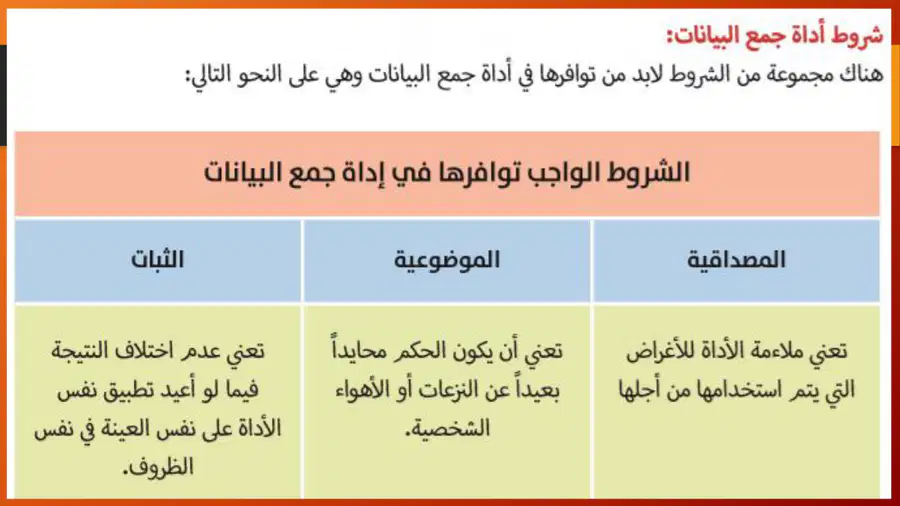
What are the tools used for data collection in scientific research?
Surveys
Interviews
Observations
All of the above
6
7
Multiple Choice
Ms. Li, a principal, is interested in the differences in student behavior between two of the third-grade classrooms at her school. She asks the teachers, Mr. Williams, whose class meets at 9:00, and Ms. Walsh, whose class meets at 1:00, to record over a week the number of times students in their classrooms act out. Mr. Williams’ class has 31 students, and Ms. Walsh’s class has 32 students. "Acting out" is defined as students speaking without raising their hand or getting out of their seats without being given permission. At the end of the week, Mr. Williams reports that on average, his students acted out 73 times a day, and Ms. Walsh reports that, on average, her students acted out 27 times a day. Ms. Li decides that the students in Ms. Walsh's classroom act out more often than those in Mr. William's class. The results of this study are inconclusive because
the sample size is too small to draw valid conclusions
the number of students in the classrooms is unequal
Ms. Li did not use random assignment
Ms. Li did not use random selection
the time of day was a confounding variable
8

9
Multiple Choice
What is the tool for collecting information from the previous video?
Survey
Interview
Observation
Test
10

11
Multiple Choice
What are the components of a questionnaire as mentioned in the text?
The purpose and topic
Basic information like name and age
The questions themselves
All of the above
12
13
Multiple Choice
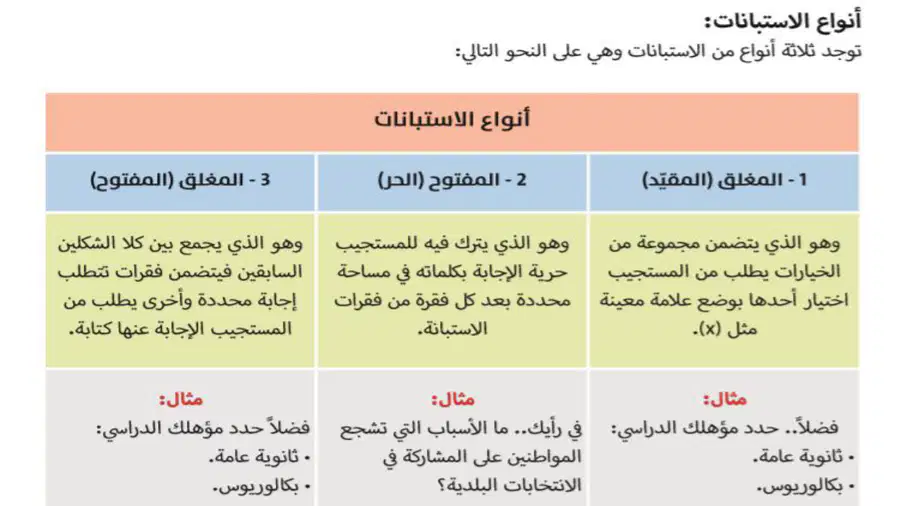
What are the three types of questions mentioned in the image?
Open-ended
Closed-ended
Multiple-choice
All of the above
14
15
Multiple Choice
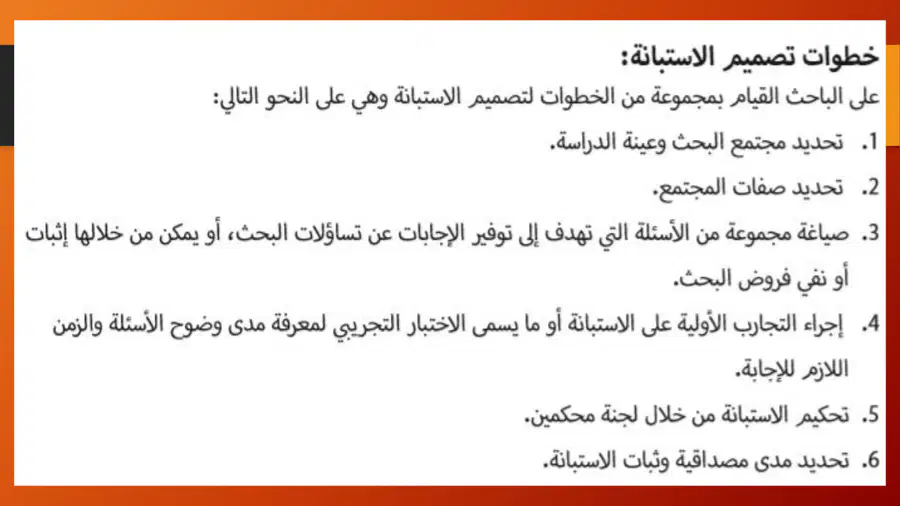
What are the steps involved in designing a questionnaire according to the image?
Identify the research community and sample
Determine the characteristics of the community
Formulate a set of questions that aim to provide answers to research questions
Conduct preliminary trials on the questionnaire
16
17
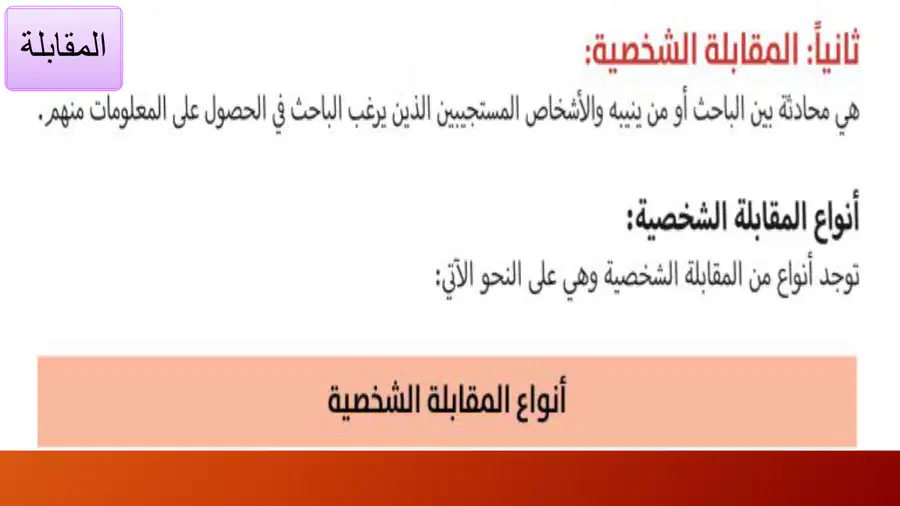
Multiple Choice
An interview with a fixed list of open and closed questions
Structured Interview
Unstructured Interview
Semi-structured Interview
18
19
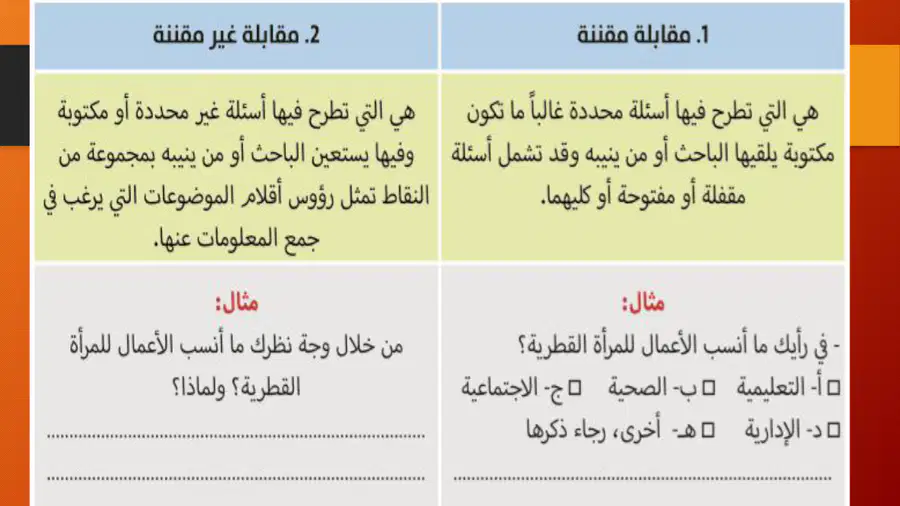
Open Ended
What type of questions are typically asked in a structured interview?
20
Multiple Choice
What is the difference between a structured interview and an unstructured interview?
Structured interviews have specific questions
Unstructured interviews are more flexible
Structured interviews are less reliable
Unstructured interviews are always longer
21
Multiple Choice
What are the advantages of using close-ended questions in interviews?
Close-ended questions provide specific and concise answers, save time, and guide the conversation towards relevant topics.
Close-ended questions allow for more creativity in responses
Open-ended questions lead to more detailed responses
Close-ended questions make the interviewee feel more comfortable
22
23
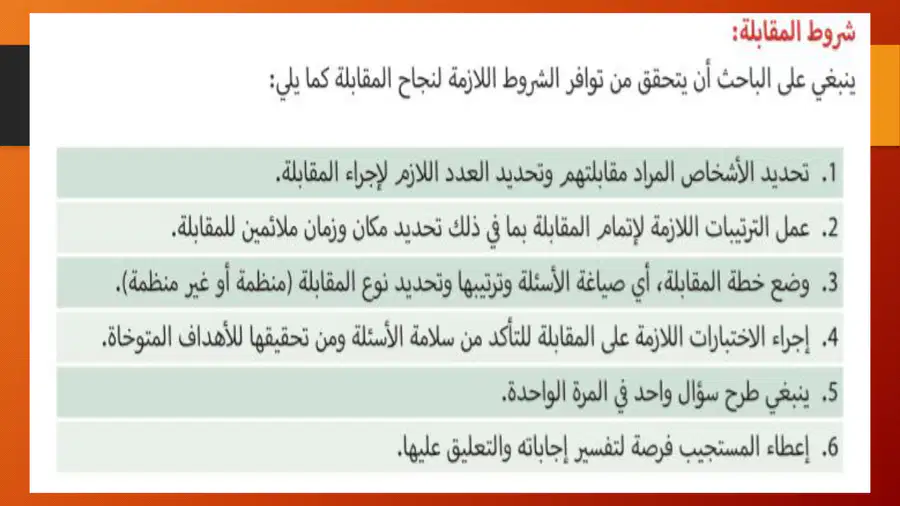
Multiple Choice
What are the necessary conditions for conducting an interview as outlined in the image?
Identifying the interviewees and determining the number of interviews needed.
Arranging the necessary requirements for conducting the interview.
Creating a plan for the interview, including the types of questions to ask.
Ensuring the interview process is safe and meets the intended goals.
24

25
Multiple Choice
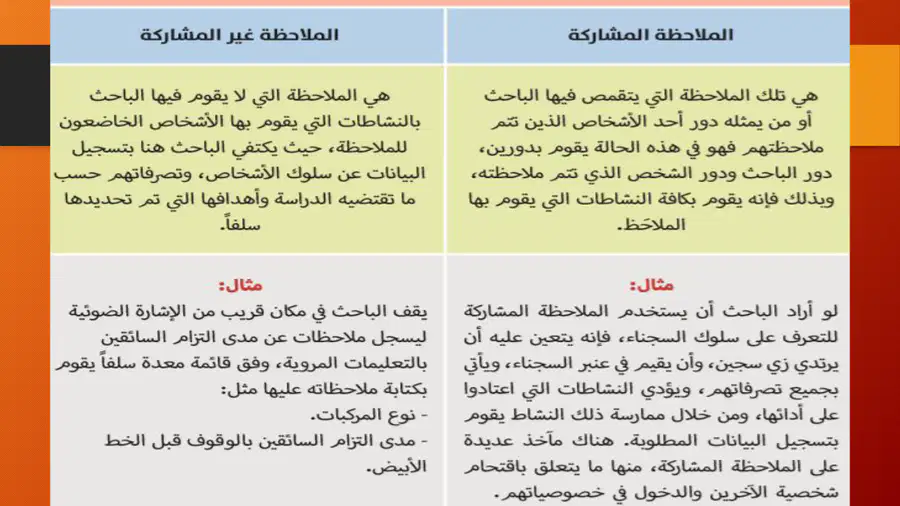
A method where the researcher is not a part of the group they are observing.
participant observation
non-participant observation
Experiment
Field Experiment
26
27
Multiple Choice
What is the difference between participatory and non-participatory observation?
Participatory observation involves the researcher taking part in the activities being observed.
Non-participatory observation does not involve the researcher in the activities being observed.
Both types of observation require the researcher to interact with the subjects.
Participatory observation is less detailed than non-participatory observation.
28

29
Multiple Choice
What are the conditions that must be met to achieve the objectives of observation?
To specify the behavior to be observed.
To prepare the specific tools for observation.
To ensure that observations do not harm individuals.
To record observations directly after behavior occurs.
30
31
Open Ended
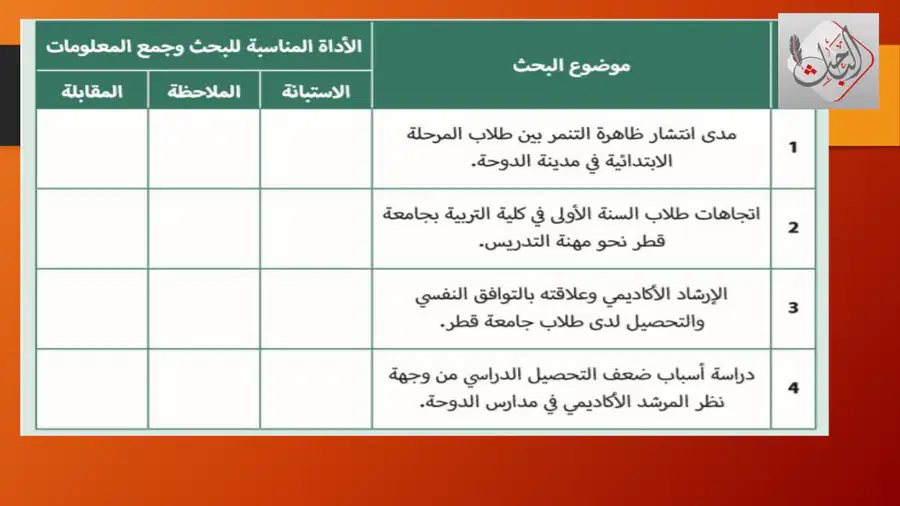
If you were a scientist/researcher and could choose between using experiments, surveys, interviews or field research, which one would you choose and why?
32
Poll
How confident do you feel about this topic now?
Show answer
Auto Play
Slide 1 / 32
SLIDE
Popular Resources on Wayground

28 questions
US History Regents Review

Quiz
•
11th Grade
36 questions
Biology Regents Review
Quiz
•
9th - 10th Grade
20 questions
Math Review
Quiz
•
3rd Grade
38 questions
Regents Life Science General Review
Quiz
•
9th Grade
20 questions
Math Review
Quiz
•
6th Grade
21 questions
EOY Grade 6 Benchmark Assessment - Content Skills
Quiz
•
6th Grade
20 questions
Inferences
Quiz
•
4th Grade
20 questions
Figurative Language Review
Quiz
•
6th Grade