

Module 16 Spherical Aberration

Presentation
•
Physics
•
10th Grade
•
Practice Problem
•
Hard

Laial Mm
FREE Resource
14 Slides • 14 Questions
1
2
Multiple Choice
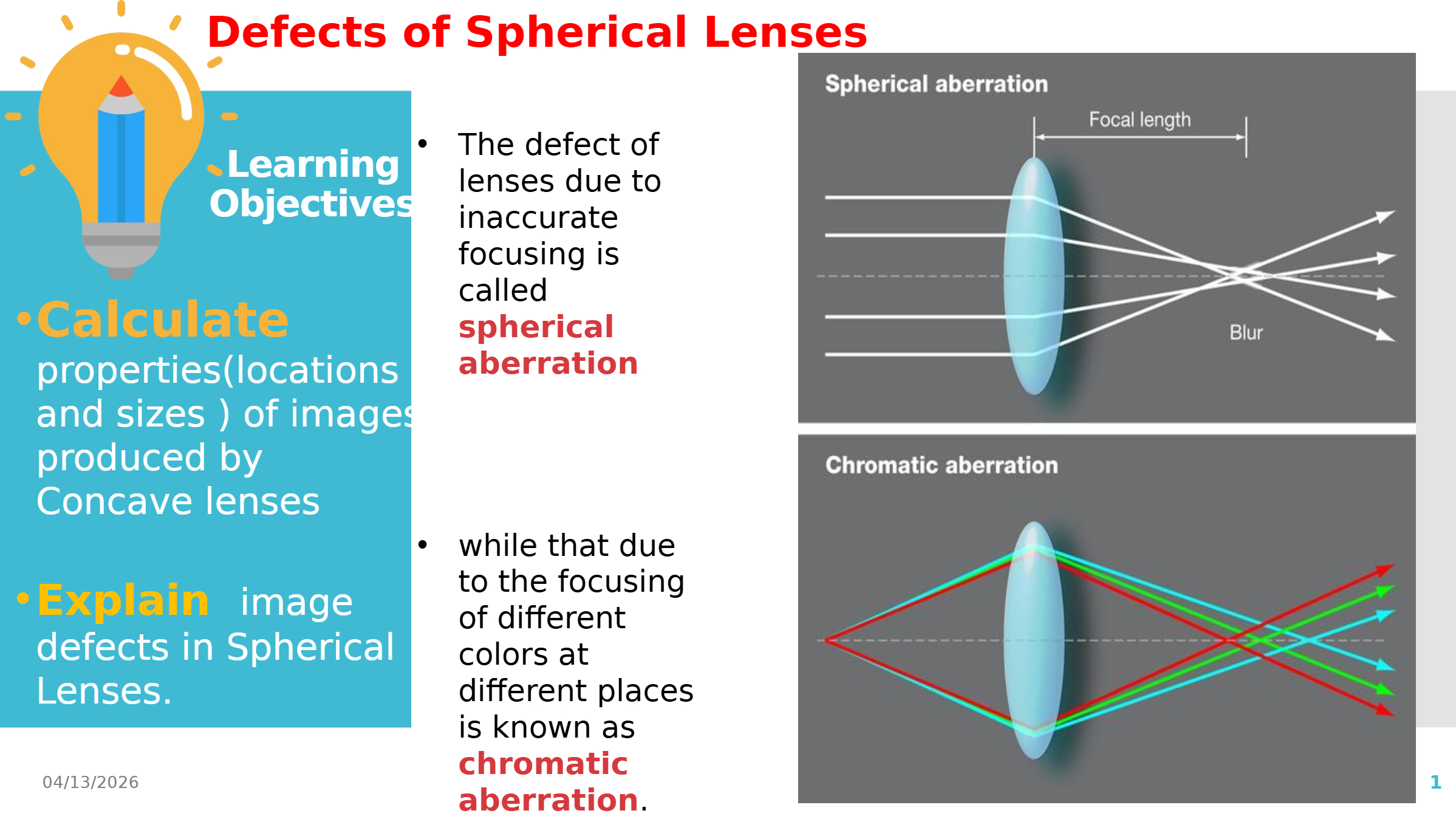
What is the significance of understanding defects in spherical lenses for optical instruments?
It helps in designing better optical devices
It is only important for decorative purposes
It is unrelated to real-world applications
It only affects colored lenses
3
4
Open Ended
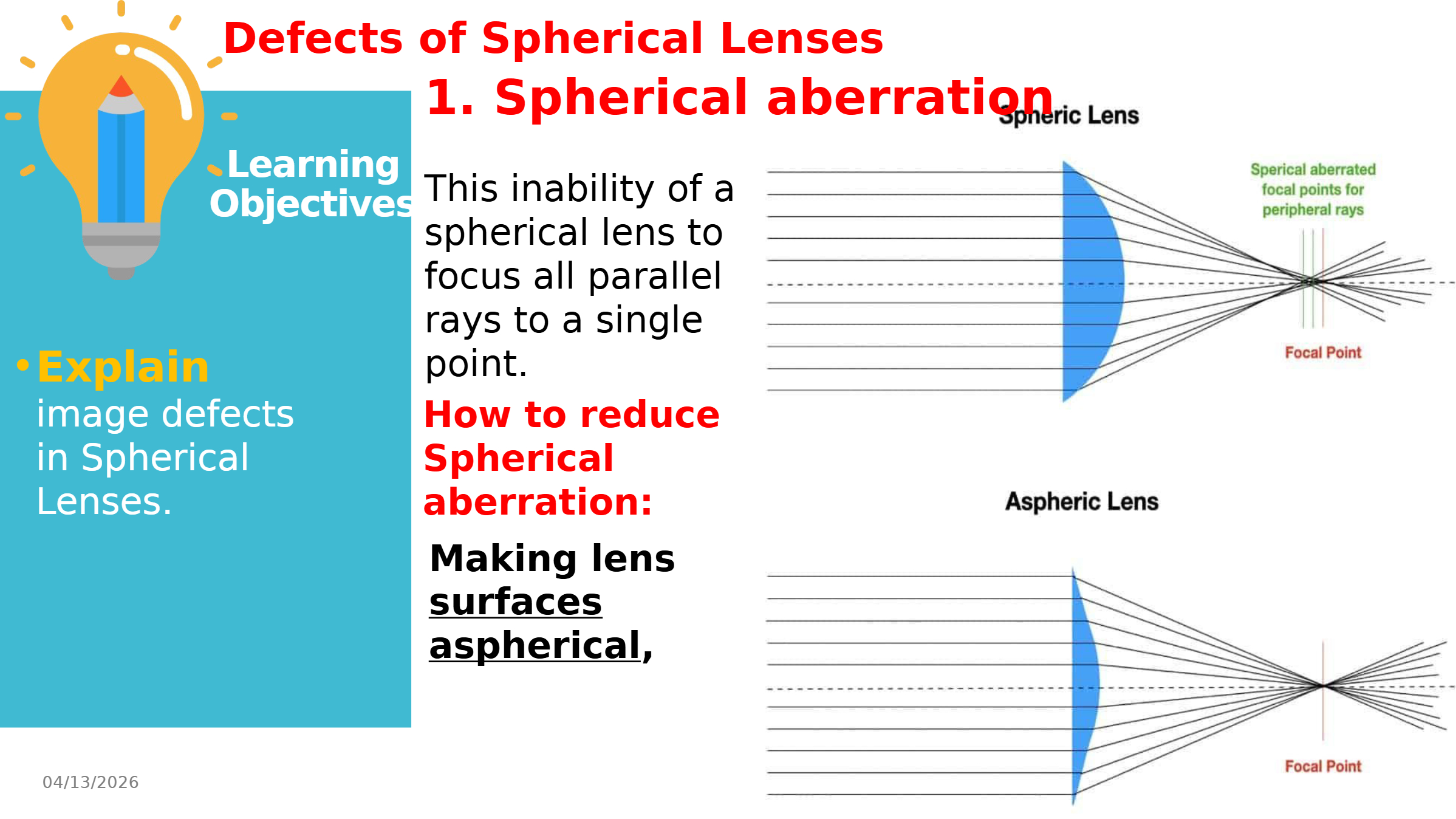
Explain how making lens surfaces aspherical helps in reducing spherical aberration.
5
6
Multiple Choice
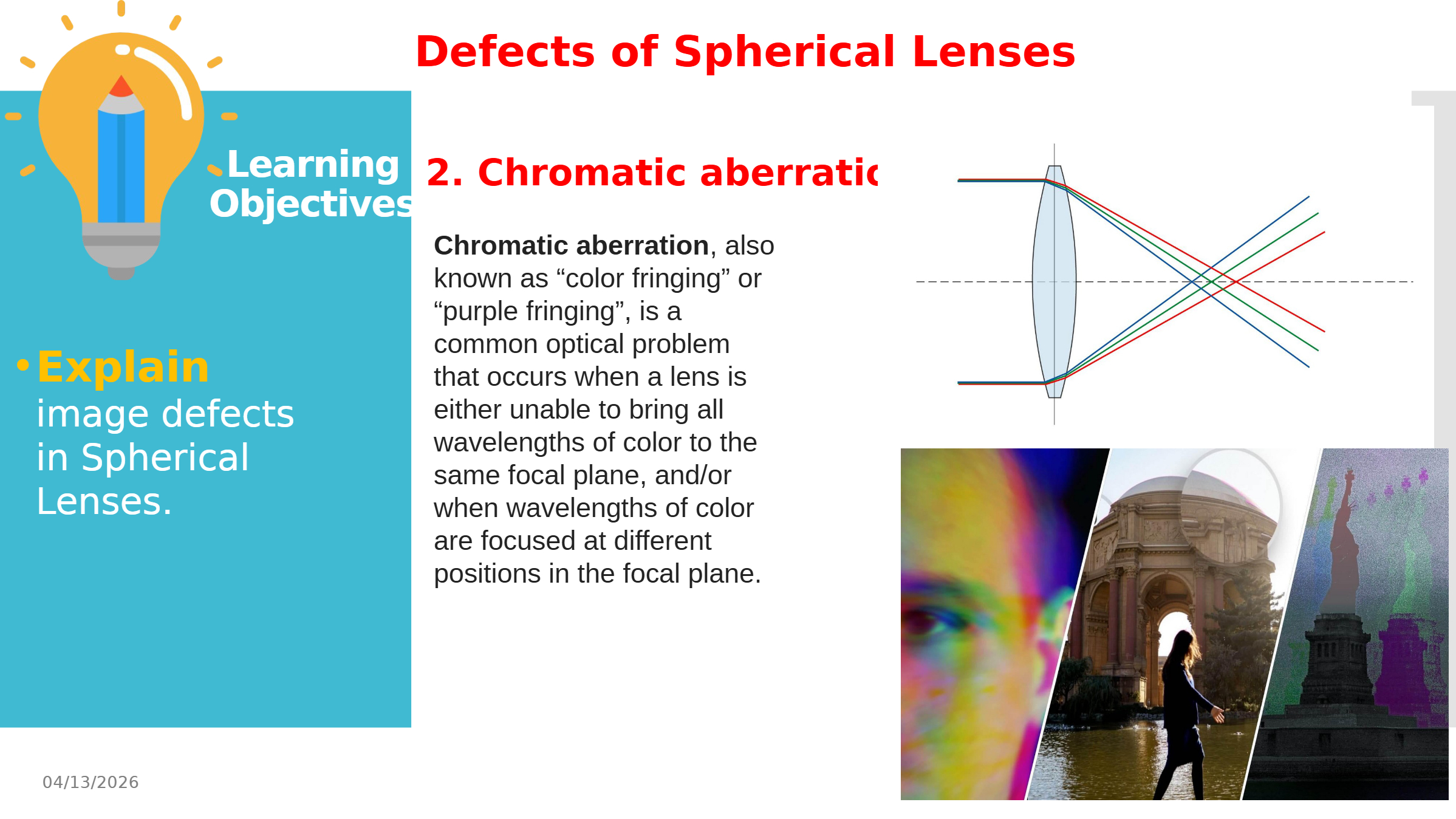
What is chromatic aberration and how does it affect the images formed by spherical lenses?
It causes blurring of images due to improper focusing of all wavelengths of light.
It causes color fringing when a lens cannot bring all wavelengths of color to the same focal plane.
It increases the brightness of the image.
It improves the sharpness of the image.
7
8

9
Fill in the Blanks
Type answer...
10
Multiple Select
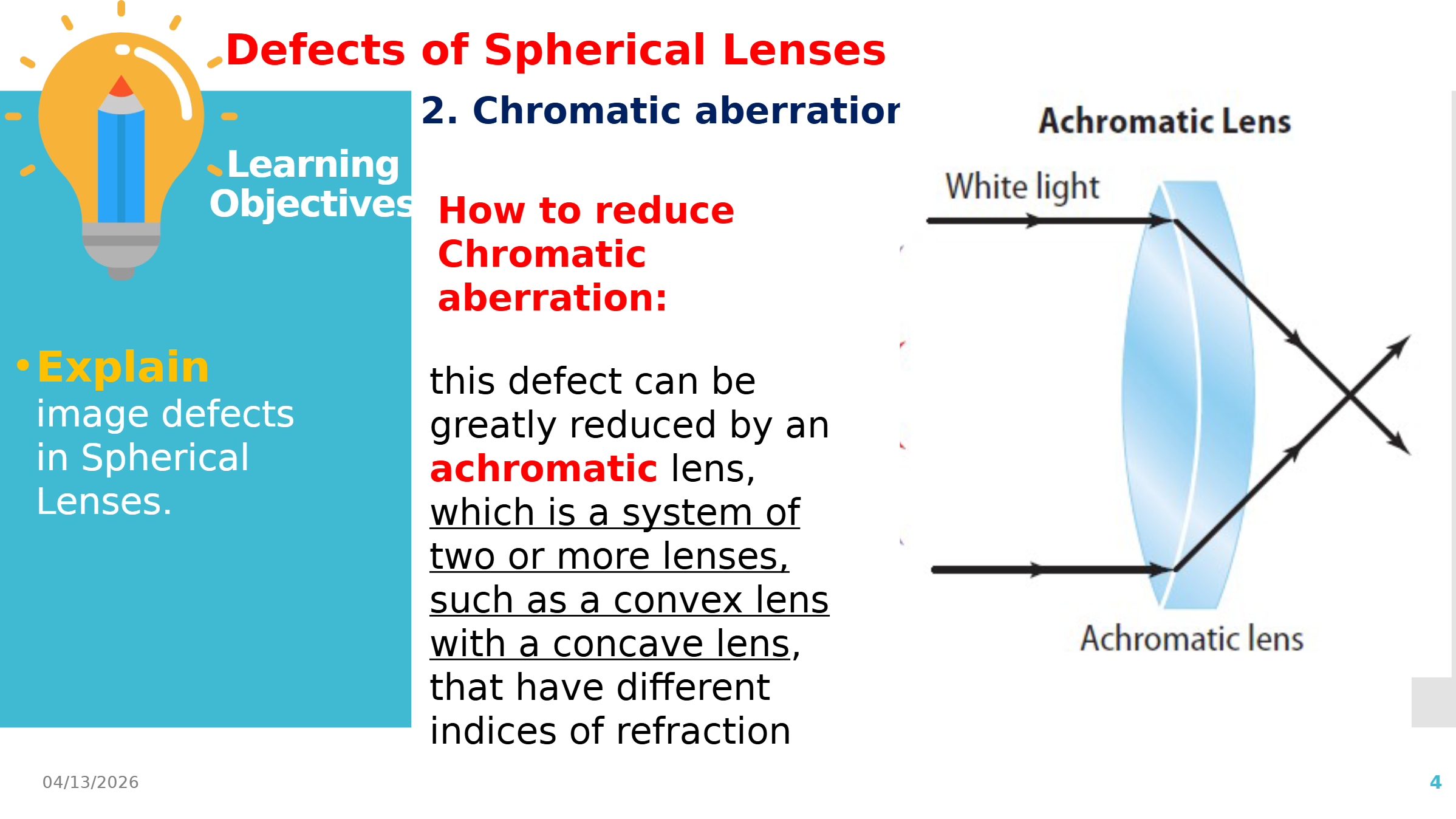
Which of the following are true about the use of multiple lenses in cameras?
One lens reduces blur.
Another fixes color distortion.
Another improves sharpness.
All lenses are identical.
11
Multiple Choice
What is the main difference between spherical aberration and chromatic aberration in spherical lenses?
Spherical aberration is caused by inaccurate focusing, while chromatic aberration is caused by the focusing of different colors at different places.
Spherical aberration is caused by lens material, while chromatic aberration is caused by lens shape.
Spherical aberration affects only concave lenses, while chromatic aberration affects only convex lenses.
Spherical aberration results in color separation, while chromatic aberration results in image blur.
12
13
14

15
Multiple Select
Which of the following are key vocabulary terms related to lens defects and corrections?
Nearsightedness
Farsightedness
Chromatic aberration
Astigmatism
16
Open Ended
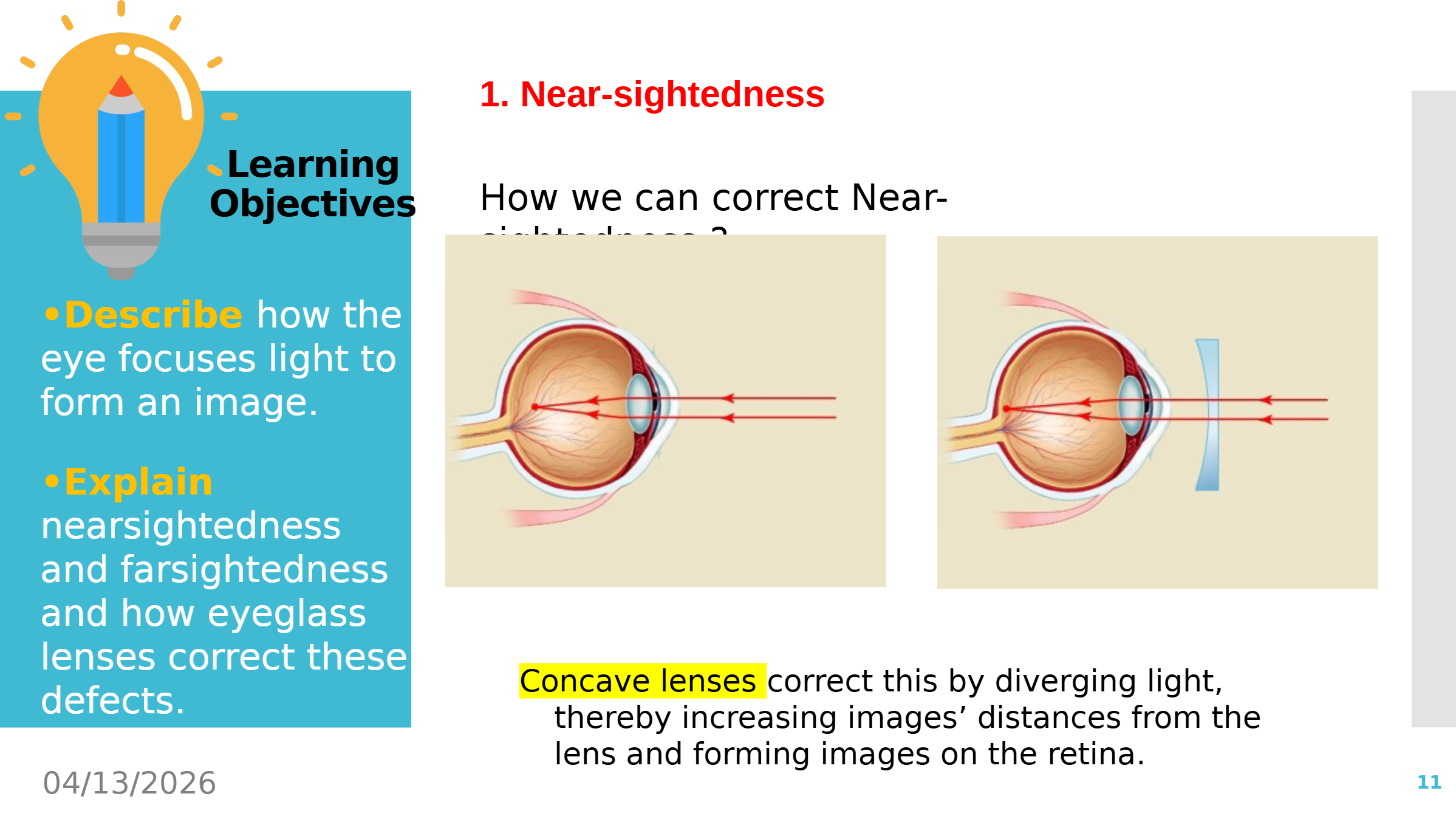
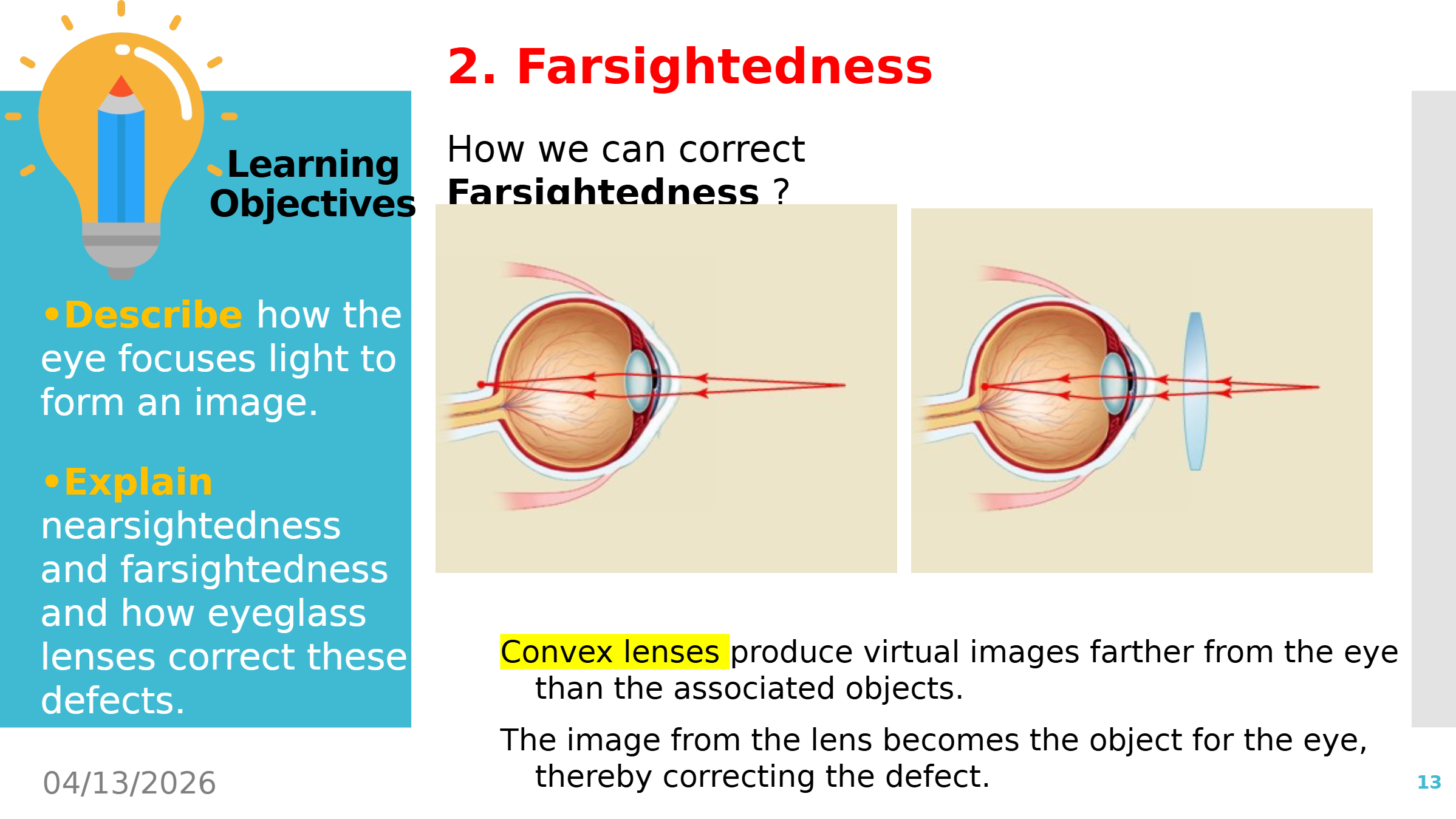
Describe how eyeglass lenses correct nearsightedness and farsightedness.
17
18
Open Ended
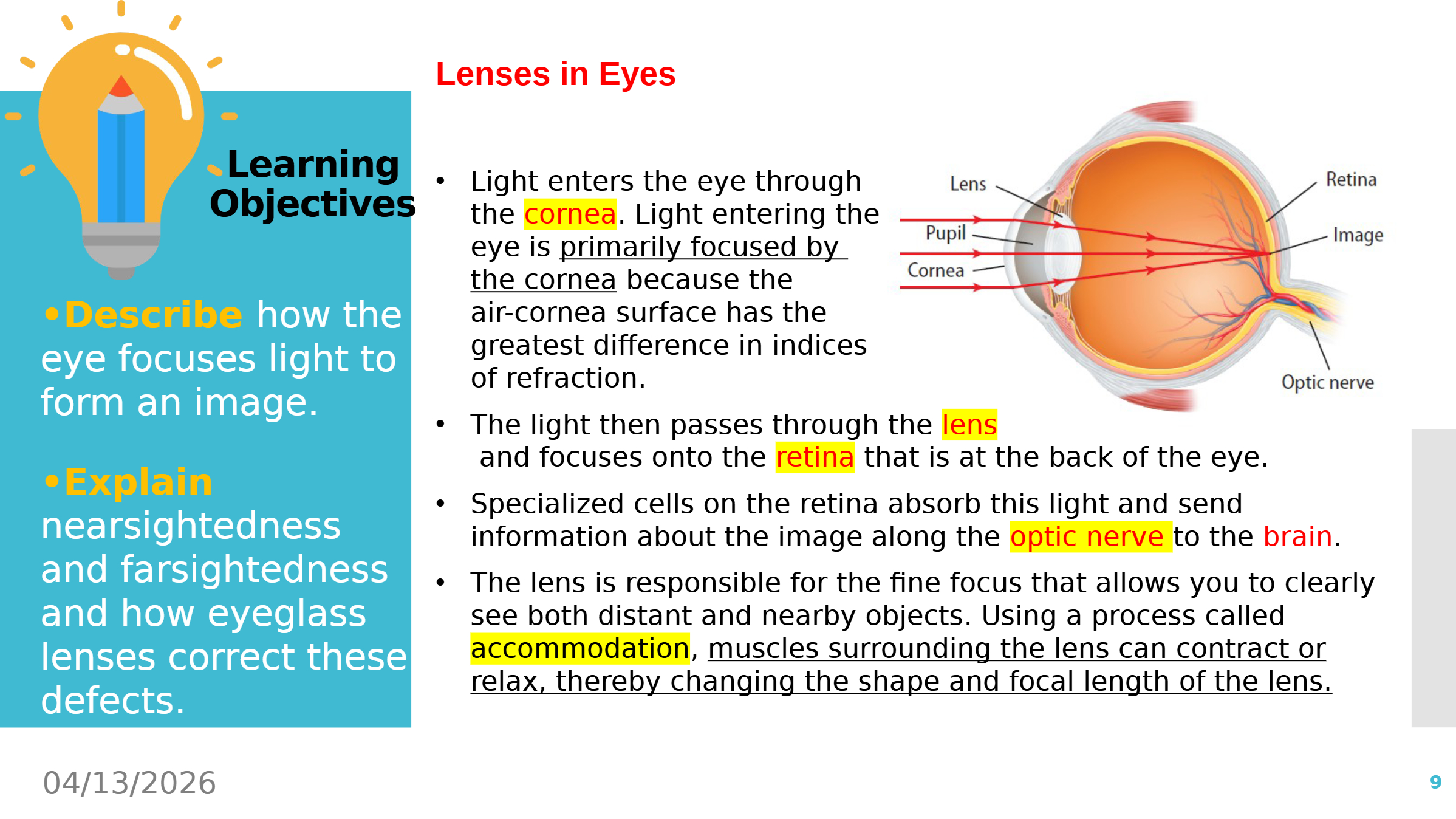
Explain how the eye adjusts to see both distant and nearby objects clearly. What is the process called and how does it work?
19
Multiple Choice
Which part of the eye is primarily responsible for focusing light as it enters the eye?
Cornea
Lens
Retina
Optic nerve
20

21
22
Fill in the Blanks
Type answer...
23
24
25
Multiple Select
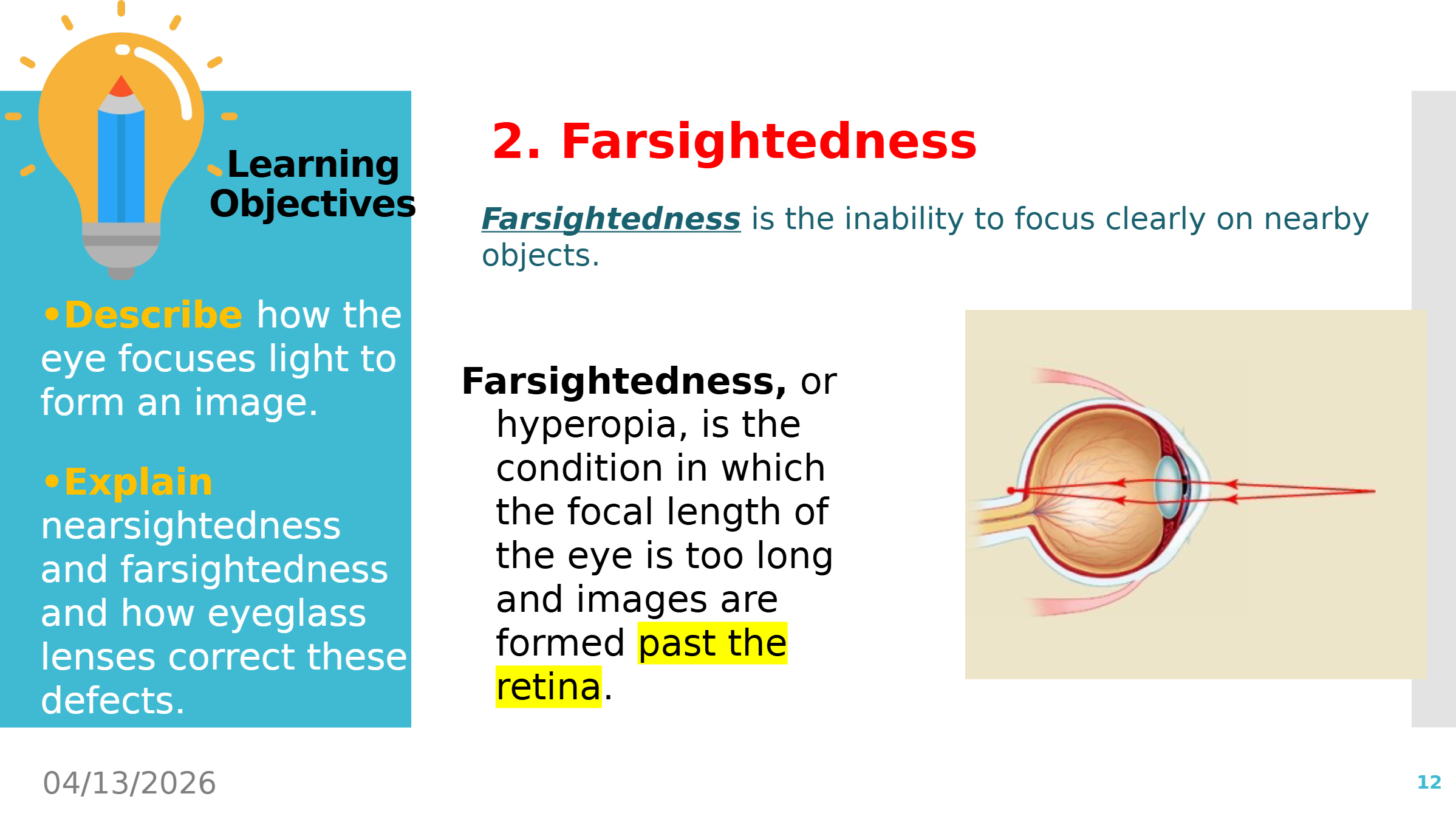
Which of the following statements are true about farsightedness?
It is also called hyperopia.
The focal length of the eye is too long.
Images are formed past the retina.
It is corrected using concave lenses.
26
27
Open Ended
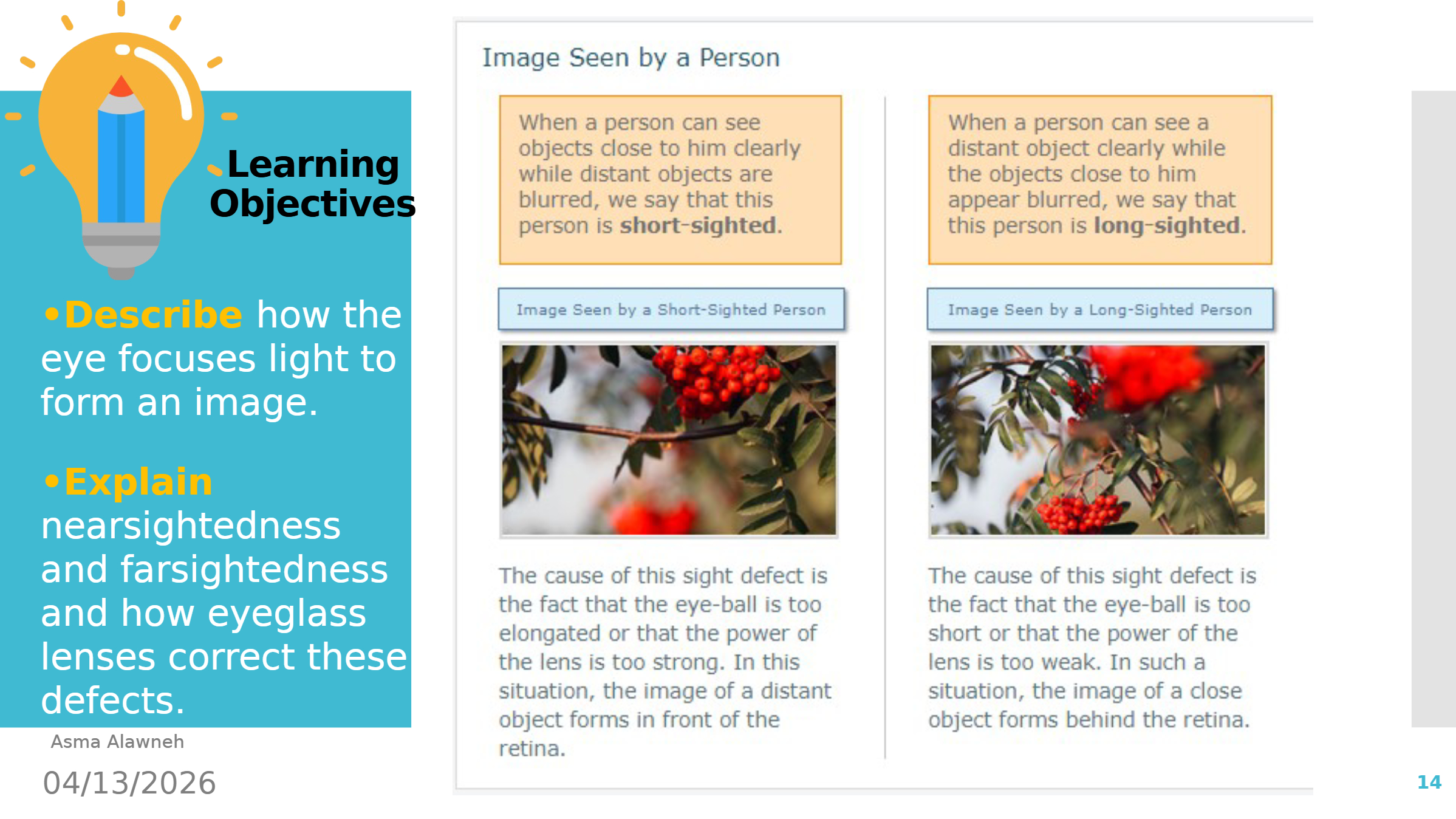
Compare the images seen by a short-sighted person and a long-sighted person. How do the causes of these sight defects differ?
28
Open Ended
How can the design of a lens be modified to reduce spherical aberration, and why does this modification help?
Show answer
Auto Play
Slide 1 / 28
SLIDE
Popular Resources on Wayground

16 questions
Grade 3 Simulation Assessment 2

Quiz
•
3rd Grade
19 questions
HCS Grade 5 Simulation Assessment_1 2526sy
Quiz
•
5th Grade
10 questions
Cinco de Mayo Trivia Questions

Interactive video
•
3rd - 5th Grade
17 questions
HCS Grade 4 Simulation Assessment_2 2526sy
Quiz
•
4th Grade
24 questions
HCS Grade 5 Simulation Assessment_2 2526sy
Quiz
•
5th Grade
13 questions
Cinco de mayo
Interactive video
•
6th - 8th Grade
20 questions
Math Review
Quiz
•
3rd Grade
30 questions
GVMS House Trivia 2026
Quiz
•
6th - 8th Grade
Discover more resources for Physics
11 questions
Electricity Explained
Interactive video
•
9th - 12th Grade
15 questions
waves and wave properties
Quiz
•
9th - 12th Grade
35 questions
Electricity and Magnetism SPS10
Quiz
•
8th - 10th Grade
18 questions
Unit 1 and 2 Concepts Review
Quiz
•
9th - 12th Grade
15 questions
Motion Graphs 101
Quiz
•
8th - 11th Grade
12 questions
EOY DAY 1 ELECTRICITY
Presentation
•
10th - 12th Grade
10 questions
EOY REVIEW 2- Electrostatics & Momentum
Presentation
•
10th - 12th Grade
6 questions
EOY REVIEW 3 (Momentum/Collisions/Impulse)
Presentation
•
10th - 12th Grade