Search Header Logo
Untitled Presentation

Untitled Presentation

Assessment

Presentation

Chemistry

9th - 12th Grade

Practice Problem

Medium

NGSS
HS-PS1-4, HS-PS3-1

Standards-aligned

Created by

Christopher Brown

Used 1+ times

FREE Resource

5 Slides • 25 Questions

1

media

2

Multiple Choice

Question image
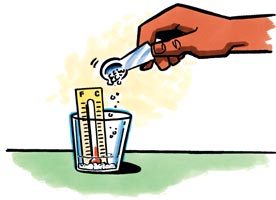
What kind of reaction is this?
1

endothermic

2
exothermic

3

Multiple Choice

Question image
A reaction accompanied by or requiring the absorption of heat.
1
endothermic
2
exothermic
3
catalyst
4
activation energy

4

Multiple Choice

Question image
A reaction accompanied by the release of heat.
1
endothermic
2
exothermic
3
catalyst
4
activation energy

5

Multiple Choice

Question image
Which statement is FALSE for an endothermic reaction?
1
Products higher in energy and less stable
2
Reactants lower in energy and more stable
3
Products have stronger bonds than reactants
4
Reactants have stronger bonds than products

6

Multiple Choice

Question image

The potential energy diagram shown represents the reaction

A + B → AB

Which statement correctly describes this reaction?

1

It is endothermic and energy is absorbed.

2

It is endothermic and energy is released.

3

It is exothermic and energy is absorbed.

4

It is exothermic and energy is released.

7

Multiple Choice

Question image

What is an exothermic reaction?

1

A reaction that absorbs energy from its surroundings.

2

A reaction that releases energy to its surroundings. You feel heat.

3

A reaction where temperature remains constant.

4

A reaction that only occurs at high temperatures.

8

Multiple Choice

Question image

Which graph represents an endothermic reaction?

1

A

2

B

9

Multiple Choice

Question image
In an endothermic reaction, heat is ...
1
taken in or absorbed
2
given out or released 

10

Multiple Choice

Question image
If a chemical reaction is EXOTHERMIC, the temperature would....
1
Stay the same
2
Increase
3
Decrease

11

Multiple Choice

Question image
What kind of graph is this?
1
endothermic
2
exothermic

12

Open Ended

Explain the significance of coefficients in thermochemical equations.

13

Fill in the Blanks

Type answer...

14

Multiple Choice

What is the difference between exothermic and endothermic reactions?

1

Exothermic reactions release heat, while endothermic reactions absorb heat

2

Exothermic reactions absorb heat, while endothermic reactions release heat

3

Both types of reactions release heat

4

Both types of reactions absorb heat

15

Multiple Choice

What is a thermochemical equation?

1

A balanced chemical equation that includes heat change (ΔH)

2

An equation that only includes reactants

3

An equation that only includes products

4

An equation that does not include heat change

16

media

17

Open Ended

List two common mistakes to avoid when working with ΔH values.

18

Open Ended

Explain the significance of a large negative ΔH value in a chemical reaction.

19

Multiple Choice

What should you always pay attention to when interpreting ΔH values?

1

The temperature

2

The physical states of the substances

3

The pressure

4

The volume

20

Multiple Choice

What happens to the value of ΔH when you reverse a reaction?

1

It remains the same

2

It doubles

3

It changes sign

4

It becomes zero

21

media

22

Multiple Choice

What is ΔH for: C + O₂ → CO₂?

1

-92 kJ

2

-184 kJ

3

-286 kJ

4

-394 kJ

23

Multiple Choice

What is ΔH for: 2H₂ + O₂ → 2H₂O(l)?

1

-92 kJ

2

-184 kJ

3

-286 kJ

4

-394 kJ

24

Multiple Choice

What is ΔH for producing 4 NH₃?

1

-92 kJ

2

-184 kJ

3

-286 kJ

4

-394 kJ

25

media

26

Open Ended

What does the reaction C + O₂ → CO₂ tell you about thermochemical equations?

27

Multiple Choice

Find ΔH for the reaction C + 1/2 O₂ → COC + 1/2 O₂ → CO.

1

-394 kJ

2

-283 kJ

3

-572 kJ

4

-890 kJ

28

Multiple Choice

What is ΔH for the reaction CO₂ + C + O₂ → C + O₂ + CO₂?

1

-394 kJ

2

-283 kJ

3

-572 kJ

4

-890 kJ

29

media

30

Open Ended

Find ΔH for the reaction: C + 2H2 → CH4

media

Show answer

Auto Play

Slide 1 / 30

SLIDE