
PH1032F_Test_3
Authored by 黃振崗 黃振崗
Physics
University
Used 7+ times


AI Actions
Add similar questions
Adjust reading levels
Convert to real-world scenario
Translate activity
More...
Content View
Student View
10 questions
Show all answers
1.
MULTIPLE CHOICE QUESTION
30 sec • 1 pt
If you push twice as hard against a stationary wall, the amount of work you do on the wall
quadruples
doubles
remains constant but non-zero
remains constant at zero
is halved
2.
MULTIPLE CHOICE QUESTION
30 sec • 1 pt
If you double both the mass and the velocity of a ball, the kinetic energy is increased by a factor of
2
4
8
16
32
3.
MULTIPLE CHOICE QUESTION
30 sec • 1 pt
If the net work done on an object is negative, then the kinetic energy of the object
increases.
decreases.
stays the same.
is zero.
cannot be determined without knowing the object's mass.
4.
MULTIPLE CHOICE QUESTION
30 sec • 1 pt
Assuming the Moon moves in a circular orbit of radius R under Earth's gravity, how much work is done by the gravitational force F during one complete revolution?
0
πRF
2πRF
RF
5.
MULTIPLE CHOICE QUESTION
30 sec • 1 pt
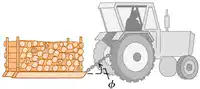
A tractor driving at a constant speed pulls a sled loaded with firewood. There is friction between the sled and the road. The total work done on the sled after it has moved a distance d is
positive
negative
zero
two of A, B, and C, depending on circumstances
three of A, B, and C, depending on circumstances
6.
MULTIPLE CHOICE QUESTION
30 sec • 1 pt
Can a system have negative potential energy?
No, because a negative potential energy is unphysical.
No, because the kinetic energy of a system must be equal to its potential energy.
Yes, as long as the total energy remains positive.
Yes, as long as the total energy remains negative.
Yes, because the choice of the zero of potential energy is arbitrary.
7.
MULTIPLE CHOICE QUESTION
30 sec • 1 pt
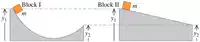
The two ramps shown are both frictionless. The heights y1 and y2 are the same for each ramp. A block of mass m is released from rest at the left-hand end of each ramp. Which block arrives at the right-hand end with the greater speed?
The block on the curved track arrives with greater speed
The block on the straight track arrives with greater speed
Both blocks arrive at the right-hand end with the same speed
The answer depends on the shape of the curved track
Access all questions and much more by creating a free account
Create resources
Host any resource
Get auto-graded reports

Continue with Google

Continue with Email

Continue with Microsoft
or continue with

%20(1).png)
Apple

Others
By signing up, you agree to our Terms of Service & Privacy Policy
Already have an account?


