
Parallelograms Practice
Authored by Kim Odum
Mathematics
9th - 12th Grade
CCSS covered
Used 150+ times


AI Actions
Add similar questions
Adjust reading levels
Convert to real-world scenario
Translate activity
More...
About
This quiz focuses on parallelograms and their properties within the broader study of quadrilaterals in geometry. Designed for high school students in grades 9-12, the assessment covers fundamental parallelogram characteristics including opposite sides being parallel and congruent, opposite angles being congruent, consecutive angles being supplementary, and diagonals bisecting each other. Students must demonstrate understanding of the parallelogram family hierarchy, recognizing that rectangles, rhomuses, and squares are all special types of parallelograms, while trapezoids are not. The quiz requires students to apply various methods for proving a quadrilateral is a parallelogram, including showing both pairs of opposite sides are parallel or congruent, one pair of opposite sides is both parallel and congruent, opposite angles are congruent, or diagonals bisect each other. Students also need to solve algebraic problems involving parallelogram properties and understand "always, sometimes, never" relationships between different quadrilateral types. Created by Kim Odum, a Mathematics teacher in the US who teaches grades 9-12. This comprehensive assessment serves multiple instructional purposes in the geometry classroom, functioning effectively as guided practice during initial instruction, homework reinforcement, or formative assessment to gauge student understanding before summative evaluation. The quiz's structure allows teachers to identify specific misconceptions about parallelogram properties and address gaps in student reasoning about quadrilateral relationships. Teachers can use this assessment to prepare students for more complex geometric proofs and to strengthen algebraic skills within geometric contexts. The content directly aligns with Common Core State Standards G-CO.11 (proving theorems about parallelograms) and G-SRT.5 (using congruence and similarity criteria for triangles to solve problems and prove relationships in geometric figures), while supporting the mathematical practices of constructing viable arguments and reasoning abstractly.
Content View
Student View
20 questions
Show all answers
1.
MULTIPLE CHOICE QUESTION
1 min • 1 pt
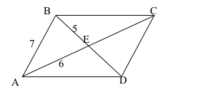
If ABCD is a parallelogram, what is the length of BD?
Tags
CCSS.HSG.CO.C.11
2.
MULTIPLE CHOICE QUESTION
45 sec • 1 pt
Which is NOT a property of a parallelogram?
Tags
CCSS.HSG.CO.C.11
3.
MULTIPLE CHOICE QUESTION
45 sec • 1 pt
The opposite angles of a parallelogram are ...
Tags
CCSS.HSG.CO.C.11
4.
MULTIPLE CHOICE QUESTION
45 sec • 1 pt
In a parallelogram, consecutive angles are __________.
Tags
CCSS.HSG.CO.C.11
5.
MULTIPLE CHOICE QUESTION
45 sec • 1 pt
In a parallelogram, diagonals are __________.
Tags
CCSS.HSG.CO.C.11
6.
MULTIPLE CHOICE QUESTION
45 sec • 1 pt
Which shape is NOT a type of parallelogram?
Tags
CCSS.5.G.B.4
7.
MULTIPLE CHOICE QUESTION
1 min • 1 pt

The figure is a parallelogram.
Solve for x.
Tags
CCSS.HSG.CO.C.11

Access all questions and much more by creating a free account
Create resources
Host any resource
Get auto-graded reports

Continue with Google

Continue with Email

Continue with Classlink

Continue with Clever
or continue with

Microsoft
%20(1).png)
Apple

Others
Already have an account?

