
AP Biology Ecology Unit Review
Authored by Michelle Bibel
Biology
11th - 12th Grade
NGSS covered
Used 46+ times


AI Actions
Add similar questions
Adjust reading levels
Convert to real-world scenario
Translate activity
More...
Content View
Student View
61 questions
Show all answers
1.
MULTIPLE CHOICE QUESTION
30 sec • 1 pt
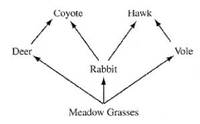
Above is a food web for a meadow habitat that occupies 25.6 km2. The primary producers’ biomass is uniformly distributed throughout the habitat and totals 1500 kg/km2. Developers have approved a project that will permanently reduce the primary producers’ biomass by 50% and remove all rabbits and deer. Which of the following is most likely to happen as a result?
The biomass of coyotes will be 6 kg and the biomass of hawks will be .5 kg
The biomass of coyotes will be dramatically reduced.
The coyotes will switch prey preferences out outcompete the hawks.
There will be 50% fewer voles and 90% fewer hawks.
Tags
NGSS.MS-LS2-4
NGSS.MS-LS2-1
NGSS.MS-LS2-2
2.
MULTIPLE CHOICE QUESTION
30 sec • 1 pt
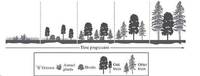
The diagram above shows the progression of ecological events after a fire in a particular ecosystem. Based on the diagram, which of the following best explains why the oak trees are later replaced by other trees?
Eventually, the other trees grow taller than the oak trees and form a dense canopy that shades the understory.
Oak trees alter the pH of the soil, making the forest better suited for shrubs and other trees.
Roots of shrubs proliferate in the soil of the forest and prevent the oak trees from obtaining water.
Oak trees succumb to environmental pollutants more readily than the shrubs or other trees.
Tags
NGSS.MS-LS2-4
NGSS.MS-LS2-1
NGSS.MS-LS2-2
3.
MULTIPLE CHOICE QUESTION
30 sec • 1 pt
The lionfish is a venomous fish found primarily in the Red Sea and the Indian Ocean. In the 1990s, lionfish were accidentally released into the Atlantic Ocean, where they found abundant resources and favorable environmental conditions. Which of the following scenarios is most likely to result in the lionfish having a major impact on the communities into which they were introduced?
With no natural predators, the lionfish population will become very large.
Some native species of invertebrates will develop a resistance to lionfish venom.
Random mating will allow the lionfish population to reach Hardy-Weinberg equilibrium.
A virus that specifically infects lionfish will become more prevalent.
Tags
NGSS.MS-LS2-4
NGSS.MS-LS2-1
NGSS.MS-LS2-2
4.
MULTIPLE CHOICE QUESTION
30 sec • 1 pt
Which of the following best explains how biological communities near deep-sea hydrothermal vents can exist in a habitat lacking sunlight?
Environmental conditions on some distant planets resemble those experienced by organisms living near hydrothermal vents.
Heterotrophs metabolize carbon-containing compounds produced by the photosynthetic organisms that live on the seafloor.
Some organisms rely on energy captured from inorganic compounds to drive basic biological processes.
Some organisms that can tolerate high temperatures are single celled, whereas others are multicellular.
5.
MULTIPLE CHOICE QUESTION
30 sec • 1 pt
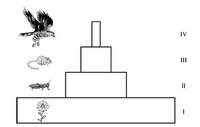
Assume there are 50,000 joules (J) of energy available in tropic level II in the figure. According to the conventional model of energy flow in ecosystems, which of the following statements correctly describes the flow of energy in the system?
Trophic level I generates a maximum of 50,000 J of energy.
Trophic level I has approximately 5,000 J of available energy.
Trophic level III has approximately 50 J of available energy.
Trophic level IV has approximately 500 J of available energy.
Tags
NGSS.MS-LS2-3
6.
MULTIPLE CHOICE QUESTION
30 sec • 1 pt
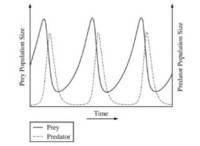
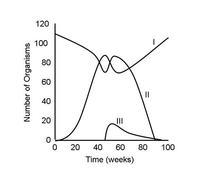
The graph above shows a model of population changes over time in a predator and its prey. Which of the following data would be most helpful in predicting possible disruptions to the relationship between the predator and its prey?
Time of day, because as days become shorter, nighttime hunting increases.
Average birth weight of predators, because heavier offspring will begin hunting a younger ages.
Numbers of additional predator species, because additional predators will increase competition for prey.
Prey metabolic rates, because predators are less successful against prey with higher metabolic rates.
Tags
NGSS.MS-LS2-4
NGSS.MS-LS2-1
7.
MULTIPLE CHOICE QUESTION
30 sec • 1 pt
There is strong evidence that two species of
cliff-dwelling birds have nested in the same
environment and fed in the same water for
thousands of years, with each having stable
population sizes. Based on this information,
which of the following statements is the best
conclusion?
The two birds compete for food.
One species will displace the other.
The two birds have different ecological niches that allow coexistence.
One species eats a more diverse diet than the other does.
Tags
NGSS.MS-LS2-2
Access all questions and much more by creating a free account
Create resources
Host any resource
Get auto-graded reports

Continue with Google

Continue with Email

Continue with Classlink

Continue with Clever
or continue with

Microsoft
%20(1).png)
Apple

Others
Already have an account?


