
Properties of Covalent structures
Authored by Michael Spowart
Chemistry, Science
9th - 11th Grade
NGSS covered
Used 47+ times


AI Actions
Add similar questions
Adjust reading levels
Convert to real-world scenario
Translate activity
More...
Content View
Student View
14 questions
Show all answers
1.
MULTIPLE CHOICE QUESTION
30 sec • 1 pt

Are covalent bonds strong or weak?
strong
weak
2.
MULTIPLE CHOICE QUESTION
30 sec • 1 pt
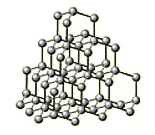
What structure is shown in the diagram?
Tags
NGSS.HS-PS1-3
3.
MULTIPLE CHOICE QUESTION
30 sec • 1 pt

True of false? Simple molecular substances have low melting and boiling points.
true
false
4.
MULTIPLE SELECT QUESTION
45 sec • 1 pt

Which two of the following are examples of simple molecules?
graphite
silicon dioxide
water
carbon dioxide
5.
MULTIPLE CHOICE QUESTION
30 sec • 1 pt

Why do simple molecular substances have low melting and boiling points?
The intermolecular forces between simple molecules are weak.
The covalent bonds holding the atoms together in a simple molecule are strong.
A large number of covalent bonds hold the atoms together in simple molecules.
6.
MULTIPLE CHOICE QUESTION
30 sec • 1 pt

What happens when a simple molecular substance melts or boils?
The weak intermolecular forces between the molecules break.
Strong covalent bonds between the atoms of the molecule break.
7.
MULTIPLE CHOICE QUESTION
30 sec • 1 pt

Why do weak intermolecular forces between simple molecules result in low melting and boiling points?
Little energy is needed to break the strong covalent bonds.
Little energy is needed to break the weak intermolecular forces.
Lots of energy is needed to break the weak intermolecular forces.

Access all questions and much more by creating a free account
Create resources
Host any resource
Get auto-graded reports

Continue with Google

Continue with Email

Continue with Microsoft
or continue with

%20(1).png)
Apple

Others
By signing up, you agree to our Terms of Service & Privacy Policy
Already have an account?

