
Evolution
9th Grade
•25 Qs

Similar activities
Genetics Vocabulary
4th Grade - University
•21 Qs
Claim, Evidence, Reasoning using Populations
6th - 9th Grade
•20 Qs
Cell as the Basic Unit of Life
7th - 11th Grade
•20 Qs
Estuaries Midpoint Review
9th - 12th Grade
•20 Qs
Vertebrates
5th - 9th Grade
•20 Qs
Cell - Unit of Life Review
8th - 10th Grade
•20 Qs
Circulatory system
9th - 10th Grade
•20 Qs
IMMUNE REVIEW
9th - 10th Grade
•20 Qs

Evolution

Quiz
•
Biology
•
9th Grade
•
Medium

Arianna Farias
Used 3+ times
FREE Resource

Enhance your content in a minute
25 questions
Show all answers
1.
MULTIPLE CHOICE QUESTION
5 mins • 1 pt
The scientific theory of evolution is supported by different types of evidence. The diagrams below show the skeletons of two different animal species. How does comparing the skeletons of these animals provide support for the scientific theory of evolution?
2.
MULTIPLE CHOICE QUESTION
3 mins • 1 pt

The diagram illustrates an embryonic stage of two organisms.Which of the following can be determined by observing the embryos shown in the diagram?
3.
MULTIPLE CHOICE QUESTION
3 mins • 1 pt
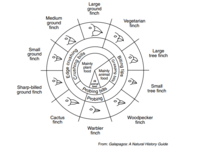
The diagram represents the relationship between beak structure and food in several species of finches found on the Galapagos Islands. The different beak structures observed in the diagram are evidence of
4.
MULTIPLE CHOICE QUESTION
2 mins • 1 pt
Natural selection is best described as
5.
MULTIPLE CHOICE QUESTION
3 mins • 1 pt
Cladograms are constructed by grouping organisms together based on their____________ characteristics.
6.
MULTIPLE CHOICE QUESTION
3 mins • 1 pt

According to this cladogram, sharks are MOST closely related to which organism?
7.
MULTIPLE CHOICE QUESTION
3 mins • 1 pt

Which two orgainsms have hair?


Access all questions and much more by creating a free account
Create resources
Host any resource
Get auto-graded reports

Continue with Google

Continue with Email

Continue with Classlink

Continue with Clever
or continue with

Microsoft
%20(1).png)
Apple

Others
Already have an account?
Similar Resources on Wayground
20 questions
Cell Membrane Structure
Quiz
•
9th - 10th Grade
25 questions
Biology-Evolution & Classification
Quiz
•
9th - 11th Grade
20 questions
Biochemistry EOC Review
Quiz
•
9th - 10th Grade
20 questions
Introduction to genetics
Quiz
•
9th - 10th Grade
20 questions
Biology Released EOC STAAR 2015 pt. 2 (20 Questions)
Quiz
•
9th - 10th Grade
20 questions
Ecology 2 - Human Impact
Quiz
•
9th - 12th Grade
20 questions
Codominance and Incomplete Dominance
Quiz
•
9th - 10th Grade
20 questions
AKS 8 & 9 Exam Review
Quiz
•
9th - 12th Grade
Popular Resources on Wayground
15 questions
Fractions on a Number Line
Quiz
•
3rd Grade
20 questions
Equivalent Fractions
Quiz
•
3rd Grade
25 questions
Multiplication Facts
Quiz
•
5th Grade
22 questions
fractions
Quiz
•
3rd Grade
20 questions
Main Idea and Details
Quiz
•
5th Grade
20 questions
Context Clues
Quiz
•
6th Grade
15 questions
Equivalent Fractions
Quiz
•
4th Grade
20 questions
Figurative Language Review
Quiz
•
6th Grade
Discover more resources for Biology
20 questions
Cell Organelles
Quiz
•
9th Grade
20 questions
DNA & Protein Synthesis
Quiz
•
9th Grade
7 questions
Amoeba Sisters Dihybrid Cross Punnett Square

Interactive video
•
9th - 12th Grade
25 questions
photosynthesis and cellular respiration
Quiz
•
9th Grade
20 questions
Human Body Systems
Quiz
•
9th Grade
19 questions
Natural Selection
Quiz
•
9th Grade
20 questions
Pedigree Practice
Quiz
•
9th Grade
10 questions
Comparing Mitosis and Meiosis: Key Differences and Stages
Interactive video
•
6th - 10th Grade