
Unit 11 Review: 7A/B, 8A,B and C
Authored by Lauren Aiken
Biology
9th - 12th Grade
Used 46+ times


AI Actions
Add similar questions
Adjust reading levels
Convert to real-world scenario
Translate activity
More...
Content View
Student View
51 questions
Show all answers
1.
MULTIPLE CHOICE QUESTION
45 sec • 1 pt
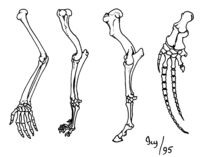
Structures with the same parts have different functions; suggests that organisms share a common ancestry
vestigial structures
homologous structures
adaptive radiation
fossil
2.
MULTIPLE CHOICE QUESTION
1 min • 1 pt
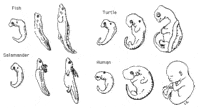
Study of embryos of various organisms to show a common ancestor because of similarities in development
natural selection
embryology
speciation
evolution
3.
MULTIPLE CHOICE QUESTION
1 min • 1 pt

Two organisms that are closely related would have
very similar DNA sequence
exactly the same DNA sequences
no proteins in common
completely different DNA sequence
4.
MULTIPLE CHOICE QUESTION
1 min • 1 pt
What does Darwin's theory of evolution suggest?
species change over time
extinct species are not related to living species
different species can interbreed
animals that look alike are most closely related
5.
MULTIPLE CHOICE QUESTION
1 min • 1 pt

Some organisms that share a common ancestor have features that have different functions, but similar structures. These are known as
vestigial structures
analogous structures
homologous structures
fossil structures
6.
MULTIPLE CHOICE QUESTION
30 sec • 1 pt
If modern organisms have a lot of homologous structures, what inference might paleontologists make about those organisms?
They are reptiles
One organism evolved from the other.
The organisms have a common ancestor
7.
MULTIPLE CHOICE QUESTION
30 sec • 1 pt
When all of the organisms of a species have died it is called
evolution
extinction
adaptation
natural selection

Access all questions and much more by creating a free account
Create resources
Host any resource
Get auto-graded reports

Continue with Google

Continue with Email

Continue with Classlink

Continue with Clever
or continue with

Microsoft
%20(1).png)
Apple

Others
Already have an account?


