
AD-AS Model
Authored by Zanoxolo Kale
Other
University
Used 2+ times


AI Actions
Add similar questions
Adjust reading levels
Convert to real-world scenario
Translate activity
More...
Content View
Student View
6 questions
Show all answers
1.
MULTIPLE CHOICE QUESTION
30 sec • 1 pt
Aggregate demand and Aggregate supply model uses to show the determination of __________ in an economy.
Real GDP and income level
Real GDP and standard of living
Real GDP and price level
Real GDP and cost level
2.
MULTIPLE CHOICE QUESTION
30 sec • 1 pt
The quantity of goods and services purchased at all possible price levels is known as.
Demand
Supply
Aggregate demand
Aggregate supply
3.
MULTIPLE CHOICE QUESTION
30 sec • 1 pt
The relationship between quantity demanded of real GDP (AD) and the price level is __________.
Positive
Negative
Constant
Linear
4.
MULTIPLE CHOICE QUESTION
30 sec • 1 pt
A fall in price cause a __________ in AS.
Expansion
Contraction
Increase
None of the options
5.
MULTIPLE CHOICE QUESTION
30 sec • 1 pt
What is true at macroeconomic equilibrium?
AD = AS
AD > AS
AD < AS
AD + AS = 1
6.
MULTIPLE CHOICE QUESTION
30 sec • 1 pt
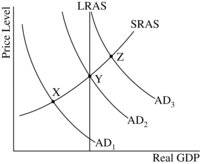
Given the graph of the short-run aggregate supply (SRAS) and long-run aggregate supply (LRAS) curves above, which of the following is true?
At point Z, the economy has cyclical unemployment.
At point Z, the economy is in long-run equilibrium but not in short-run equilibrium.
At point Y, the natural rate of unemployment is zero.
At point X, the economy is experiencing a recessionary gap.
At point X, there is no frictional unemployment.
Access all questions and much more by creating a free account
Create resources
Host any resource
Get auto-graded reports

Continue with Google

Continue with Email

Continue with Classlink

Continue with Clever
or continue with

Microsoft
%20(1).png)
Apple

Others
Already have an account?
Similar Resources on Wayground

10 questions
TARIFF MANAGEMENT 7 QUIZ 2

Quiz
•
University
10 questions
Foreign Direct Investment
Quiz
•
University
10 questions
Kuis 1 Modifikasi Perilaku
Quiz
•
University
10 questions
Maasai Mara Kültürü
Quiz
•
University
10 questions
AI in OM
Quiz
•
University
10 questions
Ética na Eng Mecânica
Quiz
•
University
10 questions
Quizizz Review/Drill
Quiz
•
University
10 questions
Quiz Idul Adha
Quiz
•
University
Popular Resources on Wayground
15 questions
Fractions on a Number Line
Quiz
•
3rd Grade
20 questions
Equivalent Fractions
Quiz
•
3rd Grade
25 questions
Multiplication Facts
Quiz
•
5th Grade
54 questions
Analyzing Line Graphs & Tables
Quiz
•
4th Grade
22 questions
fractions
Quiz
•
3rd Grade
20 questions
Main Idea and Details
Quiz
•
5th Grade
20 questions
Context Clues
Quiz
•
6th Grade
15 questions
Equivalent Fractions
Quiz
•
4th Grade
Discover more resources for Other
7 questions
How James Brown Invented Funk

Interactive video
•
10th Grade - University
5 questions
Helping Build the Internet: Valerie Thomas | Great Minds
Interactive video
•
11th Grade - University
12 questions
IREAD Week 4 - Review
Quiz
•
3rd Grade - University
23 questions
Subject Verb Agreement
Quiz
•
9th Grade - University
7 questions
Renewable and Nonrenewable Resources
Interactive video
•
4th Grade - University
19 questions
Review2-TEACHER
Quiz
•
University
15 questions
Pre2_STUDENT
Quiz
•
University
20 questions
Ch. 7 Quadrilateral Quiz Review
Quiz
•
KG - University