
Chapter 1 - The Microbial World and You
Authored by Gilberto Villarreal
Science
12th Grade
Used 8+ times


AI Actions
Add similar questions
Adjust reading levels
Convert to real-world scenario
Translate activity
More...
Content View
Student View
32 questions
Show all answers
1.
DROPDOWN QUESTION
5 mins • 10 pts
The overall theme of this textbook is the (a) between (b) —very (c) organisms that usually require a (d) to be seen—and our lives. We’ve all heard of (e) of infectious diseases such as plague or smallpox that wiped out populations.
2.
DROPDOWN QUESTION
5 mins • 10 pts
Finally, we will discuss (a) as the cause of diseases such as (b) virus disease, (c) (bird) flu, (d) virus disease, and diarrhea, and we examine the growing public health problem of (e) -resistant bacteria.
3.
DROPDOWN QUESTION
5 mins • 10 pts
Microbes in Our Lives
For many people, the words germ and (a) bring to mind a group of tiny creatures that do not quite fit into any of the categories in that old question, “Is it animal, vegetable, or mineral?” (b) actually comes from the Latin word germen, meaning to spout from, or germinate. Think of wheat germ, the plant embryo from which the plant grows. It was first used in relation to microbes in the nineteenth century to explain the rapidly growing cells that caused disease. Microbes, also called (c) , are minute living things that individually are usually too small to be seen with the unaided eye. The group includes bacteria, (d) (yeasts and molds), protozoa, and (e) algae. It also includes viruses, those noncellular entities sometimes regarded as straddling the border between life and nonlife (Chapters 11, 12, and 13, respectively).
4.
FILL IN THE BLANKS QUESTION
5 mins • 2 pts
We tend to associate these small organisms only with infections and inconveniences such as spoiled food. However, the majority of microorganisms actually help maintain the balance of life in our environment. Marine and freshwater microorganisms form the basis of the food chain in oceans, lakes, and rivers. Soil microbes break down wastes and incorporate nitrogen gas from the air into organic compounds, thereby recycling chemical elements among soil, water, living organisms, and air. Certain microbes play important roles in (a) , a food- and oxygen-generating process that is critical to life on Earth.
5.
FILL IN THE BLANKS QUESTION
5 mins • 2 pts
Microorganisms also have many commercial applications. They are used in the synthesis of such chemical products as vitamins, organic acids, enzymes, alcohols, and many drugs. For example, microbes are used to produce acetone and butanol, and the vitamins B2 (riboflavin) and B12 (cobalamin) are made biochemically. The process by which microbes produce acetone and butanol was discovered in 1914 by Chaim (a) , a Russian-born chemist working in England. With the outbreak of World War I in August of that year, the production of acetone became very important for making cordite (a smokeless form of gunpowder used in munitions). Weizmann’s discovery played a significant role in determining the outcome of the war.
6.
FILL IN THE BLANKS QUESTION
5 mins • 2 pts
The food industry also uses microbes in producing, for example, vinegar, sauerkraut, pickles, soy sauce, cheese, yogurt, bread, and alcoholic beverages. In addition, (a) from microbes can now be manipulated to cause the microbes to produce substances they normally don’t synthesize, including cellulose, human insulin, and proteins for vaccines.
7.
FILL IN THE BLANKS QUESTION
5 mins • 2 pts
The Microbiome
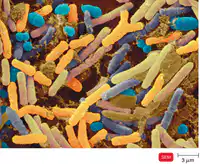
An adult human is composed of about 30 trillion body cells and harbors another 40 trillion bacterial cells. Microbes that live stably in and on the human body are called the human microbiome, or microbiota. Humans and many other animals depend on these microbes to maintain good health. Bacteria in our intestines, including E. coli, aid digestion (see Exploring the Microbiome) and even synthesize some vitamins that our bodies require, including B vitamins for metabolism and vitamin K for blood clotting. They also prevent growth of (a) (disease-causing) species that might otherwise take up residence, and they seem to have a role in training our immune system to know which foreign invaders to attack and which to leave alone. (See Chapter 14 for more details on relationships between normal microbiota and the host.)
Access all questions and much more by creating a free account
Create resources
Host any resource
Get auto-graded reports

Continue with Google

Continue with Email

Continue with Classlink

Continue with Clever
or continue with

Microsoft
%20(1).png)
Apple

Others
Already have an account?


