
LA Grade6- L.1 Compare information from two texts
Authored by Ngoc Ngo
English
6th Grade


AI Actions
Add similar questions
Adjust reading levels
Convert to real-world scenario
Translate activity
More...
Content View
Student View
13 questions
Show all answers
1.
HOTSPOT QUESTION
1 min • 1 pt
Read a text about déjà vu.
Déjà vu is the strange feeling that an event that is currently happening has somehow already happened before. Researchers estimate that two-thirds of people have felt déjà vu before. Yet the causes of déjà vu remain a mystery. This, at least in part, is because the phenomenon is extraordinarily difficult to study in a laboratory. By its very nature, déjà vu is spontaneous and unpredictable. We can't make it happen, nor can we know when it will happen. It's also very infrequent. It wouldn't be practical to bring people into a lab and simply wait for déjà vu to occur; chances are, it won't.
Select the two details that are included in the text.
2.
HOTSPOT QUESTION
1 min • 1 pt
Read a second text about déjà vu.
Epilepsy, a condition that causes interruptions in brain activity called seizures, can be particularly challenging due to its unpredictability. People with the disorder typically never know when seizures will occur. One interesting exception is temporal lobe epilepsy, which affects the section of the brain that stores long-term memories. Some temporal lobe epilepsy patients get an odd warning sign just before a seizure starts: a sensation of strong, unexplained familiarity, or déjà vu. Déjà vu itself, however, has no warning signs; it is unpredictable by nature. By studying people with temporal lobe epilepsy, researchers hope to learn more about déjà vu, which could provide important information about how memory works.
Select the two details that are included in the text.
3.
MULTIPLE CHOICE QUESTION
30 sec • 1 pt

Who would likely agree that researchers need to develop creative approaches to studying déjà vu?



4.
HOTSPOT QUESTION
1 min • 1 pt
Read a text about Dolly Parton.
Dolly Parton, one of the wealthiest female singer-songwriters of all time, grew up in extreme poverty. She and her eleven siblings were raised in a small cabin in rural Tennessee, without flush toilets or hot water. They slept several to a bed, bathed in a nearby river, and endured winter nights without sufficient heat. Rather than pretending these experiences never happened, Parton has used them as inspiration for several richly written autobiographical songs. In her lyrics, Parton neither praises nor criticizes her childhood poverty. Instead, she presents a thoughtful view of the togetherness of her family, balanced against the hardships that came with being poor.
Select the two details that are included in the text.
5.
HOTSPOT QUESTION
1 min • 1 pt
Read a second text about Dolly Parton.
As a child, the famous singer and entertainer Dolly Parton witnessed the effects of illiteracy firsthand. Her father had never learned to read or write, severely limiting his employment opportunities. Though he worked most of his life, his earnings were so low that the family lived in poverty. Her father's experience directly informed Parton's future charity work in literacy. In 1995, she launched a remarkable program called Dolly's Imagination Library. Its aim was to improve literacy by providing free books to children. Imagination Library has now expanded throughout the United States, and Parton, who has won nine Grammy Awards for her music, is known to many of the recipients as simply "the book lady."
Select the two details that are included in the text.
6.
MULTIPLE CHOICE QUESTION
30 sec • 1 pt

Who would likely agree that the challenges of Parton's childhood influenced her later life and work?



7.
HOTSPOT QUESTION
1 min • 1 pt
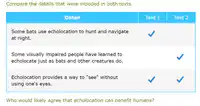
Read a text about echolocation.
Perhaps due to brown bats' strange-looking flight patterns, many people believe that these fascinating mammals are blind. This is incorrect, because not only are they perfectly capable of seeing with their eyes, but they can also visualize their surroundings with their ears. Brown bats produce high-frequency sound waves that create echoes when they bounce off objects. In a remarkable process known as echolocation, they translate these echoes into visual information. Thus, even in the pitch dark of night, these bats can hunt insects, one of their food sources. They can also use echolocation to navigate their surroundings.
Select the two details that are included in the text.



Access all questions and much more by creating a free account
Create resources
Host any resource
Get auto-graded reports

Continue with Google

Continue with Email

Continue with Classlink

Continue with Clever
or continue with

Microsoft
%20(1).png)
Apple

Others
Already have an account?


