
Amplify Grade 8 Evolutionary History (CJ)
Authored by Kimberly Kalitan
Science
6th - 8th Grade
NGSS covered
Used 38+ times


AI Actions
Add similar questions
Adjust reading levels
Convert to real-world scenario
Translate activity
More...
Content View
Student View
12 questions
Show all answers
1.
MULTIPLE CHOICE QUESTION
2 mins • 1 pt
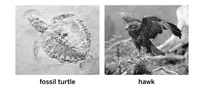
(Amplify Grade 8 Evolutional History Critical Juncture)
This fossil turtle and this living hawk both have a structure in their neck called the atlas bone. What best explains why both species have an atlas bone?
The turtle and hawk are different species, so they must not share an ancestor population. They inherited their atlas bone structure from separate ancestor populations.
The turtle and hawk both share the same ancestor population that had an atlas bone. They inherited this structure from the ancestor population.
It is impossible to say. Fossils are very old; therefore, we cannot make observations of the turtle’s ancestors, and we cannot explain its body structures.
All species have their own specific body structures, so it is a coincidence that this turtle and hawk each happen to have the atlas bone structure.
Tags
NGSS.MS-LS4-2
NGSS.MS-LS4-1
2.
MULTIPLE CHOICE QUESTION
2 mins • 1 pt
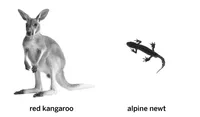
This red kangaroo and this alpine newt both have a femur bone in their back limbs. However, their femur bones are very different. The red kangaroo has long femur bones that help it jump very far. The alpine newt has short femur bones that help it swim. What most likely explains why both have back limbs with a femur and why the femur bones are different?
The red kangaroo and alpine newt are different species, so they do not share an ancestor population. These species had separate ancestor populations, and each evolved femur bones that help it survive in its environment.
It is impossible to explain the structures of different species. The way that structures change over time is very complex, and no one has ever observed these changes occurring.
The red kangaroo and alpine newt both inherited femur bones from a shared ancestor population, but this population separated into different environments. In each environment, different types of femur bone evolved, which helped the populations survive.
All species have their own specific body structures, so it is a coincidence that the red kangaroo and alpine newt each happen to have femur bones that are different.
Tags
NGSS.MS-LS4-2
3.
MULTIPLE CHOICE QUESTION
2 mins • 1 pt
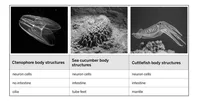
This ctenophore, this sea cucumber, and this cuttlefish have similarities and differences in their body structures. What does the information about these structures tell you about the ancestors of these species?
All three species share an ancestor population, but the sea cucumber and the cuttlefish share a more recent ancestor population. This is why they share the intestine structure.
None share an ancestor population because different species cannot share an ancestor population. It is a coincidence that these species have some of the same body structures.
Sea cucumbers and cuttlefish share an ancestor population, but they must not share an ancestor with the ctenophore because ctenophores don’t have the intestine structure.
We cannot make observations of ancestor populations from the past. It is impossible to explain ancestors with only the information about the body structures of different species.
Tags
NGSS.MS-LS4-2
NGSS.MS-LS4-1
4.
MULTIPLE CHOICE QUESTION
2 mins • 1 pt
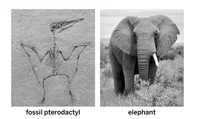
This fossil pterodactyl and this living elephant both have a bone in their hip called the ilium. What best explains why both species have an ilium?
The pterodactyl and elephant both share the same ancestor population that had an ilium bone. They inherited this structure from the ancestor population.
All species have their own specific body structures, so it is a coincidence that the pterodactyl and elephant each happen to have the ilium bone structure.
It is impossible to say. Fossils are very old; therefore, we cannot make observations of the pterodactyl’s ancestors, and we cannot explain its body structure.
The pterodactyl and elephant are different species, so they must not share an ancestor population. They inherited their ilium bone structures from separate ancestor populations.
Tags
NGSS.MS-LS4-2
NGSS.MS-LS4-1
5.
MULTIPLE CHOICE QUESTION
2 mins • 1 pt
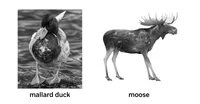
This mallard duck and this moose both have bones in their feet called metatarsals. However, they have different types of feet. The duck has webbed feet that help it swim in water. The moose has feet with hooves that help it walk on hard ground. What most likely explains why both the duck and moose have feet with metatarsals and why the feet are different?
The mallard duck and moose are different species, so they do not share an ancestor population. These species had separate ancestor populations, and each evolved feet with metatarsals that help it survive in its environment.
It is impossible to explain the body structures of different species. The way that structures change over time is very complex, and no one has ever observed these changes occurring.
All species have their own specific body structures, so it is a coincidence that this mallard duck and moose each happen to have different types of feet with metatarsals.
The mallard duck and moose both inherited metatarsals from a shared ancestor population, but this population separated into different environments. In each environment, different types of feet with metatarsals evolved, which helped the populations survive.
Tags
NGSS.MS-LS4-2
6.
MULTIPLE CHOICE QUESTION
30 sec • 1 pt
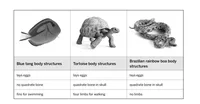
This blue tang, this tortoise, and this Brazilian rainbow boa have similarities and differences in their body structures. What does the information about these structures tell you about the ancestors of these species?
We cannot make observations of ancestor populations from the past. It is impossible to explain ancestors with only the information about the body structures of different species.
None share an ancestor population because different species cannot share an ancestor population. It is a coincidence that these species have some of the same body structures.
All three species share an ancestor population, but tortoises and Brazilian rainbow boas share a more recent ancestor population. This is why they share the quadrate bone structure.
Tortoises and Brazilian rainbow boas share an ancestor population, but they must not share an ancestor with blue tangs because blue tangs have no quadrate bone.
Tags
NGSS.MS-LS4-2
7.
MULTIPLE CHOICE QUESTION
2 mins • 1 pt
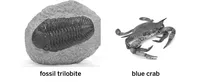
This fossil trilobite and this living blue crab both have a limb structure called a biramous limb. What best explains why both species have biramous limbs?
It is impossible to say. Fossils are very old, so we cannot make observations of the trilobite’s ancestors, and we cannot explain its body structures.
The trilobite and blue crab both share the same ancestor population that had a biramous limb. They inherited this structure from the ancestor population.
All species have their own specific body structures, so it is a coincidence that this trilobite and blue crab each happen to have the biramous limb structure.
The trilobite and blue crab are different species, so they must not share an ancestor population. They inherited their biramous limb structure from separate ancestor populations.
Tags
NGSS.MS-LS4-2
NGSS.MS-LS4-1
Access all questions and much more by creating a free account
Create resources
Host any resource
Get auto-graded reports

Continue with Google

Continue with Email

Continue with Classlink

Continue with Clever
or continue with

Microsoft
%20(1).png)
Apple

Others
Already have an account?


