
Boyle's Law
Authored by Theresa Bennin
Chemistry
9th - 12th Grade
Used 1+ times


AI Actions
Add similar questions
Adjust reading levels
Convert to real-world scenario
Translate activity
More...
Content View
Student View
7 questions
Show all answers
1.
MULTIPLE CHOICE QUESTION
45 sec • 1 pt
What is the formula for Boyle's Law?
P1V1=P2V2
P1V1/P2V2
P1V2=P2V1
P1/V1=P2/V2
Answer explanation
The correct formula for Boyle's Law is P1V1=P2V2, which states that the initial pressure multiplied by the initial volume is equal to the final pressure multiplied by the final volume.
2.
MULTIPLE CHOICE QUESTION
45 sec • 1 pt
A gas occupies 4.98 L at 2.6 atm of pressure. What volume does it occupy at 1.8 atm pressure?
12.9 L
0.72 L
7.2 L
3.44 L
Answer explanation
To find the new volume, use Boyle's Law: P1V1 = P2V2. Plug in the values: (2.6 atm)(4.98 L) = (1.8 atm)(V2). Solve for V2 to get V2 = 7.2 L.
3.
MULTIPLE CHOICE QUESTION
45 sec • 1 pt
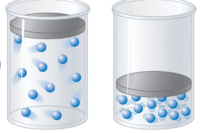
Which container will have a lower pressure?
left
right
they both have the same pressure
I don't know
Answer explanation
The left container will have a lower pressure because it has a larger volume, resulting in lower pressure according to Boyle's Law.
4.
MULTIPLE CHOICE QUESTION
45 sec • 1 pt
The relationship of which two variables are compared in Boyle's Law?
pressure & volume
volume & temperature
temperature & pressure
volume & moles (amount of gas)
Answer explanation
Boyle's Law compares the relationship between pressure and volume of a gas, showing that when pressure increases, volume decreases, and vice versa.
5.
MULTIPLE CHOICE QUESTION
45 sec • 1 pt
True or False: Gases can be compressed.
True
False
Answer explanation
Gases can be compressed because their particles are far apart, allowing them to be squeezed closer together under pressure.
6.
MULTIPLE CHOICE QUESTION
45 sec • 1 pt
When Pressure increases then the Volume must...
Increase
decrease
Answer explanation
When pressure increases, the volume must decrease according to Boyle's Law, which states that pressure and volume are inversely proportional.
7.
MULTIPLE CHOICE QUESTION
45 sec • 1 pt
When Volume increases then Pressure must...
Increase
Decrease
Answer explanation
When volume increases, the molecules have more space to move around, resulting in fewer collisions and lower pressure. Therefore, pressure must decrease.
Access all questions and much more by creating a free account
Create resources
Host any resource
Get auto-graded reports

Continue with Google

Continue with Email

Continue with Classlink

Continue with Clever
or continue with

Microsoft
%20(1).png)
Apple

Others
Already have an account?
Similar Resources on Wayground

10 questions
Los Fluidos.

Quiz
•
10th Grade
10 questions
Persamaan Reaksi
Quiz
•
10th - 11th Grade
10 questions
CHEMICAL FORMULA & EQUATIONS QUIZ
Quiz
•
10th - 11th Grade
10 questions
Acide sulfurique (rapport molaire et concentration molaire)
Quiz
•
11th Grade
12 questions
Q2. A1_P1. Mol, Masa y Volumen Molar
Quiz
•
12th Grade
10 questions
TERMOKIMIA
Quiz
•
11th Grade
10 questions
Review kimia kelas 11
Quiz
•
11th Grade
10 questions
PILA DANIELL
Quiz
•
9th - 10th Grade
Popular Resources on Wayground
15 questions
Fractions on a Number Line
Quiz
•
3rd Grade
10 questions
Probability Practice
Quiz
•
4th Grade
15 questions
Probability on Number LIne
Quiz
•
4th Grade
20 questions
Equivalent Fractions
Quiz
•
3rd Grade
25 questions
Multiplication Facts
Quiz
•
5th Grade
22 questions
fractions
Quiz
•
3rd Grade
6 questions
Appropriate Chromebook Usage

Lesson
•
7th Grade
10 questions
Greek Bases tele and phon
Quiz
•
6th - 8th Grade
Discover more resources for Chemistry
20 questions
Predicting Products
Quiz
•
9th - 12th Grade
11 questions
Balancing Chemical Equations
Lesson
•
9th Grade
10 questions
Exploring Types of Chemical Reactions

Interactive video
•
6th - 10th Grade
19 questions
Stoichiometry, % yield, Limiting Reactants
Quiz
•
10th Grade
20 questions
Types of Chemical Reactions
Quiz
•
9th - 12th Grade
10 questions
Exploring Ionic and Covalent Bonding Concepts
Interactive video
•
6th - 10th Grade
7 questions
GCSE Chemistry - Balancing Chemical Equations #4
Interactive video
•
9th - 10th Grade
24 questions
Unit 2 (Part 1) Bonding Review
Quiz
•
12th Grade