
Quiz 2
Authored by Brent Mitchell
Chemistry
9th Grade
Used 1+ times


AI Actions
Add similar questions
Adjust reading levels
Convert to real-world scenario
Translate activity
More...
Content View
Student View
7 questions
Show all answers
1.
MULTIPLE CHOICE QUESTION
20 sec • 1 pt
1. Identify the sub-atomic particle that has the least mass
Nucleus
Proton
Electron
Neutron
Answer explanation
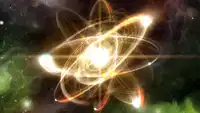
Of the three subatomic particles, the electron has the smallest mass.
2.
MULTIPLE CHOICE QUESTION
20 sec • 1 pt
Identify the correct statement about the charges of subatomic particles
Neutrons do not have a electric charge, they are neutral
Protons have an electric charge
Protons and electrons have the same charge
Electron charges do not have anything to do with atoms
Answer explanation
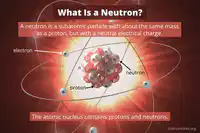
A neutron is formed by an electron and a proton combining together. Therefore, it is neutral.
3.
DRAW QUESTION
1 min • 1 pt
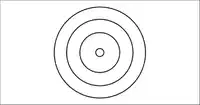
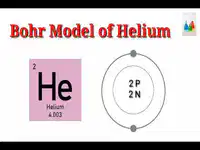
Please finishing drawing the Bohr diagram oh Helium.
P = 2
N = 2
E= 2
Answer explanation
4.
DRAG AND DROP QUESTION
45 sec • 1 pt
Isotopes - an atom of an element with the (a) number of (b) but a (c) number of (d) .
Answer explanation

Isotopes - an atom of an element with same the number of protons but a different number of neutrons.
5.
MULTIPLE CHOICE QUESTION
30 sec • 1 pt

Iodine-131 has a half-life of how many days
32 days
8 days
16 days
24 days
Answer explanation
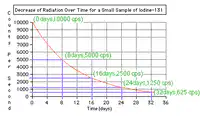
By looking at the graph you can see that half of the Iodine-131 has decayed every 8 days. We then say that Iodine-131 has a "half-life" of 8 days.
6.
MULTIPLE CHOICE QUESTION
30 sec • 1 pt
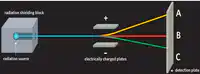
Identify the type of iodising radiation. ..... is radiation electromagnetic radiation, which has no electric charge. Therefore, the path of radiation is not effected by the electrically charged plates and continues in a straight line.
Gamma
Beta
Alpha
Answer explanation
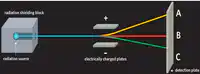
Gamma rays are uncharged, so are unaffected by the positive and negatively charged plates.
7.
MULTIPLE CHOICE QUESTION
30 sec • 1 pt
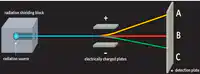
Identify the type of iodising radiation. ..... radiation consist of two protons and two neutrons which are positively charged and have comparatively large mass. The beam is thus attracted towards the negatively charged plate. The high mass means the particles have more momentum to continue in their original straight path.
Gamma
Beta
Alpha
Answer explanation
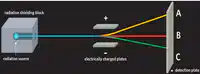
Alpha particles deflect towards the negative plate and have a small deflection due to high mass.
Access all questions and much more by creating a free account
Create resources
Host any resource
Get auto-graded reports

Continue with Google

Continue with Email

Continue with Classlink

Continue with Clever
or continue with

Microsoft
%20(1).png)
Apple

Others
Already have an account?



