
用 Quizizz 教中文
Authored by Janhvi Gupta
World Languages
KG
Used 2+ times


AI Actions
Add similar questions
Adjust reading levels
Convert to real-world scenario
Translate activity
More...
Content View
Student View
5 questions
Show all answers
1.
AUDIO RESPONSE QUESTION
10 mins • 1 pt
How to say "Hello"
" 你好 | Nǐ hǎo "
30 sec audio
Answer explanation
Chinese is a character-based language.
Eg, The Chinese word is formed by combining two singular characters “你” (you) and “好” (good) together
2.
MULTIPLE CHOICE QUESTION
30 sec • 1 pt
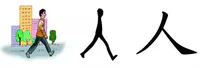
Neha is learning Chinese characters. Can you guess what the character "人" means?
Person, people
Cat
Bird
Good
3.
LABELLING QUESTION
1 min • 1 pt
Each Chinese Character corresponds to one syllable of Pinyin and each syllable consists of three parts in total:
an INITAL, a FINAL and a TONE.
Can you mark the initial, final and tonal component of the word “ 好 hǎo (good)” ?
Answer explanation
Mandarin Chinese is a tonal language, meaning that the pitch or intonation used when pronouncing a word can change its meaning.
There are four main tones in Mandarin:
First Tone (Flat or High Level Tone): The pitch is high and steady, like singing a high note. For example, "mā" (妈) means "mother."
Second Tone (Rising Tone): The pitch rises from mid to high, similar to the intonation used in English when asking a question. For example, "má" (麻) means "hemp."
Third Tone (Low or Dipping Tone): The pitch starts mid, dips to low, and then rises again. It is often described as a “falling-rising” tone. For example, "mǎ" (马) means "horse."
Fourth Tone (Falling Tone): The pitch starts high and falls sharply to a low pitch, resembling a firm statement or command. For example, "mà" (骂) means "to scold."
There is also a neutral tone, which is light and quick, and its pitch depends on the tone of the preceding syllable.
Mastering these tones is crucial for clear communication in Mandarin, as different tones can completely alter the meanings of words. For instance, "mā," "má," "mǎ," and "mà" are four distinct words with different meanings, all differentiated by their tones.
4.
MULTIPLE CHOICE QUESTION
30 sec • 1 pt
Which one of the following is "goodbye, see you again"




5.
REORDER QUESTION
1 min • 1 pt
Translate and Rearrange what you hear
Hello
Dawei
Goodbye
Dawei
Access all questions and much more by creating a free account
Create resources
Host any resource
Get auto-graded reports

Continue with Google

Continue with Email

Continue with Classlink

Continue with Clever
or continue with

Microsoft
%20(1).png)
Apple

Others
Already have an account?


