
Marathon CFA 2 Practice
Authored by William Carlisle
Biology
10th Grade
NGSS covered
Used 14+ times


AI Actions
Add similar questions
Adjust reading levels
Convert to real-world scenario
Translate activity
More...
Content View
Student View
32 questions
Show all answers
1.
MULTIPLE CHOICE QUESTION
45 sec • 1 pt

A student conducts an experiment on cellular respiration by mixing a teaspoon of dried yeast, water, and sugar in a test tube. The student then adds a layer of oil on top of the solution to prevent the entry of oxygen. After 4 hours, the student dips a pH strip into the solution in the test tube. The pH strip turns orange, indicating an acidic solution. Water has a neutral pH. The table shows the pH for different substances in water.
The experiment is repeated without using the oil layer and the pH strip still turns orange. Which reaction shows the change occurring in the test tube without the oil layer?
Sugar + Oxygen → Lactic Acid + Alcohol
Sugar + Oxygen → Alcohol + Carbon Dioxide
Sugar + Oxygen → Carbon Dioxide + Water
Sugar + Oxygen → Lactic Acid + Water
Tags
NGSS.HS-LS1-7
NGSS.HS-LS2-3
2.
MULTIPLE CHOICE QUESTION
45 sec • 1 pt
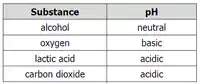
A student conducts an experiment on cellular respiration by mixing a teaspoon of dried yeast, water, and sugar in a test tube. The student then adds a layer of oil on top of the solution to prevent the entry of oxygen. After 4 hours, the student dips a pH strip into the solution in the test tube. The pH strip turns orange, indicating an acidic solution. Water has a neutral pH. The table shows the pH for different substances in water.
The oil layer causes what type of respiration and what is the product shown by the orange color on the pH strip?
The oil layer causes the yeast to perform aerobic respiration, and the pH test shows the production of alcohol.
The oil layer causes the yeast to perform anaerobic respiration, and the pH test shows the production of oxygen.
The oil layer causes the yeast to perform aerobic respiration, and the pH test shows the production of lactic acid.
The oil layer causes the yeast to perform anaerobic respiration, and the pH test shows the production of carbon dioxide.
Tags
NGSS.HS-LS1-7
NGSS.HS-LS2-3
3.
MULTIPLE CHOICE QUESTION
45 sec • 1 pt
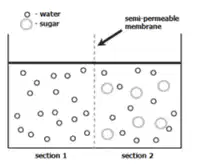
Examine the diagram that shows a container divided into sections by a semi-permeable membrane. What will happen to the container over time?
Diffusion will not take place so the concentration of water and sugar will stay the same.
The water will diffuse from section 2 into section 1 until the concentration of water is balanced.
The water will diffuse from section 1 into section 2 until the concentration of water is balanced.
The sugar will diffuse from section 2 into section 1 until the concentration of sugar is balanced.
Tags
NGSS.MS-PS1-2
4.
MULTIPLE CHOICE QUESTION
45 sec • 1 pt
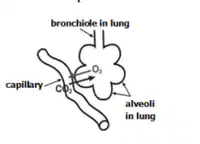
The diagram shows the exchange of gases between the cells in the alveoli of the lungs and the red blood cells in the capillaries. What process is taking place?
active transport
diffusion
facilitated diffusion
osmosis
Tags
NGSS.HS-LS2-3
5.
MULTIPLE CHOICE QUESTION
45 sec • 1 pt
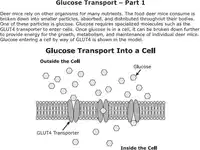
A researcher claims that glucose is moved into cells by facilitated diffusion through the GLUT4 transporter. Based on the model, which statement BEST supports the researcher's claim?
The movement of glucose across the membrane does not require ATP.
Glucose moves from an area of low concentration to an area of high concentration.
The glucose molecules diffuse freely through the membrane without a protein channel.
Glucose provides energy for the protein channel to transport materials across the membrane.
6.
MULTIPLE CHOICE QUESTION
45 sec • 1 pt
Liver cells intake large amounts of glucose after a meal in response to insulin and convert it into glycogen. These cells are able to convert glycogen back to glucose, thereby increasing its concentration inside the liver cells. Under what circumstances does the liver cell convert glycogen back to glucose?
when the level of glucose is low inside the cell
when the level of glucose is high inside the cell
when the level of glucose is low outside the cell
when the level of glucose is high outside the cell
Tags
NGSS.HS-LS1-3
7.
MULTIPLE CHOICE QUESTION
45 sec • 1 pt
Due to the dual nature of the phospholipid bilayer that makes up the cellular membrane, the membrane is selectively permeable to particular molecules and ions that need to enter or exit the cell. The selective nature of the membrane is based on the size and charge of the particles. Which of the following would be able to pass through the membrane by simple rather than facilitated diffusion?
C₆H₁₂O₆
CO₃²⁻
Ca²⁺
CO₂


Access all questions and much more by creating a free account
Create resources
Host any resource
Get auto-graded reports

Continue with Google

Continue with Email

Continue with Microsoft
or continue with

%20(1).png)
Apple

Others
Already have an account?

