
Solving mathematical and real-world problems involving surface area of cylinders
Authored by Wayground Content
Mathematics
9th - 12th Grade
7 covered


AI Actions
Add similar questions
Adjust reading levels
Convert to real-world scenario
Translate activity
More...
Content View
Student View
20 questions
Show all answers
1.
MULTIPLE CHOICE QUESTION
1 min • 1 pt

Find the surface area of the cylinder.
2.
MULTIPLE CHOICE QUESTION
30 sec • 1 pt
Jacob uses an empty can for a project. It has a diameter of 4in. and height of 8 in. He peels off the label of the can and finds the area of the label. What is the approximate area of the can label? Use 3.14 for pi.
56.52 in²
100.48 in²
70.65 in²
169.56 in²
3.
MULTIPLE CHOICE QUESTION
2 mins • 1 pt
What is the difference between lateral and total surface area?
4.
MULTIPLE CHOICE QUESTION
15 mins • 1 pt
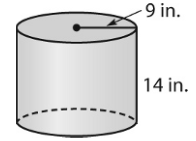
What is the total surface area of the cylinder?
5.
MULTIPLE CHOICE QUESTION
30 sec • 1 pt
Suppose an aluminum can is 6 inches tall with a radius of 3 inches. Which measurement best describes the amount of aluminum it takes to make the can?
113 in2
28 in2
57 in2
170 in2
6.
MULTIPLE CHOICE QUESTION
15 mins • 1 pt

Find the surface area of the cylinder.
7.
MULTIPLE CHOICE QUESTION
30 sec • 1 pt
What is the difference between lateral and total surface area?
Total surface area solves for perimeter of all the sides where lateral solves for area.
Total surface area is the sum of the area of all the sides where lateral surface area is the sum of the area of only the sides. (Not including the bases or top and bottom).
Total surface area can only be used for prisms and lateral surface area can only be used for cylinders and cones.
None of the above.

Access all questions and much more by creating a free account
Create resources
Host any resource
Get auto-graded reports

Continue with Google

Continue with Email

Continue with Classlink

Continue with Clever
or continue with

Microsoft
%20(1).png)
Apple

Others
Already have an account?


