
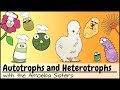
Understanding Autotrophs and Heterotrophs

Interactive Video
•
Biology, Science
•
5th - 8th Grade
•
Practice Problem
•
Medium

Sophia Harris
Used 101+ times
FREE Resource
Read more
10 questions
Show all answers
1.
MULTIPLE CHOICE QUESTION
30 sec • 1 pt
What is a common characteristic of all animals discussed in the video?
They are all herbivores.
They are all omnivores.
They are all autotrophs.
They are all heterotrophs.
2.
MULTIPLE CHOICE QUESTION
30 sec • 1 pt
What is the primary way plants produce their own food?
By absorbing nitrogen from the soil.
Through photosynthesis.
Through consuming organic matter.
By digesting insects.
3.
MULTIPLE CHOICE QUESTION
30 sec • 1 pt
How do carnivorous plants supplement their nutritional needs?
By photosynthesis only.
By consuming other plants.
By absorbing more sunlight.
By digesting insects for nitrogen.
4.
MULTIPLE CHOICE QUESTION
30 sec • 1 pt
Which organism is mentioned as having both autotrophic and heterotrophic capabilities?
Velvet ant
Euglena
Silkie bantam chicken
Sea pig
5.
MULTIPLE CHOICE QUESTION
30 sec • 1 pt
What is the main source of carbon for autotrophs?
Other animals
Sunlight
Inorganic substances
Organic substances
6.
MULTIPLE CHOICE QUESTION
30 sec • 1 pt
What type of autotroph uses light as its energy source?
Chemoautotroph
Photoautotroph
Photoheterotroph
Chemoheterotroph
7.
MULTIPLE CHOICE QUESTION
30 sec • 1 pt
Which organisms are known to live near deep sea vents?
Photoautotrophs
Chemoheterotrophs
Chemoautotrophs
Photoheterotrophs
Access all questions and much more by creating a free account
Create resources
Host any resource
Get auto-graded reports

Continue with Google

Continue with Email

Continue with Classlink

Continue with Clever
or continue with

Microsoft
%20(1).png)
Apple

Others
Already have an account?

