
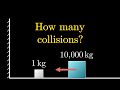
Physics and Math: The Pi Collision Puzzle

Interactive Video
•
Mathematics, Physics, Science
•
10th Grade - University
•
Practice Problem
•
Hard

Sophia Harris
FREE Resource
Read more
10 questions
Show all answers
1.
MULTIPLE CHOICE QUESTION
30 sec • 1 pt
What is assumed about the collisions in the mathematical croquet scenario?
They are perfectly elastic with no energy loss.
They are inelastic and energy is lost.
They involve friction and sound.
They are partially elastic with some energy loss.
2.
MULTIPLE CHOICE QUESTION
30 sec • 1 pt
How many collisions occur when the first block is 100 times the mass of the second?
3,141
31
3
314
3.
MULTIPLE CHOICE QUESTION
30 sec • 1 pt
What surprising pattern emerges when the mass of the first block is a power of 100 times the second?
The number of collisions matches the digits of pi.
The collisions decrease exponentially.
The collisions form a geometric sequence.
The collisions are random.
4.
MULTIPLE CHOICE QUESTION
30 sec • 1 pt
Who is credited with introducing the narrator to the pi collision fact?
Albert Einstein
Henry Cavill
Gregory Galperin
Isaac Newton
5.
MULTIPLE CHOICE QUESTION
30 sec • 1 pt
What is the first step in the algorithm to compute pi using collisions?
Choose the number of digits of pi to compute.
Implement a physics engine.
Set the mass of one block to 100 to the power d-1.
Count all the collisions.
6.
MULTIPLE CHOICE QUESTION
30 sec • 1 pt
Why is the collision-based pi algorithm considered inefficient?
It requires a large number of blocks.
It needs a supercomputer to run.
It uses outdated physics principles.
It involves counting an enormous number of collisions.
7.
MULTIPLE CHOICE QUESTION
30 sec • 1 pt
What hidden element is suggested to explain the appearance of pi in the collision scenario?
A hidden square
A hidden ellipse
A hidden triangle
A hidden circle
Access all questions and much more by creating a free account
Create resources
Host any resource
Get auto-graded reports

Continue with Google

Continue with Email

Continue with Classlink

Continue with Clever
or continue with

Microsoft
%20(1).png)
Apple

Others
Already have an account?
Popular Resources on Wayground

7 questions
History of Valentine's Day
Interactive video
•
4th Grade
15 questions
Fractions on a Number Line

Quiz
•
3rd Grade
20 questions
Equivalent Fractions
Quiz
•
3rd Grade
25 questions
Multiplication Facts
Quiz
•
5th Grade
22 questions
fractions
Quiz
•
3rd Grade
15 questions
Valentine's Day Trivia
Quiz
•
3rd Grade
20 questions
Main Idea and Details
Quiz
•
5th Grade
20 questions
Context Clues
Quiz
•
6th Grade
Discover more resources for Mathematics
10 questions
Factor Quadratic Expressions with Various Coefficients
Quiz
•
9th - 12th Grade
10 questions
Elijah McCoy: Innovations and Impact in Black History
Interactive video
•
6th - 10th Grade
10 questions
Evaluating Piecewise Functions Practice
Quiz
•
11th Grade
5 questions
Triangle Congruence Theorems
Interactive video
•
9th - 12th Grade
15 questions
Module 3 Topic 1 Vocabulary Quiz
Quiz
•
10th Grade
16 questions
Circle Vocabulary
Quiz
•
9th - 10th Grade
15 questions
Exponential Growth and Decay Word Problems Practice
Quiz
•
9th - 12th Grade
10 questions
Multiplying Fractions with Area Models
Interactive video
•
6th - 10th Grade