
3rd Study Quiz
9th Grade
•14 Qs

Similar activities
Ecology Cycles Webquest
9th Grade
•17 Qs
protein synthesis
7th - 11th Grade
•10 Qs
2.2.6 - A Family Affair
9th - 10th Grade
•13 Qs
Introduction To Forestry - Regions and Tree Growth
9th - 12th Grade
•15 Qs
Ecosystems Review
KG - University
•18 Qs
The Ultimate AXOLOTL Quiz!
2nd Grade - Professional Development
•13 Qs
All about bacteria
8th - 9th Grade
•12 Qs
Cell Respiration
9th Grade
•15 Qs
3rd Study Quiz

Quiz
•
Biology
•
9th Grade
•
Practice Problem
•
Hard
+1
Standards-aligned

Felix Tamayo
FREE Resource

Enhance your content in a minute
14 questions
Show all answers
1.
MULTIPLE CHOICE QUESTION
30 sec • 1 pt

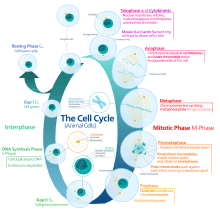
This model of the cell cycle includes two arrows that represent a process in the cycle. Fill in the blanks to describe the two arrows. Arrow 1 represents ___, and Arrow 2 represents ___.
M Phase
Interphase
Interphase
M Phase
Cytokinesis
M Phase
Interphase
Cytokinesis
Tags
NGSS.HS-LS1-4
2.
MULTIPLE SELECT QUESTION
30 sec • 1 pt

Which statements best explain how the cell cycle is important to the life cycle of the frog? Select TWO correct answers.
It enables frogs to produce tadpoles that are clones.
It prevents overproduction of frog offspring.
It allows frogs to reproduce.
It ensures the best-adapted frogs survive and pass on traits to offspring.
It enables the growth and development of the frog.
Tags
NGSS.HS-LS1-4
3.
MULTIPLE CHOICE QUESTION
30 sec • 1 pt

Which statement best describes the cells during Stage II?
The cells have replicated their DNA, but have not completed mitosis and cytokinesis.
The cells have completed mitosis and cytokinesis without replicating their DNA.
The cells have replicated their DNA and completed mitosis and cytokinesis.
The cells have temporarily exited the cell cycle without replicating their DNA.
Tags
NGSS.HS-LS1-4
4.
MULTIPLE CHOICE QUESTION
30 sec • 1 pt

Which model accurately shows a cell progressing through mitosis?
Option A
Option B
Option C
Tags
NGSS.HS-LS1-4
5.
MULTIPLE CHOICE QUESTION
30 sec • 1 pt
What are the steps of Mitosis?
Tags
NGSS.HS-LS1-4
6.
MULTIPLE CHOICE QUESTION
30 sec • 1 pt

Which table best compares the events that occur during different stages of the cell cycle?
A) S Phase: DNA replication, M Phase: Nuclear division
B) S Phase: Nuclear division, M Phase: Cytoplasm division
C) S Phase: Cytoplasm division, M Phase: Cell growth
D) S Phase: Cell growth, M Phase: DNA replication
Tags
NGSS.HS-LS1-4
7.
MULTIPLE CHOICE QUESTION
30 sec • 1 pt

Which statement best explains how the cell cycle is important to the life cycle of the frog?
It enables frogs to produce tadpoles that are clones.
It allows frogs to grow, develop, and reproduce.
It prevents overproduction of frog offspring.
It ensures the best adapted frogs survive and pass on traits to offspring.
Tags
NGSS.HS-LS1-2
NGSS.HS-LS1-4


Access all questions and much more by creating a free account
Create resources
Host any resource
Get auto-graded reports

Continue with Google

Continue with Email

Continue with Classlink

Continue with Clever
or continue with

Microsoft
%20(1).png)
Apple

Others
Already have an account?
Similar Resources on Wayground
16 questions
Ch. 7 Quiz Review
Quiz
•
9th Grade
15 questions
Ecology Vocabulary Review
Quiz
•
9th - 12th Grade
16 questions
2.2 Blood Vessels
Quiz
•
9th - 11th Grade
12 questions
Shark Internal Anatomy
Quiz
•
9th - 12th Grade
14 questions
Eye Parts Study Guide
Quiz
•
6th - 9th Grade
10 questions
PLANT TISSUES
Quiz
•
8th - 10th Grade
15 questions
Photosynthesis and Cellular Respiration Study Guide
Quiz
•
9th Grade
10 questions
Prokaryotic vs Eukaryotic DOL
Quiz
•
9th Grade
Popular Resources on Wayground
15 questions
Fractions on a Number Line
Quiz
•
3rd Grade
20 questions
Equivalent Fractions
Quiz
•
3rd Grade
25 questions
Multiplication Facts
Quiz
•
5th Grade
54 questions
Analyzing Line Graphs & Tables
Quiz
•
4th Grade
22 questions
fractions
Quiz
•
3rd Grade
20 questions
Main Idea and Details
Quiz
•
5th Grade
20 questions
Context Clues
Quiz
•
6th Grade
15 questions
Equivalent Fractions
Quiz
•
4th Grade
Discover more resources for Biology
20 questions
Cell Organelles
Quiz
•
9th Grade
14 questions
Ecological Succession: Primary and Secondary
Quiz
•
9th Grade
22 questions
Human Body Systems Overview
Quiz
•
9th Grade
25 questions
photosynthesis and cellular respiration
Quiz
•
9th Grade
10 questions
Comparing Mitosis and Meiosis: Key Differences and Stages

Interactive video
•
6th - 10th Grade
13 questions
Amoeba Sisters Viruses Video quiz
Interactive video
•
9th Grade
20 questions
Carbon Cycle
Quiz
•
9th Grade
97 questions
Benchmark 2
Quiz
•
9th Grade